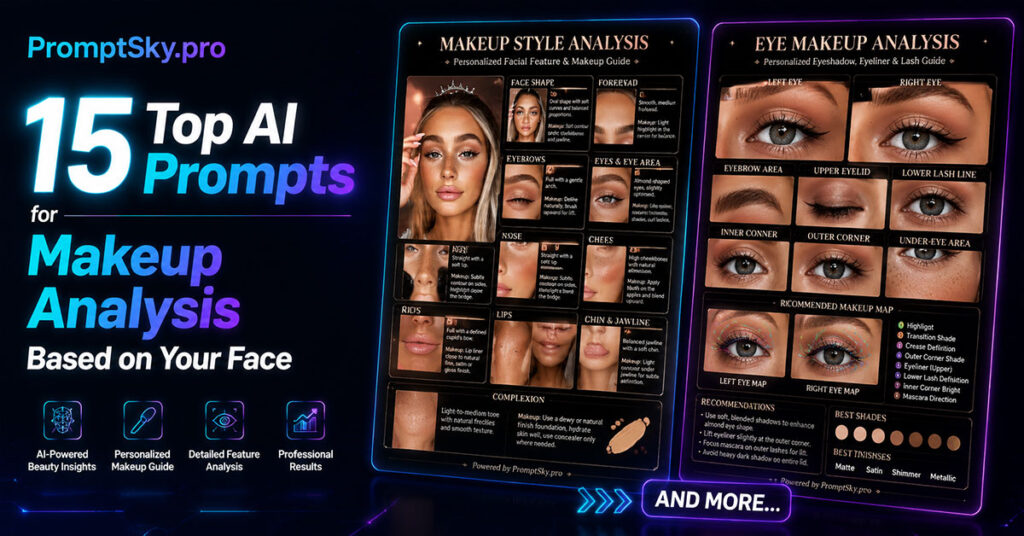
Prompt for makeup analysis can turn a photo of your face into a personalized visual makeup guide, analyzing areas such as your eyes, eyebrows, lips, complexion, contour, and blush placement. Simply upload a clear face photo, paste one of the prompts below, and let the AI create a detailed Style Analysis Board based on your actual features.
Each prompt is designed to analyze a specific part of the face and present the result in a separate visual panel, making the recommendations easier to understand and apply. You can also explore more AI Prompt Ideas and Categories for other creative and practical use cases.
For more inspiration, check out these Professional AI Wedding Photo Prompts for Two People, especially if you’re looking for personalized photo-editing and image-generation ideas.
If you need a specific makeup, beauty, or photo-editing prompt that isn’t included here, leave your request in the comments and ask for it!
1. Full Face Makeup Analysis Board
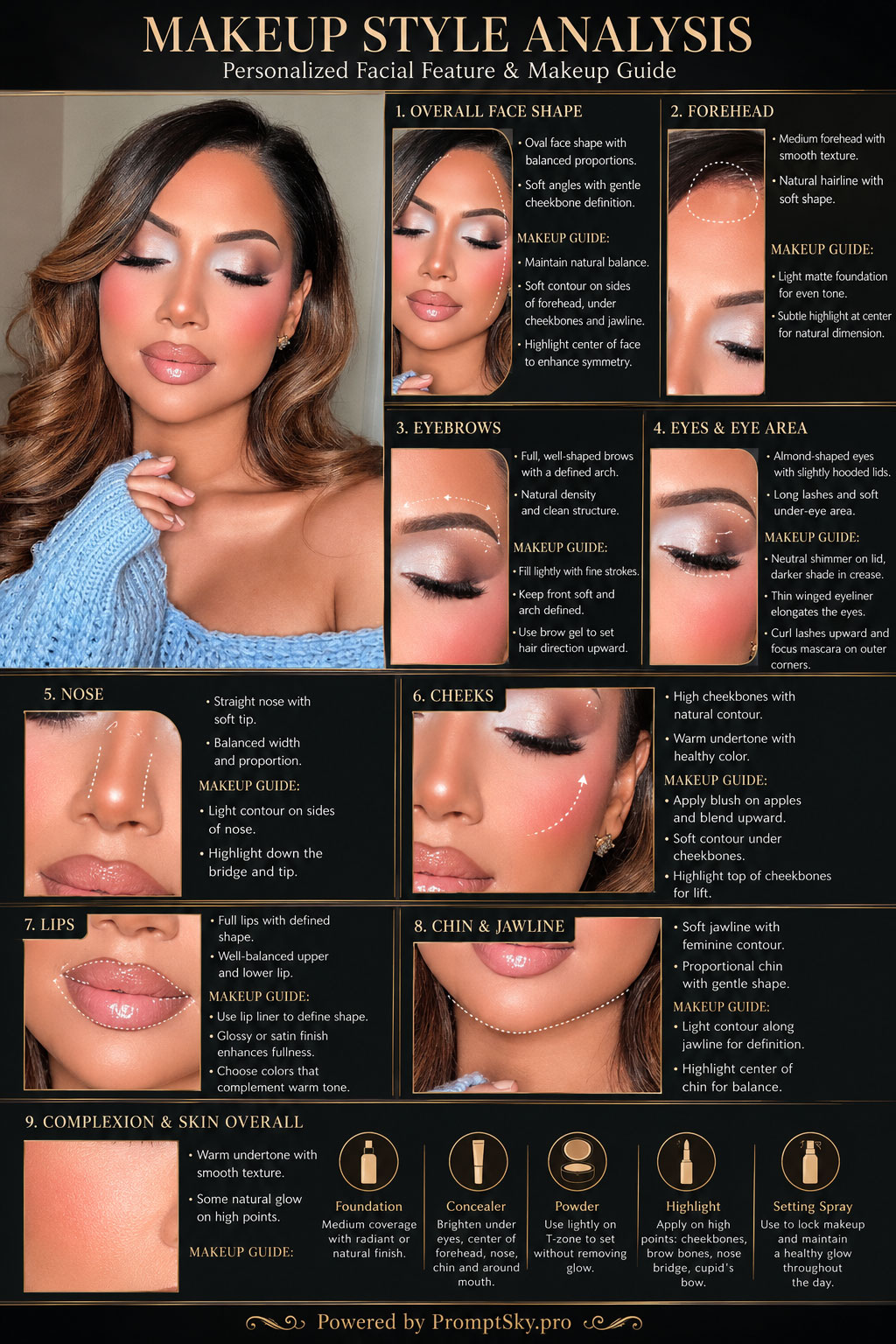
This prompt creates a comprehensive visual makeup analysis from the user’s own face photo. It separates the face into key areas and presents each area with a dedicated visual analysis panel.
Prompt:
A highly detailed AI makeup analysis and photo-editing composition using the user-provided face photo as the exact identity and visual reference. Preserve the person’s real facial identity, natural proportions, skin texture, facial structure, eye shape, eyebrow shape, nose, lips, jawline, and all distinctive features without beautifying, reshaping, or replacing the face. Create a premium professional “Style Analysis Board” that analyzes the face section by section in a clean editorial beauty-analysis layout.
Use the original uploaded photograph as the primary reference and divide the analysis into clearly separated visual sections. Create individual close-up image panels for: overall face shape, forehead, eyebrows, eyes and eye area, nose, cheeks, lips, chin and jawline, and overall complexion. Each close-up must be derived directly from the user’s actual face rather than generating a generic model.
For every facial section, visually analyze the existing features and provide a corresponding makeup interpretation. Examine eyebrow density, arch, direction, eye shape, eyelid structure, under-eye area, nose proportions, cheekbone placement, lip shape, lip volume, jaw definition, complexion characteristics, visible skin texture, natural facial contours, and overall facial balance.
For each section, display a realistic annotated close-up beside a concise but informative analysis explaining which makeup techniques, shapes, textures, finishes, and placement strategies would complement that specific facial feature. Include recommendations for foundation finish, concealer placement, blush placement, contour direction, highlight placement, eyebrow styling, eyeliner shape, eyeshadow placement, mascara direction, and lip makeup according to the actual facial structure.
The visual design should resemble a luxury professional beauty consultation board created by a high-end makeup artist. Use realistic photography, accurate skin texture, natural lighting, subtle editorial typography, thin section dividers, elegant spacing, and a clean premium beauty-magazine aesthetic. Avoid excessive retouching, plastic skin, unrealistic makeup, exaggerated facial reshaping, or generic beauty standards.
Every analysis panel must clearly correspond to the correct facial region. Do not mix observations between different facial areas. Keep the recommendations practical, visually understandable, and directly connected to the user’s actual features.
Add the main title “MAKEUP STYLE ANALYSIS” at the top and the subtitle “Personalized Facial Feature & Makeup Guide” underneath. At the bottom of the complete board, clearly display the exact text “Powered by PromptSky.pro” in a refined professional style.
The final result must look like a professionally designed personalized makeup consultation sheet based entirely on the uploaded face photo, with high photographic realism, precise facial-feature analysis, clean composition, and premium editorial presentation.
2. Eye Makeup Analysis — Eyeshadow, Eyeliner & Lashes
This prompt focuses specifically on the user’s eyes and surrounding area. It creates separate visual close-ups and recommends makeup placement based on the actual eye structure.
Prompt:
Create an ultra-detailed personalized eye makeup analysis board using the user-provided portrait as the exact facial reference. Preserve the user’s identity and reproduce the real eyes, eyebrows, eyelids, eyelashes, eye spacing, orbital area, under-eye structure, and surrounding skin accurately. Do not replace the eyes with idealized or generic features and do not alter the natural facial anatomy.
Extract and present multiple high-resolution close-up panels from the original face photo, focusing specifically on the left eye, right eye, eyebrow area, upper eyelids, lower lash lines, inner corners, outer corners, under-eye area, and complete eye region. Each panel should remain visually consistent with the original person.
Analyze the actual eye shape and structure, including whether the eyes appear almond-shaped, round, hooded, deep-set, monolid, upturned, downturned, close-set, wide-set, or another naturally occurring structure. Examine eyelid visibility, crease placement, brow-to-eye distance, lash direction, outer-corner angle, under-eye space, and visual symmetry.
Based on the real eye structure, provide a personalized makeup strategy for eyeshadow placement, transition shade placement, crease definition, outer-corner shading, inner-corner brightness, eyeliner direction, eyeliner thickness, wing angle, lower lash-line definition, mascara application, lash emphasis, and optional false-lash placement.
Create a small visual “recommended makeup map” for each eye. Use subtle graphical overlays or arrows to demonstrate where products should be placed while keeping the underlying facial image realistic and recognizable. Clearly distinguish between the original eye close-up and the suggested makeup placement.
Include practical recommendations for balancing the eye area while respecting the user’s natural structure. Explain which techniques should be emphasized and which common techniques may visually overpower or reduce the natural appearance of the eyes.
Present everything as a premium professional “Style Analysis Board” with a sophisticated beauty-editorial layout, realistic skin texture, high-resolution photography, neutral studio lighting, elegant typography, clean lines, balanced spacing, and clearly labeled sections.
Add the title “EYE MAKEUP ANALYSIS”, followed by “Personalized Eyeshadow, Eyeliner & Lash Guide”. At the bottom of the board, clearly include the exact text “Powered by PromptSky.pro”.
The final composition must feel like a personalized consultation prepared by an expert makeup artist after carefully studying the user’s actual eyes, rather than a generic makeup tutorial.
3. Face Shape & Contour Placement Analysis
This prompt analyzes the structure of the user’s face and translates it into a personalized contour, blush, bronzer, and highlighting guide.
Prompt:
Create a highly realistic personalized face-shape and contour analysis board from the user-provided face photograph. Use the uploaded image as the exact identity reference and preserve the person’s real facial structure, proportions, skin texture, natural asymmetry, cheekbones, forehead, temples, nose, jawline, and chin. Do not reshape the face or apply artificial beauty filters.
Carefully analyze the complete face structure and determine the most visually appropriate face-shape classification based on the actual proportions visible in the photograph. Consider the relative width of the forehead, cheekbones, jawline, chin shape, face length, temple area, and overall facial balance.
Create separate visual close-up sections for the forehead and temples, cheekbones, nose, jawline, chin, and complete face contour. Each section must be cropped directly from the user’s uploaded face and must retain realistic photographic details.
For each area, provide a personalized makeup-placement analysis showing where contour, bronzer, blush, and highlighter would be most naturally flattering. Use realistic visual guides such as subtle translucent markings, arrows, contour maps, and highlighted placement zones directly over the corresponding facial region.
Analyze the natural direction of the cheekbones and determine the most appropriate blush placement, such as higher toward the temples, centered on the cheeks, slightly lifted, or strategically diffused. Analyze the jawline and chin to determine where subtle contour could add definition without making the face appear unnaturally narrow. Analyze the forehead and temples for balanced bronzer or contour placement. Analyze the nose independently and recommend subtle contour and highlight placement based on its actual structure.
Include a clear section explaining the overall balance between contour, bronzer, blush, and highlight, ensuring that the recommendations work together rather than treating each product independently.
Make the board visually resemble a premium professional makeup artist’s facial-mapping consultation. Use realistic close-up photography, natural skin texture, soft studio lighting, refined editorial typography, clean geometric dividers, elegant annotations, and a sophisticated beauty-analysis aesthetic.
At the top, add the title “FACE SHAPE & CONTOUR ANALYSIS” and the subtitle “Personalized Contour, Blush, Bronzer & Highlight Map”.
At the bottom of the complete Style Analysis Board, clearly display the exact text “Powered by PromptSky.pro”.
The final result must be highly personalized to the uploaded face, technically detailed, visually organized, realistic, and immediately useful as a makeup-placement reference.
4. Eyebrow Shape & Styling Analysis
This prompt creates a detailed eyebrow consultation from the user’s actual eyebrows and identifies the most suitable shape, arch, thickness, and makeup approach.
Prompt:
Create a highly detailed personalized eyebrow analysis board using the user’s uploaded face photo as the exact reference. Preserve the original identity, eyebrow hairs, natural density, hair direction, facial proportions, forehead shape, eye position, and natural asymmetry. Do not replace the eyebrows with artificial brows or significantly alter the person’s facial anatomy.
Extract separate high-resolution close-up panels of the left eyebrow, right eyebrow, both eyebrows together, eyebrow-to-eye relationship, forehead area, and complete upper-face region. Every close-up must originate from the user’s actual photograph and maintain realistic skin pores, individual eyebrow hairs, natural shadows, and authentic facial details.
Analyze the existing eyebrows in detail, including overall brow shape, thickness, density, arch position, brow length, tail direction, front density, natural growth pattern, hair texture, spacing between the eyebrows, brow-to-eye distance, symmetry, and relationship to the eyes and forehead.
Determine the most suitable eyebrow styling approach based on the actual facial structure. Create a visual eyebrow mapping guide showing the recommended brow beginning point, arch position, highest point, tail endpoint, lower boundary, and areas that should remain natural or be lightly filled.
Demonstrate the recommended shape with subtle professional mapping lines while keeping the original eyebrow visible underneath. Do not create an exaggerated Instagram-style brow unless it naturally suits the user’s existing structure.
Provide separate recommendations for brow pencil, powder, pomade, tinted gel, clear gel, hair-stroke technique, front-of-brow softness, arch definition, tail definition, and final setting. Explain how product placement should change between the inner brow, middle section, arch, and tail.
Include a comparison-style panel showing “Natural Brow Structure” and “Recommended Styling Direction”, using the actual user’s eyebrows rather than a stock model.
Design the entire composition as a luxury professional “Style Analysis Board”, using realistic beauty photography, clean editorial typography, fine annotation lines, subtle section labels, premium spacing, natural lighting, and highly detailed facial close-ups.
Add the main title “EYEBROW STYLE ANALYSIS” and the subtitle “Personalized Brow Shape, Mapping & Styling Guide”.
At the bottom of the board, clearly display the exact text “Powered by PromptSky.pro”.
The final image should look like a professional personalized brow consultation prepared from the user’s own photograph, with accurate visual mapping and detailed, practical recommendations.
5. Lip Shape & Lip Makeup Analysis
This prompt focuses on the user’s actual lips and surrounding facial area, creating a detailed guide for lipstick, liner, gloss, and lip-shaping techniques.
Prompt:
Create a highly realistic personalized lip makeup analysis board using the user-provided face photograph as the exact visual and identity reference. Preserve the natural lip shape, lip proportions, Cupid’s bow, upper and lower lip volume, corners of the mouth, surrounding skin texture, smile lines, chin structure, and all distinctive facial characteristics. Do not replace, enlarge, shrink, reshape, or artificially beautify the lips.
Create multiple detailed close-up panels directly from the user’s photograph, including full lips, upper lip, lower lip, Cupid’s bow, lip corners, lip-to-chin relationship, lip-to-nose relationship, and complete lower-face area.
Analyze the actual lip structure in detail, including upper-to-lower lip proportion, Cupid’s bow definition, natural lip volume, corner direction, lip width, symmetry, visible lip texture, pigmentation, natural border definition, and relationship between the lips and surrounding facial features.
Based on the real structure, create a personalized makeup map showing recommended placement for lip liner, lipstick, lip stain, gloss, lip balm, highlight, and subtle shadow. Clearly indicate where the liner should follow the natural lip border and where, if appropriate, a very subtle overlining technique could be used without creating an artificial appearance.
Create a visual diagram showing the recommended Cupid’s bow definition, upper-lip liner direction, lower-lip liner direction, corner definition, center-of-lip emphasis, and gloss placement. Keep all recommendations proportional to the user’s real lips.
Include separate recommendations for different makeup finishes such as natural nude, soft matte, satin, glossy, defined evening lip, and soft everyday lip, while ensuring that each recommendation remains compatible with the user’s actual lip shape.
Analyze whether the lips would benefit more from emphasizing the center, defining the corners, softening the Cupid’s bow, adding dimension to the lower lip, or maintaining the natural border. Avoid generic recommendations that are unrelated to the uploaded face.
Present the result as a sophisticated professional “Style Analysis Board” with realistic close-up photography, authentic skin and lip texture, subtle beauty-editorial lighting, elegant typography, thin annotation lines, clean section divisions, and a premium makeup-consultation aesthetic.
Add the title “LIP MAKEUP ANALYSIS” and the subtitle “Personalized Lip Shape, Liner & Makeup Placement Guide”.
At the bottom of the complete board, clearly display the exact text “Powered by PromptSky.pro”.
The final result should function as a detailed personalized lip consultation based entirely on the user’s actual face photo, with accurate visual mapping, realistic facial details, and practical makeup recommendations.
6. Foundation & Skin Finish Analysis
This prompt analyzes the user’s visible complexion and creates a personalized foundation, concealer, and skin-finish guide. The result is designed to show different areas of the face separately while keeping the recommendations tied to the actual uploaded photo.
Prompt:
Create an ultra-detailed personalized foundation and skin-finish analysis board using the user-provided face photograph as the exact visual reference. Preserve the person’s real identity, facial proportions, natural skin texture, pores, fine lines, freckles, pigmentation, natural shadows, facial contours, and all distinctive characteristics. Do not replace the skin with artificial flawless skin, excessive smoothing, plastic texture, or an unrelated generated face.
Carefully examine the uploaded face and create separate high-resolution visual panels for the forehead, left cheek, right cheek, nose and T-zone, under-eye area, chin, jawline, and complete complexion. Every panel must be an authentic close-up derived from the user’s actual photograph and should retain realistic skin details.
Analyze each visible area for overall skin appearance, texture, visible pores, dryness or oiliness indicators, areas of uneven tone, redness, pigmentation, under-eye darkness, natural highlights, natural shadows, and areas where heavier or lighter coverage may visually work better. Do not diagnose medical or dermatological conditions; focus exclusively on cosmetic makeup appearance.
Create a personalized foundation placement map showing where full coverage, medium coverage, light coverage, or minimal product would create the most natural result. Demonstrate where concealer should be applied under the eyes, around the nose, around areas of uneven tone, and on other visible areas where targeted coverage could be useful.
Include a separate visual comparison of recommended matte, natural-satin, radiant, and dewy finishes, explaining which finish would visually complement the user’s existing complexion and facial texture. Show how the finish should change between the T-zone, cheeks, under-eye area, and other facial zones.
Create a detailed skin-prep and makeup-layering map showing the recommended order of primer, foundation, concealer, cream products, powder, setting spray, and finishing products. Keep the recommendations cosmetic and practical.
Include a section titled “Coverage Strategy” and divide it into Targeted Coverage, Overall Foundation, Under-Eye Coverage, T-Zone Control, and Final Finish. Each section should correspond directly to the appropriate facial region.
Present everything as a luxury professional “Style Analysis Board” with realistic beauty photography, accurate skin texture, soft studio lighting, premium editorial typography, thin annotation lines, elegant spacing, clean section divisions, and a sophisticated professional makeup-consultation aesthetic.
Add the main title “FOUNDATION & SKIN FINISH ANALYSIS” and the subtitle “Personalized Coverage, Concealer & Complexion Guide”.
At the bottom of the complete board, clearly display the exact text “Powered by PromptSky.pro”.
The final composition must look like a professional makeup artist analyzed the user’s actual complexion photograph and created a customized foundation and complexion strategy specifically for that person.
7. Blush Placement & Cheek Analysis
This prompt studies the user’s actual cheekbones and facial contours to create personalized blush, bronzer, and cheek-makeup placement maps.
Prompt:
Create a highly detailed personalized cheek and blush analysis board using the user-provided face photograph as the exact identity and facial-structure reference. Preserve the real cheekbones, facial width, natural skin texture, natural asymmetry, face proportions, eye position, nose position, jawline, and all recognizable facial characteristics. Do not reshape the face or generate an idealized beauty-standard version.
Extract multiple high-resolution close-up panels from the original photograph focusing on the left cheek, right cheek, both cheeks, cheekbone area, apples of the cheeks, temples, upper cheek area, lower cheek area, and complete face.
Analyze the actual cheek structure in detail, including cheekbone height, cheek fullness, natural contour direction, facial width, cheek-to-temple transition, cheek-to-jaw transition, and overall relationship between the cheeks and the rest of the face.
Based on this analysis, create a personalized blush placement map showing the most visually appropriate areas for cream blush, powder blush, liquid blush, bronzer, contour, and highlighter. Use subtle transparent makeup zones and professional arrows directly over the appropriate facial areas.
Create separate recommendations for different blush effects, including soft natural flush, lifted blush placement, sculpted editorial blush, youthful centered blush, monochromatic makeup, and soft evening blush. For every technique, demonstrate exactly where the product should begin, where it should be blended, and how far it should extend toward the temples, nose, or jawline.
Analyze whether the user’s natural cheek structure would benefit from placing blush higher toward the temples, closer to the center of the cheeks, slightly outward, slightly upward, or more softly diffused. Explain the visual effect of each recommendation while keeping the actual face unchanged.
Include a dedicated “Cheek Mapping” panel showing the original cheek area alongside a clean makeup placement diagram. Use different subtle visual indicators for blush, bronzer, contour, and highlighter while maintaining a sophisticated professional appearance.
Include recommendations for brush direction, blending direction, intensity, product texture, and transition between blush and contour. Make the recommendations specific to the uploaded face rather than generic makeup advice.
Design the result as a premium “Style Analysis Board” inspired by a luxury makeup artist consultation document, featuring realistic facial close-ups, authentic skin texture, refined editorial typography, clean lines, minimal graphical elements, soft studio lighting, and precise facial annotations.
Add the title “BLUSH & CHEEK ANALYSIS” and the subtitle “Personalized Blush, Bronzer & Cheek Placement Map”.
At the bottom of the board, clearly display the exact text “Powered by PromptSky.pro”.
The finished composition must be visually precise, highly realistic, personalized to the uploaded face, and useful as an actual blush and cheek-makeup reference.
8. Nose Contour & Highlight Analysis
This prompt isolates the user’s nose and surrounding facial structure to create a detailed contour and highlighting strategy based on the actual nose shape.
Prompt:
Create an ultra-detailed personalized nose makeup analysis board from the user-provided face photograph. Use the original photograph as the exact identity and facial-structure reference. Preserve the natural nose shape, bridge, tip, nostrils, width, length, natural asymmetry, surrounding skin texture, and relationship between the nose, eyes, cheeks, lips, and forehead. Never replace or reshape the actual nose.
Generate multiple realistic close-up panels of the full nose, upper bridge, middle bridge, nose tip, nostril area, sides of the nose, nose-to-cheek transition, nose-to-eyebrow relationship, and complete central face. Each panel must be cropped directly from the uploaded face and maintain authentic photographic details.
Analyze the visible structure of the nose, including bridge width, bridge direction, tip shape, tip projection, nostril visibility, side profile indications when available, nose length, nose-to-face proportion, natural highlight areas, natural shadow areas, and visible asymmetry.
Create a personalized contour map showing the recommended placement for cream contour, powder contour, bronzer, concealer, and highlighter. Use subtle semi-transparent markings directly on the real nose image to indicate where each product could be placed.
Create separate visual guides for soft everyday nose contour, refined natural contour, evening sculpting, and minimal no-makeup makeup. Each guide should respect the actual nose structure rather than applying the same two-line contour technique to every face.
Analyze whether the user would benefit from emphasizing the bridge, softening the sides, subtly defining the tip, visually balancing the nostril area, or keeping the nose mostly natural. Recommendations must remain subtle, realistic, and proportional.
Include a “Before Mapping” panel using the untouched original nose close-up and a “Recommended Placement” panel using a precise makeup overlay. Keep the original facial structure visible underneath all annotations.
Include detailed instructions for where the contour should start, where it should stop, how wide the contour lines should be, where the highlight should remain narrow or diffused, and how the products should transition into the surrounding complexion.
Present the entire design as a premium professional “Style Analysis Board” with realistic photography, authentic skin texture, elegant beauty-editorial typography, thin mapping lines, refined labels, clean white or neutral space, and sophisticated visual hierarchy.
Add the title “NOSE CONTOUR & HIGHLIGHT ANALYSIS” and the subtitle “Personalized Nose Sculpting & Highlight Placement Guide”.
At the bottom of the complete board, clearly display the exact text “Powered by PromptSky.pro”.
The final result must resemble a personalized professional makeup consultation based entirely on the user’s real nose and surrounding facial structure.
9. Complete Eye & Brow Harmony Analysis
This prompt examines the eyebrows and eyes together instead of analyzing them separately. It creates a coordinated guide for brow shape, eyeshadow, eyeliner, and visual balance.
Prompt:
Create a highly detailed personalized eye-and-brow harmony analysis board using the user-provided face photograph as the exact identity reference. Preserve the real facial anatomy, natural eye shape, eyebrow hairs, eyelid structure, eye spacing, brow density, brow position, forehead proportions, natural asymmetry, skin texture, and all distinctive facial characteristics. Do not replace the eyes or eyebrows with generic beauty-model features.
Extract separate high-resolution visual panels for the left eye and eyebrow, right eye and eyebrow, both eyes and eyebrows, complete upper face, eyelid region, eyebrow arch, inner brow area, outer brow tail, and under-eye region.
Analyze the relationship between the brows and eyes, including brow-to-eye distance, brow thickness, arch height, eye spacing, eyelid visibility, eye direction, outer-corner angle, eyebrow tail direction, brow length, and visual balance between the left and right sides.
Determine the most appropriate eyebrow styling and eye makeup combination for the actual facial structure. Create a coordinated visual map showing recommended brow thickness, arch location, brow tail direction, eyeshadow transition area, crease definition, outer-corner shadow, eyeliner direction, inner-corner brightness, and mascara emphasis.
Create separate visual overlays for eyebrow mapping and eye makeup mapping, ensuring that the two recommendations work together. For example, if the brow arch naturally sits high, adjust the eye makeup strategy accordingly; if the brow-to-eye distance is smaller, demonstrate a makeup placement strategy that maintains visual openness.
Create a detailed “Balance Map” comparing the left and right sides of the face and identify areas where makeup can create visual harmony without changing the underlying facial anatomy. Do not claim perfect symmetry; work with the person’s natural structure.
Include recommendations for brow pencil or powder placement, brow gel, eyeshadow depth, eyeliner thickness, wing direction, lash emphasis, lower-lash makeup, and highlight placement.
Include a small section showing “Natural Structure”, “Recommended Brow Map”, “Recommended Eye Makeup Map”, and “Final Harmony”, with each section visually derived from the same uploaded photograph.
Use a premium luxury beauty-consultation aesthetic with high-resolution realistic facial photography, authentic skin and eyebrow hair texture, subtle studio lighting, elegant editorial typography, precise annotation lines, clean spacing, and refined professional graphic design.
Add the main title “EYE & BROW HARMONY ANALYSIS” and the subtitle “Personalized Brow Shape & Eye Makeup Balance Guide”.
At the bottom of the board, clearly display the exact text “Powered by PromptSky.pro”.
The final result should look like a professional makeup artist created a customized eye-and-brow strategy after carefully studying the user’s actual facial structure.
10. Everyday Makeup Look Analysis
This prompt turns the user’s complete facial analysis into a practical everyday makeup look, while showing each face section separately and explaining how the products should work together.
Prompt:
Create an ultra-realistic personalized everyday makeup analysis and styling board using the user-provided face photograph as the exact identity reference. Preserve the person’s real face, natural facial proportions, skin texture, facial structure, eyes, eyebrows, nose, cheeks, lips, jawline, and all recognizable features. Do not replace the person with a generic model, apply unrealistic beauty filters, reshape facial anatomy, or excessively smooth the skin.
Begin by analyzing the complete face and then create separate close-up visual panels for complexion, eyebrows, eyes, cheeks, nose, lips, jawline, and overall facial balance. Each panel must be generated from the actual uploaded face photograph and remain visually consistent with the original identity.
For the complexion panel, analyze and demonstrate the recommended foundation coverage, concealer placement, powder placement, and natural skin finish. For the eyebrow panel, show the recommended brow shape, filling direction, arch definition, and brow-gel placement. For the eye panel, demonstrate a practical everyday eyeshadow arrangement, eyeliner direction, and mascara emphasis.
For the cheek panel, create a personalized map for blush, bronzer, subtle contour, and highlighter based on the actual cheek structure. For the nose panel, show a very subtle contour and highlight strategy only where it visually complements the natural structure. For the lip panel, show the recommended lip liner, lipstick, tint, or gloss placement based on the real lip shape.
Create a complete final makeup preview using the same person, showing how all recommendations work together as one cohesive everyday look. The final makeup should be realistic, wearable, refined, and appropriate for everyday use rather than an exaggerated editorial transformation.
Include a detailed product-placement sequence showing the recommended order of skin preparation, primer, foundation, concealer, brows, eyeshadow, eyeliner, mascara, bronzer, contour, blush, highlighter, lip liner, lipstick or tint, and finishing products.
Create separate mini-panels titled “Complexion”, “Brows”, “Eyes”, “Cheeks”, “Nose”, “Lips”, and “Final Look”. Each section must contain the relevant close-up of the user’s actual face and a concise personalized analysis.
Add a “Why It Works” section explaining how the recommended makeup choices complement the person’s natural facial structure, proportions, and features. Keep the explanation specific to the uploaded face rather than using generic beauty advice.
Design the final composition as a premium professional “Style Analysis Board” inspired by a luxury beauty consultation and editorial makeup guide. Use realistic photography, natural skin texture, sophisticated neutral styling, elegant typography, precise visual annotations, clean dividers, balanced spacing, and high-end editorial presentation.
Add the title “EVERYDAY MAKEUP STYLE ANALYSIS” and the subtitle “Personalized Complete Makeup Routine & Placement Guide”.
At the bottom of the complete board, clearly display the exact text “Powered by PromptSky.pro”.
The finished image must look like a personalized makeup consultation created specifically from the user’s uploaded face, with each facial area analyzed separately and the final recommendations combined into one cohesive, realistic everyday makeup style.
11. Evening & Glam Makeup Analysis
This prompt transforms the user’s facial analysis into a personalized evening makeup strategy. Every major facial area is analyzed separately before being combined into a polished glam look.
Prompt:
Create an ultra-detailed personalized evening and glam makeup analysis board using the user-provided face photograph as the exact identity and facial reference. Preserve the person’s real identity, facial proportions, eye shape, eyebrow structure, nose, cheekbones, lips, jawline, natural asymmetry, and realistic skin texture. Do not replace the person with a generic beauty model, alter facial anatomy, over-smooth the skin, or create unrealistic facial proportions.
Carefully analyze the uploaded face and create individual high-resolution close-up panels for the complexion, eyebrows, left eye, right eye, nose, left cheek, right cheek, lips, jawline, and complete face. Every close-up must originate from the actual uploaded photograph and maintain the same identity, lighting characteristics, skin texture, and natural facial structure.
For the complexion, determine the most appropriate evening foundation coverage and finish, including strategic concealer placement, controlled powder placement, and areas where a more radiant finish would enhance the face.
For the eyes, analyze the actual eye shape, eyelid structure, brow-to-eye distance, eye spacing, outer-corner direction, and under-eye area. Create a personalized glam eye map showing transition shade placement, crease definition, outer-corner depth, shimmer placement, inner-corner highlight, lower lash-line definition, eyeliner direction, wing length, and mascara or false-lash emphasis.
For the eyebrows, demonstrate how the natural brow can be slightly intensified for an evening look without creating an artificial or overly heavy appearance.
For the cheeks, create a customized placement map for contour, bronzer, blush, and highlighter, showing how each product should transition into the next. Make the placement appropriate for the user’s actual cheekbone structure.
For the nose, show a refined and subtle contour strategy that remains proportional to the original nose. For the lips, analyze the actual lip shape and recommend a coordinated evening lip approach, including liner shape, lipstick placement, center highlight, and optional gloss.
Create a final full-face preview showing the complete recommended glam makeup look applied to the same person. The final result must remain photorealistic, elegant, sophisticated, and wearable, with realistic makeup texture and believable product application.
Include separate sections titled “Complexion Strategy”, “Eye Glam Map”, “Brow Definition”, “Cheek Sculpting”, “Lip Definition”, and “Final Evening Look”.
Present the entire composition as a luxury professional “Style Analysis Board” with high-end beauty-editorial photography, sophisticated typography, thin annotation lines, clean dividers, refined spacing, realistic shadows, and premium consultation-board aesthetics.
Add the title “EVENING & GLAM MAKEUP ANALYSIS” and subtitle “Personalized Glam Makeup, Sculpting & Eye Definition Guide”.
At the bottom of the board, clearly display the exact text “Powered by PromptSky.pro”.
The finished image must look like a professional makeup artist created a customized evening makeup plan after carefully analyzing the user’s real face.
12. Bridal Makeup Analysis Board
This prompt creates a personalized bridal makeup consultation from the user’s own photograph, focusing on balanced, elegant makeup that remains realistic and photograph-friendly.
Prompt:
Create a highly detailed personalized bridal makeup analysis board using the user-provided face photograph as the exact visual and identity reference. Preserve the person’s real facial identity, facial proportions, natural skin texture, eye shape, eyebrow structure, nose, cheekbones, lips, jawline, natural asymmetry, and distinctive facial characteristics. Do not replace the person with a generic bridal model or dramatically modify facial anatomy.
Create separate high-resolution close-up panels for the full complexion, forehead, eyebrows, left eye, right eye, under-eye area, cheeks, nose, lips, jawline, and complete face. Every panel must be derived directly from the uploaded photograph and retain realistic skin pores, natural facial texture, and authentic proportions.
Analyze the complexion specifically for a bridal makeup context, focusing on natural-looking coverage, redness or uneven visible tone, under-eye appearance, foundation finish, strategic concealer placement, powder placement, and areas where excessive shine could affect professional photography.
Analyze the eyes and create a personalized bridal eye-makeup map showing soft transition shades, crease placement, outer-corner definition, eyelid brightness, inner-corner highlight, eyeliner direction, lash-line enhancement, mascara, and optional natural-looking false-lash placement. Keep the design elegant and photograph-friendly rather than overly dramatic.
Analyze the eyebrows and demonstrate a refined bridal brow style that preserves natural hair texture while adding definition where necessary.
Analyze the cheeks and create a customized map for soft contour, bronzer, blush, and highlighter, ensuring the makeup provides dimension without looking harsh under professional photography lighting.
Analyze the nose independently and create a subtle contour and highlight strategy based on the actual nose structure. Analyze the lips and recommend a bridal lip combination including lip liner, lipstick or lip tint, center definition, and optional soft gloss based on the real lip shape.
Create a final full-face bridal preview showing the complete recommended makeup look. The result should appear elegant, timeless, realistic, refined, and suitable for both close-up photography and wider wedding photographs.
Include a dedicated “Photography Considerations” panel explaining how foundation finish, under-eye coverage, contour intensity, highlight placement, and lip definition should be balanced for photography.
Create sections titled “Bridal Complexion”, “Eye Makeup Map”, “Brow Styling”, “Cheek Sculpting”, “Lip Design”, and “Complete Bridal Look”.
Use a premium luxury bridal consultation aesthetic with realistic beauty photography, soft professional lighting, elegant editorial typography, clean annotation lines, refined neutral backgrounds, sophisticated spacing, and high-resolution facial close-ups.
Add the title “BRIDAL MAKEUP ANALYSIS” and subtitle “Personalized Wedding Makeup & Photography Guide”.
At the bottom of the board, clearly display the exact text “Powered by PromptSky.pro”.
The final result should look like a professional bridal makeup artist prepared a personalized consultation specifically from the user’s own face photograph.
13. Color Palette & Makeup Harmony Analysis
This prompt analyzes the user’s visible coloring and facial features to build a coordinated makeup color palette, while keeping all recommendations visually connected to the uploaded face.
Prompt:
Create an ultra-detailed personalized makeup color palette and facial harmony analysis board using the user-provided face photograph as the exact identity reference. Preserve the real facial identity, skin appearance, natural undertones visible in the photograph, eye color, natural eyebrow color, lip color, hair color if visible, facial proportions, skin texture, and all distinctive features. Do not alter the person’s identity or replace their natural coloring with an unrelated generated appearance.
Create separate high-resolution close-up panels for the overall complexion, forehead, left cheek, right cheek, left eye, right eye, eyebrows, lips, and complete face. Every visual panel must be based directly on the uploaded photograph.
Carefully evaluate the visible relationship between the complexion, eyes, brows, lips, and overall facial coloring. Focus on cosmetic color harmony rather than making medical or definitive claims about undertones. Where lighting conditions or image quality make color assessment uncertain, present the recommendation as an approximate visual match rather than a certainty.
Create a personalized makeup palette containing coordinated recommendations for foundation appearance, blush, bronzer, contour, highlighter, eyeshadow, eyeliner, eyebrow products, lipstick, lip liner, and gloss.
Create individual color swatch sections showing suggested families such as soft neutrals, warm tones, cool tones, muted shades, deeper evening shades, natural everyday shades, and accent colors. The swatches should be presented beside the relevant facial close-up so users can understand why each color family works with that particular feature.
For the eyes, analyze the visible eye color and recommend complementary eyeshadow families while preserving the natural eye appearance. For the lips, analyze the natural lip coloring and recommend several lipstick and liner directions. For the cheeks, create personalized blush and bronzer color recommendations based on the overall facial harmony.
Create three coordinated makeup palettes:
EVERYDAY PALETTE — soft, wearable, natural shades.
ELEVATED PALETTE — refined shades for dinners, events, and polished looks.
EVENING PALETTE — deeper, richer, more dramatic colors while maintaining harmony with the face.
Include a “Best Color Combinations” panel showing several complete combinations, such as eyeshadow + blush + lipstick, with the colors visually displayed next to each other.
Design the final composition as a premium professional “Style Analysis Board” using realistic beauty photography, elegant color swatches, refined editorial typography, clean dividers, sophisticated spacing, subtle annotations, and luxury beauty-consultation aesthetics.
Add the title “MAKEUP COLOR PALETTE ANALYSIS” and subtitle “Personalized Makeup Colors & Facial Harmony Guide”.
At the bottom of the complete board, clearly display the exact text “Powered by PromptSky.pro”.
The final result must be highly personalized, visually organized, realistic, and based on the actual visible coloring and features of the uploaded photograph.
14. Makeup Mistakes & Improvement Analysis
This prompt examines the current makeup visible in the user’s uploaded photo and identifies areas that could be adjusted, while preserving the original face and presenting constructive recommendations.
Prompt:
Create a highly detailed personalized makeup improvement and analysis board using the user-provided face photograph as the exact identity and visual reference. Preserve the person’s real identity, facial structure, skin texture, eye shape, eyebrows, nose, cheeks, lips, jawline, natural asymmetry, and all distinctive features. Do not change the person’s face or generate an idealized replacement.
First determine whether the uploaded photograph contains visible makeup. If makeup is present, carefully analyze the actual application. If little or no makeup is visible, analyze the existing natural facial structure and create a “Potential Improvement Areas” guide instead of falsely claiming that specific makeup mistakes are present.
Create individual high-resolution close-up panels for the complexion, eyebrows, eyes, under-eye area, cheeks, contour, nose, lips, and complete face. Each panel must originate from the user’s actual uploaded image.
Examine the visible makeup application for areas such as foundation coverage, foundation texture, concealer placement, powder intensity, eyebrow density, brow shape, eyeshadow placement, eyeliner direction, mascara balance, contour placement, bronzer blending, blush placement, highlighter intensity, lip-liner accuracy, lipstick edges, and overall makeup balance.
For each area, create three clearly separated visual sections:
OBSERVED RESULT — show the relevant original close-up without altering it.
WHAT COULD BE IMPROVED — provide a concise visual and written explanation based only on what is actually visible.
RECOMMENDED APPROACH — create a realistic placement map showing how the makeup could be adjusted.
Use subtle arrows, circles, lines, and transparent makeup zones to identify specific areas. Avoid harsh red “mistake” markings or judgmental language. The analysis should feel constructive, professional, and useful.
Create a final “Improved Makeup Direction” preview using the same person, showing a realistic version of the recommended adjustments while maintaining the original identity and facial proportions.
Include practical recommendations for product quantity, blending direction, placement, intensity, transition areas, and finish wherever relevant. Explain why each adjustment would improve the overall makeup balance.
Present the entire composition as a professional “Style Analysis Board” inspired by a luxury makeup correction consultation, using realistic photography, authentic skin texture, clean typography, elegant annotation lines, sophisticated section dividers, balanced spacing, and premium editorial styling.
Add the title “MAKEUP IMPROVEMENT ANALYSIS” and subtitle “Personalized Makeup Corrections, Balance & Refinement Guide”.
At the bottom of the board, clearly display the exact text “Powered by PromptSky.pro”.
The final composition must remain respectful and constructive, focusing on makeup technique rather than judging the person’s natural appearance.
15. Complete Personalized Makeup Style Analysis
This prompt combines the entire face analysis into one comprehensive professional makeup consultation board. It creates individual visual sections for every major facial area and then produces a final personalized makeup direction.
Prompt:
Create an exceptionally detailed professional personalized makeup style analysis board using the user-provided face photograph as the exact identity, facial structure, and visual reference. Preserve the person’s real identity, natural facial proportions, skin texture, pores, fine lines, freckles or visible marks, eye shape, eyebrow structure, nose, cheekbones, lips, jawline, natural asymmetry, and all distinctive characteristics. Do not replace the person with a generic model, reshape facial anatomy, apply unrealistic beauty filters, or artificially perfect the skin.
Treat the uploaded image as a professional makeup consultation reference and analyze the face systematically from top to bottom.
Create individual high-resolution visual analysis panels for:
1. OVERALL FACE SHAPE — analyze forehead width, cheekbone width, jawline, chin, face length, and overall facial proportions.
2. COMPLEXION — analyze visible complexion characteristics and create a personalized foundation, concealer, powder, and skin-finish strategy.
3. EYEBROWS — analyze brow thickness, density, arch, length, hair direction, brow-to-eye distance, and symmetry, then create a personalized brow mapping guide.
4. EYES — analyze eye shape, eyelid structure, spacing, outer-corner direction, crease visibility, under-eye area, and brow relationship, then create an eyeshadow, eyeliner, mascara, and lash-placement map.
5. NOSE — analyze bridge, tip, width, length, nostril area, and surrounding facial relationships, then create a subtle contour and highlight map.
6. CHEEKS — analyze cheekbone placement, facial fullness, and natural contours, then create a personalized contour, bronzer, blush, and highlighter map.
7. LIPS — analyze lip width, upper-to-lower lip proportion, Cupid’s bow, corners, natural border, and lip volume, then create a personalized liner, lipstick, tint, and gloss map.
8. JAWLINE & CHIN — analyze the lower-face structure and create subtle contour and highlight recommendations based on the actual facial proportions.
9. COLOR HARMONY — analyze the visible relationship between complexion, eyes, brows, and lips and create a coordinated makeup color palette with everyday, elevated, and evening options.
10. COMPLETE MAKEUP LOOK — combine all previous recommendations into one cohesive personalized makeup style that remains realistic and recognizable as the same person.
For every facial section, show the original close-up first, followed by a detailed visual analysis map. Use subtle transparent overlays, arrows, contour zones, highlight zones, color swatches, product-placement indicators, and professional annotations directly connected to the relevant facial region.
For every recommendation, explain what to emphasize, what to soften, where to place the product, where to blend it, how intense it should be, which finish would work best, and how the technique interacts with neighboring facial features.
Create three final complete makeup directions:
EVERYDAY LOOK — natural, balanced, wearable, softly defined makeup.
ELEVATED LOOK — polished makeup for dinners, events, professional photography, or special occasions.
GLAM LOOK — more defined eyes, sculpted cheeks, enhanced lips, and elevated complexion while remaining realistic and proportional.
Include a final “Personalized Makeup Blueprint” summarizing the recommended order of application from skin preparation → primer → foundation → concealer → brows → eyeshadow → eyeliner → mascara → bronzer → contour → blush → highlighter → lip liner → lipstick or tint → gloss → setting products.
Create a premium visual hierarchy with a large title, clear section numbers, consistent typography, thin editorial dividers, elegant labels, realistic facial close-ups, authentic skin texture, sophisticated neutral styling, and a luxury professional beauty-consultation aesthetic.
The board must feel like a comprehensive consultation prepared by an expert makeup artist who carefully studied the user’s individual face rather than a generic makeup infographic.
Add the main title “PERSONALIZED MAKEUP STYLE ANALYSIS” and subtitle “Complete Facial Feature, Color & Makeup Placement Guide”.
At the bottom of the complete Style Analysis Board, clearly display the exact text “Powered by PromptSky.pro”.
Ensure every visual recommendation is directly connected to the corresponding facial area in the uploaded photograph. Keep the person recognizable throughout the entire board, maintain realistic photographic detail, and make the final analysis highly specific, practical, visually clear, and professionally presented.