
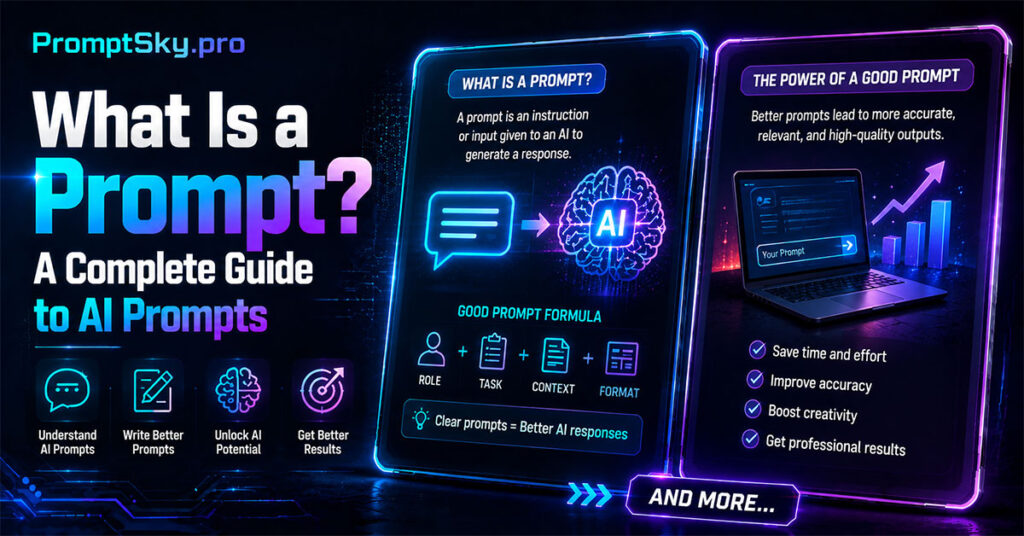
A prompt is the instruction, question, or description you give to an AI tool to tell it what you want. In simple terms, a prompt is the input that guides an AI model toward a specific output, whether you want to write text, create an image, analyze information, generate ideas, or build a strategy.
As AI tools have become more capable, knowing how to write an effective prompt has become an important skill. A clear and detailed prompt can produce a much more useful result than a short, vague instruction.
What Is a Prompt?
A prompt is the text or information you provide to an artificial intelligence system before it generates a response.
For example, instead of simply asking:
Write a business plan.
You could provide a more detailed instruction:
Create a detailed business plan for a small online clothing store targeting women aged 20–35. Include the target market, customer personas, competitors, pricing strategy, marketing channels, startup costs, revenue model, and a 90-day launch plan.
Both are prompts, but the second gives the AI much more context about the desired result.
A prompt can be as short as a few words or as detailed as several paragraphs. Its complexity usually depends on the task, the AI tool being used, and how specific the desired output needs to be.
Why Are Prompts Important?
AI models can perform many different tasks, but they still need instructions about what you want them to do and how you want them to do it.
A well-written prompt can help you:
- Get more relevant answers
- Reduce unnecessary or generic output
- Control the tone and writing style
- Specify the format of the response
- Provide important background information
- Generate more consistent results
- Save time when performing repetitive tasks
- Improve the quality of AI-generated content
- Guide AI toward a specific business or creative objective
This is particularly important when using AI for professional tasks such as marketing, SEO, business planning, resume writing, content creation, research, and image generation.
What Makes a Good Prompt?
A good prompt does not necessarily have to be extremely long. What matters most is that it gives the AI enough relevant information to understand the task.
A strong prompt commonly includes several important elements.
1. The Role
You can tell the AI what type of expert or perspective it should use.
For example:
Act as a senior SEO strategist.
Or:
Act as an experienced resume writer and recruiter.
This helps establish the context and perspective for the response.
2. The Task
Clearly explain what you want the AI to do.
For example:
Create a 90-day marketing strategy for my business.
Instead of:
Marketing plan.
The first instruction gives the AI a specific objective.
3. Context
Provide information that the AI needs to understand your situation.
For example:
My business sells handmade skincare products to customers aged 25–45 in the UK.
Context can significantly improve the relevance of the result.
4. Requirements
Explain what the output should include.
For example:
Include customer personas, competitor analysis, pricing, content strategy, paid advertising, and KPIs.
This prevents the response from focusing only on one part of the task.
5. Output Format
You can specify how you want the answer organized.
For example:
Present the strategy using headings, bullet points, tables, and a week-by-week 90-day roadmap.
This is especially useful when you plan to publish, edit, or reuse the generated content.
Simple Prompt vs. Detailed Prompt
Consider these two examples.
Simple Prompt
Create an Instagram strategy for my business.
The AI has to guess almost everything: the type of business, audience, location, goals, budget, content style, and expected results.
Detailed Prompt
Act as a social media marketing strategist. Create a 30-day Instagram strategy for a small online clothing store targeting women aged 20–35 in the UK. The main goals are increasing website traffic, generating product sales, and building brand awareness. Include content pillars, Reels ideas, carousel topics, Stories, posting frequency, hooks, CTAs, and weekly KPIs. Prioritize strategies that can be executed by one person with a limited budget.
The second prompt gives the AI a much clearer framework.
The key difference is not simply length—it is useful context and precise instructions.
What Are AI Prompt Templates?
A prompt template is a reusable prompt that contains placeholders for information that can change from one use case to another.
For example:
Act as a [ROLE] and create a [TASK] for [TARGET AUDIENCE]. The main objective is [GOAL]. Include [REQUIREMENTS] and present the result as [OUTPUT FORMAT].
You can replace the placeholders each time you use the prompt.
For example:
[ROLE]→ SEO strategist[TASK]→ content strategy[TARGET AUDIENCE]→ SaaS founders[GOAL]→ increase organic traffic[REQUIREMENTS]→ keywords, topics, content clusters[OUTPUT FORMAT]→ 12-month roadmap
This makes prompt templates especially useful for marketers, agencies, business owners, creators, and professionals who perform similar tasks repeatedly.
What Are AI Prompts Used For?
AI prompts can be used for almost any task supported by an AI system.
Writing and Content Creation
Prompts can help generate:
- Blog posts
- Social media captions
- Email campaigns
- Product descriptions
- Video scripts
- Headlines
- Advertising copy
- Content ideas
- Newsletters
For example:
Write five Instagram captions for a new coffee brand using a friendly, conversational tone.
Marketing
Marketing prompts can help with:
- Marketing strategies
- Customer personas
- Competitor analysis
- Advertising campaigns
- Content strategies
- Email funnels
- Lead generation
- Conversion optimization
- Customer retention
SEO
SEO prompts can be used to analyze:
- Search intent
- Keywords
- Content clusters
- Topic ideas
- Internal linking
- On-page optimization
- Competitor content
- Content gaps
Business Planning
Business prompts can help structure:
- Business plans
- Revenue models
- Pricing strategies
- Market research
- SWOT analysis
- Startup strategies
- Growth plans
- Financial assumptions
- Competitive analysis
Career and Resume Development
Prompts can also help improve:
- Resumes
- Cover letters
- LinkedIn profiles
- Professional summaries
- Achievement statements
- Interview preparation
- Career transition strategies
Image Generation
Prompts are not limited to text-based AI.
Image-generation prompts can describe:
- Subjects
- Clothing
- Environment
- Lighting
- Camera angle
- Composition
- Style
- Background
- Colors
- Realism
- Aspect ratio
For example:
Create a realistic editorial portrait of a professional woman wearing a modern business suit in a luxury office, soft natural window lighting, shallow depth of field, realistic skin texture, and high-end corporate photography style.
The more important visual details you specify, the more control you can potentially have over the generated image.
What Is Prompt Engineering?
Prompt engineering is the process of designing and refining instructions so an AI system can produce a more useful and predictable result.
It does not simply mean writing very long prompts.
Effective prompt engineering can involve:
- Defining the objective
- Providing relevant context
- Assigning an appropriate role
- Setting constraints
- Providing examples
- Specifying the desired output format
- Identifying what should be avoided
- Reviewing the result
- Refining the prompt based on the output
For example, if an AI-generated article is too generic, you might improve the prompt by adding the target audience, search intent, required sections, tone, examples, and specific information that must be covered.
Do Longer Prompts Always Produce Better Results?
No.
A long prompt can still be ineffective if it contains irrelevant information or contradictory instructions.
A good prompt should be specific rather than unnecessarily complicated.
For example:
Write a professional product description.
is too vague for many professional use cases.
But this:
Write a 150-word product description for a waterproof hiking backpack targeting beginner hikers. Highlight its lightweight design, 30-liter capacity, laptop compartment, water-resistant material, and comfortable shoulder straps. Use a clear, practical tone and finish with a short CTA.
contains the information the AI actually needs.
The goal is not to make every prompt as long as possible. The goal is to provide useful instructions and relevant context.
Should You Include Examples in a Prompt?
Sometimes, yes.
Providing examples can help an AI understand the expected style, structure, or type of output.
For example:
Write five headlines following this structure:
“How to [ACHIEVE RESULT] Without [COMMON PROBLEM]”
This gives the AI a pattern to follow.
Examples can be particularly useful when you need:
- A specific writing style
- A particular structure
- Consistent formatting
- A certain type of classification
- A specific tone
- Repeated outputs with similar characteristics
This approach is often called few-shot prompting when examples are included to demonstrate the desired behavior.
Common Prompting Mistakes
Even powerful AI tools can produce poor results when the prompt is poorly designed.
Being Too Vague
Give me marketing ideas.
There is no information about the business, audience, budget, or objective.
Giving Conflicting Instructions
For example:
Write a detailed 2,000-word article but keep the entire response under 300 words.
Conflicting requirements can make the expected output unclear.
Providing Too Little Context
If the AI does not know your target audience or business model, it may have to make assumptions.
Asking for Unsupported Facts
AI should not be treated as an automatic source of verified market statistics, financial data, or current competitor information. Important claims should be independently verified.
Overloading the Prompt With Irrelevant Information
More information is not always better. Include details that actually affect the task.
Not Reviewing the Output
Even a carefully written prompt does not guarantee a perfect response. AI output should be reviewed, corrected, and refined when accuracy or quality matters.
How to Improve an AI Prompt
If the first response is not good enough, you do not necessarily need to start over.
You can refine the prompt.
For example:
First request:
Create a content strategy for my website.
If the result is too generic, add:
My website targets small business owners. Focus on SEO-driven content that can generate qualified leads for website design and SEO services. Organize the strategy into informational, commercial, comparison, and transactional topics. Include search intent, target audience, suggested titles, funnel stage, and CTA for every topic.
The second version gives the AI a much clearer direction.
A Simple Formula for Writing Better Prompts
A useful starting structure is:
Role + Task + Context + Requirements + Constraints + Output Format
For example:
Role: Act as a senior digital marketing strategist.
Task: Create a 90-day marketing plan.
Context: My business sells accounting software to small businesses in the UK.
Requirements: Include SEO, content, email, social media, and paid advertising.
Constraints: The monthly marketing budget is £2,000.
Output: Create a week-by-week roadmap with KPIs and priorities.
You do not always need every element, but this structure can help you think about what information the AI actually needs.
Can the Same Prompt Be Used With Different AI Tools?
Often, yes, but results can vary.
Different AI models and platforms may interpret instructions differently and may have different strengths, capabilities, context limits, and available tools.
A prompt designed for text generation may also need to be adapted when used for:
- Image generation
- Video generation
- Coding
- Research
- Data analysis
- Voice generation
The basic principle remains the same: clearly communicate the desired result and provide the information required to produce it.
How to Get Better Results From AI Prompts
For more consistent results, try these practices:
- Clearly define the goal.
- Tell the AI who the target audience is.
- Provide relevant background information.
- Specify important requirements.
- Mention the desired tone and style.
- Define the output format.
- Use placeholders in reusable templates.
- Provide examples when a specific style is required.
- Tell the AI what it should avoid.
- Ask it to identify assumptions when information is missing.
- Review important factual claims.
- Refine the prompt based on the first result.
You can also ask AI to improve your prompt before using it. For example:
Improve this prompt for clarity and precision. Identify missing information and rewrite it so another AI model can produce a more useful result.
Prompt vs. Prompt Template: What’s the Difference?
The terms are related but not identical.
A prompt is an instruction created for a particular task.
A prompt template is a reusable version containing placeholders.
For example:
Prompt:
Create a marketing strategy for my online clothing store targeting women aged 20–35.
Prompt Template:
Create a marketing strategy for [BUSINESS TYPE] targeting [TARGET AUDIENCE] in [MARKET].
The template can be reused for many different businesses.
Final Takeaway
A prompt is the instruction you give an AI system to guide its response. The quality of the result depends heavily on how clearly you communicate the task, context, requirements, and desired output.
You do not need complicated language or extremely long instructions to write a good prompt. Start with a clear objective, provide relevant context, define what you expect, and refine the instruction when necessary.
Whether you are using AI for business planning, marketing, SEO, content creation, resume improvement, research, or image generation, learning how to write effective prompts can help you get more relevant, consistent, and useful results from AI tools.