
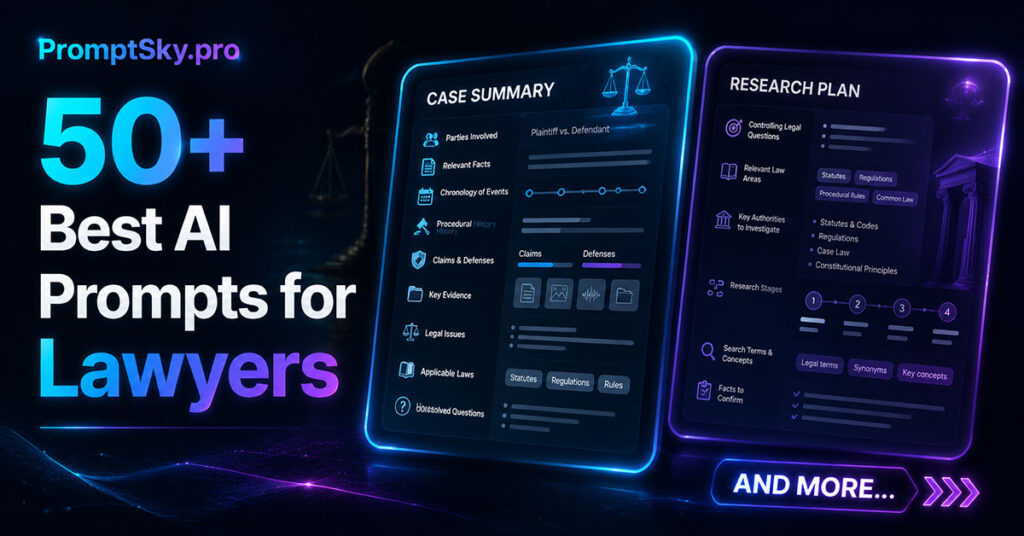
Prompts for lawyers can help with legal research, case analysis, contract review, document drafting, discovery preparation, and organizing complex legal information. This collection includes 50 detailed AI prompts designed to support lawyers and legal professionals across different stages of legal work.
To use these prompts, copy the prompt that matches your task, replace the placeholders with your case details or documents, and review the output carefully. AI should be used as a research and productivity assistant—not as a replacement for professional legal judgment, verified legal authorities, or jurisdiction-specific advice.
If you need a specific legal prompt for a particular case, document, practice area, or workflow, let us know in the comments and request the prompt you need.
Related AI Prompt Collections
For legal professionals who also use AI for career development and professional branding, you may find these collections useful:
- 20 AI Prompts to Improve Your Resume and Get More Interviews — useful for lawyers updating their CV, highlighting legal experience, and preparing for new career opportunities.
- 30 AI Prompts to Improve Your LinkedIn Profile and Attract Better Opportunities — helpful for improving a lawyer’s LinkedIn profile, professional positioning, and online presence.
- Explore All AI Prompts — browse more AI prompt collections covering different professional and creative use cases.
1. Legal Case Summary
A concise but comprehensive case summary can make complex legal matters easier to review and communicate. This prompt focuses on facts, issues, procedural history, evidence, and legal questions without inventing missing information.
Prompt:
Act as a senior legal research and case-analysis assistant. Analyze the legal case information I provide and create a structured case summary covering the parties involved, relevant facts, chronology of events, procedural history, claims and defenses, key evidence, disputed facts, legal issues, applicable laws, and unresolved questions. Clearly separate confirmed facts from allegations, assumptions, and missing information. Do not invent statutes, cases, evidence, dates, or legal conclusions. Use precise professional legal language and identify areas that require verification by a qualified attorney before the analysis is relied upon.
2. Legal Issue Spotting
This prompt helps identify the main and secondary legal questions hidden inside a complicated factual situation. It is useful when a lawyer needs a structured starting point for deeper research.
Prompt:
Review the factual scenario I provide as a legal issue-spotting assistant. Identify every potentially relevant legal issue, including the primary legal question, secondary issues, procedural concerns, jurisdictional questions, evidentiary issues, contractual questions, potential liabilities, defenses, and possible conflicts between competing legal principles. For each issue, explain which facts trigger the issue, what additional facts are needed, and what legal authorities should be researched. Do not assume a specific jurisdiction unless I provide one, and clearly label anything that requires jurisdiction-specific verification.
3. Legal Research Strategy
This prompt creates a research roadmap before searching for statutes, regulations, case law, or other authorities. It helps organize research rather than pretending that unverified legal information is authoritative.
Prompt:
Act as an experienced legal research strategist. Based on the legal problem I provide, create a detailed research plan that identifies the controlling legal questions, relevant statutory areas, regulations, procedural rules, constitutional or common-law principles where applicable, and categories of case law that should be investigated. Prioritize primary sources over secondary commentary and explain what facts must be confirmed before applying each authority. Organize the research into logical stages and provide suggested search terms and legal concepts. Never fabricate citations or claim that an authority exists without verification.
4. Contract Review
This prompt helps lawyers systematically review agreements for important provisions, ambiguities, obligations, and potential risks.
Prompt:
Review the contract I provide from the perspective of a careful commercial lawyer. Analyze the parties, definitions, scope of obligations, payment terms, deadlines, representations and warranties, indemnification, limitation of liability, confidentiality, intellectual property, termination, renewal, dispute resolution, governing law, force majeure, assignment, notice requirements, and other material provisions. Identify ambiguous language, conflicting clauses, unusual obligations, missing protections, commercially significant risks, and provisions that deserve clarification. Quote only the necessary contract language, never invent missing clauses, and distinguish between legal observations and issues that require jurisdiction-specific legal advice.
5. Contract Clause Analysis
This prompt focuses on individual clauses that may have significant legal or commercial consequences.
Prompt:
Analyze the contract clause I provide as a legal drafting and risk-review assistant. Explain the clause in plain English, identify the obligations imposed on each party, describe the practical consequences, highlight ambiguity or potentially unfavorable wording, and identify interactions with other clauses that may affect its interpretation. Explain what questions a lawyer should investigate before accepting or revising the provision. Where appropriate, provide alternative drafting concepts rather than presenting unverified language as legally sufficient. Do not assume enforceability without knowing the applicable jurisdiction and complete agreement.
6. Legal Document Proofreading
This prompt helps detect drafting problems while preserving the intended legal meaning of a document.
Prompt:
Proofread the legal document I provide as an experienced legal editor. Check grammar, spelling, punctuation, terminology consistency, defined terms, numbering, cross-references, dates, party names, formatting, sentence structure, ambiguity, contradictory wording, and obvious drafting inconsistencies. Preserve the intended legal meaning and do not silently change substantive obligations. Present each significant issue with the original wording, the suggested revision, and a short explanation of why the change may improve clarity or consistency. Flag substantive legal concerns separately so they can be reviewed by the responsible attorney.
7. Demand Letter Drafting
This prompt helps structure a professional demand letter while keeping factual and legal claims grounded in the information supplied.
Prompt:
Draft a professional demand letter based strictly on the facts, documents, and objectives I provide. Clearly identify the parties, relevant events, contractual or legal basis of the demand, specific conduct at issue, requested remedy, applicable deadline, and proposed next steps. Use firm but professional language and avoid unnecessary threats, exaggeration, unsupported allegations, or statements of law that have not been verified. Clearly distinguish established facts from disputed allegations. Include placeholders for missing information and identify any legal assertions that should be reviewed and confirmed by a qualified attorney before sending.
8. Client Intake Questionnaire
This prompt creates a structured questionnaire for collecting relevant information from a prospective legal client.
Prompt:
Create a detailed client intake questionnaire for the legal matter I describe. Organize the questions into client identification, parties involved, chronology, agreements, communications, financial information, witnesses, evidence, previous legal action, deadlines, damages, desired outcome, and other matter-specific categories. Prioritize questions that could materially affect legal analysis or procedural deadlines. Use clear language that a non-lawyer can understand while maintaining professional terminology where necessary. Avoid requesting unnecessary sensitive information and include a reminder that submitting an intake form does not automatically create an attorney-client relationship unless the firm confirms that relationship.
9. Deposition Preparation
This prompt helps organize preparation for testimony by identifying factual areas, inconsistencies, documents, and likely topics.
Prompt:
Act as a deposition-preparation assistant for the legal matter I provide. Organize the known facts, chronology, relevant documents, disputed issues, prior statements, communications, witnesses, and potential areas of questioning. Create realistic categories of questions that opposing counsel might explore, including questions designed to test credibility, knowledge, timelines, inconsistencies, damages, relationships, and documentary evidence. Do not coach the witness to mislead, conceal information, or provide false testimony. Instead, emphasize accurate recollection, careful listening, truthful answers, and clarification when the witness does not know or remember something.
10. Evidence Organization
This prompt turns a large collection of case materials into a more manageable evidence framework.
Prompt:
Organize the evidence I provide into a structured legal evidence matrix. For each document, communication, photograph, recording, testimony, or other item, identify its source, date, relevant parties, factual issue addressed, potential significance, relationship to other evidence, authenticity concerns, and whether additional verification may be required. Separate direct evidence from circumstantial evidence and established information from disputed claims. Do not determine admissibility unless the applicable jurisdiction and evidentiary rules are provided and verified. Highlight missing evidence and contradictions that should receive attorney review.
11. Chronology of Events
This prompt creates a precise timeline that can help lawyers understand how a dispute developed.
Prompt:
Create a detailed chronological timeline from the information I provide. List every relevant event in date and time order where available, including communications, agreements, payments, notices, incidents, filings, decisions, and other legally significant actions. For each event, identify the people or entities involved, supporting evidence, source of the information, and any uncertainty about the date or facts. Clearly mark conflicting accounts and missing periods instead of filling gaps with assumptions. At the end, identify important chronological patterns, deadlines, gaps, and inconsistencies that should be independently verified.
12. Legal Memo Structure
This prompt helps lawyers turn research and facts into a professional internal legal memorandum.
Prompt:
Create a professional legal memorandum based on the facts and authorities I provide. Structure the memo with a concise issue statement, short answer, relevant facts, governing law, detailed analysis, counterarguments, practical considerations, and conclusion. Apply each legal rule carefully to the specific facts and distinguish controlling authority from persuasive authority where that information is available. Do not invent citations, holdings, quotations, or procedural history. Clearly identify assumptions, unresolved factual questions, and areas where additional legal research or attorney judgment is required.
13. Case Strength Assessment
This prompt evaluates arguments and vulnerabilities from multiple perspectives instead of producing a one-sided assessment.
Prompt:
Evaluate the strengths and weaknesses of the legal position described in the materials I provide. Analyze the strongest arguments for each side, supporting facts, unfavorable facts, available evidence, potential defenses, procedural vulnerabilities, legal uncertainties, and possible counterarguments. Distinguish between issues supported by strong evidence and issues dependent on disputed facts or unverified law. Do not predict an outcome with false certainty. Conclude with a prioritized list of questions and evidence that could materially change the assessment and should be investigated by the responsible attorney.
14. Litigation Risk Analysis
This prompt helps identify practical risks that may arise during litigation beyond the basic legal merits of a claim.
Prompt:
Conduct a structured litigation-risk analysis based on the case information I provide. Evaluate potential claims and defenses, evidentiary weaknesses, procedural risks, jurisdictional concerns, credibility issues, damages uncertainty, cost considerations, timing, settlement pressure, reputational concerns, and possible outcomes. Separate legal risks from business or strategic risks and explain the facts supporting each assessment. Do not assign arbitrary probabilities unless sufficient evidence exists to justify them. Clearly identify assumptions and explain which additional facts or legal research could materially change the risk assessment.
15. Legal Argument Development
This prompt helps organize a persuasive legal argument while ensuring that opposing positions are considered.
Prompt:
Develop a structured legal argument based on the facts and authorities I provide. Begin with the central legal proposition, identify the governing rules, connect each rule to the relevant facts, explain the strongest supporting evidence, and anticipate the most credible counterarguments. Strengthen the reasoning by addressing weaknesses rather than ignoring them. Distinguish factual assertions from legal conclusions and avoid unsupported claims. Do not fabricate case law, statutes, quotations, or citations. Present the argument in a professional format suitable for further attorney review and jurisdiction-specific refinement.
16. Counterargument Generator
This prompt stress-tests a legal position by deliberately examining how an opposing lawyer might attack it.
Prompt:
Act as opposing counsel and critically challenge the legal position I provide. Identify the strongest reasonable counterarguments based on the known facts, applicable legal principles, evidentiary weaknesses, procedural issues, ambiguous language, credibility concerns, and alternative interpretations. For each counterargument, explain what evidence or authority could support it and how the original position might respond. Do not invent facts or legal authorities. The purpose is to stress-test the argument before filing, negotiation, or further legal research, not to determine the final legal outcome.
17. Settlement Strategy Analysis
This prompt helps organize the factors lawyers may consider before entering settlement discussions.
Prompt:
Analyze the settlement considerations for the legal dispute I describe. Evaluate the strengths and weaknesses of each side, disputed facts, evidence quality, litigation risks, potential remedies, financial exposure, legal costs, time considerations, business relationships, confidentiality concerns, and non-monetary interests. Identify the issues that may create negotiation leverage and those that may make settlement more difficult. Do not recommend a specific settlement amount unless sufficient factual and financial information is provided. Clearly separate objective analysis from assumptions and identify matters that require attorney judgment.
18. Legal Client Email Draft
This prompt helps transform complex legal information into a clear and professional client communication.
Prompt:
Draft a clear and professional email to a legal client based on the information I provide. Explain the current situation, relevant developments, important deadlines, requested documents or actions, potential next steps, and any decisions the client needs to make. Use plain language wherever possible and avoid unnecessary legal jargon. Do not create facts, deadlines, legal conclusions, or promises that are not supported by the supplied information. Maintain an appropriate professional tone and clearly distinguish confirmed information from matters that remain under review.
19. Plain-English Legal Explanation
This prompt is useful when a lawyer needs to explain a complicated legal concept to a client without losing important qualifications.
Prompt:
Explain the legal concept or document I provide in clear plain English for a client who has no legal background. Start with a concise explanation of what it means, then explain how it may affect the client’s situation, what obligations or risks may exist, and what questions the client should discuss with their lawyer. Preserve important legal qualifications and do not oversimplify the point to the extent that the explanation becomes misleading. Do not provide a definitive legal conclusion without sufficient jurisdiction-specific information, and clearly identify anything that requires professional legal review.
20. Case File Organization
This prompt creates a logical structure for managing large legal matters with many documents and participants.
Prompt:
Design a comprehensive case-file organization system for the legal matter I describe. Create categories for pleadings, correspondence, contracts, financial records, evidence, discovery materials, witness information, research, court documents, deadlines, notes, and privileged or confidential materials where appropriate. Recommend consistent naming conventions, chronology rules, document metadata, version control, and a master index. Keep the system practical for a legal team and emphasize confidentiality, access control, and careful handling of privileged information. Do not recommend storing sensitive case materials in insecure or unauthorized systems.
21. Legal Research Question Generator
This prompt converts a broad legal problem into focused research questions that can be investigated systematically.
Prompt:
Convert the legal problem I provide into a prioritized list of specific legal research questions. Break the problem into questions concerning applicable law, jurisdiction, elements of potential claims, defenses, procedural requirements, evidentiary standards, remedies, deadlines, and relevant exceptions. For each question, explain why it matters and what facts must be confirmed before answering it. Suggest precise legal search terms and categories of primary authority to investigate. Do not provide fabricated answers or citations; the goal is to create a rigorous research roadmap for subsequent attorney-led verification.
22. Damages Analysis Framework
This prompt helps organize the different categories of damages that may be relevant to a legal dispute.
Prompt:
Create a structured damages-analysis framework for the legal matter I provide. Identify potentially relevant categories of damages based on the facts, including direct losses, consequential losses, contractual damages, property damage, lost income, business losses, or other jurisdiction-specific categories where appropriate. For each category, identify the factual basis, supporting documents, calculation method, causation questions, mitigation issues, and uncertainties. Do not assume that a category is legally recoverable without verifying the applicable jurisdiction and legal authority. Clearly distinguish documented losses from estimates and disputed claims.
23. Legal Deadline Tracker
This prompt helps identify important dates and create a structured deadline list from case materials.
Prompt:
Review the legal matter and documents I provide and create a comprehensive deadline and date tracker. Identify court deadlines, contractual deadlines, notice periods, response dates, limitation or prescription periods where relevant, hearings, filing dates, renewal dates, payment dates, and other potentially significant dates. For each deadline, provide its source, triggering event, applicable rule or document, required action, responsible party, and uncertainty level. Never invent a deadline or assume a limitation period without verified jurisdiction-specific authority. Flag dates that require immediate confirmation by the responsible attorney or court.
24. Legal Document Comparison
This prompt compares two versions of a legal document and highlights meaningful differences.
Prompt:
Compare the two legal documents I provide line by line and identify all meaningful differences. Categorize changes as additions, deletions, wording changes, changed obligations, altered deadlines, revised financial terms, modified rights, new risks, removed protections, or purely stylistic edits. Explain the practical significance of each substantive change in clear legal language. Pay particular attention to definitions, liability, indemnity, termination, confidentiality, dispute resolution, governing law, payment obligations, and representations. Do not assume that a change is legally favorable or unfavorable without explaining the relevant context and flagging issues for attorney review.
25. Legal Strategy Brainstorming
This prompt generates multiple strategic paths while leaving the final decision to the lawyer handling the matter.
Prompt:
Act as a senior legal strategy brainstorming assistant and analyze the matter I provide from multiple possible strategic perspectives. Identify potential procedural approaches, negotiation options, litigation strategies, evidence-development opportunities, settlement considerations, communication strategies, and practical alternatives. For every strategy, explain its potential advantages, disadvantages, prerequisites, risks, and unanswered questions. Include the strongest argument against each proposed approach so the analysis does not become one-sided. Do not present the brainstorming as definitive legal advice, and do not invent facts, authorities, deadlines, or procedural requirements.
26. Legal Complaint Drafting
A well-structured complaint should present the relevant facts, legal claims, and requested relief in a logical order. This prompt helps organize the initial draft while leaving jurisdiction-specific requirements for attorney review.
Prompt:
Act as an experienced legal drafting assistant and prepare a structured draft complaint based strictly on the facts and documents I provide. Organize the document into the appropriate introductory sections, identification of parties, jurisdiction and venue allegations, factual background, causes of action, supporting factual allegations, requested relief, and other sections required by the applicable procedural rules. Do not invent facts, legal claims, jurisdictional grounds, statutes, dates, damages, or procedural requirements. Clearly mark missing information with placeholders and identify each section that requires verification against the rules of the relevant court before filing.
27. Answer and Defense Preparation
This prompt helps organize responses to allegations while identifying admissions, denials, defenses, and unresolved factual questions.
Prompt:
Analyze the complaint or allegations I provide and create a structured framework for preparing an answer and potential defenses. Break every material allegation into categories such as admitted, denied, partially supported, disputed, or requiring additional investigation. Identify possible affirmative defenses and explain what facts would be necessary to support each one. Highlight inconsistencies, missing information, procedural concerns, and allegations that require clarification. Do not invent defenses or assume that a particular defense is legally available without jurisdiction-specific verification. Clearly distinguish factual analysis from legal conclusions.
28. Discovery Question Generator
This prompt helps generate focused discovery questions designed around disputed facts and important evidence.
Prompt:
Create a comprehensive set of discovery questions for the legal dispute I describe. Organize the questions around parties, witnesses, communications, documents, contracts, financial information, chronology, disputed facts, damages, defenses, and other matter-specific issues. Prioritize questions that could uncover evidence supporting or contradicting the key legal claims. Avoid unnecessary repetition and overly broad requests where possible. Identify the factual purpose of each major question or category and flag questions that may require modification because of privilege, proportionality, confidentiality, jurisdiction-specific rules, or procedural limitations.
29. Interrogatory Drafting
This prompt helps lawyers prepare targeted written interrogatories based on the factual and legal issues in a case.
Prompt:
Draft a structured set of proposed interrogatories based on the legal matter and factual issues I provide. Focus on identifying parties, witnesses, relevant events, communications, agreements, financial information, factual bases for claims and defenses, damages, and other information directly connected to disputed issues. Make each interrogatory specific, logically organized, and designed to obtain useful factual information rather than unnecessarily repetitive responses. Do not assume the applicable numerical limits, definitions, objections, or procedural requirements; identify those items for verification under the relevant jurisdiction and court rules before use.
30. Document Request Strategy
This prompt helps identify which categories of documents may be important to obtain during a legal dispute.
Prompt:
Develop a targeted document-request strategy for the legal matter I provide. Identify the categories of documents most likely to prove or disprove the disputed facts, including contracts, emails, messages, financial records, invoices, internal communications, photographs, reports, policies, technical records, and other relevant materials. For each category, explain the factual issue it may address and why it could be significant. Avoid speculative or unnecessarily broad requests and flag potential privilege, privacy, confidentiality, proportionality, or jurisdiction-specific limitations that should be reviewed before the requests are served.
31. Witness Interview Preparation
This prompt helps lawyers prepare organized and neutral questions for interviewing witnesses.
Prompt:
Create a detailed witness interview plan based on the case information I provide. Organize questions around the witness’s identity and relationship to the matter, personal knowledge, chronology of events, communications, documents, other witnesses, disputed facts, damages, and inconsistencies. Begin with open-ended questions before moving toward specific factual details. Identify important follow-up questions that could test the accuracy and completeness of the witness’s account. Do not suggest that the witness change, conceal, or manufacture facts, and clearly distinguish firsthand knowledge from assumptions, hearsay, or information received from others.
32. Legal Citation Verification
This prompt helps organize the verification of legal authorities before they are relied upon in a document.
Prompt:
Review the legal citations, statutes, regulations, court decisions, and other authorities I provide and create a verification checklist for each source. Identify the authority type, jurisdiction, court or issuing body, date, legal proposition it is being used to support, and whether the citation appears complete based only on the information available. Flag authorities that may be outdated, incomplete, from the wrong jurisdiction, or being used for a proposition broader than the source appears to support. Do not fabricate missing citation details or claim that a case supports a proposition unless the underlying authority has been independently verified.
33. Legal Brief Outline
This prompt creates a persuasive structure for a legal brief before detailed drafting begins.
Prompt:
Create a detailed outline for a legal brief based on the facts, legal issues, and authorities I provide. Organize the argument into a logical sequence beginning with the strongest central proposition and progressing through the governing law, factual application, supporting authorities, counterarguments, and requested relief. For every major section, identify the facts and authorities that should support it and explain any weaknesses that need to be addressed. Do not invent citations, quotations, procedural history, or legal standards. Design the outline so that a lawyer can verify each proposition before converting it into final filing language.
34. Appellate Argument Analysis
This prompt helps identify the strongest appellate issues and weaknesses in a lower-court decision.
Prompt:
Analyze the case materials I provide from an appellate-law perspective. Identify potential issues for appeal, standards of review that may be relevant, preserved versus potentially unpreserved arguments, material factual findings, alleged legal errors, procedural issues, harmful versus harmless errors, and possible counterarguments. Explain what portions of the record would be necessary to support each issue. Do not assume an issue is appealable or preserved without reviewing the applicable jurisdiction-specific rules and record. Clearly separate potentially strong appellate arguments from speculative issues requiring further research.
35. Legal Risk Matrix
This prompt turns a complex matter into a prioritized overview of legal and practical risks.
Prompt:
Create a detailed legal risk matrix for the matter I describe. Identify each significant risk, its underlying facts, possible legal consequences, potential financial or operational impact, likelihood based only on available information, severity, current mitigation measures, and additional information needed to assess it. Use qualitative categories instead of invented numerical probabilities unless reliable data is provided. Separate confirmed risks from hypothetical scenarios and distinguish legal exposure from business, reputational, procedural, or relationship risks. End with a prioritized list of issues that deserve immediate attorney attention.
36. Employment Dispute Analysis
This prompt helps structure analysis of workplace disputes while recognizing that employment law varies significantly by jurisdiction.
Prompt:
Analyze the employment-related dispute I provide from a structured legal-review perspective. Identify the employment relationship, relevant agreements and policies, chronology of events, communications, alleged conduct, potential claims and defenses, evidence, damages, procedural issues, and unresolved factual questions. Consider employment contracts, workplace policies, compensation, termination, discrimination, retaliation, leave, confidentiality, restrictive covenants, or other issues only when supported by the facts. Do not assume that a particular employment law applies without confirming the jurisdiction and relevant legal authority. Clearly identify issues requiring qualified employment counsel review.
37. Intellectual Property Issue Spotting
This prompt helps identify potential intellectual property concerns in business, content, software, branding, or creative projects.
Prompt:
Review the intellectual property situation I provide and identify potentially relevant legal issues involving copyright, trademarks, patents, trade secrets, licensing, ownership, permissions, infringement, attribution, derivative works, confidential information, or contractual rights where applicable. For each issue, explain the relevant facts, potential rights or risks, evidence that should be preserved, and additional information required for analysis. Do not assume ownership, infringement, registration status, fair use, or enforceability without verified facts and jurisdiction-specific law. Clearly distinguish between legal possibilities and conclusions that require professional legal review.
38. Privacy and Data Protection Review
This prompt helps identify privacy-related issues when an organization collects, stores, processes, or shares personal information.
Prompt:
Analyze the data-processing scenario I provide for potential privacy and data-protection issues. Identify what categories of personal information are involved, how information is collected, the stated purpose, storage practices, access, sharing, retention, security, user rights, international transfers, vendors, and relevant agreements or notices. Identify which legal and regulatory frameworks may need to be investigated based on the jurisdictions involved, but do not assume that any particular law applies without verification. Flag missing facts, compliance questions, documentation gaps, and areas that require review by qualified privacy counsel.
39. Legal Policy Drafting
This prompt helps create an initial framework for an internal legal or business policy.
Prompt:
Draft a professional internal policy based on the organizational purpose and requirements I provide. Define the policy’s scope, covered personnel, responsibilities, prohibited or required conduct, approval procedures, documentation requirements, reporting mechanisms, exceptions, enforcement considerations, review procedures, and relevant definitions. Use clear language that employees can understand while preserving necessary legal precision. Do not invent statutory requirements or claim that the policy guarantees legal compliance. Clearly identify areas that should be customized and reviewed against applicable laws, regulations, contracts, and organizational practices before implementation.
40. Compliance Checklist
This prompt creates a practical checklist for reviewing whether a business process addresses identified legal or regulatory requirements.
Prompt:
Create a detailed legal and regulatory compliance checklist for the business activity I describe. Organize the checklist by applicable legal areas, required documents, notices, approvals, contracts, internal procedures, recordkeeping, employee responsibilities, reporting obligations, deadlines, monitoring, and potential enforcement risks. First identify which jurisdiction, industry, business model, and factual details are necessary to determine the applicable requirements. Do not claim that an item is legally required unless the relevant authority has been verified. Clearly label assumptions, optional best practices, and requirements requiring qualified counsel confirmation.
41. Legal Negotiation Preparation
This prompt helps prepare for negotiations by mapping priorities, concessions, risks, and possible responses.
Prompt:
Prepare a legal negotiation strategy based on the dispute, agreement, or transaction information I provide. Identify my stated objectives, legal and commercial priorities, non-negotiable issues, preferred outcomes, possible concessions, risks, leverage points, and information gaps. Analyze what the other side may prioritize and develop several plausible responses to their strongest positions. Create a negotiation agenda and suggested questions that uncover their interests without making unsupported assumptions. Do not present speculative leverage as fact and clearly identify issues requiring attorney judgment before negotiations begin.
42. Mediation Preparation
This prompt helps organize the facts and objectives needed for a productive mediation.
Prompt:
Create a comprehensive mediation-preparation framework for the legal matter I provide. Summarize the key facts, disputed issues, strongest arguments on both sides, evidence, damages, practical risks, emotional or relationship considerations, settlement objectives, non-monetary interests, and unresolved questions. Identify which issues are most likely to prevent settlement and which may provide opportunities for compromise. Prepare concise talking points and questions for the mediation while avoiding inflammatory language. Do not recommend a settlement amount without sufficient information and clearly separate legal analysis from negotiation strategy.
43. Legal FAQ Generator
This prompt helps lawyers create useful answers to recurring client questions without turning general information into individualized legal advice.
Prompt:
Create a professional FAQ based on the legal topic or service information I provide. Identify the questions clients are most likely to ask and answer them in clear, concise language suitable for a general audience. Explain important concepts, common procedures, documents, timelines, costs or considerations only when supported by reliable information. Clearly distinguish general legal information from advice about an individual’s specific circumstances. Avoid definitive conclusions when the answer depends on jurisdiction or individual facts, and identify questions that should be discussed directly with a qualified lawyer.
44. Legal Website Content
This prompt helps law firms create informative website content while maintaining a professional and responsible tone.
Prompt:
Write an authoritative but accessible legal website article based on the topic and jurisdiction I provide. Structure the content with a clear introduction, key legal concepts, relevant process or considerations, common questions, practical preparation steps, and a concise conclusion. Use plain English while preserving legal accuracy and clearly explain jurisdictional limitations where relevant. Do not fabricate statistics, cases, statutes, deadlines, or client outcomes. Avoid guarantees or exaggerated claims about legal results, and include appropriate language explaining that the content provides general information rather than individualized legal advice.
45. Legal Content SEO Strategy
This prompt helps a law firm develop search-focused content without sacrificing legal accuracy or credibility.
Prompt:
Create an SEO content strategy for a law firm targeting the legal topic and jurisdiction I provide. Identify search intent, primary and secondary keywords, relevant questions, topic clusters, supporting articles, internal-link opportunities, page structure, title ideas, meta-description concepts, and FAQ topics. Prioritize accurate, useful information over keyword repetition and avoid making unsupported legal claims. Recommend content that demonstrates expertise through clear explanations, relevant authority, practical information, and transparent limitations. Do not invent legal statistics or search-volume data; clearly label any assumptions that require separate SEO research.
46. Legal Document Checklist
This prompt helps identify documents that may be needed for a particular legal matter before substantive work begins.
Prompt:
Create a matter-specific legal document checklist based on the facts and objective I provide. Organize potentially relevant materials into identity and party information, contracts, correspondence, financial records, notices, court documents, evidence, photographs, digital communications, witness information, prior legal documents, and other case-specific categories. For every category, explain why the document may matter and whether it is essential, useful, or dependent on additional facts. Do not assume that a document is legally required without verification. Include a section for missing information and documents that should be obtained or confirmed before further legal analysis.
47. Conflict of Interest Screening
This prompt helps organize information that may be relevant when conducting an initial conflict review.
Prompt:
Create a structured preliminary conflict-of-interest screening checklist for the legal matter I describe. Identify all relevant individuals, companies, affiliates, opposing parties, witnesses, attorneys, prior clients, current clients, related entities, and other relationships that may require review. Organize the information into names, roles, relationships, previous representations, relevant matters, and potential areas of overlap. Do not determine that a conflict exists based solely on incomplete information. Emphasize that formal conflict screening must follow the firm’s procedures and applicable professional-conduct rules, with verification by the responsible legal team before accepting or continuing representation.
48. Legal Matter Handoff Summary
This prompt helps transfer a case between lawyers or legal teams without losing important context.
Prompt:
Create a concise but comprehensive legal matter handoff summary from the case materials I provide. Include the parties, matter background, current procedural status, important dates, key facts, disputed issues, claims and defenses, important evidence, outstanding tasks, pending communications, legal research completed, unresolved questions, risks, and immediate next steps. Clearly distinguish confirmed information from assumptions or issues still being investigated. Prioritize information that a new attorney would need to understand the matter quickly and avoid unnecessary repetition. Do not invent missing facts, deadlines, authorities, or procedural status.
49. Legal Case Status Report
This prompt helps create a repeatable update for clients, partners, or internal legal teams.
Prompt:
Prepare a professional legal case status report using the information I provide. Summarize what has happened since the previous update, current procedural status, completed actions, pending actions, important deadlines, recent communications, evidence developments, legal issues, risks, and decisions that require attention. Separate confirmed developments from unresolved matters and avoid overstating the significance of incomplete information. Use a concise structure that can be updated regularly and clearly identify the responsible person or next action where that information is available. Do not invent deadlines, court events, legal conclusions, or case outcomes.
50. Comprehensive Legal Case Review
This prompt combines multiple analytical perspectives into one structured review for complex matters.
Prompt:
Act as a senior legal case-analysis assistant and conduct a comprehensive review of the legal matter I provide. Analyze the facts and chronology, identify the central and secondary legal issues, summarize claims and defenses, organize the evidence, identify strengths and weaknesses on both sides, examine procedural and jurisdictional concerns, evaluate potential damages and risks, identify missing information, and outline possible strategic options. Separate verified facts, allegations, assumptions, and unresolved questions throughout the analysis. Do not fabricate statutes, case law, procedural rules, evidence, deadlines, or legal conclusions. Clearly identify which issues require jurisdiction-specific research and final review by a qualified attorney before the analysis is used for legal advice, filings, negotiations, or client decisions.