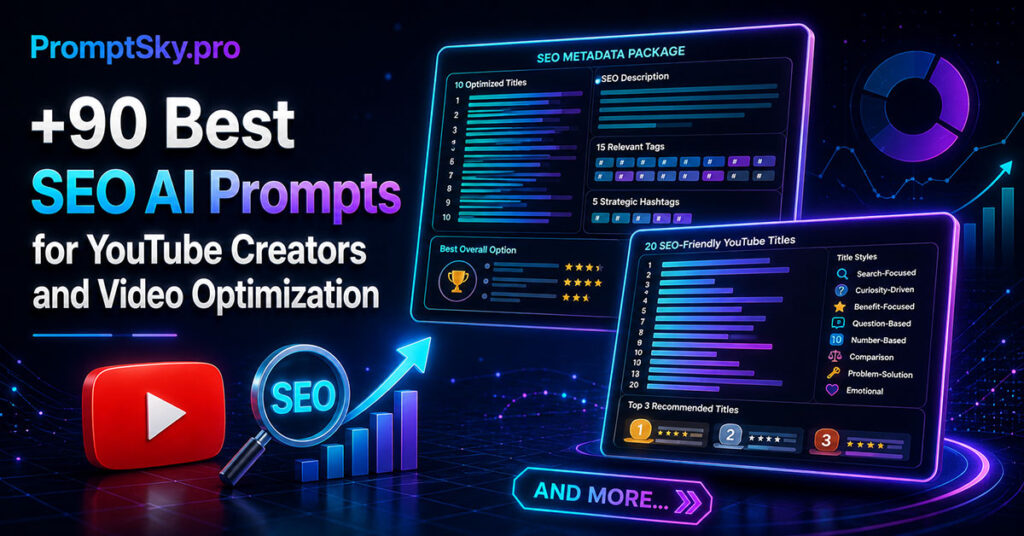
A strong YouTube SEO strategy can improve both your channel and individual videos by helping AI tools structure your keywords, titles, descriptions, playlists, content topics, and overall channel architecture. These prompts are designed to help you optimize your YouTube channel and videos systematically instead of treating SEO as just adding keywords to a title.
To use these prompts, copy the prompt you need and replace every item inside [brackets] with your own information. For example, replace [CHANNEL NAME] with your actual channel name, [NICHE] with your channel topic, [TARGET AUDIENCE] with the people you want to reach, [PRIMARY KEYWORD] with the main keyword of your video, and [VIDEO LIST] with the titles of your existing videos. If a prompt asks for [ANALYTICS], paste the relevant YouTube Analytics data, such as CTR, impressions, views, average view duration, traffic sources, or returning viewers. The more accurate information you provide inside the brackets, the more useful and specific the AI output will be.
You can use these prompts with ChatGPT, Claude, Google Gemini, Microsoft Copilot, Perplexity, or other capable AI assistants. They cover both YouTube channel SEO and individual video SEO, including keyword research, titles, descriptions, tags, hashtags, playlists, content gaps, CTR, retention, Suggested Videos, Browse traffic, topical authority, channel structure, and long-term content planning.
Whether you are starting a new channel or improving an established one, these prompts give you a practical framework for making your YouTube channel and videos more SEO-friendly and discoverable. Use them to build a connected SEO strategy where your channel, playlists, videos, and content topics support each other instead of optimizing every video separately.
For the visual side of YouTube optimization, explore these Creative YouTube Thumbnail Prompts for Content Creators and Viral YouTube Gaming Thumbnail Prompts for More Clicks. If you’re working on the script itself, these Best Prompts for YouTube Script Writing, Storytelling & Content Creation can help you develop stronger video content before optimizing its metadata.
If you need a specific YouTube SEO prompt for another task, let us know in the comments. We can add more prompts for your exact channel, niche, or video strategy.
1. Complete YouTube SEO Metadata Prompt
This all-in-one prompt creates a complete SEO package for a YouTube video. It combines the main metadata elements so creators can optimize an upload from a single workflow.
Prompt:
Act as an expert YouTube SEO strategist and create a complete SEO metadata package for my video about [VIDEO TOPIC].
My primary keyword is [PRIMARY KEYWORD], secondary keywords are [SECONDARY KEYWORDS], and my target audience is [TARGET AUDIENCE].
Generate 10 optimized video titles, one SEO-focused description, 15 relevant tags, and 5 strategic hashtags.
Make the titles compelling without misleading clickbait and naturally incorporate the primary keyword where appropriate.
Write the description for humans first while naturally covering the primary keyword, related terms, video value, and search intent.
Make the tags highly relevant and include exact-match, long-tail, semantic, and niche-specific variations without keyword stuffing.
Present the final recommendations in clearly labeled sections and explain which title, keyword structure, and metadata combination you would choose as the strongest overall option.
2. YouTube SEO Title Generator Prompt
This prompt focuses entirely on generating titles that balance search relevance with click appeal. It is useful when you already know the topic but need stronger title variations.
Prompt:
Generate 20 SEO-friendly YouTube titles for a video about [VIDEO TOPIC] targeting the primary keyword [PRIMARY KEYWORD].
Create different title styles including search-focused, curiosity-driven, benefit-focused, question-based, number-based, comparison, problem-solution, and emotional formats.
Keep every title natural and relevant to the actual video content rather than using misleading clickbait.
Include the primary keyword naturally in several titles while allowing other variations to place it later or use closely related phrases.
Make each title specific enough to communicate the video’s value within a few seconds.
Avoid repetitive sentence structures, generic phrases, excessive capitalization, unnecessary punctuation, and exaggerated promises.
Rank the 20 titles from strongest to weakest and briefly explain which three have the best balance between search relevance and potential click-through appeal.
3. YouTube SEO Description Prompt
This prompt generates a complete video description with search relevance and useful information for viewers. It is designed to keep the description natural rather than turning it into a keyword list.
Prompt:
Write a complete SEO-optimized YouTube description for my video titled “[VIDEO TITLE]” about [VIDEO TOPIC].
The primary keyword is [PRIMARY KEYWORD] and related keywords are [RELATED KEYWORDS].
Make the first two sentences immediately explain what the video offers while naturally including the primary keyword.
Expand the description with a clear summary of the video’s main points, useful context, relevant secondary keywords, and specific benefits for the target viewer.
Add a concise section for [TIMESTAMPS], a useful resources section for [LINKS], and a natural call to action for subscribing or watching a related video.
End with 3 to 5 relevant hashtags that accurately describe the video’s topic and audience.
Keep the writing conversational, informative, and human-readable, and avoid keyword stuffing, repetitive phrases, generic SEO language, and claims that the video does not actually support.
4. YouTube Tags Generator Prompt
This prompt creates a focused tag set rather than a random collection of broad keywords. It is useful when you want tags organized by relevance and search variation.
Prompt:
Generate a strategic set of YouTube tags for a video titled “[VIDEO TITLE]” targeting the primary keyword [PRIMARY KEYWORD].
Create 25 highly relevant tags divided into exact-match keywords, close variations, long-tail phrases, related searches, semantic terms, niche keywords, and broader topic terms.
Prioritize relevance to the actual video instead of generating unrelated high-volume keywords simply because they are popular.
Include natural variations based on how viewers might search for the topic using different wording, questions, and phrases.
Identify the 10 strongest tags and place them first in priority order.
Avoid duplicate phrases, irrelevant trending keywords, competitor names unless directly relevant, and excessive keyword variations that communicate the same meaning.
Return the final tags as a comma-separated list and then explain the strategic role of the most important tag groups.
5. YouTube Hashtag Strategy Prompt
This prompt creates a small, relevant hashtag set instead of overwhelming the description with hashtags. It focuses on topical and audience relevance.
Prompt:
Create a strategic YouTube hashtag set for my video about [VIDEO TOPIC] targeting [TARGET AUDIENCE].
My primary keyword is [PRIMARY KEYWORD] and my niche is [NICHE].
Generate 15 potential hashtags divided into broad niche, specific topic, long-tail, audience-focused, and branded categories.
Prioritize hashtags that accurately describe the actual video rather than using unrelated trending terms for visibility.
Select the 5 strongest hashtags for the final description and rank them by relevance to the video’s subject.
Avoid duplicate hashtags, excessive variations, spammy phrases, and hashtags that could confuse viewers about what the video covers.
Present the final five hashtags separately and briefly explain why each one fits the video’s topic and intended audience.
6. YouTube Keyword Research Prompt
This prompt helps discover keyword opportunities before creating or optimizing a video. It covers broad terms, long-tail phrases, questions, and content angles.
Prompt:
Act as a YouTube keyword research specialist and generate a comprehensive keyword map for the topic [VIDEO TOPIC] and niche [NICHE].
Identify the primary keyword opportunities, secondary keywords, long-tail searches, question-based queries, comparison phrases, problem-solving searches, and beginner-focused variations.
Group the keywords by search intent including informational, how-to, comparison, commercial, problem-solving, and exploratory intent.
For each keyword, explain the likely viewer intent and suggest what type of YouTube video could satisfy that search.
Prioritize keywords based on relevance, specificity, potential audience value, and realistic content opportunities rather than assuming search volume without data.
Identify keyword clusters that could be covered by one video and keywords that deserve separate videos.
Finish by recommending the strongest primary keyword and five supporting keywords for a new video about this topic.
7. YouTube Search Intent Prompt
This prompt helps creators understand what viewers actually expect when searching a keyword. It can prevent a mismatch between the title and the content.
Prompt:
Analyze the YouTube search intent behind the keyword “[PRIMARY KEYWORD]” and explain what viewers are most likely trying to find.
Identify the dominant intent as informational, educational, navigational, comparison, commercial, entertainment, or problem-solving.
Generate the main questions a viewer would expect the video to answer after searching this keyword.
Identify related searches, common subtopics, potential viewer concerns, and information gaps that could make a video more useful than competing content.
Recommend the ideal video format, title angle, content structure, and opening hook for satisfying this search intent.
Explain which information should appear early in the video and which topics can be introduced later.
Finish with a concise SEO content brief that a YouTube creator could use to produce a video directly aligned with the keyword’s likely search intent.
8. YouTube Keyword Cluster Prompt
This prompt groups related keywords into topical clusters that can guide individual videos or an entire content series. It is useful for building broader topical coverage.
Prompt:
Build a complete YouTube keyword cluster around the primary topic “[MAIN TOPIC]” and primary keyword “[PRIMARY KEYWORD].”
Create groups for primary keywords, secondary keywords, long-tail variations, questions, related concepts, comparisons, problems, beginner searches, advanced searches, and commercial-intent terms.
Explain the relationship between each cluster and the central topic so I can understand which phrases belong together.
Identify which keywords should be targeted in one comprehensive video and which ones would be better served by separate videos.
Suggest one potential YouTube video topic for each major cluster and provide a natural primary keyword for that video.
Avoid keyword variations that are nearly identical unless they represent a meaningful difference in search intent.
Finish by creating a recommended content cluster of [NUMBER] videos that collectively covers the topic without excessive overlap.
9. YouTube Title A/B Testing Prompt
This prompt creates title variations that can be compared after publication or during content planning. It focuses on different psychological and search angles rather than simple rewrites.
Prompt:
Create 12 YouTube title variations for the same video about [VIDEO TOPIC] using the primary keyword [PRIMARY KEYWORD].
Divide the titles into four groups: search-first, curiosity-first, benefit-first, and balanced SEO-plus-CTR.
Make every title accurately represent the content while testing a different reason for the viewer to click.
Keep the wording concise, natural, specific, and appropriate for [TARGET AUDIENCE].
For each title, provide a predicted strength score from 1 to 10 for search relevance, clarity, curiosity, and click appeal.
Identify potential weaknesses such as vague wording, excessive length, weak differentiation, or misleading implications.
Select the three strongest title candidates and explain what type of audience or traffic source each title would likely suit best.
10. YouTube Description First-Paragraph Prompt
This prompt focuses on the most visible part of the description. It helps creators make the opening informative and search-friendly without sounding robotic.
Prompt:
Write five alternative opening paragraphs for a YouTube video titled “[VIDEO TITLE]” targeting the keyword “[PRIMARY KEYWORD].”
Each opening should clearly explain what the video covers within the first two or three sentences and naturally include the primary keyword.
Create different approaches including direct answer, curiosity-driven, problem-solution, benefit-focused, and conversational styles.
Make each version useful to a real viewer rather than writing only for search engines.
Avoid keyword stuffing, generic introductions, unnecessary greetings, exaggerated claims, and repetitive wording.
Keep each opening concise enough to work effectively before the viewer expands the full description.
Recommend the strongest version for both search relevance and human readability and explain why it is the best fit for the video.
11. YouTube SEO Description Rewrite Prompt
This prompt improves an existing description without changing the video’s actual subject. It is useful for updating older videos with weak or outdated metadata.
Prompt:
Rewrite the existing YouTube description below to improve its SEO relevance, clarity, readability, and viewer usefulness while preserving the video’s actual meaning.
Video title: [VIDEO TITLE]
Primary keyword: [PRIMARY KEYWORD]
Secondary keywords: [SECONDARY KEYWORDS]
Existing description: [CURRENT DESCRIPTION]
Naturally improve the opening, keyword placement, topical coverage, structure, calls to action, and relevant contextual information.
Remove keyword stuffing, repetition, vague statements, unnecessary promotional language, and outdated information that is not supported by the provided content.
Return the improved description first, followed by a short explanation of the most important SEO and readability improvements you made.
12. YouTube SEO Audit Prompt
This prompt audits existing video metadata and identifies practical optimization opportunities. It can be used for new uploads or older videos that are underperforming.
Prompt:
Perform a detailed YouTube SEO audit for the following video metadata: title “[TITLE]”, description “[DESCRIPTION]”, tags “[TAGS]”, and primary keyword “[KEYWORD].”
Evaluate keyword relevance, search intent alignment, title clarity, click appeal, description quality, topical coverage, tag relevance, hashtag usage, and consistency between all metadata elements.
Identify weaknesses that could make it difficult for viewers or search systems to understand what the video is about.
Separate high-priority problems from minor improvements so I know what should be changed first.
Provide specific rewritten versions of the title, opening description, tags, and hashtags where improvements are necessary.
Avoid recommending keyword stuffing or misleading clickbait and keep every change relevant to the actual video content.
Finish with a prioritized SEO action list ranked from highest to lowest potential impact.
13. YouTube Metadata Optimization Prompt
This prompt optimizes existing metadata as a complete system rather than treating the title, description, tags, and hashtags separately. It helps keep all signals aligned around the same topic.
Prompt:
Optimize the complete YouTube metadata package for my video about [VIDEO TOPIC] using the primary keyword [PRIMARY KEYWORD].
Review the existing title “[CURRENT TITLE]”, description “[CURRENT DESCRIPTION]”, tags “[CURRENT TAGS]”, and hashtags “[CURRENT HASHTAGS].”
Create an improved title that balances search relevance, clarity, curiosity, and click appeal without misleading the viewer.
Rewrite the description so it naturally reinforces the primary topic, related keywords, viewer intent, important content, and relevant calls to action.
Replace weak or irrelevant tags with a focused set of exact-match, long-tail, semantic, and niche-specific terms.
Select a small group of relevant hashtags that reinforce the topic without creating unnecessary repetition.
Return the optimized metadata in publication-ready sections and explain the most important changes.
14. YouTube Long-Tail Keyword Prompt
This prompt focuses on specific searches that may have clearer intent than broad keywords. It is particularly useful for tutorials and problem-solving videos.
Prompt:
Generate 30 highly specific long-tail YouTube keywords related to [MAIN TOPIC] and the primary keyword [PRIMARY KEYWORD].
Include how-to phrases, question-based searches, problem-solving queries, comparison phrases, beginner searches, advanced searches, and situation-specific variations.
Prioritize keywords that express a clear viewer need rather than simply adding extra words to the main keyword.
For each keyword, identify the likely search intent and suggest a suitable YouTube video angle.
Group similar long-tail keywords into logical clusters so closely related phrases can be targeted with one video when appropriate.
Avoid duplicate variations, unnatural wording, and phrases that are unlikely to be used by real viewers.
Finish by selecting the 10 strongest long-tail opportunities based on specificity, relevance, usefulness, and potential content value.
15. YouTube Competitor Metadata Analysis Prompt
This prompt analyzes competitor metadata to uncover patterns and opportunities without simply copying another creator’s strategy. It helps identify gaps and differentiation opportunities.
Prompt:
Analyze the following competitor YouTube metadata for videos covering “[TOPIC]” and identify useful SEO patterns and content opportunities.
Competitor titles: [COMPETITOR TITLES]
Competitor descriptions: [COMPETITOR DESCRIPTIONS]
Competitor tags or keywords: [COMPETITOR KEYWORDS]
Identify recurring keywords, title structures, search intents, content angles, audience promises, and topics that multiple competitors target.
Then identify gaps, underserved questions, unique angles, and opportunities to create a more useful or differentiated video.
Do not recommend copying competitor titles, descriptions, or exact keyword combinations; instead use the analysis to develop original positioning.
Create five original title concepts, a recommended primary keyword, secondary keywords, and a content angle based on the identified opportunity.
16. YouTube SEO Content Brief Prompt
This prompt transforms a keyword into a detailed production brief. It can be used before writing a script to ensure the entire video has a clear SEO direction.
Prompt:
Create a complete YouTube SEO content brief for the primary keyword “[PRIMARY KEYWORD]” and topic “[VIDEO TOPIC].”
Define the likely search intent, target audience, viewer problem, desired outcome, primary keyword, secondary keywords, related questions, and important subtopics.
Recommend the ideal video format, content angle, title strategy, opening hook, section structure, and approximate depth needed to satisfy the viewer.
Identify related terms and concepts that should be naturally covered without forcing keywords into the narration.
Suggest a strong SEO title, description angle, tag strategy, hashtag set, and potential chapter topics.
Identify content gaps that could make this video more useful or distinctive compared with existing videos.
Finish with a concise production checklist that a creator can follow before publishing the video.
17. YouTube Chapter SEO Prompt
This prompt creates descriptive video chapters that help viewers navigate long videos while keeping chapter names closely aligned with the actual content.
Prompt:
Create SEO-friendly YouTube chapter titles for my video about [VIDEO TOPIC] using the transcript or section outline below: [TRANSCRIPT OR OUTLINE].
Identify the major sections and create concise chapter names that clearly tell viewers what they will find at each timestamp.
Include relevant keywords naturally when they accurately describe the section without forcing repetitive phrases into every chapter.
Keep chapter titles specific, useful, and easy to scan rather than using vague labels such as “Introduction,” “More Information,” or “Final Thoughts” unless they are genuinely appropriate.
Use the provided timestamps exactly where available and create [NUMBER] chapters that represent meaningful changes in the video’s content.
Avoid creating chapters for tiny sections, repeated ideas, or transitions that do not contain substantial information.
Return the final chapters in a clean YouTube-ready format with timestamps followed by concise, descriptive titles.
18. YouTube SEO FAQ Prompt
This prompt extracts questions viewers may have around the video’s main keyword. It can help creators identify additional content angles and improve topical coverage.
Prompt:
Generate a comprehensive list of frequently asked questions related to the YouTube video topic “[VIDEO TOPIC]” and primary keyword “[PRIMARY KEYWORD].”
Create questions based on beginner concerns, practical problems, comparisons, common misconceptions, advanced issues, and related search intent.
Group the questions into logical categories and prioritize the questions most closely connected to the video’s main topic.
For each question, provide a concise answer that could potentially be incorporated naturally into the video description, script, chapters, or future content.
Avoid inventing statistics, claims, or facts that cannot be supported by the information provided.
Identify which questions should be answered directly in this video and which could become separate videos.
Finish by selecting the 10 most valuable questions for building a YouTube content cluster around the primary keyword.
19. YouTube SEO Content Gap Prompt
This prompt helps find topics competitors may not fully cover. It focuses on creating genuinely useful differentiation rather than simply adding more keywords.
Prompt:
Identify content gaps for YouTube videos targeting the keyword “[PRIMARY KEYWORD]” and broader topic “[TOPIC].”
Based on the competitor titles, descriptions, outlines, or transcripts provided below, identify questions, examples, use cases, comparisons, problems, objections, and audience needs that appear weakly covered or missing.
Group the gaps into informational, practical, beginner, advanced, comparison, and real-world experience categories.
Explain why each gap could make a video more useful to viewers searching for the primary keyword.
Recommend specific sections or unique content angles that could fill the most valuable gaps without adding irrelevant information.
Create five original video concepts based on the strongest opportunities and provide a primary keyword for each.
Avoid assuming that a content gap automatically means high search volume; focus on relevance and usefulness.
20. YouTube Local SEO Prompt
This prompt is designed for businesses targeting viewers in a specific city, region, or service area. It helps align video metadata with local search intent.
Prompt:
Create a YouTube SEO strategy for a local business video targeting “[SERVICE]” in “[CITY OR REGION].”
Identify the primary local keyword, secondary location-based keywords, service variations, question-based searches, and neighborhood or regional phrases that may be relevant.
Generate 10 YouTube titles that naturally combine the service and location without awkward keyword stuffing.
Write an optimized description that clearly explains the service, location, customer benefit, relevant local context, and call to action.
Generate relevant tags and hashtags using a mixture of service, location, niche, and audience terms.
Make every recommendation specific to the actual business and avoid adding locations or services that the business does not serve.
Finish with a local YouTube SEO checklist covering the title, description, chapters, tags, hashtags, CTA, and video content.
21. YouTube Shorts SEO Prompt
This prompt adapts SEO principles for short-form YouTube content. It focuses on concise metadata and matching the title with the video’s immediate topic.
Prompt:
Optimize the YouTube SEO metadata for a Short about [TOPIC] targeting the keyword “[PRIMARY KEYWORD].”
Generate 15 concise title options designed for clarity, curiosity, and relevance to the actual Short.
Write three short description options that naturally mention the primary keyword and explain the video’s value without unnecessary text.
Generate 10 relevant tags and 5 appropriate hashtags based specifically on the Short’s topic and audience.
Make the metadata concise and avoid stuffing multiple unrelated keywords into a very short video.
Ensure that every title and description accurately represents what viewers will see or learn within the Short.
Rank the strongest title, description, tag set, and hashtag combination and explain why it provides the clearest match between viewer intent and content.
22. YouTube Video SEO Checklist Prompt
This prompt turns the optimization process into a final pre-publishing review. It is useful when all metadata has already been written and needs a quality check.
Prompt:
Create a detailed pre-publishing YouTube SEO checklist for my video “[VIDEO TITLE]” targeting “[PRIMARY KEYWORD].”
Review the title, description, tags, hashtags, chapters, thumbnail concept, transcript, CTA, and overall search intent alignment using the information I provide.
Identify missing elements, weak sections, keyword inconsistencies, irrelevant metadata, unclear viewer promises, and opportunities to improve topical relevance.
Separate essential fixes from optional improvements so I can prioritize the work before publishing.
Check that the primary keyword is used naturally and that supporting keywords reinforce the same topic rather than creating unrelated signals.
Do not recommend manipulative tactics, misleading clickbait, or keyword stuffing.
Finish with a simple “Ready to Publish” checklist containing only the final actions that should be completed before uploading the video.
23. YouTube SEO Audit for an Existing Video Prompt
This prompt is useful for optimizing older videos that already have performance data. It combines metadata review with practical update recommendations.
Prompt:
Audit the YouTube SEO of my existing video using the following information: title [TITLE], description [DESCRIPTION], tags [TAGS], hashtags [HASHTAGS], primary keyword [KEYWORD], views [VIEWS], impressions [IMPRESSIONS], CTR [CTR], average view duration [AVD], and traffic sources [TRAFFIC SOURCES].
Identify potential weaknesses in the video’s metadata, search intent alignment, title positioning, description structure, keyword targeting, and audience promise.
Separate metadata problems from performance issues that may require improvements to the content, thumbnail, hook, or retention rather than SEO changes alone.
Recommend a revised title, opening description, tag set, hashtag set, and chapter strategy where appropriate.
Prioritize changes based on the information provided instead of assuming that every low-performing video has an SEO problem.
Explain which changes should be tested first and what performance signals should be monitored afterward.
Finish with a prioritized optimization plan divided into immediate changes, tests, and longer-term content improvements.
24. YouTube SEO Title and Description Generator Prompt
This prompt creates the two most visible metadata elements together so the title and description reinforce the same search intent. It is useful for new uploads where both need to be created from scratch.
Prompt:
Act as a YouTube SEO copywriter and create a complete title and description package for a video about [VIDEO TOPIC].
The primary keyword is [PRIMARY KEYWORD], related keywords are [RELATED KEYWORDS], and the target audience is [TARGET AUDIENCE].
Generate 15 title options using different combinations of search relevance, curiosity, benefits, numbers, questions, and problem-solving angles.
Select the strongest title and write a complete description that naturally supports the chosen title and primary keyword.
Make the opening immediately communicate the video’s value and then expand with relevant details, secondary keywords, viewer benefits, timestamps, links, and a CTA.
Keep the title and description accurate, natural, readable, and consistent with the actual content.
Return the final recommended title and description first, followed by the alternative titles and a brief explanation of the SEO strategy used.
25. YouTube SEO Tags and Hashtags Prompt
This prompt handles tags and hashtags as separate metadata elements with different purposes. It avoids simply repeating the same keywords everywhere.
Prompt:
Create a complete YouTube tag and hashtag strategy for my video about [VIDEO TOPIC] targeting “[PRIMARY KEYWORD].”
Generate 25 relevant tags divided into exact-match, keyword variations, long-tail, semantic, niche, and broader category terms.
Then generate 10 potential hashtags divided into broad topic, specific topic, niche, audience, and branded categories.
Select the strongest tags based on direct relevance to the video’s actual content rather than popularity alone.
Select the strongest 3 to 5 hashtags that provide useful topical context without excessive repetition.
Remove duplicates, irrelevant trends, misleading terms, and keywords that describe content not actually covered in the video.
Return a publication-ready comma-separated tag list and a separate hashtag list, followed by a short explanation of how the two sets differ.
26. YouTube SEO Keyword Placement Prompt
This prompt helps place keywords naturally across metadata instead of repeating the same phrase mechanically. It is useful when you already have a keyword list.
Prompt:
Create a natural keyword placement strategy for my YouTube video about [VIDEO TOPIC] using the primary keyword “[PRIMARY KEYWORD]” and secondary keywords “[SECONDARY KEYWORDS].”
Show where each important keyword could naturally appear across the title, opening description, full description, chapters, tags, hashtags, and spoken content.
Prioritize natural language and viewer readability instead of repeating exact-match phrases unnecessarily.
Identify which keywords should be used directly and which should appear as semantic variations, synonyms, questions, or related concepts.
Create a sample optimized title and description demonstrating how the keyword structure can work without sounding artificial.
Flag any keyword that appears too broad, unrelated, redundant, or potentially misleading for the video’s actual content.
Finish with a concise keyword placement map that can be reused as a checklist during YouTube optimization.
27. YouTube Search-Friendly Title Rewrite Prompt
This prompt is useful when a title is interesting but does not clearly communicate its topic or search relevance. It creates stronger alternatives without changing the video’s subject.
Prompt:
Rewrite the existing YouTube title “[CURRENT TITLE]” to improve its search relevance, clarity, specificity, and click appeal for the primary keyword “[PRIMARY KEYWORD].”
Create 15 alternatives using different approaches such as exact keyword placement, question format, benefit-driven wording, problem-solution structure, curiosity, numbers, and comparison.
Make sure every version accurately represents the actual video content and does not promise information that the video does not provide.
Avoid awkward keyword insertion, excessive capitalization, unnecessary punctuation, generic clickbait, and repetitive phrasing.
Score each title from 1 to 10 for keyword relevance, clarity, curiosity, and click appeal.
Identify the three strongest options and explain what makes each one different.
Recommend the single best title for a channel prioritizing sustainable search traffic and long-term viewer trust.
28. YouTube Description with Chapters and Links Prompt
This prompt creates a full description structure that combines search-focused opening text with useful navigation and resources.
Prompt:
Write a complete SEO-friendly YouTube description for “[VIDEO TITLE]” about [VIDEO TOPIC] using the primary keyword “[PRIMARY KEYWORD].”
Start with a concise opening that naturally includes the primary keyword and clearly explains what viewers will learn or discover.
Add a useful summary paragraph covering the major topics and related keywords without repeating the same phrase unnecessarily.
Create a chapter section using these timestamps: [TIMESTAMPS] and write concise, descriptive chapter titles that accurately reflect each section.
Add a resources section using these links or placeholders: [LINKS], followed by a natural subscribe or related-video CTA.
Finish with 3 to 5 relevant hashtags and make the entire description easy to scan.
Do not add unsupported claims, fake chapters, irrelevant keywords, or excessive promotional language.
29. YouTube SEO for Educational Videos Prompt
This prompt is designed for educational channels where search intent and topical depth are especially important. It helps organize metadata around what viewers want to learn.
Prompt:
Create a complete YouTube SEO package for an educational video teaching “[TOPIC]” to “[TARGET AUDIENCE].”
Primary keyword: [PRIMARY KEYWORD]
Secondary keywords: [SECONDARY KEYWORDS]
Generate 10 educational YouTube titles, select the strongest one, and write an SEO-optimized description that clearly explains the lesson and expected learning outcome.
Generate relevant tags and hashtags covering the subject, concepts, problems, related searches, and learner intent without adding unrelated terms.
Suggest 5 to 8 chapter titles that reflect the learning progression and naturally incorporate relevant terminology where appropriate.
Make the metadata understandable to beginners while retaining accurate subject terminology for more advanced viewers.
Finish with a complete metadata package and a short explanation of how it matches the educational search intent.
30. YouTube SEO for Tutorial Videos Prompt
This prompt helps optimize instructional videos around task-based search queries. It emphasizes the problem the viewer wants solved.
Prompt:
Create a complete YouTube SEO strategy for a tutorial teaching viewers how to “[TASK]” using “[TOOL OR METHOD].”
Identify the primary keyword, supporting keywords, question-based searches, long-tail phrases, and common problems associated with this task.
Generate 12 search-friendly titles that clearly communicate the tutorial’s result without using misleading promises.
Write an optimized description that explains what viewers will learn, what they need before starting, the major steps covered, and the expected outcome.
Generate relevant tags, hashtags, and chapter titles based on the actual tutorial process.
Ensure the metadata matches beginner search intent and includes useful variations without stuffing the same keyword repeatedly.
Finish by recommending the strongest title, primary keyword, and metadata combination for attracting viewers who genuinely need this tutorial.
31. YouTube SEO for Product Review Videos Prompt
This prompt optimizes review videos around buyer questions and product-specific searches. It works for technology, software, gadgets, services, and other products.
Prompt:
Create a complete YouTube SEO package for a review of “[PRODUCT]” targeting “[TARGET AUDIENCE].”
Identify the primary product keyword, model or version terms, comparison keywords, buyer questions, problem-solving searches, and related search phrases.
Generate 15 titles covering review, testing, pros and cons, comparison, value, performance, and buyer-decision angles.
Write a detailed description that explains what was tested, the major findings, strengths, weaknesses, relevant specifications, comparisons, and who the product is best suited for.
Generate strategic tags and hashtags based on the product, category, use case, and buyer intent.
Create chapter titles that reflect meaningful review sections such as design, performance, features, drawbacks, comparisons, and verdict.
Finish with the strongest title and explain how the metadata targets viewers who are actively researching the product.
32. YouTube SEO for Gaming Videos Prompt
This prompt is designed for gaming channels covering guides, updates, reviews, strategies, and news. It organizes keywords around player intent and game-specific searches.
Prompt:
Create a complete YouTube SEO strategy for a gaming video about “[GAME]” and “[VIDEO TOPIC].”
Identify the main game keyword, update or feature keywords, player questions, strategy searches, character or item terms, and long-tail queries relevant to the video.
Generate 15 engaging titles optimized for search and player interest while avoiding unsupported claims, fake leaks, or misleading hype.
Write an SEO-friendly description that naturally explains what players will learn, discover, or gain from watching the video.
Generate relevant tags and hashtags using game-specific, topic-specific, strategy, update, and audience terms.
Suggest descriptive chapters for the major sections and make sure every keyword reflects content actually covered in the video.
Finish by recommending the strongest title, primary keyword, and tag cluster for reaching the most relevant gaming audience.
33. YouTube SEO for Shorts and Viral Topics Prompt
This prompt combines concise metadata with strong curiosity while keeping the content accurately represented. It is useful for short videos built around facts, trends, or surprising moments.
Prompt:
Create a YouTube Shorts SEO package for a Short about “[TOPIC]” targeting “[PRIMARY KEYWORD]” and “[TARGET AUDIENCE].”
Generate 20 short, curiosity-driven titles that accurately describe the content and avoid misleading clickbait.
Identify the strongest primary keyword and 10 related search phrases that could naturally describe the Short’s subject.
Write five concise description options that communicate the video’s value quickly and naturally include relevant keywords.
Generate 10 relevant tags and 5 carefully selected hashtags based on the topic and audience.
Avoid stuffing keywords into the metadata and prioritize clarity, topical relevance, and immediate viewer understanding.
Rank the strongest title, description, tags, and hashtags and explain which combination provides the clearest match between the Short and its intended audience.
34. YouTube SEO for Faceless Videos Prompt
This prompt is optimized for channels that rely on narration, stock footage, animations, screenshots, and B-roll. It aligns metadata with the actual content format.
Prompt:
Create a YouTube SEO package for a faceless video about “[TOPIC]” targeting “[TARGET AUDIENCE].”
Identify the primary keyword, related search terms, viewer intent, and most useful content angles for this topic.
Generate 15 titles that combine strong search relevance with curiosity while accurately representing the narration and visual content.
Write a detailed description that naturally includes the primary keyword, secondary topics, key information, chapters, resources, and a relevant CTA.
Generate a focused set of tags and hashtags based on the actual subject rather than the fact that the channel is faceless.
Suggest chapter titles and metadata wording that make the video’s value immediately clear to viewers arriving from search or recommendations.
Finish with a recommended metadata package and explain how it supports discovery without relying on generic phrases such as “faceless channel” unless they are genuinely relevant.
35. YouTube SEO for Business Videos Prompt
This prompt helps businesses optimize educational, promotional, case-study, and industry videos for search. It combines commercial relevance with useful content.
Prompt:
Create a complete YouTube SEO strategy for a business video about “[TOPIC]” created for “[BUSINESS OR BRAND]” targeting “[TARGET AUDIENCE].”
Identify the primary keyword, commercial-intent keywords, informational searches, industry terminology, customer problems, and related questions relevant to the video.
Generate 12 professional titles that communicate a clear benefit or answer while maintaining strong search relevance.
Write an SEO-friendly description that explains the video’s value, naturally covers important keywords, introduces the business where appropriate, and includes a clear but non-aggressive CTA.
Generate relevant tags, hashtags, and chapter titles based on the topic, industry, audience, and customer intent.
Avoid overly promotional language, keyword stuffing, vague corporate phrases, and claims that cannot be supported by the video.
Finish with the strongest metadata combination and explain how it balances informational value with business goals.
36. YouTube SEO for How-To Searches Prompt
This prompt targets searches beginning with “how to” and similar problem-solving phrases. It helps align the metadata with the exact task viewers want to complete.
Prompt:
Optimize a YouTube video designed to answer the search query “[HOW-TO QUERY].”
Identify the primary task keyword, supporting variations, related questions, common mistakes, beginner searches, and advanced variations associated with the query.
Generate 15 titles that clearly communicate the solution and include natural keyword variations without making every title identical.
Write a description that answers the search intent immediately, explains the process covered, identifies prerequisites, and naturally incorporates related keywords.
Generate relevant tags, hashtags, and chapters based on the actual steps demonstrated in the video.
Identify the information that should appear in the opening because it directly satisfies the viewer’s reason for searching.
Finish with a complete optimized metadata package and a concise explanation of how each element matches the user’s search intent.
37. YouTube SEO for Comparison Keywords Prompt
This prompt is useful for “X vs Y,” “best X,” and alternative-focused searches. It organizes metadata around decision-making intent.
Prompt:
Create a YouTube SEO strategy for a comparison video about “[OPTION A] vs [OPTION B]” targeting “[TARGET AUDIENCE].”
Identify comparison keywords, alternative searches, buyer questions, feature-specific searches, price-related queries, performance terms, and “best” variations relevant to the topic.
Generate 15 titles using comparison, recommendation, testing, pros-and-cons, and decision-focused angles.
Write an SEO-friendly description explaining what is being compared, the evaluation criteria, the major findings, and which types of viewers may prefer each option.
Generate relevant tags and hashtags that cover both options, the comparison topic, and the decision-making intent.
Create chapter titles for each comparison category such as price, performance, features, usability, limitations, and final verdict.
Finish with the strongest title and keyword combination and explain how it aligns with viewers actively comparing the two options.
38. YouTube SEO Hashtag Audit Prompt
This prompt checks whether existing hashtags actually help describe the video. It removes irrelevant or repetitive hashtags from an existing upload.
Prompt:
Audit the existing hashtags for my YouTube video about “[VIDEO TOPIC].”
Current hashtags: [CURRENT HASHTAGS]
Primary keyword: [PRIMARY KEYWORD]
Target audience: [TARGET AUDIENCE]
Evaluate each hashtag for relevance, specificity, duplication, audience alignment, and connection to the actual video content.
Identify hashtags that are too broad, irrelevant, repetitive, misleading, or unnecessary and explain why they should be removed.
Generate 10 replacement hashtag candidates divided into broad niche, specific topic, audience, and branded categories.
Select the strongest 3 to 5 final hashtags and provide them in a clean copy-ready format.
39. YouTube SEO Tag Audit Prompt
This prompt reviews an existing tag list and replaces weak terms with more relevant variations. It is useful when updating older videos.
Prompt:
Audit the existing YouTube tags for my video about “[VIDEO TOPIC]” targeting “[PRIMARY KEYWORD].”
Current tags: [CURRENT TAGS]
Analyze every tag for topical relevance, search intent, specificity, duplication, and relationship to the actual content.
Identify tags that are irrelevant, overly broad, repetitive, misleading, or unnecessarily similar to other tags.
Generate replacement tags using exact-match, long-tail, semantic, question-based, niche, and related-topic variations.
Prioritize relevance to the video’s subject and target audience rather than assuming that popular terms are automatically useful.
Return a final prioritized tag list in comma-separated format and explain the most important changes made to the original set.
40. YouTube SEO Description for Old Videos Prompt
This prompt is designed for refreshing older uploads whose descriptions no longer reflect their strongest keywords or content value. It helps update metadata without rewriting the video’s identity.
Prompt:
Rewrite and modernize the YouTube description of my existing video “[VIDEO TITLE]” using the primary keyword “[PRIMARY KEYWORD].”
Existing description: [OLD DESCRIPTION]
Video content summary: [VIDEO SUMMARY]
Identify outdated wording, missing context, weak keyword relevance, unclear viewer benefits, and poor description structure.
Create a new opening that clearly explains the video’s value and naturally includes the primary keyword.
Add relevant secondary keywords, useful sections, chapter placeholders, resource links, and a natural CTA while preserving the original video’s actual subject.
Avoid inventing new claims, changing the video’s promise, or stuffing keywords into every sentence.
Return the updated publication-ready description followed by a concise list of the most important SEO improvements.
41. YouTube SEO Title and Thumbnail Alignment Prompt
This prompt evaluates the relationship between metadata and the thumbnail concept. It helps prevent titles and thumbnails from communicating conflicting messages.
Prompt:
Analyze the SEO and click appeal of my YouTube title “[TITLE]” together with this thumbnail concept “[THUMBNAIL DESCRIPTION].”
The primary keyword is “[PRIMARY KEYWORD]” and the video’s actual topic is “[VIDEO TOPIC].”
Determine whether the title and thumbnail communicate one clear viewer promise or create conflicting, confusing, or repetitive messages.
Generate 10 improved title options that complement the thumbnail instead of simply repeating its text.
Ensure the titles maintain natural keyword relevance while creating curiosity and clearly communicating the video’s value.
Identify which title-thumbnail combination provides the strongest balance between search intent, clarity, curiosity, and audience trust.
Finish with three recommended title and thumbnail messaging combinations and explain the role each element should play.
42. YouTube SEO Pinned Comment Prompt
This prompt extends the SEO and engagement strategy beyond the metadata. It creates pinned comments that encourage meaningful discussion related to the video’s subject.
Prompt:
Write five strategic YouTube pinned comments for my video about “[VIDEO TOPIC]” targeting “[TARGET AUDIENCE].”
The primary keyword is “[PRIMARY KEYWORD]” and the main discussion goal is “[ENGAGEMENT GOAL].”
Create different comment styles including a direct question, opinion prompt, viewer challenge, useful recap, and related-video transition.
Make each comment sound natural and conversational rather than like an automated marketing message.
Encourage viewers to respond with specific experiences, choices, opinions, or questions related to the video’s actual content.
Avoid repeating the title, stuffing keywords, using generic “comment below” language, or making exaggerated engagement requests.
Select the strongest pinned comment and explain why it is most likely to encourage meaningful discussion around the video’s topic.
43. YouTube SEO Content Refresh Prompt
This prompt creates a broader refresh strategy for an existing video that has useful content but weak discovery. It considers metadata and content positioning together.
Prompt:
Create a YouTube SEO refresh strategy for my existing video “[VIDEO TITLE]” targeting “[PRIMARY KEYWORD].”
Current metadata: [CURRENT METADATA]
Video summary: [VIDEO SUMMARY]
Performance data: [PERFORMANCE DATA]
Identify whether the main issue appears to be search intent, title clarity, thumbnail positioning, description quality, keyword targeting, content relevance, audience mismatch, or another factor based on the information provided.
Recommend specific changes to the title, description, tags, hashtags, chapters, opening hook, and thumbnail messaging where appropriate.
Prioritize changes that preserve the video’s original value while making its topic and audience benefit clearer.
Finish with a staged refresh plan showing what to change first, what to test, and which performance metrics should be monitored after the update.
44. YouTube SEO Content Cluster Prompt
This prompt helps creators turn one successful keyword into a broader group of interconnected videos. It is useful for building topical authority within a YouTube niche.
Prompt:
Build a YouTube SEO content cluster around the primary topic “[MAIN TOPIC]” and keyword “[PRIMARY KEYWORD].”
Identify the core pillar video, supporting tutorial videos, beginner videos, advanced videos, comparison videos, problem-solving videos, FAQ videos, case studies, and related long-tail topics.
For each proposed video, provide a unique title concept, primary keyword, secondary keywords, search intent, and recommended content angle.
Make sure each video targets a meaningful variation of viewer intent rather than simply rewriting the same topic with slightly different keywords.
Suggest how the videos can naturally reference one another through playlists, descriptions, end screens, and related content.
Prioritize topics based on relevance, audience usefulness, content differentiation, and potential to build a coherent topical library.
Finish with a recommended publishing order that starts with the strongest foundational topics and expands into more specific searches.
45. Ultimate SEO ChatGPT Prompt for YouTube
This is the complete all-in-one seo chatgpt prompt for creators who want ChatGPT to handle keyword research, titles, descriptions, tags, hashtags, chapters, and metadata analysis in one workflow.
Prompt:
Act as an advanced YouTube SEO strategist, keyword researcher, content planner, and metadata editor for my video about [VIDEO TOPIC].
Primary keyword: [PRIMARY KEYWORD]
Secondary keywords: [SECONDARY KEYWORDS]
Target audience: [TARGET AUDIENCE]
Video goal: [VIDEO GOAL]
Competitor information: [COMPETITOR DATA]
First, analyze the likely search intent and identify the most relevant keyword cluster, including long-tail queries, related questions, semantic terms, and audience problems.
Then generate 15 SEO-friendly YouTube titles, select the strongest title, write a complete natural description with a strong opening, chapters, resources, and CTA, generate prioritized tags and 3 to 5 relevant hashtags, and recommend a concise keyword placement strategy across the metadata.
Finally, audit the complete package for keyword stuffing, weak search intent alignment, misleading clickbait, repetitive wording, irrelevant tags, unclear viewer value, and inconsistencies between the title, description, chapters, and actual video topic.
Return the final result in clearly labeled sections: KEYWORD STRATEGY, SEARCH INTENT, TITLE OPTIONS, RECOMMENDED TITLE, SEO DESCRIPTION, CHAPTERS, TAGS, HASHTAGS, METADATA AUDIT, and FINAL RECOMMENDATIONS.
Prioritize relevance, accuracy, natural language, viewer usefulness, and sustainable YouTube SEO over arbitrary keyword density or claims about guaranteed rankings.
46. YouTube CTR Optimization Prompt
This prompt focuses on improving the relationship between search relevance, title appeal, and thumbnail messaging. It is useful when a video gets impressions but does not generate enough clicks.
Prompt:
Act as an advanced YouTube SEO and audience growth strategist and analyze my video for click-through rate optimization.
Video topic: [VIDEO TOPIC], current title: [CURRENT TITLE], thumbnail concept: [THUMBNAIL CONCEPT], primary keyword: [PRIMARY KEYWORD], target audience: [TARGET AUDIENCE].
Generate 15 alternative titles using curiosity, specificity, transformation, contrast, emotional relevance, numbers, urgency, and problem-solution angles.
Evaluate every title for search relevance, clarity, curiosity, perceived value, and potential click appeal on a scale from 1 to 10.
Analyze whether the thumbnail and title complement each other or simply repeat the same message.
Identify weak wording, generic phrases, unnecessary keywords, and misleading elements that could reduce viewer trust or attract the wrong audience.
Select the five strongest title-and-thumbnail combinations and explain why each combination could encourage the intended viewer to click.
47. YouTube Audience Retention Optimization Prompt
This prompt goes beyond traditional SEO and examines whether the actual video fulfills the promise made by its metadata. It is especially useful for videos with strong impressions but weak retention.
Prompt:
Analyze my YouTube video strategy with a focus on audience retention and search intent alignment.
Video topic: [VIDEO TOPIC], primary keyword: [PRIMARY KEYWORD], average view duration: [AVD], average percentage viewed: [APV], and retention data: [RETENTION DATA].
Identify whether the opening immediately delivers the promise communicated by the title and thumbnail.
Analyze possible reasons for viewer drop-off, including slow introductions, unclear expectations, excessive context, weak hooks, repetition, delayed answers, or poor pacing.
Create three improved opening structures designed to satisfy search intent quickly while maintaining curiosity throughout the video.
Recommend specific moments where examples, visual changes, questions, pattern interrupts, or concise summaries could improve retention.
Finish with a retention optimization plan that clearly separates SEO problems from content, scripting, and presentation problems.
48. YouTube Suggested Videos Optimization Prompt
This prompt is designed for creators who want to increase the chance of receiving traffic from Suggested Videos. It focuses on creating logical relationships between related videos.
Prompt:
Develop an advanced YouTube Suggested Videos optimization strategy for my video about [VIDEO TOPIC].
Primary keyword: [PRIMARY KEYWORD], target audience: [TARGET AUDIENCE], and related videos on my channel are [RELATED VIDEOS].
Identify the topics, viewer needs, questions, and content relationships that could make this video naturally relevant to viewers watching related content.
Generate 12 titles that create a strong topical connection with related videos without copying competitor titles or using misleading wording.
Suggest 10 related video topics that could logically come before or after this video in a viewer’s content journey.
Recommend playlist structures, end-screen destinations, internal references, and description links that could encourage viewers to continue watching related content.
Finish with a complete Suggested Videos strategy focused on topical continuity, viewer satisfaction, and creating a natural multi-video viewing journey.
49. YouTube Browse Features Optimization Prompt
This prompt focuses on Home and Browse traffic, where viewers may not be actively searching for your topic. The goal is to improve the overall packaging and immediate appeal of the video.
Prompt:
Create an advanced YouTube Browse Features optimization strategy for my video about [VIDEO TOPIC].
Assume that many potential viewers will discover this video without actively searching for the topic.
Analyze the emotional appeal, curiosity, relevance, timeliness, audience problem, and immediate value proposition of the video.
Generate 15 titles designed for Home and Browse discovery while remaining accurate and directly connected to the actual content.
Create five thumbnail concepts that communicate a clear visual idea without simply repeating the title.
Identify the audience segment most likely to stop scrolling for this topic and explain what promise should be communicated immediately.
Finish with a recommended title, thumbnail concept, opening hook, and packaging strategy specifically designed for Browse-based discovery.
50. YouTube Transcript SEO Optimization Prompt
This prompt optimizes the actual spoken content of a video for topical depth and natural keyword coverage. It can help identify missing concepts without making the script sound artificially optimized.
Prompt:
Analyze and optimize the transcript of my YouTube video for topical relevance and natural keyword coverage.
Primary keyword: [PRIMARY KEYWORD], secondary keywords: [SECONDARY KEYWORDS], and transcript: [TRANSCRIPT].
Identify important concepts, entities, terminology, questions, and keyword variations that are already covered naturally in the transcript.
Find important topical gaps where additional context could make the video more comprehensive and useful to viewers.
Recommend specific sections where relevant terms, explanations, examples, or definitions could be added naturally without creating repetitive keyword usage.
Rewrite only the necessary sections while preserving the creator’s original tone, personality, examples, and factual meaning.
Finish with a topical coverage report showing strong areas, missing concepts, unnecessary repetition, and recommended improvements.
51. YouTube E-E-A-T Content Optimization Prompt
This prompt helps strengthen experience, expertise, authority, and trust in videos where credibility matters. It specifically avoids inventing credentials or unsupported claims.
Prompt:
Optimize my YouTube video for experience, expertise, authority, and trustworthiness around the topic [VIDEO TOPIC].
Target audience: [TARGET AUDIENCE], primary keyword: [PRIMARY KEYWORD], and creator background: [CREATOR EXPERIENCE OR CREDENTIALS].
Identify opportunities to demonstrate first-hand experience, practical knowledge, transparent limitations, relevant evidence, examples, testing methods, case studies, or credible sources.
Suggest sections where personal experience, original observations, demonstrations, documented results, or expert explanations could strengthen the content.
Identify claims that require verification, clearer context, or appropriate qualification before publication.
Do not invent credentials, statistics, personal experiences, testimonials, research findings, or professional qualifications.
Finish with a trust-building content structure that makes the video more useful and credible while maintaining a natural conversational style.
52. YouTube Playlist SEO Optimization Prompt
This prompt helps transform playlists into organized content journeys rather than simple collections of videos. It is useful for channels with multiple videos covering the same broader subject.
Prompt:
Create an advanced YouTube playlist SEO strategy for my channel around the main topic [MAIN TOPIC].
Existing videos: [VIDEO LIST], target audience: [TARGET AUDIENCE], and primary content goal: [CONTENT GOAL].
Group the videos into logical playlists based on viewer intent, skill level, topic, problem, content format, or learning progression.
Generate an SEO-friendly title and detailed description for each playlist using natural terminology without keyword stuffing.
Determine the ideal viewing order for each playlist and explain why the sequence makes sense from the viewer’s perspective.
Identify missing videos that would make each playlist more complete and suggest a title and primary keyword for every missing topic.
Finish by creating a playlist architecture designed to help viewers discover related videos and continue through a coherent content journey.
53. YouTube Seasonal SEO Strategy Prompt
This prompt is designed for holidays, events, seasons, annual occasions, and other time-sensitive opportunities. It separates evergreen opportunities from content that depends on timing.
Prompt:
Create a seasonal YouTube SEO content strategy around [EVENT, SEASON, HOLIDAY, OR OCCASION] for [TARGET AUDIENCE].
Identify evergreen keywords, seasonal keywords, time-sensitive searches, question-based queries, and emerging content opportunities related to the topic.
Generate 15 video concepts divided into pre-event, during-event, and post-event content.
Create an optimized title, primary keyword, supporting keywords, and suggested publishing window for each concept.
Identify which topics should be published early to build discovery potential and which topics depend on real-time developments.
Avoid fabricated trends, unsupported predictions, or claims about search volume unless actual data is provided.
Finish with a seasonal publishing calendar and explain which videos could continue attracting viewers after the event has ended.
54. YouTube News and Trending Topic SEO Prompt
This prompt is designed for news, breaking developments, viral stories, and rapidly changing topics where accuracy and freshness are critical.
Prompt:
Create a YouTube SEO strategy for a timely video about [NEWS OR TRENDING TOPIC].
Separate the subject into confirmed facts, developing information, background context, audience questions, and potential follow-up searches.
Generate 12 accurate and timely title options that communicate the latest information without exaggeration, sensationalism, or unsupported claims.
Identify the primary keyword, breaking-news variations, related entities, questions, and contextual terms viewers may use when searching for the topic.
Write an SEO-friendly description that clearly distinguishes confirmed information from developing or uncertain details.
Suggest relevant tags, hashtags, chapters, and follow-up video ideas based on the topic’s potential evolution.
Finish with a strategy for updating the title and description when new information becomes available while preserving accuracy and viewer trust.
55. YouTube Multilingual SEO Prompt
This prompt is for creators who publish content in multiple languages. It focuses on localization and search intent instead of literal translation.
Prompt:
Create a multilingual YouTube SEO strategy for my video about [VIDEO TOPIC].
Original language: [ORIGINAL LANGUAGE], target languages: [TARGET LANGUAGES], primary keyword: [PRIMARY KEYWORD].
Identify culturally natural keyword equivalents and search-intent variations for each target language instead of translating the keyword literally.
Create optimized title options, description openings, tags, and hashtags for each language while preserving the video’s actual meaning.
Identify differences in terminology, audience expectations, spelling, phrasing, and search behavior that may affect optimization in each market.
Avoid awkward machine-translated expressions, unnatural keyword placement, and culturally irrelevant examples.
Finish with a language-by-language SEO package and explain which terms should be localized rather than directly translated.
56. YouTube International Audience SEO Prompt
This prompt is useful when a video has the potential to reach viewers across multiple countries. It helps maintain a clear core topic while accounting for meaningful regional differences.
Prompt:
Analyze my YouTube video for international audience potential around the topic [VIDEO TOPIC].
Current language: [LANGUAGE], target countries: [COUNTRIES], primary keyword: [PRIMARY KEYWORD], and audience profile: [AUDIENCE].
Identify which parts of the topic are globally relevant and which depend on regional terminology, culture, laws, prices, products, or local context.
Recommend a metadata strategy that maintains one clear core topic while accounting for meaningful international search variations.
Generate title and description variations only where localization provides a genuine benefit rather than creating unnecessary keyword duplication.
Suggest subtitle, translated metadata, terminology, and content adaptation opportunities for each major target market.
Finish with a practical international YouTube SEO plan that balances global discoverability with clear audience targeting.
57. YouTube Content Cannibalization Analysis Prompt
This prompt identifies videos on the same channel that may be competing for similar search intent. It can help you differentiate topics instead of repeatedly targeting the same audience need.
Prompt:
Analyze my YouTube channel for potential content cannibalization across videos targeting similar topics and keywords.
Video list: [VIDEO TITLES, KEYWORDS, TOPICS, AND DESCRIPTIONS].
Identify videos that appear to target the same search intent, audience problem, keyword cluster, or content angle.
Group overlapping videos according to the type of competition, such as identical intent, closely related intent, broad-versus-specific intent, or complementary intent.
Recommend whether each overlapping video should be differentiated, updated, merged conceptually, redirected toward another search intent, or kept as a supporting video.
Create new title and keyword angles for videos that need stronger differentiation while preserving their original value.
Finish with a channel-wide keyword map showing which primary topic each video should own and how the videos can support one another instead of competing unnecessarily.
58. YouTube Evergreen Content SEO Prompt
This prompt helps identify video topics that can continue generating search traffic over a long period. It is particularly useful for building a stable content library.
Prompt:
Identify evergreen YouTube content opportunities around [MAIN TOPIC] for [TARGET AUDIENCE].
Separate potential topics into timeless educational searches, recurring problems, tutorials, definitions, comparisons, beginner questions, advanced questions, and reference-style content.
Generate 20 video concepts with an optimized title, primary keyword, secondary keywords, search intent, and recommended content format for each.
Prioritize topics that can remain useful without depending heavily on temporary news, trends, prices, product versions, or short-lived events.
Identify which concepts may require periodic updates and explain what information would need to be refreshed.
Avoid claiming that a topic has high search volume unless actual keyword data is provided.
Finish by ranking the 10 strongest evergreen opportunities based on long-term usefulness, audience relevance, content depth, and update requirements.
59. YouTube Low-Competition Topic Discovery Prompt
This prompt is designed to find narrower content opportunities where a channel can provide a more specific answer. It does not assume that low competition automatically means high traffic.
Prompt:
Discover specific YouTube content opportunities around [MAIN TOPIC] that may be less competitive because they target narrower audience needs or more specific search intent.
Identify long-tail questions, unusual use cases, beginner problems, advanced problems, comparisons, troubleshooting searches, niche applications, and underserved audience segments.
Generate 25 potential video topics and assign each a specificity score, audience relevance score, content depth score, and potential differentiation score from 1 to 10.
Do not invent search volume, competition metrics, or ranking difficulty without actual data.
Explain why each topic could provide value even if its audience is smaller than a broad keyword.
Select the strongest 10 opportunities and create an SEO-friendly title and primary keyword for each.
Finish with a prioritized list of topics suitable for a channel trying to establish authority within a specific niche.
60. YouTube Video Update and Re-Optimization Prompt
This prompt is for older videos that still have useful content but may need refreshed metadata or positioning. It helps determine whether the video should be updated instead of replaced.
Prompt:
Create a detailed re-optimization strategy for my existing YouTube video “[VIDEO TITLE]” targeting “[PRIMARY KEYWORD].”
Original publication date: [DATE], current views: [VIEWS], impressions: [IMPRESSIONS], CTR: [CTR], average view duration: [AVD], and current traffic sources: [TRAFFIC SOURCES].
Analyze whether the video’s current performance suggests a metadata problem, content problem, packaging problem, audience mismatch, outdated information, or a combination of factors.
Review the current title, description, tags, hashtags, thumbnail concept, transcript, and content summary provided below.
Recommend specific updates to the title, description, keywords, chapters, thumbnail messaging, and opening section where appropriate.
Identify which changes can be made without altering the original video and which improvements would require editing or creating a new version.
Finish with a prioritized re-optimization plan containing immediate metadata changes, optional content updates, testing ideas, and the performance signals that should be monitored after the changes.
61. Complete YouTube Channel SEO Audit Prompt
This prompt provides a full SEO audit of an entire YouTube channel rather than focusing on a single video. It examines channel positioning, keywords, content structure, metadata, playlists, and discoverability.
Prompt:
Act as an advanced YouTube channel SEO strategist and perform a complete SEO audit of my channel.
Channel name: [CHANNEL NAME], niche: [NICHE], target audience: [TARGET AUDIENCE], channel URL or data: [CHANNEL INFORMATION].
Analyze my channel positioning, channel name, handle, About section, banner messaging, homepage structure, playlists, video topics, titles, descriptions, keywords, and overall topical relevance.
Identify whether the channel clearly communicates what it covers, who it serves, and why viewers should subscribe.
Find weaknesses in keyword targeting, content organization, topic consistency, search intent coverage, and internal content relationships.
Recommend specific improvements to the channel positioning, About section, playlists, homepage sections, and content strategy without using keyword stuffing.
Finish with a prioritized YouTube channel SEO action plan divided into immediate fixes, medium-term improvements, and long-term growth opportunities.
62. YouTube Channel Keyword Strategy Prompt
This prompt creates a keyword framework for the entire channel instead of selecting keywords independently for individual videos.
Prompt:
Build a comprehensive YouTube keyword strategy for my entire channel about [MAIN NICHE].
Target audience: [TARGET AUDIENCE], current content topics: [CURRENT TOPICS], and business or content goals: [GOALS].
Identify core channel keywords, supporting topic keywords, long-tail keywords, audience questions, problem-based searches, commercial-intent terms, and emerging topic opportunities.
Organize the keywords into logical content clusters and explain which clusters should become major channel categories.
Identify keywords that are too broad for my current channel and recommend more specific alternatives where appropriate.
Map the strongest keyword clusters to potential video topics and playlist categories.
Finish with a channel-wide keyword map showing the primary topic each content cluster should target and how the clusters can work together without excessive overlap.
63. YouTube Channel About Section SEO Prompt
This prompt optimizes the channel’s About section for both humans and topical clarity. It focuses on explaining the channel naturally instead of turning the description into a keyword list.
Prompt:
Rewrite my YouTube channel About section to improve clarity, audience targeting, topical relevance, and SEO.
Channel name: [CHANNEL NAME], niche: [NICHE], target audience: [TARGET AUDIENCE], primary topics: [TOPICS], unique value: [UNIQUE VALUE].
Create three different About section versions using professional, conversational, and concise styles.
Naturally communicate what the channel covers, who should subscribe, what viewers can expect, and what makes the channel different.
Incorporate the most important channel keywords naturally without repeating the same terms unnecessarily.
Avoid generic phrases, exaggerated claims, keyword stuffing, and promises that the channel cannot consistently deliver.
Select the strongest version and explain why it provides the clearest combination of SEO relevance, positioning, and subscriber appeal.
64. YouTube Channel Name SEO Prompt
This prompt helps evaluate whether a channel name communicates its niche clearly while remaining memorable and brandable.
Prompt:
Analyze my current YouTube channel name “[CURRENT CHANNEL NAME]” for branding, discoverability, clarity, memorability, and niche relevance.
Channel niche: [NICHE], target audience: [TARGET AUDIENCE], primary topics: [TOPICS].
Determine whether the current name clearly communicates the channel’s subject or whether it may create confusion about the content.
Generate 30 alternative channel names divided into brand-focused, keyword-informed, personal-brand, descriptive, creative, and niche-specific styles.
Avoid names that are generic, difficult to pronounce, overly long, trademark-dependent, or stuffed with keywords.
Score the strongest names for memorability, niche clarity, brand potential, and long-term flexibility.
Recommend the five strongest options and explain which one would provide the best foundation for a long-term YouTube brand.
65. YouTube Channel Handle Optimization Prompt
This prompt focuses specifically on the @handle and its relationship with the channel brand. It is useful when creating or rebranding a channel.
Prompt:
Analyze and improve my YouTube channel handle strategy for the brand “[CHANNEL NAME].”
Niche: [NICHE], target audience: [TARGET AUDIENCE], current handle: [CURRENT HANDLE].
Generate 25 potential handle variations that are short, recognizable, easy to spell, and consistent with the channel’s identity.
Prioritize brand consistency and memorability over forcing keywords into the handle.
Avoid unnecessary numbers, confusing punctuation, excessive abbreviations, or handles that could be mistaken for unrelated brands.
Rank the strongest options according to memorability, readability, brand consistency, niche relevance, and long-term usability.
Finish by recommending the best handle strategy for building a recognizable YouTube presence across other social platforms.
66. YouTube Channel Topic Authority Prompt
This prompt evaluates whether a channel has enough depth around its main subject to establish strong topical relevance.
Prompt:
Analyze my YouTube channel for topical authority around [MAIN NICHE].
Current videos: [VIDEO LIST], playlists: [PLAYLIST LIST], primary audience: [TARGET AUDIENCE].
Identify the major subtopics already covered and compare them with the broader knowledge structure of the niche.
Find important beginner, intermediate, advanced, practical, comparison, troubleshooting, and emerging topics that are missing.
Identify areas where the channel has excessive repetition and areas where additional depth could strengthen topical coverage.
Create a recommended content map showing pillar topics, supporting topics, and long-tail questions.
Finish with a prioritized list of [NUMBER] videos that would most effectively expand the channel’s topical authority without drifting outside its core niche.
67. YouTube Channel Content Architecture Prompt
This prompt creates a structured content system for channels that currently publish disconnected videos. It organizes the channel around clear content pillars.
Prompt:
Design a complete content architecture for my YouTube channel about [NICHE].
Target audience: [TARGET AUDIENCE], current videos: [VIDEO LIST], and main business or content goal: [GOAL].
Create 5 to 8 core content pillars that represent the most important areas of the niche.
For each pillar, generate supporting topics, beginner topics, advanced topics, problem-solving topics, comparison topics, and long-tail questions.
Assign existing videos to the most appropriate pillar and identify videos that do not fit the channel’s positioning.
Recommend playlist categories and a logical homepage structure based on these pillars.
Finish with a complete channel content architecture that can guide future video production while maintaining a consistent SEO-focused topical identity.
68. YouTube Channel Homepage SEO Prompt
This prompt optimizes how the channel homepage presents its content to new visitors. It focuses on helping users quickly understand the channel and find relevant videos.
Prompt:
Optimize my YouTube channel homepage for discoverability, user navigation, and subscriber conversion.
Channel niche: [NICHE], target audience: [TARGET AUDIENCE], current playlists: [PLAYLISTS], and featured videos: [VIDEOS].
Recommend the ideal homepage structure for new viewers and returning subscribers.
Determine which videos, playlists, and content categories should appear first and explain the reasoning behind the order.
Suggest section titles that clearly communicate each content category without unnecessary keyword repetition.
Identify weak, redundant, outdated, or poorly organized homepage sections and recommend replacements.
Finish with a complete homepage blueprint including the recommended trailer, featured video, playlist order, section titles, and content priorities.
69. YouTube Channel Trailer SEO Prompt
This prompt helps optimize the channel trailer as a concise introduction for new visitors. It combines channel positioning with a clear reason to subscribe.
Prompt:
Create a high-converting and SEO-aware YouTube channel trailer strategy for [CHANNEL NAME].
Niche: [NICHE], target audience: [TARGET AUDIENCE], primary topics: [TOPICS], unique value proposition: [VALUE PROPOSITION].
Create three trailer concepts with different approaches: direct introduction, problem-solution, and transformation-focused.
Each concept should quickly communicate what the channel is about, who it is for, what viewers can expect, and why they should subscribe.
Naturally incorporate important topical language without making the script sound like an SEO advertisement.
Suggest an optimized title, description, CTA, and opening hook for the strongest trailer concept.
Finish with a 30–60 second channel trailer script designed to communicate the channel’s identity quickly and clearly.
70. YouTube Channel Playlist Structure Prompt
This prompt focuses specifically on organizing existing videos into meaningful playlists that reflect viewer intent and channel topics.
Prompt:
Analyze my existing YouTube videos and create an SEO-focused playlist structure for my channel.
Channel niche: [NICHE], target audience: [TARGET AUDIENCE], video list: [VIDEO LIST].
Group the videos into playlists based on topic, search intent, skill level, problem, format, or viewer journey.
Create an SEO-friendly title and description for each playlist using natural language and relevant topic terminology.
Identify videos that could belong to multiple playlists and determine the primary playlist where each should appear.
Find gaps where a playlist needs additional videos and suggest new video topics to complete the viewer journey.
Finish with the recommended playlist structure and explain how it can make the channel easier to navigate and understand.
71. YouTube Channel Keyword Cannibalization Prompt
This prompt identifies overlapping keyword targets across an entire channel. It helps prevent multiple videos from competing for nearly identical search intent.
Prompt:
Analyze my entire YouTube channel for keyword cannibalization and overlapping search intent.
Channel videos: [VIDEO TITLES], target keywords: [KEYWORDS], descriptions: [DESCRIPTIONS].
Identify videos that target identical or extremely similar search queries, problems, topics, or viewer intent.
Group overlapping videos into exact overlaps, partial overlaps, broad-versus-specific relationships, and complementary relationships.
Recommend a unique primary keyword and search intent for each video where differentiation is possible.
Create revised title and content angles for videos that need stronger differentiation while preserving their original purpose.
Finish with a channel keyword ownership map showing which video should primarily target each major search intent.
72. YouTube Channel Content Gap Analysis Prompt
This prompt finds important subjects missing from a channel’s current content library. It is useful when you want to expand without publishing random topics.
Prompt:
Perform a deep content gap analysis for my YouTube channel about [NICHE].
Current videos: [VIDEO LIST], playlists: [PLAYLISTS], target audience: [TARGET AUDIENCE].
Identify important topics, questions, problems, comparisons, tutorials, beginner concepts, advanced concepts, and use cases that are missing from the current content library.
Organize the gaps into high-priority, medium-priority, and experimental opportunities based on relevance and usefulness.
Identify gaps that could become pillar videos and those better suited to supporting videos or Shorts.
Generate a unique title, primary keyword, search intent, and recommended format for each high-priority opportunity.
Finish with the 20 most valuable content gaps the channel should consider covering next.
73. YouTube Subscriber Search Intent Prompt
This prompt examines what existing subscribers are likely to want next. It helps balance search traffic with audience loyalty.
Prompt:
Analyze the likely search and content intent of my existing YouTube subscribers based on my channel’s current content.
Channel niche: [NICHE], audience: [AUDIENCE], existing videos: [VIDEO LIST], subscriber interests or analytics: [DATA].
Identify recurring problems, interests, questions, content formats, and topics that appear most relevant to the existing audience.
Separate content designed primarily for existing subscribers from content designed primarily to attract new search audiences.
Recommend 20 future video topics that can serve both groups where possible.
Identify topics that may attract new viewers but could be poorly aligned with the existing audience.
Finish with a balanced content strategy showing how the channel can grow search traffic without losing relevance for its current subscribers.
74. YouTube Returning Viewers Optimization Prompt
This prompt focuses on building repeat viewing behavior. It is especially useful for channels that receive one-time viewers but struggle to turn them into regular viewers.
Prompt:
Create a YouTube strategy for increasing returning viewers on my channel about [NICHE].
Current content: [VIDEO LIST], target audience: [TARGET AUDIENCE], current returning viewer data: [DATA].
Identify content themes, recurring formats, series concepts, playlists, and publishing patterns that could encourage viewers to return.
Create 10 repeatable video series concepts with a consistent naming structure and distinct viewer benefit.
Suggest how individual videos can naturally lead into future videos through open loops, related topics, playlists, end screens, and clear content progression.
Avoid artificial engagement tactics and focus on creating genuine reasons for viewers to return.
Finish with a repeat-viewer content system that combines evergreen videos, recurring series, and timely topics.
75. YouTube Search Funnel Strategy Prompt
This prompt maps content across different stages of viewer awareness. It is particularly useful for business and educational channels.
Prompt:
Build a complete YouTube search funnel for my channel about [NICHE] targeting [TARGET AUDIENCE].
Identify keywords and video topics for viewers at different stages: problem awareness, information gathering, solution research, comparison, decision-making, and advanced usage.
Create at least five video ideas for each stage with a suggested primary keyword, search intent, title concept, and content format.
Explain how viewers could naturally move from one stage to another through related videos, playlists, descriptions, and end screens.
Identify which topics should prioritize broad reach and which should prioritize highly qualified audiences.
Avoid making every video commercially focused and maintain useful informational content throughout the funnel.
Finish with a channel-wide content funnel showing how search traffic can develop into deeper audience relationships.
76. YouTube Competitor Channel SEO Analysis Prompt
This prompt analyzes competing channels at the channel level rather than examining only individual videos. It helps uncover content strategies and gaps.
Prompt:
Perform a strategic SEO analysis of these competing YouTube channels: [COMPETITOR CHANNELS].
My channel: [MY CHANNEL], niche: [NICHE], target audience: [TARGET AUDIENCE].
Compare their channel positioning, content pillars, video topics, publishing patterns, titles, playlists, recurring formats, and apparent audience segments.
Identify topics they cover extensively, topics they barely cover, and opportunities where my channel could develop a differentiated position.
Do not recommend copying their titles, branding, thumbnails, or content.
Instead, identify strategic patterns that can inform original content planning and channel positioning.
Finish with a competitive opportunity matrix showing where my channel can differentiate through topic selection, depth, format, audience, or unique expertise.
77. YouTube Channel Rebranding SEO Prompt
This prompt helps redesign an existing channel without completely losing its accumulated identity. It is useful when the niche, audience, or brand direction is changing.
Prompt:
Create a YouTube channel rebranding and SEO transition strategy for my existing channel.
Current channel identity: [CURRENT IDENTITY], new direction: [NEW DIRECTION], existing audience: [AUDIENCE], existing videos: [VIDEO LIST].
Identify which elements should remain consistent and which should be changed, including channel name, handle, About section, banner messaging, playlists, homepage sections, and content pillars.
Analyze existing videos and classify them as keep, update, reposition, archive, or leave unchanged based on their relevance to the new direction.
Create a transition content plan that gradually introduces the new positioning without confusing existing subscribers.
Generate an updated channel description, content pillars, playlist structure, and 20 video topics aligned with the new direction.
Finish with a phased rebranding plan designed to maintain audience clarity while establishing the new channel identity.
78. YouTube Channel Niche Validation Prompt
This prompt helps determine whether a proposed niche is focused enough to build a coherent channel while still offering enough content opportunities.
Prompt:
Evaluate the YouTube channel niche “[PROPOSED NICHE]” for long-term content potential and SEO positioning.
Target audience: [TARGET AUDIENCE], creator expertise: [EXPERTISE], business goal: [GOAL].
Identify the core audience problem, major subtopics, recurring questions, content formats, search opportunities, and potential audience segments within the niche.
Determine whether the niche is too broad, too narrow, highly fragmented, or appropriately focused for a new channel.
Generate three possible niche positioning strategies: broad, focused, and highly specialized.
For each strategy, provide content pillars, example keywords, video ideas, playlist categories, and potential differentiation.
Finish by recommending the strongest niche positioning based on content depth, audience clarity, creator expertise, and long-term expansion potential.
79. YouTube Channel Topic Expansion Prompt
This prompt identifies adjacent topics that can expand a channel without damaging its topical identity. It is useful once the original niche begins to mature.
Prompt:
Identify safe and strategic topic expansion opportunities for my YouTube channel about [CURRENT NICHE].
Current audience: [AUDIENCE], existing content pillars: [CONTENT PILLARS], strongest videos: [TOP VIDEOS].
Identify adjacent topics that naturally connect to the audience’s existing interests and problems.
Divide the opportunities into highly relevant, moderately relevant, experimental, and risky categories.
For each highly relevant topic, provide a primary keyword, search intent, title concept, playlist placement, and suggested video format.
Identify topics that may generate views but could weaken the channel’s overall positioning if introduced too frequently.
Finish with a controlled expansion strategy that grows the channel’s audience while preserving a recognizable core niche.
80. YouTube Channel Content Calendar SEO Prompt
This prompt creates a search-focused publishing calendar instead of choosing topics randomly. It balances evergreen, seasonal, trending, and supporting content.
Prompt:
Create a 90-day SEO-focused YouTube content calendar for my channel about [NICHE].
Target audience: [TARGET AUDIENCE], content pillars: [CONTENT PILLARS], publishing frequency: [FREQUENCY], and business or channel goal: [GOAL].
Divide the calendar between evergreen search content, timely topics, trending opportunities, supporting videos, Shorts, comparison videos, tutorials, and audience-driven content.
Assign a primary keyword, search intent, content format, working title, and relevant playlist to every planned video.
Create logical relationships between videos so individual uploads support broader topic clusters instead of existing as isolated pieces.
Identify which topics should be updated seasonally or revisited after publishing.
Finish with a complete 90-day publishing calendar and explain the strategic role of each content type.
81. YouTube Channel SEO for Personal Brands Prompt
This prompt is specifically designed for creators who build the channel around their own expertise, personality, career, or reputation.
Prompt:
Develop a YouTube SEO strategy for my personal brand channel.
Creator name: [NAME], expertise: [EXPERTISE], target audience: [AUDIENCE], core topics: [TOPICS], and personal brand goals: [GOALS].
Identify the topics and keyword clusters that should become strongly associated with my personal brand over time.
Create content pillars that combine searchable educational topics with personality-driven, experience-based, and opinion-led content.
Recommend channel positioning, About section messaging, playlist categories, recurring video formats, and 20 video concepts.
Ensure the strategy demonstrates genuine expertise and first-hand experience without inventing credentials or exaggerated authority claims.
Finish with a personal-brand SEO framework designed to make the creator recognizable for a specific set of topics and audience problems.
82. YouTube Channel SEO for Businesses Prompt
This prompt creates a channel-level SEO strategy for companies that want YouTube to support visibility, education, trust, and customer acquisition.
Prompt:
Build a complete YouTube SEO strategy for the business “[BUSINESS NAME]” in the industry “[INDUSTRY].”
Target audience: [TARGET AUDIENCE], products or services: [PRODUCTS OR SERVICES], locations served: [LOCATIONS], and business goals: [GOALS].
Create channel content pillars covering educational searches, customer problems, product or service explanations, comparisons, case studies, FAQs, industry insights, and trust-building content.
Generate keyword clusters and video concepts for each pillar while maintaining a useful balance between informational and commercial content.
Recommend an optimized About section, playlist structure, homepage layout, channel positioning, and 30 video topics.
Identify opportunities to connect YouTube content with the company’s website, products, services, resources, and other marketing channels without making every video promotional.
Finish with a 90-day business YouTube SEO strategy focused on visibility, qualified traffic, trust, and long-term content value.
83. YouTube Channel SEO for Local Businesses Prompt
This prompt is tailored to businesses serving a specific city, region, or local market. It builds content around local problems and service-related searches.
Prompt:
Create a local YouTube SEO strategy for my business “[BUSINESS NAME]” serving “[CITY, REGION, OR SERVICE AREA].”
Industry: [INDUSTRY], services: [SERVICES], target customers: [CUSTOMERS], and main business goals: [GOALS].
Identify local service keywords, question-based searches, neighborhood topics, customer problems, seasonal opportunities, and educational topics relevant to the target area.
Create content pillars that combine local search intent with useful educational information rather than producing only advertisements.
Generate 30 video ideas with titles, primary keywords, search intent, and recommended playlist categories.
Recommend an optimized channel About section, local positioning statement, playlist structure, and description framework.
Finish with a local YouTube SEO plan designed to attract relevant viewers from the service area and turn useful content into qualified business inquiries.
84. YouTube Channel Shorts SEO Strategy Prompt
This prompt creates a Shorts strategy that supports the channel’s broader SEO and content ecosystem rather than treating Shorts as disconnected viral content.
Prompt:
Create a YouTube Shorts SEO strategy that supports my main channel about [NICHE].
Target audience: [AUDIENCE], primary content pillars: [PILLARS], existing long-form videos: [VIDEOS].
Identify Shorts topics that can attract new viewers while remaining closely connected to the channel’s main subjects.
Generate 30 Shorts ideas divided into educational, curiosity-driven, quick tips, myths, mistakes, comparisons, questions, reactions, and short tutorials.
For each idea, provide a working title, primary topic, viewer intent, and the long-form video or playlist it could naturally support.
Recommend how Shorts should complement rather than duplicate long-form content.
Finish with a Shorts-to-long-form content funnel designed to introduce new viewers to the channel and guide them toward deeper content.
85. YouTube Channel SEO for Educational Creators Prompt
This prompt builds a structured educational channel around learning progression. It is useful for teachers, instructors, experts, and tutorial-based creators.
Prompt:
Build a complete YouTube SEO strategy for an educational channel teaching [SUBJECT] to [TARGET LEARNERS].
Identify beginner, intermediate, advanced, practical, exam-focused, project-based, troubleshooting, and reference-style content clusters.
Create a logical learning progression that connects individual videos into playlists and structured learning paths.
Generate keyword clusters and 30 video concepts with titles, search intent, difficulty level, and recommended playlist placement.
Recommend an About section, channel positioning statement, playlist architecture, homepage structure, and recurring educational formats.
Identify gaps where learners may become confused or where prerequisite concepts are missing from the current content library.
Finish with a channel-wide educational SEO framework designed to help viewers discover the channel at different stages of their learning journey.
86. YouTube Channel SEO for Gaming Creators Prompt
This prompt builds a complete SEO structure for gaming channels instead of optimizing isolated gameplay videos.
Prompt:
Create a complete YouTube channel SEO strategy for my gaming channel focused on [GAME OR GAMING NICHE].
Target audience: [PLAYER TYPE], current content: [CONTENT TYPES], and channel goal: [GOAL].
Identify major content pillars such as guides, builds, strategies, updates, news, reviews, challenges, gameplay, rankings, secrets, and beginner content where relevant.
Create keyword clusters and 30 video concepts covering different player intents and stages of experience.
Recommend playlist categories, channel positioning, About section wording, homepage structure, recurring series, and Shorts opportunities.
Identify content gaps and underserved player questions that could differentiate the channel from larger competitors.
Finish with a gaming channel SEO roadmap showing how individual videos, playlists, Shorts, and recurring series can work together.
87. YouTube Channel SEO for Review Channels Prompt
This prompt is designed for channels focused on reviewing products, software, services, games, gadgets, or other consumer decisions.
Prompt:
Build a channel-level YouTube SEO strategy for a review channel covering [REVIEW CATEGORY].
Target audience: [TARGET AUDIENCE], current products or subjects reviewed: [SUBJECTS], and channel goal: [GOAL].
Identify keyword clusters around reviews, comparisons, alternatives, buying decisions, testing, performance, problems, features, pricing, and long-term usage.
Create content pillars and playlist categories that organize reviews according to viewer decision-making intent.
Generate 30 video concepts with a primary keyword, search intent, title angle, and recommended playlist for each.
Recommend recurring formats that can build audience expectations while allowing the channel to cover new products or topics.
Finish with a complete channel SEO framework designed to become a trusted destination for viewers researching products or services before making decisions.
88. YouTube Channel SEO for Faceless Channels Prompt
This prompt is designed for faceless channels using narration, animation, screen recordings, stock footage, documentaries, or AI-assisted production.
Prompt:
Create a complete YouTube channel SEO strategy for a faceless channel about [NICHE].
Content format: [FORMAT], target audience: [AUDIENCE], main topics: [TOPICS], and channel goal: [GOAL].
Develop 5 to 8 content pillars and identify keyword clusters for each pillar.
Generate 30 video ideas across evergreen, educational, documentary, list-based, problem-solving, comparison, and curiosity-driven formats where appropriate.
Recommend a channel name strategy, About section, homepage structure, playlist architecture, recurring series, title framework, and thumbnail messaging principles.
Ensure the strategy is built around useful content and strong topical consistency rather than relying on generic “faceless” keywords.
Finish with a complete channel roadmap showing how individual videos can build topical depth, recurring viewership, and a recognizable content identity.
89. YouTube Channel SEO Performance Diagnosis Prompt
This prompt helps diagnose why an entire channel is underperforming. It separates discoverability issues from content, packaging, and audience problems.
Prompt:
Perform a deep performance diagnosis of my YouTube channel using the following data: [CHANNEL ANALYTICS].
Analyze impressions, CTR, views, average view duration, audience retention, returning viewers, new viewers, traffic sources, subscribers gained, top videos, declining videos, and search terms where available.
Determine whether the main weaknesses appear to come from topic selection, keyword targeting, packaging, thumbnails, titles, retention, audience mismatch, publishing consistency, or channel positioning.
Identify patterns among successful and unsuccessful videos rather than evaluating each metric in isolation.
Recommend specific changes to content pillars, titles, thumbnails, playlists, publishing strategy, and SEO targeting based only on the provided evidence.
Separate problems that require immediate action from problems that require longer-term testing.
Finish with a prioritized channel recovery strategy and define which metrics should improve if each recommendation is successful.
90. Ultimate YouTube Channel SEO Strategy Prompt
This is the most comprehensive channel-level prompt in the collection. It combines positioning, keywords, content architecture, playlists, competitors, analytics, and long-term growth into one workflow.
Prompt:
Act as an advanced YouTube channel SEO strategist, content architect, audience researcher, and growth consultant.
Channel name: [CHANNEL NAME], niche: [NICHE], target audience: [TARGET AUDIENCE], channel URL or data: [CHANNEL DATA], current videos: [VIDEO LIST], playlists: [PLAYLISTS], analytics: [ANALYTICS], and business or creator goals: [GOALS].
First, audit the channel’s positioning, name, handle, About section, homepage structure, playlists, content pillars, keyword targeting, titles, descriptions, thumbnails, and overall topical consistency.
Then build a complete channel keyword map covering core topics, supporting clusters, long-tail searches, questions, commercial intent, seasonal opportunities, and underserved audience needs.
Identify content gaps, keyword cannibalization, weak topic areas, competitive opportunities, and potential areas for topical authority.
Create an improved content architecture with 5 to 8 core pillars, playlist categories, recurring series, Shorts opportunities, and a 90-day publishing roadmap.
Generate future video opportunities across search, Browse, Suggested Videos, evergreen content, seasonal topics, educational content, comparison content, and audience-driven topics.
Recommend improvements to the channel name, handle, About section, homepage, playlists, trailer, title strategy, thumbnail strategy, and internal content connections where necessary.
Analyze the provided analytics and distinguish between SEO problems, packaging problems, retention problems, audience mismatch, and content strategy problems.
Do not invent search volume, rankings, credentials, audience data, or performance claims that are not present in the provided information.
Finish with a prioritized YouTube channel SEO roadmap divided into immediate fixes, 30-day improvements, 60-day improvements, and 90-day growth initiatives, with specific actions and measurable performance indicators for each stage.