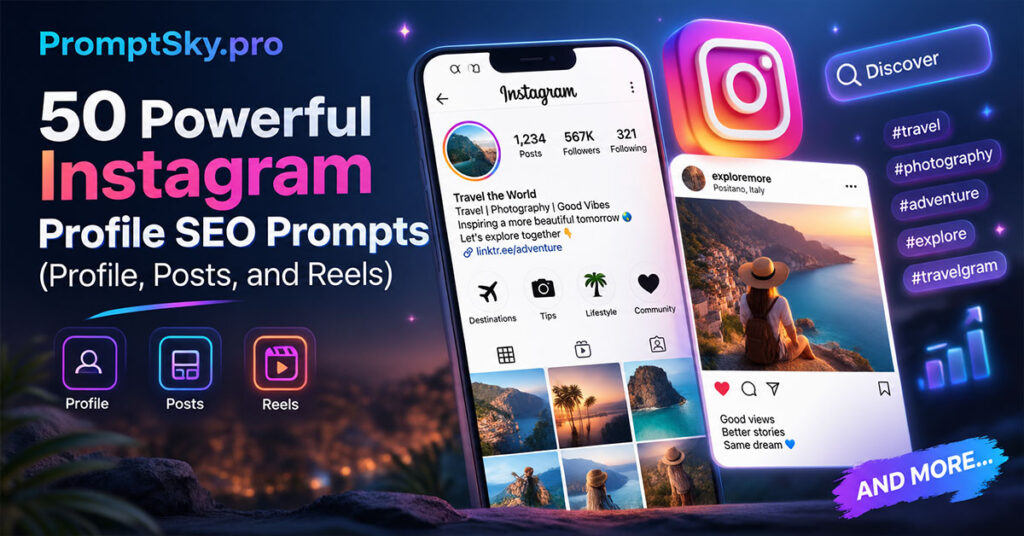
Instagram’s search algorithm has quietly become one of the most powerful discovery tools on the platform. Yet most creators spend their energy crafting the perfect caption or obsessing over posting times while ignoring how people actually find them through search. Optimizing for discoverability requires a different mindset—one that blends keyword strategy with the authentic voice your audience expects.
This guide gives you fifty focused prompts designed to sharpen every part of your Instagram presence. You’ll find tools for rewriting your bio for search clarity, crafting captions that rank without sounding robotic, and building Reels metadata that gets your videos in front of the right eyes. Each prompt works with conversational AI, letting you generate multiple optimized options in minutes while keeping your personality intact. The collection also includes variations for different niches, tone shifts to match your brand, and prompts that help you study what competitors are doing right.
To get started, pick your AI assistant and feed in details about your account, who you’re trying to reach, and what you want to achieve. The outputs give you solid starting points—refine them until they sound like you. This approach saves serious time if you’re handling several accounts or building a cohesive strategy for a business. Scroll down to browse the prompts organized by content type, or jump straight to the section that addresses your current needs.
1. Instagram Profile SEO Audit and Optimization
A diagnostic approach for evaluating every searchable element of an Instagram profile against current best practices. The intended result is a prioritized list of changes that improve discoverability through name, username, bio, category, and link fields.
Prompt:
Act as an Instagram profile SEO specialist. Review my profile and produce a detailed audit covering display name, @username, bio line, category tag, profile photo, highlights, and external link. For each element, state the current SEO function, identify weaknesses or missed keyword opportunities, and recommend a specific revised version. Conclude with a ranked action list of the highest-impact fixes I can implement in under 30 minutes.
2. Bio Keyword Strategy for Niche Visibility
A focused method for embedding searchable terms into the 150-character bio so the profile surfaces for the right audience queries. The goal is a bio that reads naturally while signaling topic authority to Instagram’s search system.
Prompt:
Design a bio keyword strategy for an Instagram profile targeting the niche I provide. Identify five primary keyword clusters a buyer or fan in this niche would actually search, map each cluster to a specific bio slot (name, first line, second line, call-to-action), and write three complete bio variants that integrate these keywords without sounding stuffed. Explain why each placement strengthens search relevance.
3. Post Caption SEO Framework for Reach
A repeatable caption structure designed to rank in Instagram keyword search and the Explore tab while still feeling human to readers. The intended result is a template that balances hooks, semantic keywords, and engagement prompts.
Prompt:
Create a post caption SEO framework I can reuse across my Instagram feed. Include guidance on the opening hook, primary keyword placement in the first 125 characters, supporting semantic terms, natural hashtag integration versus caption keywords, and a closing engagement prompt that supports algorithmic ranking. Provide one fully written example caption applying the framework to a topic I will supply.
4. Reels Script With Embedded Search Terms
A short-form video scripting format that weaves spoken keywords, on-screen text, and caption keywords together for stronger Reels SEO. The purpose is to help the Reel surface in both keyword search and suggested Reels for related topics.
Prompt:
Write a 15 to 45 second Reels script optimized for Instagram search. Include a suggested hook in the first two seconds, the primary keyword spoken aloud and shown as on-screen text, two supporting terms woven into the script naturally, a written caption that reinforces the same keywords, and a recommended audio or trending sound category that supports discovery. Specify the exact keyword placements for spoken, on-screen, and caption layers.
5. Hashtag and Keyword Layering System
A combined tagging approach that separates classic hashtags, SEO keywords in copy, and topical tags used in Reels for maximum discoverability. The goal is to stop treating hashtags as the only SEO lever and use a layered signal system.
Prompt:
Build a layered SEO tagging system for an Instagram account. Define how to choose one core keyword, three supporting long-tail keywords, one branded tag, and two community or niche tags. Show how to distribute these across the caption, the first comment, and the Reels topical tag field. Provide a worked example using the topic I provide, with rationale for each tag’s role.
6. Profile SEO Content Calendar
A 30-day planning system that aligns profile-level SEO signals with a steady cadence of keyword-optimized posts and Reels. The intended result is consistent discoverability gains rather than one-off viral attempts.
Prompt:
Generate a 30-day Instagram content calendar focused on profile and content SEO. For each week, define one profile-level focus area (such as updating highlights or refining the bio keyword cluster), then schedule four feed posts and two Reels that reinforce the same keywords. For each scheduled piece, include working title, target keyword, caption keyword placement, and a short note on how it strengthens overall profile search authority.
7. Instagram Profile SEO Audit Blueprint
A diagnostic prompt that walks through every discoverability lever on an Instagram profile. It surfaces concrete fixes for the username, name field, bio, highlights, and link so the account becomes easier to find through search and Explore.
Prompt:
Act as an Instagram SEO specialist auditing a creator or brand profile. Ask me for the current username, display name, bio, link in bio, highlight titles, and profile category. Then produce a structured audit that includes: (1) a score from 0 to 100 for overall profile findability, (2) a list of every field ranked by current SEO strength, (3) specific rewrite suggestions for the name field that weave in a primary keyword without looking spammy, (4) three bio variants under 150 characters each that balance keyword placement with personality, (5) highlight title recommendations that double as topical signal boosters, and (6) notes on whether the link-in-bio destination supports keyword consistency. Finish with a prioritized action list of the five highest-impact edits I can make this week.
8. Instagram Username and Handle Keyword Test
A practical research prompt that pressure-tests which version of a username or handle will rank better for a target search term. It compares variants for memorability, keyword placement, and conflict risk.
Prompt:
I run an Instagram account and want to choose the strongest possible handle for a target keyword. Give me the niche and the primary search term I want to rank for. Produce a comparison table of ten handle candidates that each embed the keyword differently: full match, partial match with prefix, partial match with suffix, abbreviation, and creative compound. For each candidate, evaluate character length, readability on mobile, whether the name field would need to repeat the keyword, and the likelihood that a casual viewer would remember it. Conclude with a single recommendation and explain why it beats the other nine.
9. Niche Bio Keyword Architecture
A planning prompt that designs a three-layer keyword system for the Instagram bio. It balances a primary niche term, a supporting descriptor, and a location or audience signal so the profile reads naturally while still being indexed.
Prompt:
Design a keyword architecture for my Instagram bio using a primary niche term, a secondary expertise term, and an audience or location signal. Ask me for my industry, target audience, and the city or region I serve. Then deliver: (1) the primary keyword I should anchor the name field on, (2) a secondary keyword cluster of five phrases I can rotate inside the bio without sounding repetitive, (3) a final 150-character bio that weaves in the primary term once, one secondary term, and one audience cue, and (4) a checklist of bio phrases I should avoid because Instagram has flagged them as spam patterns. Make sure the writing still sounds like a human wrote it, not a keyword list.
10. Post Caption SEO Brief Generator
A content prompt that produces a fully-formed caption brief optimized for Instagram search and Explore placement. It pairs the on-page keyword with hook structure, body copy, and a closing CTA.
Prompt:
Generate a complete Instagram post caption brief for a target keyword cluster. Ask me for the post topic, the primary keyword I want to rank for, two supporting long-tail phrases, and the action I want the reader to take. Deliver: (1) a hook line under 12 words that opens with the primary keyword or a strong variation, (2) a body of three to five short paragraphs that naturally repeats the primary phrase once and the long-tail phrases each once, (3) a closing line with a clear call to action, (4) an alt-text suggestion that includes the keyword in plain language, and (5) a notes section explaining how the caption supports the grid pillar the post belongs to. Keep the tone conversational and the total caption under 220 words.
11. Reels Script With Search-Optimized Hook
A scripting prompt that builds a 30 to 60 second Reels script engineered around spoken and on-screen search terms. It blends watch-time hooks with keyword placement so the Reel ranks in both Reels tab and search.
Prompt:
Write a Reels script for a target topic and primary keyword. Ask me for the topic, the primary keyword phrase, the audience takeaway, and whether the tone is educational, behind-the-scenes, or opinion-led. Deliver: (1) an on-screen text hook under 8 words that contains the primary keyword, (2) the spoken opening line that mirrors the on-screen hook in natural speech, (3) a beat-by-beat script between 30 and 60 seconds with timestamped cues, (4) a list of three captioned text overlays that repeat the primary or supporting keywords without overstuffing, (5) a caption under 150 words that restates the primary keyword in the first sentence, and (6) a suggested cover frame text that reinforces the search term. The final script should feel native to Reels, not like a search-engine page read aloud.
12. Monthly Instagram SEO Content Calendar
An editorial planning prompt that converts keyword research into a four-week posting rhythm across feed posts, Reels, carousels, and Stories. It assigns each content slot a keyword target so the profile compounds authority over time.
Prompt:
Build a one-month Instagram content calendar focused on SEO compounding. Ask me for my niche, three pillar topics, and the frequency I want to post on each format. Deliver a week-by-week table with one row per planned post or Reel. Each row must include the publish date, format, working title, primary keyword target, secondary keyword, the search intent it satisfies, and a one-line content angle. After the table, add a short summary that explains how the calendar rotates the pillar topics, how often the primary keywords appear across the month, and which week is built for a high-volume keyword push versus evergreen reinforcement.
13. Competitive SEO Gap Analysis for Instagram Positioning
Analyzes rival profiles to uncover untapped keyword opportunities and underserved search queries within your niche. This prompt helps you understand where competitors rank and where positioning gaps exist. The result is an actionable gap analysis you can use to differentiate your profile’s SEO strategy.
Prompt:
Conduct a comprehensive competitive SEO gap analysis for Instagram profiles in the [YOUR INDUSTRY/NICHE] niche. Identify the top 5 competitor profiles by follower count and engagement, then analyze their bio keywords, username keywords, post caption keyword patterns, hashtag strategies, and Reels title/tag optimizations. Create a detailed gap analysis matrix showing which high-value keywords and search queries competitors are targeting, which they have missed, and how their audience searches for content in your space. For each gap identified, provide a specific recommendation for how you can capture that keyword territory. Include estimated search volume indicators based on Instagram’s internal search behavior patterns. Format the output as a competitive positioning map with priority rankings for each keyword opportunity.
14. Accessible Alt Text Templates for SEO and Reach
Generates optimized alt text descriptions that serve both accessibility compliance and search discovery goals for Instagram images. This prompt bridges the gap between visually impaired user experience and algorithmic keyword indexing. The output creates reusable templates aligned with your brand voice and content themes.
Prompt:
Develop a library of 15 alt text templates specifically designed for Instagram posts and carousel images that balance accessibility compliance with SEO keyword integration. For each template, include the structural pattern, placeholder slots for key information, recommended keyword density approach, and example alt text demonstrating the format in action. Templates should cover: product showcase posts, behind-the-scenes content, text-based quote graphics, before/after comparisons, user-generated content reposts, and educational infographics. Each template must include 2-3 natural language keyword variations that can be swapped based on campaign goals. Ensure all templates pass accessibility readability standards while strategically incorporating secondary keywords Instagram’s algorithm indexes.
15. Highlight Reel SEO Strategy for Long-Tail Keywords
Transforms Instagram Story Highlights into an underutilized SEO asset by optimizing cover images, titles, and descriptions for long-tail search queries. This approach captures discovery traffic from users browsing profile sections. The output provides a systematic method to retrofit existing highlights and plan new ones.
Prompt:
Create a strategic framework for optimizing Instagram Story Highlights to capture long-tail keyword search traffic that bypasses the main feed algorithm. Develop a step-by-step process for: selecting high-value long-tail keywords that don’t fit naturally into bio or captions, designing highlight cover images that incorporate visual keyword cues within platform guidelines, writing highlight titles that mirror actual search queries your target audience uses, and adding keyword-rich descriptions to the highlight cover that remain visible to profile visitors. Provide specific before-and-after examples showing how a typical highlight can be reoptimized. Include a priority scoring system to determine which existing highlights to retrofit first based on current traffic potential and keyword opportunity.
16. Geolocation Targeting Matrix for Local Search Visibility
Builds a location-based SEO strategy that captures discovery traffic from users searching for content within specific geographic areas. This prompt addresses the intersection of local search behavior and Instagram’s location indexing system. The deliverable creates a systematic approach to location keyword integration.
Prompt:
Design a geolocation targeting matrix for Instagram that maximizes visibility in local and regional search results without sacrificing niche authority. Develop a systematic approach to: identifying high-value location keywords relevant to your business (cities, neighborhoods, regions, landmarks), integrating location keywords naturally into bio, captions, Reels scripts, and Stories without appearing spammy, creating location-specific content strategies that target distinct geographic search intents, leveraging Instagram’s check-in and location tagging features for algorithm indexing, and building a location keyword rotation schedule for profiles serving multiple geographic markets. Provide specific integration examples for each content type showing before/after optimization. Include a mapping guide showing how different location keyword combinations can serve different audience segments simultaneously.
17. Discovery Keyword Mining Framework from Audience Language
Reverse-engineers the actual search language your target audience uses by analyzing engagement patterns, DMs, comments, and saved post queries. This prompt shifts SEO strategy from assumption-based to evidence-based keyword selection. The output creates a sustainable process for continuously discovering organic search terms.
Prompt:
Build a discovery keyword mining framework that extracts organic search language directly from your existing audience’s behavior and communications. Develop a systematic methodology for: analyzing saved post descriptions to identify what language users employ when bookmarking content, reviewing DM conversations and comment patterns for recurring questions phrased in search-query format, monitoring which posts generate the most profile visits to understand what drives click-through from search results, tracking saved collections and followed hashtags to map audience-curated keyword territories, and creating a keyword validation loop that confirms discovered terms through engagement correlation. Provide a 30-day audit calendar showing how to systematically mine keywords from each data source, plus a tracking spreadsheet structure for organizing discoveries by search volume proxy (engagement correlation), competition level, and content fit.
18. Search-to-Follower Conversion Copywriting Framework
Bridges the gap between SEO-driven discovery and actual follower acquisition by crafting bio and caption copy that converts search traffic into committed followers. This prompt addresses the conversion challenge after users find your profile through keywords. The output provides actionable copywriting templates tied to different search intents.
Prompt:
Develop a conversion copywriting framework specifically designed to transform Instagram users who discover your profile through search into loyal followers. Create a matrix of bio and caption templates optimized for different search intent categories: informational searchers seeking answers, commercial investigation users comparing options, and niche enthusiasts seeking community. For each intent category, provide: headline structures that validate the searcher’s query immediately upon profile arrival, credibility signals that establish authority without keyword stuffing, value proposition formulations that create follower motivation specifically for search-referred visitors, and CTA patterns optimized for conversion from cold search traffic. Include 5 complete bio examples demonstrating the framework in action across different industries, with annotations explaining why each copy element drives follower conversion from search discovery.
19. Profile Name Field Search Algorithm Optimization
The profile display name carries significant SEO weight in Instagram’s internal search ranking. This prompt focuses on strategically positioning primary and secondary keywords within the name field itself, separate from the username. The result is a fully optimized display name that improves discoverability without sacrificing brand identity.
Prompt:
Create an Instagram profile name optimization strategy for a [business type/niche] account called [account name]. Research Instagram’s search algorithm behavior for the display name field versus username, then provide three distinct options for structuring the display name to include high-volume search keywords while maintaining brand recognition. For each option, explain how the keyword placement impacts search ranking, recommend whether to include symbols or numbers, and suggest A/B testing approaches to measure visibility improvements. Include specific examples of before and after display names tailored to the [target audience] demographic.
20. Highlight Reel Covers SEO-Named Categorization System
Story highlights offer an often-overlooked SEO opportunity through their cover names and descriptions. This prompt addresses how to strategically name, organize, and describe highlight categories to capture keyword-based discovery traffic. The approach treats highlight organization as a mini-site-map with search intent alignment.
Prompt:
Design a complete highlight reel organization system optimized for Instagram search for a [niche/account type] profile with approximately [number] existing highlights. Map out a naming convention that incorporates search-relevant keywords into cover titles without violating Instagram’s character limits. Create a categorization framework that groups highlights by both audience journey stage and search intent type (informational, transactional, navigational). Include recommended descriptions for each highlight category that naturally integrate secondary keywords. Provide a suggested reordering priority based on which categories should appear first for maximum SEO impact.
21. Bio Link Landing Page SEO Integration Strategy
The single website link in an Instagram bio represents a critical SEO bridge between the platform and external content. This prompt explores how to create a bio link experience that reinforces keyword relevance and extends discoverability beyond Instagram’s walls. The focus is on technical SEO elements that support the overall profile optimization strategy.
Prompt:
Develop an SEO-integrated strategy for the Instagram bio link destination for a [business type/niche] account. The strategy should include recommendations for a dedicated landing page versus a link-in-bio tool, with specific technical requirements for each option. Detail the on-page SEO elements that should be present (title tags, meta descriptions, header structure, schema markup) to reinforce the Instagram-based keyword strategy. Provide a content outline for the landing page that maintains topical authority and keyword consistency with the profile’s SEO targets. Include recommendations for internal linking between the bio destination and Instagram content themes.
22. Keyword-to-Profile-Section Mapping Framework
Effective Instagram SEO requires distributing keywords strategically across multiple profile components rather than concentrating them in one area. This prompt creates a systematic mapping approach that ensures comprehensive coverage while maintaining authentic, non-spammy presentation. The result is a balanced optimization architecture.
Prompt:
Create a comprehensive keyword mapping framework that assigns specific search terms to each Instagram profile element for a [niche/topic] account targeting [primary keywords]. Break down the mapping across: display name, username, bio text, highlight categories, CTA button labels, and existing posts. For each element, specify which keyword type to use (head term, long-tail, LSI, or question-based) and why that placement maximizes algorithmic benefit. Include a prioritization matrix showing which elements carry the most SEO weight and how to handle conflicts when multiple keywords compete for limited space. Add guidance on maintaining keyword variation to avoid appearing manipulative while still capturing search visibility.
23. Content Pillar Search Demand Alignment Audit
Connecting content pillars to actual search demand data ensures that profile optimization efforts align with what users are actively seeking. This prompt addresses the strategic layer of SEO planning: ensuring that the content being optimized actually serves discoverable topics rather than assumed interests.
Prompt:
Conduct a search demand alignment audit for an Instagram profile in the [industry/niche] space. Start by identifying the account’s existing content pillars or topic categories. Then analyze real search behavior data to determine which pillar topics have measurable Instagram search volume versus those that rely purely on follower engagement. Provide a gap analysis showing which content pillars are underserving high-demand search queries and which are optimized for terms users aren’t actively searching for. Recommend a rebalanced content pillar strategy that aligns high-search-volume topics with the account’s authentic expertise areas, including specific content format recommendations (static posts, carousels, or reels) for each priority pillar.
24. Instagram SEO Performance Tracking Dashboard Specification
Measuring Instagram SEO success requires tracking metrics beyond standard engagement analytics. This prompt focuses on creating a measurement framework that captures keyword-specific performance indicators, enabling data-driven optimization decisions over time. The output serves as a specification document for building or configuring tracking systems.
Prompt:
Design an Instagram SEO performance tracking dashboard specification for a [business type/marketer level] account managing [number] optimized profiles. Define the specific metrics that indicate SEO success on Instagram, including: keyword-specific profile discovery rates, search result ranking positions for target terms, search-to-profile visits ratio, and branded versus non-branded search traffic patterns. For each metric, specify the data source (Instagram Insights, third-party tools, or manual tracking), measurement frequency, and benchmark values to target. Include a section on tracking the SEO performance of individual high-value posts that serve as keyword-optimized entry points. Provide recommendations for visualization layouts that make keyword performance trends actionable for ongoing optimization decisions.
25. Instagram Profile Search Snippet Builder
Crafts a high-impact, keyword-rich Instagram profile summary that mirrors how the Instagram search algorithm ranks handle, name, and bio fields. The goal is a discoverable snapshot that converts profile visitors into followers.
Prompt:
Act as an Instagram SEO strategist who specializes in profile-level search ranking. I will paste my current Instagram bio, display name, and handle. Rewrite each field so that: (1) the handle contains my single highest-value niche keyword if available, (2) the display name pairs my primary keyword with a recognizable brand phrase, and (3) the 150-character bio front-loads one primary keyword, one secondary keyword, and one audience qualifier in a natural reading order. Include a short rationale after each rewrite explaining how each field contributes to Instagram search visibility for the target niche.
26. Reels Caption SEO Layering Brief
Builds a structured caption brief for Instagram Reels that balances algorithmic keyword signals with on-screen retention language. The output keeps spoken hooks, on-screen text, and caption keywords aligned to one search query.
Prompt:
Create a Reels caption brief for one Instagram Reel I want to publish. Ask me for the topic, target audience, and one main search phrase I want to rank for. Then produce: a 1-line spoken hook optimized for the first 3 seconds, a 2-line on-screen text overlay suggestion, a 220-character caption that opens with the main search phrase, a 3-line keyword-rich description below the fold, and a recommended set of 8-10 hashtags grouped as 3 large, 4 medium, and 2 niche. Conclude with a checklist confirming the main keyword appears in hook, caption opening, and at least one on-screen text line.
27. Carousel Post Caption SEO Outline Generator
Generates a slide-by-slide caption and alt text plan for Instagram carousels that targets one primary keyword cluster and several supporting terms. The intended result is a multi-page post that holds attention while signaling topical depth to search systems.
Prompt:
I will give you a carousel topic and a primary keyword. Produce a numbered outline covering slides 1 through 10 with these elements for each slide: suggested on-slide headline, a one-sentence caption fragment that flows into the full caption, and a unique alt text line of 100-125 characters that weaves in a supporting keyword variation. End the outline with a master caption that opens with the primary keyword, includes a soft call-to-action, and lists the chosen hashtags. Ensure every slide contributes one distinct supporting term so the carousel collectively signals broad topical coverage.
28. Instagram Hashtag Tiering and Replacement Map
Designs a tiered hashtag architecture that maps large, medium, and niche tags to specific Instagram posts and Reels. It is meant to prevent hashtag cannibalization and maintain consistent search visibility across a niche.
Prompt:
Design a hashtag tiering and replacement system for an Instagram account in one specific niche. Build three tiers: 10 large hashtags (broad industry terms), 15 medium hashtags (sub-niche phrases), and 20 niche hashtags (long-tail or community tags). For each tier, provide a short note on when to rotate a tag out and what metric signals replacement. Then list a 7-day posting schedule showing which tier combinations pair with feed posts versus Reels. Finish with a rule for how many tags from each tier should appear per post and how to avoid repeating the exact same set across consecutive publishes.
29. Instagram Highlight Reel SEO Naming Plan
Creates a naming and ordering plan for Instagram Story Highlights that aligns with high-intent search phrases related to the account’s niche. The objective is to turn saved Stories into a permanent, browsable SEO asset on the profile.
Prompt:
Build an Instagram Highlight Reel naming plan for my profile. Ask me for my niche, top three content themes, and the audience questions I most want to surface in search. Produce: a recommended number of Highlights, a prioritized naming list that places a primary keyword at the start of each Highlight title, a short 1-line description for the cover image concept, and an ordering order that puts the highest-search-volume Highlight first. Include guidance on which older Stories to archive inside each Highlight so the saved content reinforces the chosen keyword cluster.
30. Monthly Instagram SEO Performance Review
Sets up a repeatable monthly review of Instagram profile SEO health, covering bio keyword performance, top-ranking posts, and underused search terms. The goal is a single-page report that informs the next month’s content and optimization decisions.
Prompt:
Create a one-page Instagram SEO monthly review template I can fill in each month. Include sections for: profile-level signals (handle, name, bio keyword usage), top 5 posts ranked by saves and shares, top 5 Reels ranked by reach and average watch time, hashtag tier performance across the month, and a search insights log where I note which suggested search terms appeared in my impressions. Add a short reflection block at the end with prompts that ask what to test, what to drop, and what to double down on next month to strengthen profile-level search visibility.
31. Collaborative Content SEO Amplification Strategy
This prompt addresses how co-created or shoutout content can be optimized for search across multiple profiles simultaneously. It covers tagging sequences, shared keyword insertion, and cross-profile search authority building. The result is a systematic approach to leveraging collaborations as SEO multipliers rather than missed optimization opportunities.
Prompt:
Create a comprehensive SEO amplification strategy for collaborative Instagram content that maximizes search visibility across all participating profiles. Include a tagging sequence framework that ensures search crawlers can associate keywords with multiple accounts. Detail how shared captions should distribute primary and secondary keywords so both profiles benefit in search results. Provide a checklist for when the collaborator should use their branded hashtags versus a unified campaign hashtag for maximum indexation. Explain how cross-profile mentions in comments should be strategically timed to reinforce shared keyword associations. Add a template for documenting which keywords each profile owns in the collaboration to prevent cannibalization. Specify how carousel collaborations should structure keyword placement in slide headers versus body text for dual-profile indexing. The final deliverable should be an actionable playbook that transforms one piece of content into shared search authority.
32. Bio URL Conversion Funnel SEO Architecture
This prompt explores how the profile link territory—bio URL, link-in-bio tools, and landing pages—can function as an SEO ecosystem rather than isolated elements. It bridges external domain authority with Instagram profile search signals. The result creates a complete conversion architecture where every click builds cumulative search relevance.
Prompt:
Design a complete SEO architecture for the Instagram profile link ecosystem that builds cumulative search authority from external touchpoints back to the profile. Map out a strategy for using a short branded link domain in the bio URL that redirects through a link-in-bio aggregator. Detail how each destination page should incorporate the same primary keywords found in the Instagram bio to create topical consistency signals. Provide guidance on whether link-in-bio tool subdomains contribute to search indexing and how to optimize for that possibility. Include a framework for what percentage of external landing page keywords should match Instagram bio keywords versus complement them. Explain how UTM parameters can be structured to demonstrate which content formats drive the most qualified profile visits. Add instructions for how link-in-bio tool profiles themselves should be optimized for search. The deliverable should be a technical blueprint showing how every link click reinforces the same search narrative.
33. Seasonal Trend SEO Content Alignment Matrix
This prompt focuses on aligning Instagram content strategy with predictable seasonal search behavior patterns to capture recurring demand spikes. It connects platform content calendars with keyword trend data to create proactive SEO timing. The result is a strategic framework for publishing that anticipates search volume fluctuations rather than reacting to them.
Prompt:
Build a seasonal trend SEO alignment matrix that coordinates Instagram content timing with predictable search demand cycles for your niche. Include a methodology for identifying which keywords in your niche have recurring seasonal spikes and at what lead time you need to publish content to index before peak demand. Provide a publishing timeline template that front-loads evergreen SEO content before seasonal content windows open. Detail how highlight reel titles and post captions should incorporate both evergreen keywords and seasonal modifiers as compound search terms. Explain how to audit existing high-performing posts to add seasonal keyword updates without disrupting already-indexed content. Include guidance on when seasonal hashtag combinations should replace standard hashtag stacks. Add a monitoring checklist for detecting unexpected trend acceleration that requires pivoting planned content. The final deliverable should be a rolling 12-month calendar framework with SEO timing rationale for each content push.
34. Instagram Search Algorithm Behavior Pattern Analysis
This prompt addresses the behavioral patterns of Instagram’s search algorithm and how different content types receive differential indexing treatment. It moves beyond keyword tactics to strategic content format selection based on search visibility patterns. The result is an informed content strategy that allocates effort toward formats with highest search return.
Prompt:
Conduct a behavioral pattern analysis of how Instagram’s search algorithm differentially indexes and ranks content across profile sections, posts, and Reels. Create a comparative framework for understanding how long it takes new posts versus new Reels to appear in search results after posting. Detail the observable differences in search snippet length and keyword density between top-ranking posts and Reels in your niche. Provide a methodology for A/B testing whether Reels or static posts rank higher for specific keyword clusters in your category. Include guidance on how cross-format keyword repetition affects overall profile authority for search terms. Explain what percentage of your search-related content should be allocated to each format based on current indexing patterns. Add specific signals that indicate the algorithm is actively indexing new content versus relying on existing indexed material. The deliverable should be a strategic allocation guide backed by observable pattern evidence.
35. Comment Section Keyword Authority Reinforcement
This prompt explores how to strategically use the comment section to reinforce search indexing for specific keywords without appearing manipulative. It recognizes that engagement signals and keyword context in comments contribute to overall post relevance signals. The result is a natural-seeming strategy that builds keyword authority through genuine-seeming community interaction.
Prompt:
Develop a strategic approach to using the comment section as a keyword authority reinforcement layer for Instagram posts and Reels. Create guidelines for when a first-comment keyword placement improves search indexing versus when it triggers perceived spam behavior. Detail a framework for crafting question-based comments that naturally incorporate secondary keywords in ways that invite further engagement. Provide a pacing strategy for how many keyword-relevant comments you should add to a post in the first hour versus the first 24 hours to maximize indexing window without manipulation flags. Include a list of comment structures that reinforce topic relevance without feeling forced, such as industry statistics, related use cases, or tool mentions. Explain how responding to comments with keyword-expanded language can strengthen the conversation’s search relevance. Add guidance on when to pin comments that contain important keyword terms. The deliverable should be an engagement timing and content template that treats comments as search infrastructure.
36. Emoji and Symbol SEO Integration Framework
This prompt addresses how emoji usage in captions, bios, and highlight names affects search indexing and discoverability in Instagram’s algorithm. It provides guidance on selecting emojis that serve as visual keywords without sacrificing readability or brand tone. The result is a systematic approach to visual vocabulary that contributes to search positioning while maintaining aesthetic standards.
Prompt:
Build an emoji and symbol integration framework that strategically uses visual elements to enhance Instagram search discoverability across profile sections. Create a decision matrix for when emoji placement in captions reinforces keyword meaning versus when it disrupts keyword readability for indexing purposes. Provide a curated list of industry-relevant emojis that function as category signals in your niche without appearing spammy. Detail how highlight reel cover names should combine text keywords with complementary emoji that the search algorithm can associate with topic relevance. Include guidance on whether emoji in Instagram bio fields contribute to search indexing and how they should be sequenced with text keywords. Explain how Reels captions should handle emoji to maintain both search visibility and mobile-first display quality. Add testing instructions for tracking whether emoji-inclusive captions outperform plain-text alternatives for specific keyword clusters. The final deliverable should be an integration guide that treats emoji as searchable vocabulary rather than decoration.
37. Instagram Profile Name Field Discoverability Stress Test
A diagnostic prompt built around how the Name field is parsed by Instagram search. It helps creators test which keyword-loaded formats actually surface the profile in search. The intended result is a defensible profile name recommendation backed by simulated discovery scenarios.
Prompt:
Act as an Instagram search behavior analyst. Review my current Instagram profile name field, my niche, and the three primary search terms my target audience types into Instagram search. Simulate how the platform’s Name field (distinct from the @username) is indexed and ranked, then propose three rewrite options that maximize discoverability without sacrificing brand clarity. For each option, explain the exact keyword placement logic, estimate relative search-surface exposure for the provided terms, and flag any risk of being read as spam. Deliver a final recommendation, the rationale behind it, and a one-sentence Name field the creator can paste into the profile immediately.
38. Reels Audio Keyword Alignment Brief for Topic Authority
A focused brief generator for selecting trending audio that reinforces on-topic search terms. It bridges the gap between viral sound selection and niche authority signaling. The output is a shortlist of audio choices with explicit keyword reinforcement notes for each.
Prompt:
You are a short-form video SEO strategist. Given my niche, three primary Instagram search terms I want to own, and a current trending Reels audio pool, produce a brief that pairs each trending audio with the search term it best reinforces. For every audio option, note the on-screen text, spoken hook, and caption direction needed so the audio’s mood and the keyword’s intent reinforce each other rather than conflict. Flag any audio where the trend context would dilute topic authority and suggest a replacement. Finish with a ranked shortlist and a one-line directive for which audio to use in the next three Reels.
39. Profile-Level Search Intent Coverage Map
A planning tool that maps each profile section (Name, Username, Bio, Highlights, Link) against the search intents a target audience brings to Instagram. It reveals gaps where intent is unaddressed. The intended result is a one-page coverage map with priority fixes.
Prompt:
Act as an Instagram SEO planner. Take my niche, my target audience’s top ten probable search intents on Instagram, and my current profile sections (Name, @username, Bio, Highlight titles, Link page). Build a coverage map in table form with columns for search intent, the profile section that currently addresses it, the strength of the match (strong, partial, missing), and the smallest possible fix. Then list the three highest-impact gaps and a single sentence describing how each gap should be closed. End with a confirmation sentence stating the profile is now positioned to capture the listed intents.
40. Reels On-Screen Text SEO Micro-Audit Checklist
A pre-publish checklist focused on the on-screen text layers of a Reel. It ensures every visible text element is doing search-reinforcement work rather than just visual decoration. The deliverable is a tickable audit creators can run in under two minutes per Reel.
Prompt:
You are a Reels SEO reviewer. Given the script, hook line, and planned on-screen text for a single Reel in my niche, audit the text elements that appear on screen: opening frame text, lower-thirds, captioned spoken words, end-card text, and any text overlay on B-roll. For each element, judge whether it reinforces, neutralizes, or conflicts with the target search term. Mark every element as Keep, Tighten, or Replace and provide the exact replacement string when applicable. Deliver the audit as a checklist with checkboxes, then conclude with a one-sentence verdict on whether the Reel should publish as-is or after one revision pass.
41. Bio Search Query Conversion Hierarchy
A writing framework that orders bio lines so the most searchable phrase sits in the highest-weight position. It treats the 150-character bio as a ranking surface, not a tagline. The result is a ranked bio draft with reasoning for each line’s placement.
Prompt:
Act as an Instagram profile copywriter specializing in search-optimized bios. Given my niche, three target search terms ranked by monthly intent, and my one differentiating offer, draft a 150-character bio where each line is placed according to how Instagram weights characters from left to right and top to bottom. For every line, cite the search term it serves and explain why that position earns more visibility than a later slot. Provide two full bio variants ordered by different strategic priorities (authority-first versus offer-first), then state which variant a new account in this niche should ship first.
42. Highlight Title Search-Intent Naming Sprint
A naming exercise that rewrites Highlight titles as search-aligned labels rather than vague categories. It turns a navigational feature into an indexed keyword surface. The output is a complete Highlight naming plan with rationale per title.
Prompt:
You are an Instagram profile SEO specialist focused on Highlight reels. Given my niche, the six to eight topics I want to be found for in Instagram search, and my current Highlight titles, rewrite each title so it functions as a search-aligned label rather than a generic category word like Tips or About. For every rewrite, name the search intent it captures, compare it against the original title’s likely discoverability, and confirm the title still reads naturally to a first-time profile visitor. Deliver the full naming plan as a before-and-after list, then end with a single sentence confirming the Highlight stack now supports the chosen search intents from the profile’s entry point.
43. Search-Intent Bio Rewrite for Profile Visibility
Designed for profile-level discoverability, this prompt rewrites the Instagram bio to align with how people search for the niche. It blends primary keywords, supporting terms, and a conversion line, so the profile reads naturally and ranks for intent-led queries.
Prompt:
Act as an Instagram SEO copywriter focused on profile-level search visibility. Using my niche, target audience, and one main keyword, rewrite my Instagram bio (150-character limit) so that it (1) leads with the primary search term my audience types into Instagram search, (2) supports it with two complementary intent phrases, (3) ends with a clear action line that converts profile visitors into followers or link clicks. Deliver three bio variants, each with a different angle: authority, outcome, and community. For each variant, label the primary keyword, the secondary intent phrase, and the action line, and explain in one sentence why the keyword order matches how users search. Do not use generic motivational filler. Stay within the Instagram bio character limit for every variant.
44. Reels Hook-to-Close Search Optimization Script
Focused on Reels discoverability, this prompt engineers a short-form script that front-loads spoken search phrases, reinforces them on-screen, and closes with a caption that reinforces topical authority. It treats the Reel as a three-layer SEO asset: audio, visuals, and caption.
Prompt:
Create a 25 to 40 second Instagram Reels script optimized for Instagram search. Given my topic, niche, and one target search phrase, produce a script in three labeled sections: (1) a spoken hook in the first 3 seconds that contains the target phrase naturally, (2) a body of 4 to 6 spoken beats that repeat the phrase or close variants at least twice more, and (3) a closing line that restates the topic using a related long-tail phrase. Then write the on-screen text overlays for each beat, making sure the target phrase appears as text in the first 3 seconds. Finally, write a caption of up to 150 words that repeats the target phrase once in the first line, adds two supporting search phrases, and ends with one question prompt. Format the deliverable as a single table with columns for Beat, Spoken Line, On-Screen Text, and SEO Purpose.
45. Profile-Wide Keyword Field Mapping Blueprint
This prompt audits every editable Instagram field as a search surface, including name, username, bio, category, and highlights. It assigns a keyword role to each field and flags conflicts, so the whole profile reinforces one coherent search identity.
Prompt:
Map every keyword-bearing field on my Instagram profile to a specific search role. Given my niche, primary keyword, and audience, produce a field-by-field blueprint with these rows: Field (Name, Username, Bio, Category, Pronouns, Highlights, Profile Photo Alt Context), Current Content, Recommended Keyword-Rich Replacement, Search Role, and Conflict Notes. Rules: the Name field should hold the highest-intent keyword, the Username should reinforce it without spammy repetition, the Bio should cover three intent clusters, the Category should match the niche exactly, and Highlight titles should each target a distinct long-tail phrase. Flag any field where keyword repetition may look unnatural or trigger spam signals. Conclude with a one-paragraph summary explaining how the combined fields support topical authority across Instagram search.
46. 30-Day Profile SEO Refresh Sprint Plan
Built for creators who want a structured rollout, this prompt turns profile SEO work into a 30-day sprint with weekly checkpoints. It sequences bio updates, highlight naming, post and Reels keyword passes, and review moments so changes build on each other rather than compete.
Prompt:
Design a 30-day Instagram Profile SEO refresh sprint for a single account in my niche. Break the sprint into four weekly blocks with daily actions: Week 1 Profile Field Audit and Bio Reset, Week 2 Highlight Naming and Category Alignment, Week 3 Post Caption and Reels Caption Keyword Pass, Week 4 Reels Hook and Audio Search Alignment. For each day, list the deliverable, the search benefit, and the estimated time required. Include a Friday Review checkpoint in each week with three diagnostic questions to confirm the previous block improved profile-level search signals. End the sprint with a Week 4 wrap-up that compares starting state to ending state across five metrics: name-field clarity, bio intent coverage, highlight topical breadth, post caption search density, and Reels spoken search density.
47. Competitor Search Footprint Comparison Report
This prompt produces a side-by-side competitive view of how rival Instagram profiles appear in search. It isolates the keyword signals each competitor uses across name, bio, highlights, and captions, and surfaces the gaps my profile can fill to outrank them for shared queries.
Prompt:
Act as an Instagram search analyst. Given my niche, primary keyword, and three named competitor profiles, produce a competitive search footprint report. For each competitor, extract and label: (1) the keyword used in their Name field, (2) the top three intent phrases in their Bio, (3) the long-tail phrases used in their Highlight titles, (4) the recurring search phrases in their last 10 post captions, and (5) the spoken hook patterns in their top 3 Reels by views. Then build a comparison table showing which search phrases all four profiles compete for, which appear on only one or two, and which appear on none. Conclude with a prioritized Gap List of five search phrases I should target first, ranked by likely ranking difficulty and audience intent match.
48. Search Query to Follower Conversion Diagnostic
A diagnostic prompt that traces how a profile visitor arrives via search and decides whether to follow. It links specific bio lines, highlight names, and pinned posts to the search queries that bring people in, so I know which on-profile elements are doing the conversion work.
Prompt:
Diagnose the search-to-follower conversion path on my Instagram profile. Given my niche, primary search keyword, and current bio plus pinned post list, build a flow that maps (1) the top five search queries a new visitor is likely typing, (2) which on-profile element first answers that query, (3) what the visitor reads or watches next, and (4) the moment that prompts a follow action. Present the result as a five-row table with columns for Likely Query, First Match Element, Secondary Reinforcement, Drop-Off Risk, and Follow Trigger. Then write three specific edits, one per row where drop-off risk is highest, that tie the search phrase directly to a follow-worthy promise in the bio, a highlight title, or a pinned post caption. End with a short paragraph explaining how each edit tightens the path from search impression to committed follower.
49. Spoken Reel Audio SEO Transcript Scripting Engine
Focuses on optimizing the spoken audio content in Reels to leverage Instagram’s automatic speech-to-text indexing algorithms. Helps creators naturally embed high-intent search terms directly into their video voiceovers and dialogue. Delivers a production script complete with keyword placement callouts and pacing guides.
Prompt:
Act as an expert Instagram SEO strategist specializing in video audio indexing and speech recognition algorithms. Develop a spoken voiceover script for a 30-to-60-second Reel designed to rank for specific search queries on Instagram.
First, prompt me to provide:
1. Target Niche or Topic
2. Primary Target Search Keyword
3. 3-4 Secondary Long-Tail Keywords
4. Core Message or Actionable TipOnce I provide this information, create a detailed production script that fulfills the following requirements:
– Script Structure: Break down the script line-by-line with timestamps (e.g., 0:00-0:03, 0:03-0:10).
– Audio Keyword Placement: Integrate the primary search keyword clearly within the first 3 seconds of spoken audio, and distribute secondary keywords naturally across the mid-roll and concluding call-to-action.
– On-Screen Text Alignment: Provide exact matching on-screen text overlays for key phrases to reinforce algorithm detection and reader accessibility.
– Caption Integration Brief: Write a concise 2-sentence caption optimized for Instagram search that complements the spoken script without verbatim duplication.Ensure all audio dialogue flows naturally without sounding forced or keyword-stuffed. End your output with clear instructions on how to pronounce key terms clearly for speech recognition accuracy.
50. Visual Entity and Image Alt Text Search Optimization Protocol
Establishes a systematic workflow for writing descriptive, keyword-rich image alt text that appeals to Instagram’s visual recognition search engine. Guides users in mapping visual subjects, background context, and niche industry terminology into accessible captions and backend alt descriptions. Generates ready-to-use alt text formulas for single-image and carousel posts.
Prompt:
Act as an Instagram SEO specialist and accessibility consultant. Develop a comprehensive Image Alt Text and Visual Entity Mapping Protocol for a single-image or multi-slide carousel post to maximize discoverability in Instagram Search.
To begin, request the following details from me:
1. Niche or Industry
2. Primary Target Search Term
3. Description of the Image or Carousel Content (visual elements, text on screen, props, background)
4. Target Audience Intent (Inspirational, Educational, Product Purchase)Upon receiving my input, generate a structured optimization output featuring:
– Visual Entity Checklist: List key visual elements that Instagram’s computer vision algorithm will scan and categorize.
– Single-Image Alt Text (under 125 words): Write a highly descriptive, accessible alt text that naturally incorporates the primary search term and contextual entities.
– Carousel Alt Text Breakdown (up to 5 slides): Write sequential alt text descriptions for each slide, maintaining topical consistency and search relevance across the sequence.
– Caption Semantic Layering: Provide a short paragraph explaining how to align the post caption’s opening sentence with the image alt text for maximum algorithmic synergy.Format the final response cleanly with distinct headers for easy copying and implementation.