AI prompts to improve LinkedIn profile can help you rewrite your headline, About section, work experience, skills, keywords, and personal branding strategy with greater clarity and precision. These 30 prompts are designed for job seekers, professionals, freelancers, executives, students, and anyone looking to build a stronger LinkedIn presence.
Each prompt targets a specific LinkedIn goal, from improving recruiter visibility and optimizing keywords to changing careers, attracting clients, building a personal brand, and creating a more credible professional profile. You can use them individually or combine several prompts for a complete LinkedIn profile makeover.
If you need a specific LinkedIn prompt for your career, industry, or professional goal, leave your request in the comments and tell us what kind of prompt you want next.
You can also explore 20 AI Prompts to Improve Your Resume and Get More Interviews for optimizing your resume alongside your LinkedIn profile. For more ready-to-use ideas, browse the Complete AI Prompts Collection.
1. Complete LinkedIn Profile Optimization
A comprehensive prompt for improving the overall quality, positioning, consistency, and professional presentation of a LinkedIn profile.
Prompt:
Act as a senior LinkedIn profile strategist, personal branding consultant, and professional career writer. Review the LinkedIn profile information I provide and create a comprehensive optimization plan that makes the profile more credible, searchable, professional, and compelling to recruiters, hiring managers, potential clients, and relevant industry professionals.
Analyze every major profile section separately, including the headline, About section, current position, previous experience, skills, featured section, education, certifications, accomplishments, career positioning, profile keywords, and overall personal brand consistency.
Identify weak, vague, repetitive, generic, or overly corporate wording. Replace it with specific language that communicates expertise, professional value, measurable outcomes, areas of specialization, and career direction.
Do not invent employers, job responsibilities, achievements, certifications, metrics, technologies, clients, awards, or qualifications. If important information is missing, mark it clearly as [ADD INFORMATION] rather than guessing.
Optimize the profile for both human readers and LinkedIn search. Naturally incorporate relevant industry terminology and role-specific keywords without keyword stuffing.
Provide:
- A revised headline.
- A rewritten About section.
- Improved descriptions for each experience entry.
- Recommended skills.
- Recommended profile keywords.
- Suggestions for the Featured section.
- Missing information I should add.
- Specific weaknesses that should be fixed.
- A final profile positioning statement.
Keep the writing professional, confident, specific, and human. Avoid clichés such as “passionate professional,” “results-driven individual,” and “hardworking team player” unless they are supported by concrete evidence.
Here is my LinkedIn profile information:
[PASTE PROFILE INFORMATION HERE]
2. LinkedIn Headline for Recruiters
Designed to create a stronger headline that immediately communicates role, specialization, value, and relevant keywords.
Prompt:
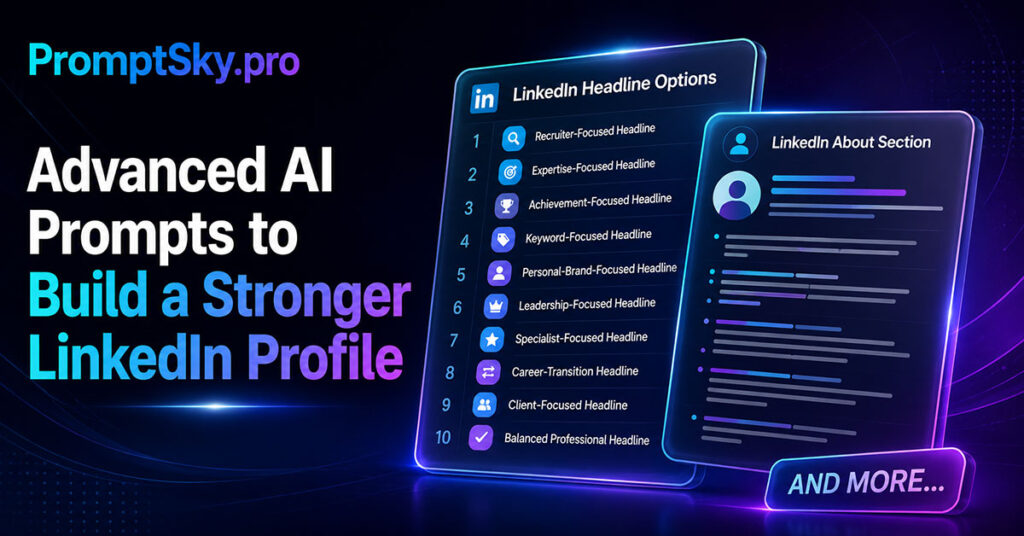
Act as an expert LinkedIn headline writer and recruiter. Based on the professional information below, create 10 high-quality LinkedIn headline options designed to attract relevant recruiters and hiring managers.
Each headline should clearly communicate who I am professionally, what I specialize in, the type of value I provide, and relevant keywords that recruiters may search for.
Prioritize clarity over generic personal branding language. Avoid vague phrases such as “passionate professional,” “innovative thinker,” or “motivated individual.”
Create different strategic versions:
- Recruiter-focused.
- Expertise-focused.
- Achievement-focused.
- Keyword-focused.
- Personal-brand-focused.
- Leadership-focused.
- Specialist-focused.
- Career-transition-focused.
- Client-focused.
- Balanced professional version.
Keep every option concise enough for practical LinkedIn use. Do not invent qualifications or achievements.
After the 10 options, identify the strongest option and explain briefly why it is the best fit for my goals.
Professional information:
[PASTE INFORMATION HERE]Target role:
[TARGET ROLE]Target industry:
[TARGET INDUSTRY]Career goal:
[CAREER GOAL]
3. LinkedIn About Section
A detailed prompt for turning career information into a compelling and natural LinkedIn About section.
Prompt:
Write a professional LinkedIn About section based entirely on the information I provide. The goal is to create a clear personal narrative that explains who I am, what I do, what I specialize in, the problems I solve, the experience I bring, and what professional opportunities or connections I am looking for.
Start with a strong opening that immediately communicates my professional identity instead of using a generic introduction.
Structure the About section naturally:
- Professional identity.
- Core expertise.
- Key experience and areas of specialization.
- Professional strengths.
- Notable achievements or measurable results provided in the source material.
- Types of problems I solve.
- Industries, technologies, or areas I understand.
- Current professional direction.
- Appropriate closing invitation for relevant connections or opportunities.
Use natural first-person language and avoid sounding like a corporate biography. Make the writing confident but not arrogant.
Include relevant LinkedIn search keywords naturally throughout the text, but never repeat keywords unnaturally.
Do not invent achievements, numbers, clients, employers, credentials, or experience.
Create three versions:
- Professional and recruiter-friendly.
- Personal-brand focused.
- Concise and highly readable.
My information:
[PASTE INFORMATION HERE]
4. LinkedIn Profile Keywords
Use this prompt to discover keywords that can improve LinkedIn search visibility for a specific career target.
Prompt:
Act as a LinkedIn SEO and recruitment strategist. Analyze my professional background, target role, industry, skills, experience, and career goals and identify the most relevant keywords I should naturally use throughout my LinkedIn profile.
Divide the keywords into:
- Primary job-title keywords.
- Secondary role keywords.
- Technical skills.
- Industry keywords.
- Tools and software.
- Methodologies and frameworks.
- Certifications and qualifications.
- Functional expertise.
- Leadership keywords.
- Problem-solving keywords.
- Recruiter search phrases.
For each keyword, explain where it should naturally appear, such as headline, About section, experience descriptions, skills section, or Featured section.
Prioritize keywords that accurately represent my real experience. Do not recommend keywords solely because they are popular if they do not match my background.
Avoid keyword stuffing. The final profile must remain natural and readable.
Professional background:
[PASTE BACKGROUND]Target role:
[TARGET ROLE]Target industry:
[TARGET INDUSTRY]
5. LinkedIn Experience Section Rewrite
Improve job descriptions so they demonstrate professional value instead of simply listing responsibilities.
Prompt:
Rewrite my LinkedIn experience section as an experienced career writer and recruiter.
For every position, transform generic responsibility-based descriptions into concise, achievement-oriented professional descriptions. Show what I was responsible for, what I actually did, what skills or methods I used, and what outcomes resulted whenever the information is available.
Use strong but accurate action verbs such as led, developed, managed, optimized, implemented, analyzed, coordinated, designed, improved, launched, or delivered when they accurately describe the work.
Prioritize measurable achievements. If I provide numbers, preserve them accurately. If a useful metric is missing, write [ADD METRIC] rather than inventing one.
Avoid repeating the same verbs and sentence structures across different positions.
For each job provide:
- A concise role summary.
- 4–6 achievement-focused bullet points.
- Recommended keywords.
- Missing information that could strengthen the entry.
Keep everything truthful and professional.
My experience:
[PASTE EXPERIENCE HERE]
6. LinkedIn Profile for Job Seekers
Optimize a profile specifically for someone actively searching for a new job.
Prompt:
Act as a senior recruiter and LinkedIn career strategist. Optimize the following LinkedIn profile for an active job seeker.
The goal is to make the profile immediately understandable to recruiters and hiring managers while clearly communicating the candidate’s target role, strongest qualifications, relevant experience, accomplishments, and career direction.
Review the headline, About section, experience, skills, education, certifications, Featured section, and keyword placement.
Identify anything that could confuse recruiters about the candidate’s target role. Remove vague positioning and create a consistent professional narrative from the most recent role through earlier experience.
Recommend specific improvements for:
- Recruiter search visibility.
- Target job alignment.
- Professional positioning.
- Achievement presentation.
- Keyword usage.
- Skills.
- Featured content.
- Profile completeness.
Rewrite the sections that need improvement.
Never invent information.
Target job:
[TARGET JOB]Current profile:
[PASTE PROFILE]
7. LinkedIn Profile for Career Change
Help reposition an existing profile for someone moving into a different career or industry.
Prompt:
Act as a career-transition strategist and LinkedIn personal branding expert. Rewrite my LinkedIn profile so it supports my transition from [CURRENT FIELD] into [TARGET FIELD].
Identify transferable skills, relevant achievements, overlapping responsibilities, industry knowledge, tools, leadership experience, communication skills, analytical abilities, project management experience, customer-facing experience, or other capabilities that can legitimately support the transition.
Do not hide my previous career history or pretend I have experience I do not have. Instead, create a coherent narrative explaining how my existing background provides relevant preparation for the target field.
Rewrite:
- LinkedIn headline.
- About section.
- Relevant experience descriptions.
- Skills.
- Featured section recommendations.
Highlight transferable achievements instead of emphasizing irrelevant responsibilities.
Recommend specific keywords associated with my target role that accurately reflect my existing skills.
Make the transition feel credible and intentional rather than random.
Current career:
[CURRENT CAREER]Target career:
[TARGET CAREER]Profile information:
[PASTE PROFILE]
8. LinkedIn Profile for Freelancers
Position a freelancer as a credible specialist who can attract relevant clients through LinkedIn.
Prompt:
Optimize my LinkedIn profile as a freelancer who wants to attract qualified clients rather than only recruiters.
Position me around the specific problems I solve, services I provide, industries I understand, and outcomes I can realistically deliver.
Rewrite the headline so it communicates my specialization and client value immediately. Rewrite the About section to explain who I help, what I do, how I work, what types of projects I handle, and why potential clients should consider contacting me.
Rewrite my experience section to emphasize project outcomes, deliverables, client problems, capabilities, and relevant proof of expertise.
Recommend content for the Featured section, including portfolio projects, case studies, websites, articles, presentations, or other professional evidence that I actually possess.
Suggest relevant LinkedIn keywords without keyword stuffing.
Avoid generic freelancer language such as “I help businesses grow” unless it is supported by specific context.
Do not invent clients, revenue figures, project results, testimonials, or case studies.
My freelance services:
[SERVICES]Target clients:
[TARGET CLIENTS]Experience:
[PASTE EXPERIENCE]
9. LinkedIn Profile for Executives and Leaders
Create a stronger leadership narrative for senior professionals.
Prompt:
Act as an executive personal branding strategist. Rewrite my LinkedIn profile to position me as a credible senior leader within my industry.
Focus on leadership scope, strategic decision-making, organizational impact, business outcomes, transformation, team leadership, operational responsibility, stakeholder management, and areas of expertise supported by my actual experience.
Avoid turning the profile into a list of executive buzzwords. Every major leadership claim should be connected to a real responsibility, achievement, scale, or outcome provided in my information.
Rewrite the headline to communicate executive positioning clearly.
Rewrite the About section as a strong leadership narrative that explains:
- What I lead.
- What business problems I solve.
- My strategic expertise.
- The environments in which I have operated.
- Major accomplishments.
- Leadership philosophy where supported by my information.
- Professional areas in which I want to build relationships.
Rewrite experience descriptions to emphasize strategic impact rather than routine responsibilities.
Keep the tone authoritative, concise, human, and credible.
Profile information:
[PASTE PROFILE]
10. LinkedIn Profile for Students and Recent Graduates
Build a credible profile when professional experience is limited.
Prompt:
Act as a university career advisor and LinkedIn profile strategist. Optimize the following LinkedIn profile for a student or recent graduate who has limited professional experience.
Do not exaggerate experience or create fake professional achievements. Instead, identify valuable evidence from education, internships, academic projects, research, volunteer work, student organizations, competitions, freelance work, certifications, technical projects, coursework, and extracurricular activities.
Create a professional headline that clearly communicates the candidate’s field of study, target career direction, relevant skills, and areas of interest.
Write an About section that explains the candidate’s current stage, interests, relevant capabilities, projects, career direction, and what opportunities they are seeking.
Rewrite project and internship descriptions to emphasize what was actually done, tools used, skills developed, and outcomes achieved.
Recommend skills, keywords, Featured content, certifications, projects, and profile sections that can strengthen credibility.
Keep the profile confident but realistic. Avoid phrases that make the candidate sound inexperienced or apologetic about having limited experience.
Student information:
[PASTE INFORMATION]
11. LinkedIn Skills Section Optimization
Choose and prioritize skills that accurately support a target role.
Prompt:
Analyze my professional background and target career and create an optimized LinkedIn skills strategy.
Identify the most valuable skills that accurately represent my real experience and divide them into:
- Core technical skills.
- Professional skills.
- Industry-specific skills.
- Tools and software.
- Leadership and management skills.
- Analytical and problem-solving skills.
- Communication and collaboration skills.
Prioritize the skills most relevant to my target job instead of simply creating a long list.
Identify skills that are too generic, outdated, weakly supported by my experience, or irrelevant to my target role.
For each recommended skill, explain which part of my experience supports it.
Also recommend which skills should appear most prominently in the profile and which should be removed or deprioritized.
Never recommend skills that my background does not support.
Background:
[PASTE BACKGROUND]Target role:
[TARGET ROLE]
12. LinkedIn Featured Section Strategy
Turn the Featured section into evidence of expertise instead of leaving it empty or random.
Prompt:
Act as a LinkedIn personal branding strategist and design a Featured section strategy based on my career goals and professional background.
Determine which types of content would provide the strongest evidence of expertise, such as portfolio projects, case studies, articles, presentations, reports, videos, certifications, interviews, websites, product launches, research, publications, or professional achievements.
Rank the recommendations by priority.
For each suggested Featured item, provide:
- Recommended content type.
- Suggested title.
- Short description.
- The professional skill or credibility signal it demonstrates.
- Why it would matter to a recruiter, client, or industry professional.
Do not recommend content I cannot realistically claim or create without clearly labeling it as a future recommendation.
My career goal:
[CAREER GOAL]My background:
[PASTE BACKGROUND]
13. LinkedIn Profile for Recruiter Visibility
Optimize the profile specifically around how recruiters search for candidates.
Prompt:
Act as an experienced recruiter who regularly uses LinkedIn to identify candidates. Review my profile and explain exactly how it could be improved for recruiter discovery.
Analyze my job titles, headline, About section, experience descriptions, skills, location, industry terminology, technologies, certifications, and target role.
Identify missing keywords that accurately describe my background and are likely to be relevant to recruiters searching for my target position.
Explain where each keyword should appear naturally.
Rewrite the headline and About section and improve the experience descriptions with recruiter-friendly terminology.
Avoid keyword stuffing and do not recommend terms unrelated to my actual experience.
Also identify confusing wording that could cause recruiters to misunderstand my professional level or target role.
Finish with a prioritized checklist of the 10 most important profile changes.
Target role:
[TARGET ROLE]Current profile:
[PASTE PROFILE]
14. LinkedIn Profile for Personal Branding
Create a recognizable professional identity instead of presenting the profile as a basic digital resume.
Prompt:
Act as a professional personal branding strategist. Develop a clear LinkedIn personal brand based on my expertise, experience, strengths, interests, achievements, and career goals.
Identify:
- My strongest professional positioning.
- My ideal audience.
- My primary areas of expertise.
- The problems I am qualified to discuss or solve.
- My differentiators.
- The professional topics I should consistently be associated with.
Then rewrite my LinkedIn headline and About section around this positioning.
Recommend 5–10 content themes I could consistently discuss on LinkedIn to reinforce the brand.
Make the positioning specific rather than generic. Avoid describing me as simply “passionate,” “motivated,” or “results-driven.”
Keep every claim grounded in the information I provide.
Professional background:
[PASTE BACKGROUND]Career goal:
[CAREER GOAL]
15. LinkedIn Profile for Sales Professionals
Optimize the profile to build credibility with prospects and business decision-makers.
Prompt:
Rewrite my LinkedIn profile for a sales professional whose goal is to build credibility, attract qualified prospects, and create meaningful business conversations.
Position me around the industries, customer types, products or services, sales capabilities, market knowledge, and business problems I actually understand.
Rewrite the headline to make my professional value clear without sounding like a generic sales pitch.
Rewrite the About section to explain who I work with, what challenges I help address, my relevant expertise, my approach to business relationships, and evidence of results where provided.
Rewrite experience descriptions to emphasize sales responsibilities, customer relationships, business development, account management, negotiation, revenue-related achievements, territory ownership, partnerships, or other relevant responsibilities supported by the source.
Do not invent revenue numbers, conversion rates, customer names, or sales achievements.
Keep the profile credible and relationship-focused rather than aggressively promotional.
Information:
[PASTE INFORMATION]
16. LinkedIn Profile for Tech Professionals
Optimize a technology-focused profile while maintaining technical precision.
Prompt:
Act as a technology recruiter and technical personal branding specialist. Rewrite my LinkedIn profile for the technology roles I am targeting.
Identify and prioritize relevant technologies, programming languages, frameworks, platforms, development methodologies, cloud services, databases, tools, architecture concepts, and technical responsibilities that are actually supported by my experience.
Rewrite the headline using relevant technical keywords without creating a keyword-stuffed list.
Rewrite the About section to explain my technical specialization, experience level, types of systems or products I have worked on, major technical responsibilities, and career direction.
Rewrite experience entries to show what I built, maintained, improved, migrated, automated, analyzed, or managed and the outcomes when those details are available.
Do not invent technical projects, technologies, certifications, or production experience.
Keep the language accessible enough for recruiters while retaining technical accuracy.
Technical background:
[PASTE BACKGROUND]Target role:
[TARGET ROLE]
17. LinkedIn Profile for Creatives
Show creative expertise through a professional profile without making it overly corporate.
Prompt:
Optimize my LinkedIn profile as a creative professional in [FIELD].
Preserve my authentic creative identity while making the profile clear and professional to potential clients, employers, collaborators, and industry professionals.
Rewrite the headline to communicate my specialization, creative discipline, and professional value.
Rewrite the About section with a strong creative narrative that explains the type of work I create, the problems I solve, the audiences or industries I work with, my creative strengths, and the kinds of opportunities I am interested in.
Rewrite experience and project descriptions to emphasize creative contributions, project scope, tools, collaboration, deliverables, and outcomes.
Recommend a Featured section containing the strongest types of portfolio evidence.
Avoid generic phrases such as “creative thinker” unless supported by specific examples.
Keep the tone distinctive but still appropriate for professional networking.
Creative field:
[FIELD]Portfolio information:
[PASTE INFORMATION]
18. LinkedIn Profile for Consultants
Position the profile around expertise, problems solved, and professional credibility.
Prompt:
Act as a consulting personal branding strategist. Rewrite my LinkedIn profile so it communicates consulting expertise clearly to potential clients, partners, and decision-makers.
Identify the business problems I have legitimate experience addressing, the industries I understand, the types of organizations I have worked with, my methodologies, professional capabilities, and relevant outcomes.
Rewrite the headline around expertise and client value rather than simply listing a job title.
Write an About section that clearly explains:
- Who I help.
- What problems I help solve.
- Areas of consulting expertise.
- Relevant experience.
- Approach or methodology where supported.
- Evidence of outcomes.
- Types of professional conversations I welcome.
Rewrite experience descriptions around projects, challenges, interventions, recommendations, implementation, and outcomes where available.
Never invent clients, case studies, results, or credentials.
Background:
[PASTE BACKGROUND]
19. LinkedIn Profile for Remote Job Opportunities
Make a profile attractive to employers hiring remote professionals without overemphasizing remote work.
Prompt:
Optimize my LinkedIn profile for remote job opportunities in [TARGET ROLE].
Highlight skills that demonstrate effective remote work, including communication, documentation, collaboration, project ownership, time management, asynchronous work, digital tools, cross-functional collaboration, and independent execution where supported by my experience.
Rewrite my headline to clearly communicate my target role and professional specialization.
Rewrite my About section to demonstrate that I can operate effectively in distributed teams without relying on generic claims like “I am a self-motivated remote worker.”
Rewrite relevant experience entries to highlight outcomes, ownership, collaboration, tools, processes, and responsibilities that are relevant to remote work.
Recommend appropriate skills and keywords.
Do not invent remote work experience if I have not provided it.
Keep the profile focused primarily on professional value, with remote capability presented as an additional strength.
Target role:
[TARGET ROLE]Background:
[PASTE BACKGROUND]
20. LinkedIn Profile for International Opportunities
Adapt the profile so it communicates clearly to an international professional audience.
Prompt:
Optimize my LinkedIn profile for international employers, recruiters, clients, and professional connections.
Review the wording for clarity to an international English-speaking audience. Remove region-specific expressions, ambiguous job titles, unexplained local terminology, and culturally specific phrases that could confuse readers.
Rewrite my headline using internationally recognizable terminology for my profession.
Rewrite the About section to clearly communicate my expertise, experience, industry background, professional level, target opportunities, and relevant achievements.
Preserve the actual geographic and professional details provided. Do not exaggerate international experience.
Where a local job title may not be immediately understandable internationally, recommend a clearer equivalent while preserving the true nature of the role.
Keep the language professional, natural, and easy for non-native English-speaking professionals to understand.
My current profile:
[PASTE PROFILE]Target country or region:
[TARGET REGION]Target role:
[TARGET ROLE]
21. LinkedIn Career Gap Explanation
Present career gaps professionally without oversharing or creating excuses.
Prompt:
Act as a career coach and LinkedIn profile strategist. Help me present a career gap professionally and honestly.
Based on the information I provide, create a concise explanation that focuses on what I did during the period, skills developed, education, caregiving, personal projects, freelance work, volunteering, job searching, professional development, or other information I explicitly provide.
Do not invent activities or attempt to disguise the gap.
Create:
- A concise LinkedIn experience entry if appropriate.
- A professional explanation for recruiters.
- A version suitable for the About section if the gap is strategically relevant.
- A list of skills or achievements from the period that can legitimately be highlighted.
Keep the tone confident, factual, and forward-looking. Avoid defensive language or unnecessary personal details.
Career gap information:
[PASTE INFORMATION]
22. LinkedIn Profile Consistency Check
Find contradictions and inconsistencies across the entire profile.
Prompt:
Audit my complete LinkedIn profile for consistency and credibility.
Compare my headline, About section, current position, previous experience, skills, education, certifications, Featured section, and career goals.
Identify:
- Conflicting job titles.
- Inconsistent dates.
- Skills mentioned in one section but unsupported elsewhere.
- Repeated claims.
- Missing important keywords.
- Career positioning that changes from section to section.
- Achievements that are mentioned vaguely.
- Experience descriptions that contradict the headline or About section.
- Professional terminology that is used inconsistently.
Create a prioritized correction list.
Then provide rewritten versions of the sections that need improvement so the entire profile communicates one coherent professional identity.
Do not invent information to resolve inconsistencies. Flag anything that requires clarification.
Full profile:
[PASTE PROFILE]
23. LinkedIn Profile Call-to-Action
Create natural calls to action that encourage relevant professional connections without sounding salesy.
Prompt:
Create 10 natural LinkedIn profile call-to-action options based on my career goals and professional audience.
The CTA should encourage relevant people to connect, discuss opportunities, collaborate, explore my work, contact me about projects, or follow my professional content depending on the goal.
Avoid aggressive sales language, generic phrases such as “feel free to reach out anytime,” and artificial engagement requests.
Create different versions for:
- Recruiters.
- Hiring managers.
- Potential clients.
- Industry peers.
- Collaborators.
- Investors or business partners where relevant.
Make each CTA short, professional, and directly connected to the information in my profile.
Do not claim availability for opportunities that I have not indicated.
Profile goal:
[PROFILE GOAL]Audience:
[TARGET AUDIENCE]
24. LinkedIn Profile for Networking
Make the profile more effective for building valuable professional relationships.
Prompt:
Rewrite my LinkedIn profile with professional networking as the primary objective.
Make it easy for another professional to understand who I am, what I specialize in, what topics I care about professionally, what industries or communities I participate in, and why connecting with me could be relevant.
Rewrite the headline to communicate expertise and interests clearly.
Rewrite the About section so it creates natural conversation opportunities without sounding like a sales pitch or job application.
Highlight projects, areas of expertise, professional interests, publications, events, communities, or other legitimate networking signals from my information.
Recommend 5 topics I could regularly discuss or post about to attract relevant professional connections.
Avoid generic networking phrases and exaggerated personal branding.
Keep the profile authentic and grounded in my actual experience.
Professional information:
[PASTE INFORMATION]
25. LinkedIn Profile for Job Promotion and Internal Growth
Position an employee for promotions and increased responsibility within their current organization or industry.
Prompt:
Optimize my LinkedIn profile to demonstrate readiness for career growth, greater responsibility, and leadership opportunities while remaining accurate to my current position.
Analyze my existing responsibilities and identify achievements, expanded scope, cross-functional work, project ownership, leadership behaviors, process improvements, mentoring, strategic contributions, and measurable outcomes that demonstrate professional growth.
Rewrite my headline and About section so they communicate my expertise and direction without falsely presenting me as already holding a senior role.
Rewrite experience descriptions to emphasize impact, ownership, initiative, and progression rather than routine tasks.
Identify areas where I can add measurable evidence.
Recommend skills and Featured content that support my next career level.
Do not invent leadership responsibilities, metrics, or promotions.
Current role:
[CURRENT ROLE]Desired next role:
[NEXT ROLE]Experience:
[PASTE EXPERIENCE]
26. LinkedIn Profile Content Strategy
Build a content strategy that reinforces the professional identity presented on the profile.
Prompt:
Act as a LinkedIn content strategist and personal branding consultant. Based on my optimized professional profile, create a content strategy that strengthens my positioning and attracts the audience I want.
Identify my 5–8 strongest content pillars based on actual expertise and experience.
For each pillar, provide:
- Why it supports my professional brand.
- 5 post ideas.
- Suitable post formats.
- The audience most likely to find it useful.
- Keywords or topics I should naturally mention.
Include a balanced mix of educational content, professional observations, project insights, lessons learned, industry analysis, practical advice, and appropriate personal professional experiences where supported.
Avoid generic motivational posts and topics unrelated to my expertise.
The content strategy should reinforce the same positioning used in my headline and About section.
Professional background:
[PASTE BACKGROUND]Target audience:
[TARGET AUDIENCE]Career goal:
[CAREER GOAL]
27. LinkedIn Profile Audit Scorecard
Get a structured evaluation of the profile before rewriting it.
Prompt:
Perform a detailed LinkedIn profile audit as an experienced recruiter, career strategist, and personal branding consultant.
Score each section from 1 to 10:
- Profile positioning.
- Headline.
- About section.
- Experience.
- Skills.
- Keywords.
- Career clarity.
- Achievement presentation.
- Personal branding.
- Recruiter appeal.
- Client appeal where relevant.
- Overall profile completeness.
For every score, explain exactly what is working, what is weak, and what should change.
Identify the 10 highest-impact improvements and rank them by priority.
After the audit, rewrite the three weakest sections.
Do not invent information. If evidence is missing, explain what information would strengthen the profile.
LinkedIn profile:
[PASTE PROFILE]
28. LinkedIn Profile Before-and-After Rewrite
Show exactly how profile wording can become stronger.
Prompt:
Review my LinkedIn profile and create a detailed before-and-after optimization.
For each major section, show:
- Current version.
- Problems with the current version.
- Improved version.
- Why the improved version is stronger.
Focus on clarity, specificity, professional positioning, keyword relevance, achievements, natural language, credibility, and recruiter readability.
Rewrite the headline, About section, current role, previous roles, and skills strategy where necessary.
Preserve all factual information and never create achievements that are not present in the original.
Where a stronger result requires missing information, use [ADD INFORMATION] and explain what should be added.
Profile:
[PASTE PROFILE]
29. LinkedIn Profile for Attracting Clients and Opportunities
Build a profile that communicates expertise and creates multiple professional opportunities.
Prompt:
Optimize my LinkedIn profile to attract a combination of relevant professional opportunities, potential clients, collaborators, industry contacts, and recruiters.
Create a balanced professional positioning that does not make the profile sound like a generic job application or an aggressive sales page.
Clearly communicate:
- What I do.
- What I specialize in.
- Who benefits from my expertise.
- What professional problems I understand.
- What evidence supports my expertise.
- What types of opportunities I am open to.
Rewrite my headline, About section, and experience descriptions.
Recommend relevant keywords, skills, Featured content, and content topics.
Create a natural closing CTA that welcomes relevant professional conversations.
Keep every claim factual and supported by my information.
Professional background:
[PASTE BACKGROUND]Desired opportunities:
[DESIRED OPPORTUNITIES]
30. Advanced LinkedIn Profile Transformation
Perform a complete strategic transformation of the LinkedIn profile from the perspective of a recruiter, personal branding expert, and professional copywriter.
Prompt:
Act as a senior LinkedIn strategist, executive recruiter, personal branding consultant, LinkedIn SEO specialist, and professional copywriter. Perform a complete strategic transformation of the LinkedIn profile information I provide.
Do not simply rewrite individual sections. First identify the strongest professional positioning based on my actual experience, skills, achievements, target role, industry, and career goals.
Then evaluate how a recruiter, hiring manager, potential client, or professional connection would interpret the profile within the first 10 seconds, 30 seconds, and 2 minutes.
Identify any uncertainty about my professional identity, target role, seniority, specialization, or value.
Build a consistent profile strategy around one clear professional narrative.
Rewrite:
- Headline
- Communicate role, specialization, value, and relevant search keywords.
- Avoid generic personal branding clichés.
- About Section
- Open with a clear professional identity.
- Explain expertise and specialization.
- Highlight relevant achievements.
- Communicate the problems I understand or solve.
- Include relevant keywords naturally.
- End with an appropriate professional CTA.
- Experience
- Replace generic responsibilities with specific contributions.
- Highlight measurable outcomes when provided.
- Use strong action verbs appropriately.
- Include relevant technologies, methods, industries, and responsibilities.
- Identify missing metrics using [ADD METRIC].
- Skills
- Recommend and prioritize the most relevant skills.
- Remove weak or irrelevant skills.
- Group skills into meaningful categories.
- Featured Section
- Recommend the strongest portfolio pieces, projects, articles, case studies, certifications, presentations, or other evidence.
- Profile Keywords
- Identify primary, secondary, technical, industry, and recruiter-search keywords.
- Explain where each should appear.
- Career Positioning
- Explain the professional identity the profile currently communicates.
- Define the stronger positioning the revised profile should communicate.
- Content Strategy
- Recommend 8–10 LinkedIn content topics that reinforce the new positioning.
- Profile Weaknesses
- Identify vague claims, missing evidence, repetitive wording, weak sections, inconsistent terminology, and potential recruiter concerns.
- Final Profile
- Present the complete rewritten profile in a polished, professional, natural voice.
Follow these rules throughout the transformation:
- Never invent employers, clients, achievements, metrics, certifications, technologies, awards, degrees, responsibilities, or professional experiences.
- Never exaggerate seniority or expertise.
- Preserve accurate facts and dates.
- Use keywords naturally instead of keyword stuffing.
- Avoid generic phrases such as “passionate professional,” “results-driven,” “dynamic individual,” and “proven track record” unless supported by specific evidence.
- Avoid excessive corporate jargon.
- Use natural, confident English.
- Make the profile readable to both recruiters and humans.
- Prioritize specificity over impressive-sounding language.
- Clearly mark missing information with [ADD INFORMATION].
My LinkedIn profile information:
[PASTE COMPLETE PROFILE HERE]Target role:
[TARGET ROLE]Target industry:
[TARGET INDUSTRY]Career goal:
[CAREER GOAL]Target audience:
[RECRUITERS / CLIENTS / EMPLOYERS / NETWORKING / OTHER]
Guide: How to Use AI Prompts to Improve Your LinkedIn Profile
These AI prompts to improve your LinkedIn profile are designed to help you optimize your headline, About section, experience, skills, keywords, and overall professional positioning. You can use them with ChatGPT or other AI tools to improve specific sections or work through a complete profile update.
1. Start With Your Current LinkedIn Profile
For the most accurate results, give the AI your existing LinkedIn information before asking it to make changes. Copy the text from your headline, About section, experience entries, skills, education, certifications, and other relevant sections.
You can also provide your current career level, industry, target role, and professional goals. The more accurate information you provide, the easier it is for the AI to create recommendations that actually fit your background.
2. Choose the Prompt Based on Your Goal
You do not need to use all 30 prompts. Start with the prompt that matches your immediate objective.
For example:
- Looking for a new job: Use prompts focused on recruiter visibility, job seekers, keywords, and profile optimization.
- Changing careers: Use the career-change prompt to identify transferable skills and reposition your experience.
- Finding clients: Use the freelancer, consultant, sales, or client-attraction prompts.
- Building a personal brand: Use the personal branding and content strategy prompts.
- Improving a specific section: Use the headline, About, skills, experience, or Featured section prompts.
- Starting your career: Use the student and recent-graduate prompt.
3. Give the AI the Target Role
Avoid simply asking AI to “make my LinkedIn better.” Tell it exactly what type of position or opportunity you are targeting.
For example:
Target role: Senior Digital Marketing Manager
Target industry: SaaS
Career goal: Find a remote management position
This gives the AI a specific direction for choosing relevant language, skills, keywords, and professional positioning.
4. Include the Job Description When Applying for a Specific Role
If you are optimizing your profile for a particular job, paste the job description alongside your LinkedIn profile.
Ask the AI to identify:
- Important job-specific keywords
- Required skills
- Relevant responsibilities
- Qualifications
- Industry terminology
- Areas where your profile already matches
- Genuine gaps that need attention
This makes the optimization more targeted than simply adding popular keywords to your profile.
5. Don’t Let AI Invent Your Experience
This is one of the most important rules when using AI for LinkedIn optimization.
AI should improve the way you present your actual experience—not create experience that you do not have.
Avoid accepting automatically generated:
- Fake achievements
- Unverified metrics
- Invented clients
- False certifications
- Technologies you have never used
- Inflated job titles
- Made-up responsibilities
If an important detail is missing, use placeholders such as [ADD METRIC] or [ADD INFORMATION] and fill them in yourself.
6. Optimize Keywords Naturally
LinkedIn keywords can help make your profile more relevant to searches, but adding the same keyword repeatedly can make the profile sound unnatural.
Instead, use relevant terminology where it genuinely fits:
- Headline
- About section
- Job descriptions
- Skills
- Projects
- Certifications
- Featured content
Focus on terms that accurately describe your experience and target role rather than trying to include every possible keyword.
7. Improve One Section at a Time
A complete profile transformation can be useful, but sometimes a section-by-section approach produces better results.
A practical workflow is:
Step 1: Analyze the complete profile
Step 2: Improve the headline
Step 3: Rewrite the About section
Step 4: Improve experience descriptions
Step 5: Optimize skills and keywords
Step 6: Build the Featured section
Step 7: Create a content strategy
Step 8: Perform a final profile audit
This makes it easier to review every change before publishing it.
8. Ask for Multiple Versions
For important sections such as the headline and About section, ask AI to create several alternatives.
For example, you can request:
- Recruiter-focused version
- Personal-brand-focused version
- Industry-focused version
- Client-focused version
- Concise version
- Executive version
You can then choose the version that best represents your actual professional identity.
9. Add Evidence to Your Profile
Strong LinkedIn profiles are easier to understand when they contain evidence rather than only claims.
Instead of:
Experienced marketing professional with strong digital marketing skills.
A stronger approach would be based on verified details such as:
Managed SEO and paid acquisition campaigns across multiple digital channels, contributing to measurable growth in qualified website traffic.
The second example communicates actual work and impact. Your own profile should use real numbers, projects, scope, and outcomes whenever you have them.
10. Use the Featured Section Strategically
The Featured section can provide evidence that supports the claims made elsewhere in your profile.
Depending on your profession, you could include:
- Portfolio projects
- Case studies
- Articles
- Research
- Presentations
- Websites
- Product launches
- Professional certifications
- Interviews
- Videos
- Published work
Use the Featured section to show evidence of your expertise rather than simply filling it with unrelated content.
11. Keep Your Profile Consistent
Your headline, About section, experience, skills, and Featured content should communicate the same general professional direction.
For example, if your headline positions you as a UX Designer, but your About section focuses primarily on sales and your Featured section contains unrelated marketing projects, visitors may not immediately understand your professional focus.
Run the LinkedIn Profile Consistency Check prompt after making major changes to identify these contradictions.
12. Review the Final Version Yourself
AI can improve wording and structure, but you should make the final decision about what appears on your LinkedIn profile.
Before publishing, check:
- Are all claims accurate?
- Are the dates correct?
- Are job titles accurate?
- Are the achievements verifiable?
- Do the keywords genuinely match your experience?
- Does the profile sound like you?
- Is your target career direction obvious?
- Would a recruiter understand your expertise quickly?
The final profile should be clearer and stronger without becoming less authentic.
A Simple Workflow for the 30 Prompts
If you want to use the prompts as a complete LinkedIn optimization system, this sequence works well:
Profile Audit → Headline → About → Keywords → Experience → Skills → Featured Section → Career Positioning → Content Strategy → Final Audit