
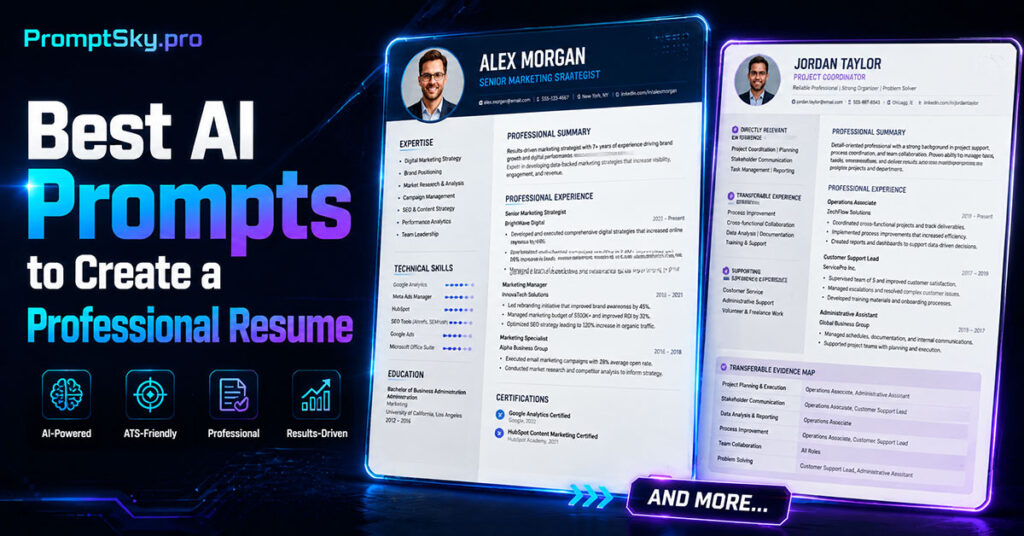
Best AI prompts to create a resume can help you build a professional CV from scratch, restructure your existing experience, highlight achievements, and tailor your resume to different types of jobs. The 30 prompts in this guide cover practical resume-building situations, from starting with a blank page to creating targeted resumes for technical, creative, management, sales, and other roles.
Instead of giving AI a vague request like “write my resume,” these detailed prompts provide specific instructions about structure, career positioning, achievements, skills, job requirements, and factual accuracy. You can adapt each prompt by adding your experience, target position, industry, and job description.
For more resume-focused ideas, check out AI Prompts to Improve Your Resume and Get More Interviews and learn how to strengthen your professional presence with AI Prompts to Improve Your LinkedIn Profile. You can also explore AI Prompts for Self-Discovery and Personal Growth for prompts that help you better understand your skills, goals, and career direction.
Looking for a specific resume prompt for your job title, industry, experience level, or career situation? Leave a comment and request it, and we may create a dedicated prompt for it.
1. Resume From a Blank Page
Starting from scratch can be difficult when you know your experience but are unsure how to structure it professionally. This prompt builds a complete resume from raw career information while keeping the content accurate and focused on the target position.
Prompt: Act as a senior recruiter, professional resume writer, career strategist, and resume information architect. I want you to create a complete, modern, professional resume from scratch based on the information I provide below. The target position is [TARGET JOB TITLE], the target industry is [INDUSTRY], and the preferred work environment is [ON-SITE/REMOTE/HYBRID]. First analyze all of my information and determine which details are most relevant to the target position. Then design the resume structure before writing the final content. Create a compelling professional headline, a concise professional profile, core areas of expertise, professional experience, education, certifications, projects, technical skills, languages, and additional sections only when they add genuine value. Convert my raw descriptions into polished resume language that communicates responsibility, expertise, ownership, complexity, and results. Whenever my information includes measurable outcomes such as revenue, cost savings, percentage improvements, project volume, customer growth, team size, processing volume, time saved, performance improvements, or other quantifiable results, highlight those details prominently. If an achievement is clearly valuable but no measurement is available, do not invent a number; instead mark it as [ADD METRIC IF AVAILABLE]. Use strong action verbs and eliminate vague phrases, unnecessary repetition, generic career objectives, and filler language. Build a coherent career story rather than simply copying my notes. Keep the resume ATS-friendly with standard section headings, straightforward formatting, consistent dates, and natural keyword usage. Do not fabricate employers, job titles, qualifications, technologies, achievements, metrics, responsibilities, or certifications. After creating the resume, provide a separate list of missing information that would make the document substantially stronger and explain exactly what information I should provide.
My information:
[PASTE YOUR CAREER INFORMATION HERE]
2. Resume Based on LinkedIn Profile
A LinkedIn profile often contains useful career information but is not structured like a strong resume. This prompt turns the available profile content into a polished resume while removing repetition and social-media-style wording.
Prompt: Act as an experienced recruiter, LinkedIn-to-resume conversion specialist, executive resume writer, and professional career editor. Convert the LinkedIn profile information I provide into a polished, professional resume targeted toward [TARGET JOB TITLE]. Carefully analyze every section of the profile, including the headline, About section, employment history, descriptions, skills, education, certifications, projects, recommendations, accomplishments, and other relevant information. Do not simply copy the LinkedIn text. Extract the strongest evidence of expertise, career progression, ownership, achievements, technical capabilities, leadership, and business impact, then rewrite it in concise resume language. Remove repetitive statements, social-media-oriented language, excessive first-person phrasing, vague self-descriptions, outdated terminology, and information that does not strengthen the application. Where the LinkedIn profile contains an achievement but does not clearly explain its impact, preserve the factual information and identify what additional metric or context would improve it. Create a professional summary specifically aligned with [TARGET JOB TITLE], followed by a prioritized skills section and achievement-focused experience bullets. Maintain accurate employment dates and titles exactly as provided. Never infer or invent qualifications simply because they are common for the role. Make the final document ATS-friendly, recruiter-readable, concise, and professionally positioned. After the resume, provide a section called “LinkedIn Information Worth Adding” containing details from my profile that could strengthen the resume but need additional context or verification.
LinkedIn profile:
[PASTE YOUR LINKEDIN CONTENT HERE]
3. Resume for a Job You Have Never Held Before
Applying for a role without having the exact job title on your previous experience requires careful positioning. This prompt focuses on relevant capabilities and transferable evidence without falsely presenting unrelated work as direct experience.
Prompt: Act as a career strategist, hiring manager, recruiter, and transferable-skills resume specialist. Create a resume that positions me competitively for [TARGET JOB TITLE], even though I have not previously held this exact job title. Analyze my complete background and identify evidence that demonstrates the capabilities required for the target position. Separate my experience into three categories: directly relevant experience, transferable experience, and supporting experience. Identify projects, responsibilities, achievements, technical skills, education, certifications, volunteer work, freelance work, and personal initiatives that can credibly demonstrate my ability to perform the target role. Rewrite relevant experience so the connection to the target position is immediately understandable without falsely changing my previous job titles or claiming responsibilities I never performed. Build a professional summary that focuses on capabilities and value rather than apologizing for the lack of a matching title. Prioritize evidence of problem-solving, ownership, communication, analysis, leadership, technical ability, customer interaction, project execution, or other competencies relevant to the target position. Use terminology from the target job description only when it accurately describes my experience. Do not fabricate direct experience, metrics, tools, certifications, or achievements. After creating the resume, include a “Transferable Evidence Map” showing which parts of my background support each major requirement of the target job.
Target job description:
[PASTE JOB DESCRIPTION]
My background:
[PASTE YOUR EXPERIENCE]
4. Resume for International Job Applications
Different markets can expect different resume conventions, terminology, and levels of detail. This prompt adapts a resume for an international application while keeping the content professional and culturally appropriate.
Prompt: Act as an international recruitment consultant, global resume specialist, ATS expert, and cross-border career advisor. Rewrite my resume for applications to employers in [COUNTRY/REGION] targeting [JOB TITLE]. Analyze my existing resume and adapt its language, structure, terminology, date formatting, professional conventions, and level of detail to be appropriate for the target employment market. Preserve the factual substance of my career history while removing wording that may sound unnatural, overly localized, translated literally, or unclear to international recruiters. Use internationally understandable job terminology while retaining official job titles where changing them could misrepresent my employment history. Emphasize qualifications, technical skills, achievements, certifications, language abilities, international projects, cross-cultural collaboration, and relevant experience that matter for the target market. Determine whether information such as nationality, photograph, date of birth, marital status, address, or other personal details should be included based on standard professional practices for the specified market; do not add sensitive personal information unless it is genuinely appropriate and explicitly provided. Optimize the document for international ATS systems and English-speaking recruiters when applicable. Never invent language proficiency, work authorization, relocation status, international experience, or qualifications. Provide the final resume followed by a short “International Application Notes” section identifying any information that may need to be adjusted before submitting applications in this market.
Target country/region:
[COUNTRY/REGION]
Target position:
[JOB TITLE]
Current resume:
[PASTE RESUME]
5. Resume for a First Professional Job
This prompt is aimed at candidates entering the workforce with limited formal employment history. It focuses on turning education, projects, internships, practical activities, and skills into credible professional evidence.
Prompt: Act as an entry-level recruiter, university career advisor, graduate hiring specialist, and professional resume writer. Create a strong first-job resume for me targeting [TARGET JOB TITLE] at [INDUSTRY/COMPANY TYPE]. I have limited formal professional experience, so strategically use my education, academic projects, internships, coursework, volunteer activities, student organizations, freelance assignments, personal projects, competitions, certifications, technical skills, language abilities, and other legitimate experiences to demonstrate job readiness. Do not make the resume sound like an apology for being inexperienced. Instead, identify evidence of initiative, learning ability, problem-solving, communication, teamwork, leadership, organization, technical competence, and responsibility. Turn relevant academic or personal projects into professional-style entries that clearly explain the objective, my contribution, tools or methods used, and outcome. Highlight meaningful achievements such as awards, rankings, completed projects, publications, presentations, competitions, or measurable improvements when they are provided. Create a concise professional profile that communicates my target direction and strongest capabilities. Prioritize skills that are relevant to [TARGET JOB TITLE] rather than creating a long generic skills list. Keep the document ATS-compatible and easy for a recruiter to scan. Never invent employment, achievements, grades, project results, certifications, or technical proficiency. At the end, identify five specific additions that would make this first-job resume stronger if I can provide them.
My information:
[PASTE EDUCATION, PROJECTS, SKILLS, EXPERIENCE, AND ACHIEVEMENTS]
6. Resume for a Portfolio-Based Career
For designers, developers, photographers, writers, marketers, creators, and other professionals whose work is often demonstrated through a portfolio, the resume should support the portfolio rather than duplicate it.
Prompt: Act as a recruiter and professional resume strategist specializing in portfolio-driven careers. Create a resume for [TARGET ROLE] that complements my portfolio instead of simply repeating the work shown there. Analyze my projects, portfolio pieces, freelance work, employment history, technical abilities, creative processes, tools, industries, clients, and measurable outcomes. Identify the projects that provide the strongest evidence for the target position and describe them using concise, outcome-focused resume language. For each major project, communicate the problem or objective, my specific role, the methods or tools I used, the complexity or scope of the work, and the final outcome whenever the information is available. Avoid generic creative descriptions such as “worked on exciting projects” or “created engaging content.” If my portfolio contains visually impressive work but the resume lacks business or professional context, add concise descriptions that explain why the work mattered. Create a strong headline and summary that establish my professional specialization. Include relevant tools and technologies without turning the skills section into an exhaustive software inventory. Preserve accurate client names, project titles, dates, and responsibilities exactly as provided. Do not invent project metrics, clients, awards, or results. Make the final resume ATS-friendly while retaining enough specificity to encourage a recruiter to review my portfolio.
Target role:
[TARGET ROLE]
Portfolio/project information:
[PASTE YOUR INFORMATION]
7. Resume for a Returning Professional
This prompt helps candidates who are returning to the workforce after an extended period away. It focuses on current capabilities and relevant experience without forcing unnecessary explanations into the resume.
Prompt: Act as a senior recruiter, career-return strategist, and professional resume writer. Create a strong resume for my return to the workforce after a career break. My target position is [TARGET JOB TITLE] and my target industry is [INDUSTRY]. Analyze my previous professional experience, current skills, education, certifications, recent training, freelance activities, volunteer work, independent projects, and other legitimate activities completed during or after the career break. Identify which capabilities remain directly relevant and which should be refreshed or repositioned. Build a professional narrative that emphasizes current readiness, transferable expertise, achievements, and relevant recent development rather than allowing the career break to dominate the document. Do not hide employment dates or create misleading timelines. If the career break involved legitimate professional development, caregiving, education, entrepreneurship, volunteering, relocation, personal projects, or other activities that I explicitly provide, determine whether and how they can be represented professionally without revealing unnecessary personal details. Strengthen older achievements when they remain relevant, but balance them with evidence of current knowledge. Create a concise professional summary that communicates where I am going professionally rather than focusing heavily on why I was away. Identify outdated skills that may need refreshing and recommend specific, realistic ways to demonstrate current competence. Never invent recent employment, certifications, projects, or skills.
Career history and current information:
[PASTE YOUR INFORMATION]
8. Resume for a Startup Position
Startups often look for candidates who can take ownership, work across functions, adapt quickly, and create measurable impact. This prompt reshapes relevant experience around those qualities.
Prompt: Act as a startup recruiter, startup hiring manager, talent strategist, and high-impact resume writer. Rewrite my resume specifically for a position at a startup targeting [TARGET ROLE] in [INDUSTRY]. Analyze my experience for evidence of ownership, adaptability, speed of execution, cross-functional collaboration, ambiguity management, experimentation, problem-solving, resourcefulness, customer focus, product thinking, process creation, and measurable impact. Identify situations where I operated without extensive supervision, built something from scratch, improved an inefficient process, solved an unfamiliar problem, managed multiple responsibilities, collaborated across departments, or delivered results with limited resources. Give these experiences greater prominence where they are relevant to the target role. Reduce overly bureaucratic or task-focused language and replace it with precise descriptions of ownership and outcomes. Highlight relevant technical, business, product, growth, operational, or customer-facing capabilities depending on the position. Keep the resume concise and energetic without using exaggerated startup buzzwords. Do not claim that I am “entrepreneurial,” “innovative,” or “adaptable” unless the experience actually demonstrates those qualities. Do not invent metrics, responsibilities, funding, company size, product impact, or startup experience. Finish with a short analysis explaining which three experiences make me most compelling for a startup hiring manager.
Target startup role:
[TARGET ROLE]
Job description:
[PASTE JOB DESCRIPTION]
My resume:
[PASTE RESUME]
9. Resume for a Government or Public-Sector Role
Public-sector applications can require clearer documentation of responsibilities, qualifications, compliance, programs, and scope than a typical private-sector resume. This prompt organizes experience around those requirements.
Prompt: Act as a public-sector recruiter, government hiring specialist, professional resume writer, and application-document strategist. Rewrite my resume for [TARGET GOVERNMENT/PUBLIC-SECTOR POSITION] while preserving complete factual accuracy. Analyze the job announcement and identify required qualifications, preferred qualifications, technical competencies, program responsibilities, compliance requirements, leadership expectations, communication requirements, and specialized terminology. Map my existing experience to these requirements and make the strongest evidence easy to locate. Expand relevant responsibilities when additional context is available, especially where my work involved program management, public services, regulatory requirements, documentation, stakeholder coordination, procurement, budgeting, reporting, compliance, policy implementation, data analysis, or operational oversight. Clearly communicate the scope of my work using accurate information such as team size, program scale, geographic coverage, workload, budgets, case volume, systems used, or project duration when provided. Preserve official job titles and employment dates. Avoid vague corporate language and focus on concrete evidence of qualifications. Do not fabricate government experience, security clearances, certifications, program scope, budget responsibility, or regulatory knowledge. After rewriting the resume, create a qualification crosswalk showing exactly where my background supports each major requirement in the job announcement and identifying any requirements for which evidence is currently missing.
Job announcement:
[PASTE JOB ANNOUNCEMENT]
Current resume:
[PASTE RESUME]
10. Resume for a Small Business Owner or Founder
Running a business can involve leadership, operations, sales, finance, marketing, hiring, technology, and strategy, but those responsibilities can be difficult to translate into conventional resume language. This prompt turns entrepreneurial experience into credible professional evidence.
Prompt: Act as an executive recruiter, entrepreneurship-to-employment career strategist, and professional resume writer. Transform my small-business owner, founder, or entrepreneur experience into a professional resume targeted toward [TARGET JOB TITLE]. Analyze every legitimate responsibility I handled, including business strategy, operations, sales, marketing, customer acquisition, client management, budgeting, vendor management, hiring, team leadership, product development, technology, partnerships, project management, process improvement, and financial or operational oversight. Identify the areas most relevant to the target position and prioritize them instead of presenting entrepreneurship as a generic title. Translate business ownership into specific professional competencies and measurable outcomes wherever supported by my information. Highlight evidence such as revenue growth, customer acquisition, retention, operational improvements, successful launches, team size, project volume, cost reductions, partnerships, process automation, or market expansion when real figures are available. If the business is no longer operating, present the experience professionally without using defensive language. Do not exaggerate the size or success of the company and never invent revenue, customers, employees, funding, partnerships, or achievements. Create a professional summary that connects my entrepreneurial background to the target role and demonstrates why my experience is relevant to an employer. Finish with a “Transferable Founder Experience” section identifying the strongest business-owner capabilities that should remain visible throughout the resume.
Target role:
[TARGET JOB TITLE]
Business/founder experience:
[PASTE YOUR INFORMATION]
11. Resume for a Remote Freelance Professional
Remote freelance work can demonstrate strong independence, client management, communication, and delivery skills, but those strengths are often buried in project descriptions. This prompt organizes that experience into a professional resume format.
Prompt: Act as a senior recruiter, remote-work hiring specialist, freelance career strategist, and professional resume writer. Create a polished resume for a freelance professional targeting [TARGET ROLE] within [INDUSTRY]. Analyze my freelance projects, clients, contracts, recurring engagements, deliverables, responsibilities, tools, communication methods, deadlines, and measurable outcomes. Identify evidence of independent work, ownership, time management, asynchronous communication, client relationship management, remote collaboration, problem-solving, project planning, and consistent delivery. Organize my freelance experience in a way that feels equivalent in professionalism to conventional employment without misrepresenting freelance engagements as full-time employment. Where several projects involved similar responsibilities, consolidate them intelligently while preserving important differences in scope or specialization. Prioritize projects that closely match the target role and reduce low-value or unrelated assignments. Rewrite project descriptions using concise action-oriented language that explains what I delivered, how I contributed, and what changed as a result. Highlight measurable information such as project volume, turnaround time, repeat clients, audience growth, conversion improvements, completed deliverables, or other verified outcomes. Never invent clients, metrics, project values, tools, or responsibilities. Create an ATS-friendly structure and finish with a list of the strongest evidence showing that I can succeed in a professional remote environment.
12. Resume for a Part-Time Professional
Part-time work can contain valuable experience even when the job title or hours do not immediately appear impressive. This prompt focuses on responsibilities, achievements, and skills rather than employment status.
Prompt: Act as a professional recruiter and resume strategist. Create a strong resume for [TARGET JOB TITLE] using my part-time employment history, internships, temporary roles, freelance work, education, and other professional experiences. Do not allow the part-time nature of my previous roles to overshadow the actual skills and responsibilities I developed. Analyze each position for transferable competencies, technical skills, customer interaction, operational responsibilities, leadership, problem-solving, reliability, organization, sales, communication, and measurable achievements. Rewrite the experience section so the focus is on what I accomplished and contributed rather than how many hours I worked. Clearly distinguish employment dates and job titles without unnecessarily emphasizing part-time status unless it is relevant to the application. Identify achievements that demonstrate increasing responsibility or trust, such as training coworkers, handling sensitive tasks, improving processes, managing customers, meeting performance targets, or taking ownership of projects. Use strong action verbs and concise bullet points. Do not invent responsibilities, metrics, promotions, or achievements. Build a professional summary aligned with [TARGET ROLE] and create a skills section that prioritizes capabilities supported by my actual experience. Finish by identifying which part-time experiences should receive the most space on the final resume and why.
13. Resume for a Career With Multiple Industries
Professionals who have worked across different industries can appear unfocused if their resume simply lists unrelated jobs. This prompt creates a unifying professional narrative around transferable expertise.
Prompt: Act as a senior career strategist, recruiter, and professional positioning specialist. Analyze my career history across multiple industries and create a cohesive resume targeted toward [TARGET ROLE]. Identify the common professional strengths connecting my different positions, such as leadership, operations, analytics, project management, sales, technology, communication, customer experience, strategy, or another recurring capability. Determine which experiences are most relevant to my target position and give them greater emphasis. Reframe seemingly unrelated roles around legitimate transferable skills and achievements without pretending that they were performed in the same industry. Create a professional summary that explains my career value through capabilities rather than forcing an artificial career narrative. Consolidate repetitive responsibilities and highlight progression in responsibility, complexity, scope, and impact. For older or less relevant positions, retain enough information to demonstrate career continuity while reducing unnecessary detail. Use terminology appropriate to the target industry while preserving accurate job titles and responsibilities. Never invent industry experience, qualifications, or achievements. After producing the resume, create a “Career Through-Line” section that explains the strongest common theme across my different industries and how that theme supports my target role.
Target role:
[TARGET ROLE]
Career history:
[PASTE YOUR EXPERIENCE]
14. Resume With Limited Work Experience
This prompt helps candidates who have some professional experience but not enough to fill a traditional resume with extensive employment history. It focuses on evidence rather than padding the document.
Prompt: Act as an entry-level and early-career recruiter, career advisor, and professional resume writer. Create a competitive resume for [TARGET ROLE] using my limited professional experience without adding artificial content simply to make the document longer. Analyze my employment history, education, coursework, internships, volunteer work, academic projects, personal projects, certifications, technical skills, freelance work, and other legitimate experiences. Determine which experiences demonstrate the strongest evidence of the competencies required for the target position. Expand relevant projects with clear descriptions of the objective, my contribution, tools or methods used, challenges addressed, and outcome when those details are available. Strengthen limited employment experience by emphasizing responsibility, ownership, learning, customer interaction, teamwork, technical ability, and measurable results. Do not use generic filler sections or exaggerated claims. Create a concise professional profile that communicates a clear career direction. Build an ATS-friendly skills section based only on capabilities I can genuinely support. If important information is missing, use [ADD DETAILS] markers rather than guessing. After creating the resume, provide five realistic recommendations for gaining additional experience that would make my application stronger within the next [TIME PERIOD].
15. Resume for a Highly Competitive Job
When many qualified candidates apply for the same position, a resume needs to communicate relevance quickly and demonstrate meaningful differentiation. This prompt performs a more selective, competitive rewrite.
Prompt: Act as a highly selective recruiter, hiring manager, and executive resume strategist evaluating candidates for a competitive [TARGET JOB TITLE] position. Assume that hundreds of qualified applicants may be applying and optimize my resume accordingly. Analyze the job description and identify the qualifications, achievements, technical capabilities, domain knowledge, leadership traits, and experiences that would most strongly differentiate a candidate. Then evaluate my background against those priorities. Build the resume around the strongest evidence rather than treating every experience equally. Rewrite the professional summary to establish immediate relevance and create a clear professional positioning statement. Rewrite experience bullets to emphasize measurable outcomes, complexity, ownership, scale, and business impact whenever supported by my information. Remove weak, generic, repetitive, or low-value content that consumes space without strengthening my candidacy. Highlight uncommon combinations of skills, specialized expertise, cross-functional experience, major projects, awards, certifications, or other legitimate differentiators. Do not manufacture uniqueness or exaggerate ordinary responsibilities. Do not add qualifications I do not possess. Keep the final document concise, ATS-compatible, and easy to scan within a few seconds. After the rewrite, identify the five strongest competitive advantages demonstrated by my background and the three areas where other candidates may currently have an advantage.
16. Resume for a Management Position
A management resume should demonstrate more than individual execution. It should show leadership, team development, decision-making, resource allocation, and measurable organizational impact.
Prompt: Act as a management recruiter, leadership assessment specialist, and senior resume writer. Rewrite my resume for [TARGET MANAGEMENT ROLE]. Analyze my experience for evidence of people leadership, team development, delegation, coaching, performance management, hiring, onboarding, conflict resolution, resource allocation, strategic planning, stakeholder management, cross-functional collaboration, process ownership, budgeting, and operational improvement. Identify situations where I influenced outcomes through other people rather than only through individual execution. Where team size, reporting structure, budget, geographic scope, project scale, or operational volume is provided, incorporate it naturally to communicate leadership scope. Rewrite individual-contributor experiences to highlight leadership behaviors only when the original information supports them. Create a professional summary that communicates my management style, areas of leadership expertise, and organizational value without using empty phrases such as “visionary leader” unless evidence supports the claim. Prioritize accomplishments involving team performance, productivity, retention, process improvements, delivery, revenue, customer outcomes, or organizational change. Preserve factual accuracy and never invent direct reports, hiring decisions, budgets, promotions, or management responsibilities. Finish with a leadership competency matrix showing the evidence supporting each major requirement of the target management role.
17. Resume for a Technical Career Without Overloading Recruiters
Technical resumes can become difficult to read when they contain dozens of technologies, platforms, frameworks, and tools. This prompt balances technical depth with recruiter-friendly presentation.
Prompt: Act as a technical hiring manager, senior technical recruiter, and resume information architect. Optimize my resume for [TARGET TECHNICAL ROLE] while making it understandable to both technical interviewers and non-technical recruiters. Analyze every technology, platform, framework, programming language, tool, methodology, certification, and technical responsibility in my background. Categorize technologies based on demonstrated proficiency and relevance rather than presenting them as one oversized list. Distinguish between technologies I used extensively, technologies I used occasionally, and technologies I have only been exposed to. Rewrite technical experience bullets so each important technology is connected to a meaningful action, problem, system, project, or outcome. Where supported, communicate scale such as users, transactions, data volume, infrastructure size, deployment frequency, performance improvements, uptime, processing time, or other technical measurements. Remove unnecessary technology repetition and avoid keyword stuffing. Preserve exact technical terminology where precision matters. Never upgrade beginner-level exposure into expert-level proficiency and never invent architecture decisions, production systems, certifications, or performance results. Create a concise technical summary, categorized skills section, and achievement-oriented experience section. Finish by identifying which technical details should be emphasized for the target job and which can be safely shortened.
18. Resume for a Sales Position
Sales resumes should demonstrate performance, customer development, pipeline management, revenue contribution, and measurable outcomes rather than simply listing sales-related responsibilities.
Prompt: Act as a sales recruiter, sales hiring manager, and performance-focused resume writer. Rewrite my resume for [TARGET SALES ROLE] in [INDUSTRY]. Analyze my experience for evidence of revenue generation, quota attainment, sales growth, lead generation, pipeline management, prospecting, account development, customer retention, upselling, cross-selling, negotiation, relationship management, territory management, sales-cycle management, CRM usage, and strategic account planning. Identify every legitimate sales metric available in my background, including quota percentage, revenue generated, deal size, conversion rate, customer growth, retention rate, average contract value, sales cycle reduction, pipeline value, ranking, or percentage growth. Give measurable achievements significantly more prominence than generic sales responsibilities. If I performed sales-related work without a formal sales title, identify transferable evidence without changing the official job title. Rewrite bullets using strong action verbs and concise commercial language. Do not invent quotas, revenue, customer counts, rankings, conversion rates, or performance percentages. Create a professional summary specifically positioned for the target sales role and organize the skills section around commercially relevant competencies. Finish with a “Sales Proof Points” section listing the strongest verified numbers and achievements that should appear prominently on the final resume.
19. Resume for a Marketing Position
Marketing resumes need to show more than content creation or campaign participation. This prompt focuses on audience growth, campaigns, channels, analytics, strategy, and measurable business outcomes.
Prompt: Act as a senior marketing recruiter, marketing hiring manager, and performance-focused resume strategist. Rewrite my resume for [TARGET MARKETING ROLE] in [INDUSTRY]. Analyze my experience across marketing strategy, content, social media, SEO, paid advertising, email marketing, brand development, campaign management, analytics, partnerships, lead generation, conversion optimization, market research, and other relevant areas. Identify the strongest measurable outcomes in my background, including traffic growth, lead generation, conversion improvements, engagement growth, revenue contribution, cost-per-acquisition changes, campaign reach, subscriber growth, ranking improvements, email performance, customer acquisition, or other verified metrics. Connect marketing activities to business outcomes wherever the original information supports the connection. Avoid generic phrases such as “created engaging content” unless the content’s purpose, scale, channel, or outcome is clearly explained. Organize marketing skills by category and prioritize those relevant to the target position. Use current industry terminology naturally without filling the resume with buzzwords. Do not invent campaign performance, budgets, audience sizes, rankings, conversions, or revenue impact. Create a concise marketing-focused professional summary and finish with a list of the strongest marketing results that could become headline achievements.
20. Resume for a Creative Professional
Creative professionals often need to communicate both creative ability and professional value. This prompt balances creative work, technical capabilities, collaboration, and measurable results.
Prompt: Act as a creative-industry recruiter, creative director, and professional resume writer. Create a polished resume for [TARGET CREATIVE ROLE] using my background in [FIELD]. Analyze my creative projects, professional experience, portfolio work, client assignments, collaborations, tools, creative processes, campaigns, publications, awards, exhibitions, launches, and measurable results. Identify the strongest evidence of creative problem-solving, concept development, execution, collaboration, communication, technical proficiency, project ownership, and commercial or audience impact. Rewrite descriptions so they communicate the purpose of the work, my specific contribution, the creative or technical approach, and the outcome rather than relying on subjective adjectives. Highlight relevant software, production tools, platforms, workflows, and technical capabilities while avoiding an unnecessarily long software inventory. Where a creative project generated measurable results such as engagement, audience growth, sales, conversion, traffic, reach, client retention, production efficiency, or recognition, emphasize the verified result. Create a professional summary that establishes a distinctive creative specialization. Keep the resume ATS-compatible without making it visually cluttered. Never invent awards, clients, campaign results, publications, project outcomes, or creative responsibilities. Finish by identifying which portfolio projects should be featured most prominently alongside the resume for this specific target role.
21. Resume for a Data-Focused Professional
Data-driven roles require more than listing software and analytical tools. A strong resume should show how data was collected, analyzed, interpreted, and ultimately used to improve decisions or business outcomes.
Prompt: Act as a senior data recruiter, analytics hiring manager, business intelligence specialist, and professional resume strategist. Create a highly detailed, achievement-focused resume for [TARGET ROLE] based on my professional background. Analyze my experience with data collection, data cleaning, statistical analysis, reporting, dashboards, visualization, forecasting, experimentation, databases, business intelligence, automation, data modeling, and decision support. Identify the strongest examples where I transformed raw information into useful insights or helped an organization make better decisions. For every relevant experience, determine whether the work involved data preparation, analysis, visualization, interpretation, automation, reporting, experimentation, or strategic recommendations, and communicate that distinction clearly. Highlight legitimate technical skills such as [TOOLS/TECHNOLOGIES] only at the level supported by my actual experience. Where available, incorporate measurable information such as dataset size, reporting frequency, processing time, automation percentage, accuracy improvement, forecasting improvement, cost reduction, revenue impact, time saved, number of stakeholders served, or number of dashboards/reports maintained. Do not invent metrics if they are unavailable. Rewrite technical accomplishments so non-technical recruiters can understand the business value while preserving enough technical specificity for a hiring manager. Create a concise professional summary, categorized technical skills section, achievement-focused experience section, selected projects section, and certifications section if applicable. Avoid turning the resume into a list of software names. Do not fabricate technical proficiency, datasets, business impact, statistical methods, or analytical results. After the final resume, provide a “Data Impact Inventory” listing every verified metric, analytical capability, and business outcome that could strengthen my candidacy.
Target role:
[TARGET DATA ROLE]
Job description:
[PASTE JOB DESCRIPTION]
My background:
[PASTE YOUR INFORMATION]
22. Resume for a Customer-Facing Role
Customer-facing positions require evidence of communication, relationship building, issue resolution, retention, service quality, and the ability to handle real customer situations professionally.
Prompt: Act as a customer-experience recruiter, hiring manager, service operations specialist, and professional resume writer. Rewrite my resume for [TARGET CUSTOMER-FACING ROLE] in [INDUSTRY]. Analyze my experience for customer interaction, account management, relationship building, complaint resolution, customer support, onboarding, retention, communication, problem-solving, service recovery, cross-functional coordination, product knowledge, and customer satisfaction. Identify situations where I handled complex customer needs, resolved difficult issues, improved service processes, retained customers, reduced response times, increased satisfaction, or supported customer growth. Whenever verified metrics exist, incorporate them naturally, including customer volume, response time, satisfaction scores, retention rates, resolution rates, ticket volume, account value, repeat business, or other measurable indicators. If my previous position did not have a customer-service title but involved substantial customer interaction, highlight that experience without changing the official title. Rewrite generic statements such as “helped customers” into specific descriptions of what I handled, how I handled it, and what outcome resulted. Emphasize communication and judgment without relying on empty phrases like “people person.” Create a professional summary specifically aligned with [TARGET ROLE]. Do not invent customer numbers, satisfaction scores, retention percentages, complaints resolved, or account values. Finish with a “Customer Impact” section summarizing the strongest verified examples of customer-related value in my background.
23. Resume for a Project-Based Professional
Project-heavy careers can become difficult to understand when responsibilities, projects, technologies, and outcomes are mixed together. This prompt organizes the resume around project ownership and delivery.
Prompt: Act as a project management recruiter, program hiring manager, project documentation specialist, and senior resume writer. Build a highly detailed resume for [TARGET ROLE] around the projects I have contributed to or managed. Analyze each project for its objective, scope, timeline, stakeholders, resources, responsibilities, tools, methodology, challenges, decisions, deliverables, and final outcome. Determine my exact level of ownership for each project and distinguish between projects I led, projects I supported, and projects where I contributed to a specific workstream. Where information is available, highlight project budgets, team size, number of stakeholders, geographic scope, project duration, delivery timeline, efficiency improvements, cost savings, quality improvements, revenue impact, or other measurable outcomes. Use project-management terminology only when it accurately reflects my work. Demonstrate abilities such as planning, prioritization, risk management, stakeholder communication, dependency management, problem-solving, resource coordination, documentation, and delivery. Avoid vague phrases such as “managed projects successfully” without evidence. Do not exaggerate project ownership or invent budgets, team sizes, deadlines, methodologies, or outcomes. Create a professional summary, core competencies section, professional experience section, and selected project highlights where appropriate. For every major project, make it clear why the project mattered, what I personally contributed, and what changed because of my work.
Target role:
[TARGET ROLE]
Project information:
[PASTE PROJECT DETAILS]
24. Resume for a Career With Employment Gaps
This prompt helps organize a career history with gaps in a clear and professional way without hiding dates or inventing employment.
Prompt: Act as an experienced recruiter, career-history strategist, and professional resume writer. Review my employment history and create a resume that presents periods between jobs clearly and professionally while keeping the timeline factually accurate. Analyze my entire background and determine whether any legitimate activities during employment gaps—such as education, certifications, freelance projects, consulting, entrepreneurship, volunteering, professional development, personal projects, or other activities I explicitly provide—can appropriately demonstrate continued development. Do not invent activities to fill gaps and do not disguise unemployment as employment. Maintain accurate employment dates and official job titles. Focus the resume on relevant accomplishments and current capabilities rather than allowing chronological gaps to dominate the document. Where appropriate, consolidate older or short-term roles into a logical structure without creating a misleading impression. Create a professional summary that emphasizes my current career direction and strongest qualifications. Identify any gaps that may require explanation during an interview and provide a concise, professional explanation based only on the information I provide. Do not include unnecessary personal details. After rewriting the resume, provide a “Timeline Review” showing where the career history is clear, where additional context could help, and what information should be prepared for potential recruiter questions.
Career history:
[PASTE YOUR TIMELINE]
25. Resume for a Leadership & Strategy Role
Senior strategic positions require evidence of decisions, direction, organizational influence, and long-term outcomes rather than a simple list of operational tasks.
Prompt: Act as an executive recruiter, strategic leadership advisor, organizational strategist, and senior-level resume writer. Create a sophisticated resume for [TARGET STRATEGY/LEADERSHIP ROLE]. Analyze my career history for evidence of strategic planning, organizational transformation, business development, market expansion, operational strategy, executive decision-making, stakeholder influence, cross-functional leadership, partnerships, resource allocation, risk management, and long-term business outcomes. Identify the decisions I influenced or owned and explain the business context, action, scope, and result without overstating my authority. Distinguish strategic responsibilities from routine execution and give greater prominence to work that changed processes, markets, teams, products, customers, or organizational performance. Where verified figures exist, incorporate revenue, growth, cost savings, budget size, team scope, market expansion, operational scale, customer growth, or other meaningful indicators. Create an executive-level professional profile that communicates strategic specialization and leadership value within a few lines. Reduce tactical details that do not contribute to the target positioning. Do not invent board involvement, executive authority, financial responsibility, strategic decisions, team sizes, or business results. Keep the resume credible, concise, ATS-compatible, and suitable for senior hiring processes. Finish with a “Strategic Leadership Evidence” section identifying the strongest examples that demonstrate readiness for the target position.
26. Resume for a Product Management Role
Product roles require a combination of customer understanding, prioritization, cross-functional coordination, analytical thinking, and product execution. This prompt turns relevant experience into product-focused evidence.
Prompt: Act as a senior product manager, product hiring manager, product recruiter, and specialized resume strategist. Rewrite my resume for [TARGET PRODUCT ROLE] by identifying evidence of product discovery, customer research, requirements gathering, roadmap planning, prioritization, experimentation, analytics, stakeholder management, product launches, feature development, user feedback, process improvement, and cross-functional collaboration. Analyze my background even if my previous job titles did not contain the word “product.” Identify legitimate transferable experiences where I influenced products, services, workflows, customer journeys, features, or business decisions. For each relevant achievement, communicate the problem or opportunity, my contribution, the stakeholders involved, the approach taken, and the measurable or observable outcome when available. Highlight product-related tools and methods only when I have actual experience with them. Avoid generic claims such as “passionate about products.” Use evidence instead. If the job description emphasizes specific competencies such as experimentation, SQL, analytics, Agile, user research, roadmap management, or stakeholder communication, assess whether my background genuinely supports those terms and incorporate them naturally when appropriate. Never invent product ownership, users, launches, experiments, metrics, or methodologies. Create a product-focused summary, relevant skills section, experience section, and selected product/project highlights. Finish with a gap analysis comparing my current product evidence with the target role.
Target product role:
[TARGET ROLE]
Job description:
[PASTE JOB DESCRIPTION]
My experience:
[PASTE EXPERIENCE]
27. Resume for a Security or Compliance Role
Security, compliance, and risk-related positions require precision and credibility. This prompt emphasizes controls, procedures, risk reduction, documentation, audits, and verified technical or regulatory experience.
Prompt: Act as a cybersecurity recruiter, compliance hiring manager, risk-management specialist, and professional resume writer. Create a precise, evidence-based resume for [TARGET SECURITY/COMPLIANCE ROLE]. Analyze my experience for security operations, risk assessment, compliance monitoring, audits, controls, incident response, access management, vulnerability management, policy development, documentation, regulatory requirements, security awareness, governance, investigations, and process improvement. Identify the specific frameworks, standards, regulations, platforms, security tools, or methodologies I have genuinely used and distinguish between direct implementation experience and general familiarity. Rewrite experience bullets to explain what risk, security, compliance, or operational problem I addressed, what action I took, what systems or controls were involved, and what outcome resulted. Where available, incorporate measurable information such as number of systems reviewed, incidents handled, audit findings reduced, vulnerabilities remediated, compliance improvements, response-time reductions, or scope of responsibility. Do not invent security incidents, certifications, clearance levels, audit results, compliance responsibilities, or technical expertise. Avoid exaggerated language that could undermine credibility in a security hiring process. Create a strong professional summary and categorize skills into security domains, technologies, frameworks, and professional competencies. Finish with a “Credibility Check” identifying any resume statement that requires additional evidence or clarification before submission.
28. Resume for an Operations Role
Operations resumes should demonstrate efficiency, reliability, process improvement, resource coordination, and the ability to keep complex workflows running effectively.
Prompt: Act as an operations hiring manager, business operations recruiter, process-improvement specialist, and professional resume strategist. Rewrite my resume for [TARGET OPERATIONS ROLE] with a strong focus on operational impact. Analyze my background for workflow management, process optimization, resource planning, vendor coordination, inventory or workload management, quality control, scheduling, documentation, team coordination, performance monitoring, automation, cost control, and operational problem-solving. Identify situations where I improved efficiency, reduced errors, shortened processing time, increased throughput, improved service quality, reduced costs, or introduced a more reliable process. For each relevant achievement, clearly communicate the original operational challenge, my action, the scope of the work, and the resulting improvement. Use verified metrics such as processing volume, turnaround time, error rate, cost savings, productivity improvements, team size, inventory volume, or service levels when available. Do not invent operational metrics or claim ownership of processes I only observed or supported. Organize the skills section around operational competencies rather than generic personality traits. Create a professional summary that positions me as someone who can improve systems and execute reliably. Finish with a list of my strongest operational achievements ranked by relevance to the target position.
29. Resume for an Academic or Research Position
Research-oriented resumes need to communicate methodology, subject expertise, publications, projects, analysis, collaboration, and contributions without becoming unnecessarily difficult to scan.
Prompt: Act as an academic recruiter, research hiring specialist, professional academic resume writer, and subject-matter career strategist. Create a detailed professional resume for [TARGET ACADEMIC/RESEARCH ROLE] based on my background. Analyze my education, research projects, methodologies, publications, presentations, conferences, laboratory or technical work, teaching experience, grants, collaborations, datasets, software, certifications, and other scholarly or professional achievements. Organize the document according to the expectations of the target role while keeping it readable and professionally structured. Clearly distinguish independent research from collaborative work and explain my specific contribution to major projects. Where appropriate, include research questions, methodologies, tools, datasets, findings, publications, presentations, awards, or other verifiable outputs. Translate highly technical research into concise language that remains understandable to recruiters outside my exact specialization. Preserve publication titles, credentials, dates, and research details accurately. Never invent publications, authorship positions, citations, grants, findings, research methods, or academic achievements. If the target position is industry-oriented, prioritize applied research, measurable outcomes, technical expertise, and real-world impact rather than creating an overly academic document. Finish with a “Research Strengths” section identifying the most relevant areas of expertise supported by my background.
30. Resume That Tells a Strong Career Story
The strongest resumes are not merely collections of jobs. They create a clear narrative showing expertise, progression, achievements, and the professional direction the candidate is pursuing.
Prompt: Act as an elite recruiter, career narrative strategist, executive resume writer, and professional positioning consultant. Analyze my complete career history and create a resume that tells a clear, compelling, and credible professional story for [TARGET ROLE]. Before rewriting anything, identify the central themes connecting my experience, including recurring skills, industries, problems solved, types of organizations served, increasing levels of responsibility, specialized expertise, leadership patterns, technical capabilities, and measurable achievements. Determine the professional identity that emerges naturally from my background and use it as the foundation for the resume. Build a concise headline and professional summary that immediately communicate what I specialize in, what value I provide, and what direction I am targeting. Structure the experience section so career progression is easy to understand and the most relevant achievements receive the greatest emphasis. Rewrite bullets to show meaningful actions, context, complexity, ownership, and outcomes rather than simply listing responsibilities. Identify and reduce repetitive tasks that appear across multiple positions. Connect older experiences to my current professional identity when relevant, while minimizing information that no longer contributes to my target positioning. Use specific evidence wherever available, including measurable business results, project scale, leadership scope, technical accomplishments, customer outcomes, efficiency gains, or other verified indicators. Do not manufacture a narrative that the facts do not support, and never invent metrics, qualifications, responsibilities, promotions, or achievements. Keep the final document ATS-compatible, recruiter-friendly, and concise enough to maintain attention. After the resume, provide a detailed “Career Story Analysis” explaining the professional identity communicated by the document, the strongest evidence supporting it, the parts of my history that could confuse recruiters, and the three most important changes that would make my career story even stronger.
How to Use These AI Prompts to Create a Resume
These AI prompts to create a resume are designed to help you get more useful results from AI than a simple request such as “create my resume.” Each prompt focuses on a specific resume situation, so choose the one that best matches your career level, target role, and current needs.
1. Choose the Right Resume Prompt
Start by selecting a prompt that matches your situation. For example, use a blank-page prompt if you are creating a resume from scratch, a career-change prompt if you are moving into a new field, or a management-focused prompt if you are applying for a leadership position.
2. Add Your Real Career Information
Replace the placeholders in the prompt with your actual information. Include details such as:
- Current and previous job titles
- Employment dates
- Main responsibilities
- Professional achievements
- Education
- Certifications
- Technical and professional skills
- Projects
- Tools and technologies
- Relevant metrics and results
The more specific your information is, the more accurately AI can structure and rewrite your resume.
3. Add the Target Job Description
For the best results, provide the full job description whenever the prompt asks for it. This allows AI to identify relevant requirements, terminology, skills, and qualifications and connect them with your existing experience.
Avoid asking AI to add skills simply because they appear in the job description. Only include keywords and qualifications that genuinely match your background.
4. Never Let AI Invent Your Experience
AI should improve how your experience is presented, not create experience that you do not have. Review every generated statement and remove anything that introduces an incorrect job title, achievement, metric, certification, technology, responsibility, or qualification.
If you do not know an exact metric, you can ask AI to mark it as [ADD METRIC] instead of allowing it to guess.
5. Ask AI to Improve Specific Sections
You do not always need to regenerate the entire resume. After creating the first version, you can use the prompts again to improve individual sections such as:
- Professional summary
- Work experience
- Achievement statements
- Skills section
- Project descriptions
- Education
- Certifications
- Career-change positioning
- Leadership experience
This usually makes the editing process more controlled and easier to review.
6. Tailor Your Resume for Each Important Application
Avoid sending exactly the same resume to every employer. Use the relevant prompt with each target job description and adjust the emphasis based on the position.
The goal is not to rewrite your entire career for every application. Instead, highlight the experience, skills, achievements, and terminology that are genuinely most relevant to that particular opportunity.
7. Review the Final Resume Yourself
Before submitting your resume, check every detail manually. Make sure names, dates, job titles, education, certifications, technologies, achievements, and contact information are correct.
AI can improve structure and wording, but you are responsible for verifying the final document.
8. Keep the Final Version Simple and Professional
For most applications, use a clean structure with standard section headings, readable typography, consistent dates, and straightforward formatting. Avoid unnecessary graphics, complicated tables, excessive colors, and decorative elements that may reduce readability or interfere with ATS parsing.
A strong resume should make the most important information easy to find within a few seconds.
9. Use AI as a Resume Editor, Not Just a Resume Generator
The strongest results usually come from an iterative process:
Create → Review → Add Missing Information → Tailor → Refine → Proofread
Start with one of the prompts in this collection, provide accurate information, review the output, then ask AI to improve the sections that still feel weak or generic.
10. Try Different Prompts for Different Career Goals
You can combine the prompts throughout your job search. For example, create your initial resume with a general resume-building prompt, use a target-role prompt for a specific application, then use a final-review prompt to identify weaknesses before submitting it.