
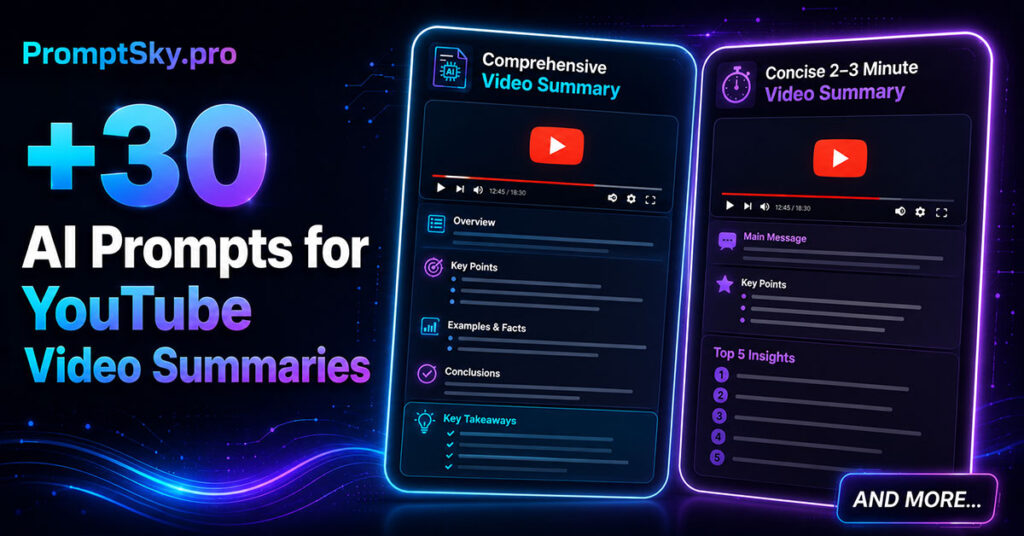
The best YouTube video summary prompt can turn a long transcript into a clear, useful summary with key points, important details, and actionable takeaways. This collection includes 30 detailed prompts for tutorials, podcasts, lectures, interviews, news, business videos, reviews, and more.
To use these prompts, copy the YouTube transcript and paste it into your preferred AI tool, then replace the content inside the [brackets] with your own information when needed. You can adjust the requested format, level of detail, or focus depending on the type of video you want to summarize.
If you need a specific prompt for YouTube summaries, transcripts, research, content creation, or another use case, leave your request in the comments and we may add it to a future collection.
1. Comprehensive YouTube Video Summary Prompt
This prompt is ideal when you need a complete summary of a long YouTube video while preserving its most important information. It works especially well for educational, documentary, tutorial, and analytical videos.
Prompt:
Analyze the provided YouTube video transcript and create a comprehensive summary that captures the video’s main topic, central argument, key points, supporting explanations, examples, important facts, and final conclusions.
Start with a concise overview that explains what the video is about and what the viewer should understand after watching it.
Organize the most important ideas into clear sections and summarize each section in logical order without unnecessarily repeating information.
Preserve important names, numbers, statistics, dates, terminology, comparisons, and specific examples mentioned in the transcript.
Clearly distinguish between factual information, opinions, assumptions, predictions, and recommendations made by the speaker.
Remove filler, greetings, repetition, promotional interruptions, unrelated stories, and conversational content that does not contribute to the video’s main message.
End with a concise list of the most important takeaways a viewer should remember from the entire video.
Make the final result accurate, readable, information-dense, and substantially shorter than the original transcript.
2. Short YouTube Video Summary Prompt
This prompt is useful when you want the core message of a video without reading a long transcript. It focuses on brevity while keeping the information necessary to understand the video.
Prompt:
Summarize the provided YouTube video transcript in a concise but informative format that can be read in approximately two to three minutes.
Begin with a short explanation of the video’s subject and primary purpose before presenting the most important information.
Identify the central message and include only the strongest supporting points, examples, facts, and conclusions from the transcript.
Remove repetitive statements, filler language, introductions, sponsorship segments, jokes, and unnecessary conversational details.
Keep important terminology, statistics, names, dates, and specific claims when they are necessary for understanding the subject.
Present the information in a logical sequence that reflects the video’s actual argument or progression.
Finish with five concise bullet points containing the most valuable insights from the video.
Do not add information that is not supported by the provided transcript, and prioritize accuracy over excessive detail.
3. Detailed Educational Video Summary Prompt
This prompt is designed for lectures, tutorials, online courses, and educational YouTube videos. It emphasizes concepts, explanations, examples, and learning outcomes.
Prompt:
Analyze the provided YouTube educational video transcript and create a detailed study-friendly summary of the material presented.
Identify the main subject, learning objectives, major concepts, definitions, explanations, examples, processes, and conclusions introduced throughout the video.
Explain complicated concepts in clear language while preserving the original meaning and technical accuracy of the speaker.
Organize the summary into logical sections that follow the progression of the lesson instead of simply rewriting the transcript.
Highlight important terms and explain how they relate to the central topic or to other concepts discussed in the video.
Include useful examples, comparisons, formulas, steps, case studies, or practical demonstrations when they contribute to understanding.
End with a concise review section containing the most important lessons and concepts that a student should remember.
Base every statement strictly on the transcript and never invent missing information or unsupported explanations.
4. YouTube Tutorial Summary Prompt
Use this prompt to quickly understand the steps demonstrated in a YouTube tutorial. It converts lengthy explanations into an actionable sequence.
Prompt:
Summarize the provided YouTube tutorial transcript with a strong focus on the practical process demonstrated by the creator.
Begin by explaining what the tutorial teaches, what problem it solves, and what final result the viewer is expected to achieve.
Extract every important step, instruction, setting, command, tool, technique, or decision required to reproduce the process correctly.
Present the procedure in the same logical order as the video and clearly explain the purpose of important steps when the transcript provides that context.
Include relevant warnings, common mistakes, prerequisites, limitations, alternatives, and troubleshooting advice mentioned by the creator.
Remove introductions, repeated explanations, sponsorships, jokes, and unrelated conversation unless they contain useful instructional information.
Finish with a compact checklist of the essential steps needed to complete the tutorial successfully.
Do not introduce instructions that are absent from the transcript, and clearly indicate when the speaker’s explanation is incomplete.
5. YouTube Video Summary for Busy Professionals
This prompt is useful for professionals who need the value of a long YouTube video without spending time watching the entire recording. It prioritizes decisions, insights, data, and actionable information.
Prompt:
Create an executive-style summary of the provided YouTube video transcript for a busy professional who needs the most valuable information quickly.
Start with a two- to three-sentence overview explaining the video’s subject, purpose, and most important conclusion.
Extract the key arguments, evidence, statistics, examples, industry insights, recommendations, risks, opportunities, and practical implications discussed by the speaker.
Prioritize information that could influence a business decision, strategy, workflow, investment, project, or professional judgment.
Remove filler, repetition, personal anecdotes, promotional content, and minor details unless they directly support an important conclusion.
Clearly separate facts from opinions and identify any major assumptions or uncertainties expressed in the video.
End with a section titled “Actionable Takeaways” containing the most useful actions or decisions suggested by the video’s content.
Keep the summary concise, professional, evidence-focused, and faithful to the original transcript.
6. YouTube Video Summary with Key Takeaways
This prompt is designed for readers who want a structured overview followed by the most memorable insights. It works across almost any video category.
Prompt:
Analyze the provided YouTube video transcript and produce a structured summary focused on the video’s most valuable information and practical insights.
Begin with a concise overview of the subject, purpose, and central message of the video.
Identify and explain the major points in the order necessary for understanding the speaker’s overall argument or narrative.
Include important facts, examples, statistics, explanations, comparisons, and conclusions while removing unnecessary repetition and filler.
For every major point, briefly explain why it matters or how it connects to the video’s central message.
Clearly identify any significant claims, recommendations, predictions, or warnings made by the speaker.
End with 7 to 10 concise key takeaways written as memorable statements that capture the video’s most useful lessons.
Do not speculate beyond the transcript and make sure the final summary accurately represents the original content.
7. YouTube Video Summary for Research
This prompt is useful when extracting research-worthy information from interviews, lectures, documentaries, expert discussions, and analytical videos.
Prompt:
Analyze the provided YouTube video transcript as a research assistant and create a precise, evidence-oriented summary of its contents.
Identify the research topic, central questions, major arguments, important claims, evidence, examples, sources mentioned, and conclusions presented by the speaker.
Preserve specific names, dates, statistics, percentages, studies, organizations, quotations, terminology, and other details that may be useful for further research.
Clearly distinguish between information presented as fact, personal opinion, interpretation, speculation, and prediction.
Organize the findings into thematic sections rather than copying the transcript’s conversational structure.
Identify any disagreements, limitations, unanswered questions, contradictions, or uncertainties explicitly mentioned in the video.
Finish with a research notes section containing the most important facts and questions that deserve further investigation.
Never treat an unsupported statement from the speaker as independently verified fact.
8. YouTube Interview Summary Prompt
This prompt works especially well for interviews, podcasts, expert conversations, and founder discussions. It captures both the interviewer’s questions and the guest’s meaningful responses.
Prompt:
Summarize the provided YouTube interview transcript by extracting the most important ideas, experiences, opinions, explanations, and insights shared by the participants.
Begin with a concise overview identifying the interview’s main topic, participants, and overall purpose when that information is available in the transcript.
Organize the summary around the major themes and questions discussed instead of reproducing every exchange in chronological order.
Clearly attribute important statements, opinions, experiences, predictions, and recommendations to the correct speaker.
Preserve significant examples, stories, statistics, professional experiences, disagreements, and explanations that add meaningful context.
Remove greetings, repeated questions, filler conversation, jokes, sponsorships, and unrelated exchanges.
End with a list of the most important insights, memorable arguments, and practical lessons provided by the interviewee or participants.
Do not attribute statements to a speaker unless the transcript clearly supports the attribution.
9. YouTube Podcast Summary Prompt
This prompt is optimized for lengthy podcasts where useful information is spread across multiple discussions. It turns a long conversation into an organized reference.
Prompt:
Analyze the provided YouTube podcast transcript and create a detailed but efficient summary of the most meaningful content discussed throughout the episode.
Start by identifying the central themes, main subjects, and overall purpose of the conversation.
Divide the summary into major discussion topics and explain the most important arguments, insights, examples, experiences, and conclusions associated with each topic.
Preserve important names, statistics, studies, recommendations, personal experiences, disagreements, and specific examples that contribute meaningful context.
Remove repetitive dialogue, casual conversation, introductions, sponsor messages, jokes, and tangents that do not contribute to the core discussion.
Distinguish clearly between personal opinions, factual claims, predictions, anecdotes, and evidence-based statements.
End with a concise list of the episode’s strongest insights and most useful practical takeaways.
Keep the final summary easy to scan while accurately representing the full conversation.
10. YouTube News Video Summary Prompt
This prompt helps summarize news videos without confusing reported facts, commentary, and speculation. It is particularly useful for current events and news analysis.
Prompt:
Summarize the provided YouTube news video transcript with a neutral, factual, and highly structured approach.
Begin with a concise explanation of the main event, issue, or development discussed in the video and why it is significant according to the transcript.
Extract the key facts, dates, people, organizations, locations, statistics, official statements, reported developments, and major claims presented by the speaker.
Clearly distinguish reported facts from commentary, analysis, allegations, predictions, interpretations, and speculation.
Preserve important context explaining what happened, what led to it, what the current situation is, and what consequences are discussed.
Remove repetition, emotional language, promotional material, unrelated commentary, and filler.
End with a brief “What Matters Most” section containing the most important verified-or-reported points from the transcript.
Do not independently verify or invent information unless external sources are explicitly provided alongside the transcript.
11. YouTube Business Video Summary Prompt
This prompt is built for business strategy, entrepreneurship, marketing, management, and corporate YouTube content. It emphasizes commercially relevant insights.
Prompt:
Analyze the provided YouTube business video transcript and create a structured summary focused on the business knowledge and strategic insights it contains.
Identify the main business problem, thesis, strategy, framework, opportunity, or lesson presented by the creator.
Extract important examples, market observations, customer insights, statistics, case studies, processes, recommendations, and strategic arguments.
Explain how the different ideas connect and identify the practical business implications discussed in the video.
Separate factual information, personal experience, opinion, assumptions, and predictions so the reader can evaluate each claim appropriately.
Remove repetitive explanations, promotional segments, generic motivational statements, and unrelated stories.
End with a list of actionable business lessons that could reasonably be applied based on the information presented.
Keep the summary practical, specific, concise, and faithful to the original transcript.
12. YouTube Marketing Video Summary Prompt
This prompt is ideal for videos about digital marketing, SEO, advertising, social media, branding, and customer acquisition. It extracts tactics and strategic recommendations.
Prompt:
Summarize the provided YouTube marketing video transcript with a strong focus on strategies, tactics, frameworks, examples, and measurable insights.
Start by explaining the main marketing problem or objective addressed by the video and the creator’s overall approach to solving it.
Extract every significant marketing strategy, campaign idea, optimization technique, audience insight, channel recommendation, metric, tool, and example discussed.
Explain the purpose and expected impact of each important tactic when the speaker provides enough context to do so.
Preserve relevant statistics, case studies, experiments, results, comparisons, and specific recommendations.
Remove generic motivational content, repetitive explanations, sponsor messages, and unrelated discussion.
Finish with a prioritized list of the most actionable marketing lessons from the video.
Clearly distinguish between strategies supported by examples or evidence and suggestions presented primarily as personal opinions.
13. YouTube Tech Video Summary Prompt
This prompt is useful for software reviews, technology explainers, programming videos, AI discussions, and technical demonstrations. It prioritizes specifications, features, comparisons, and practical implications.
Prompt:
Analyze the provided YouTube technology video transcript and create a technically accurate summary of the information presented.
Identify the main technology, product, software, framework, platform, or technical concept discussed and explain its primary purpose.
Extract important features, specifications, capabilities, limitations, technical details, performance observations, comparisons, use cases, and demonstrations.
Preserve technical terminology while explaining complex points clearly enough for an informed general reader to understand them.
Include relevant benchmarks, measurements, version numbers, compatibility details, pricing information, or implementation requirements when they appear in the transcript.
Clearly separate the creator’s personal experience and opinion from objective specifications or factual claims.
End with a concise section explaining who would benefit most from the technology and what limitations or considerations should be remembered.
Do not add technical specifications or capabilities that are not supported by the provided transcript.
14. YouTube Product Review Summary Prompt
This prompt converts lengthy product reviews into a practical buying-oriented summary. It focuses on strengths, weaknesses, performance, and the reviewer’s final judgment.
Prompt:
Summarize the provided YouTube product review transcript in a practical format designed for someone deciding whether the product is worth considering.
Begin with a concise description of the product, its intended purpose, and the reviewer’s overall impression when clearly stated.
Extract the most important features, specifications, performance observations, advantages, disadvantages, usability details, design comments, and real-world experiences.
Include meaningful comparisons with competing or previous products when the reviewer discusses them.
Preserve relevant pricing, battery life, performance results, durability observations, compatibility information, and other concrete details.
Clearly distinguish the reviewer’s subjective opinions from measurable or objectively described characteristics.
End with separate sections for “Main Pros,” “Main Cons,” and “Best For” based strictly on the transcript.
Do not invent a rating or recommendation if the reviewer does not provide one.
15. YouTube Documentary Summary Prompt
This prompt is designed for documentaries and long-form storytelling videos. It preserves chronology, context, important people, and major developments.
Prompt:
Analyze the provided YouTube documentary transcript and produce a detailed summary that preserves the documentary’s major narrative, historical context, and important developments.
Begin with a concise overview explaining the documentary’s subject, central question, and overall perspective.
Summarize the major events, people, organizations, locations, causes, consequences, discoveries, conflicts, and developments presented throughout the documentary.
Maintain a clear chronological or thematic structure that makes the progression of events easy to understand.
Preserve significant evidence, statistics, historical details, interviews, expert explanations, and examples that contribute to the documentary’s argument.
Clearly distinguish documented facts from interpretations, opinions, theories, or claims presented by participants.
End with the documentary’s main conclusions and the most important facts a viewer should remember.
Remove narration repetition, dramatic filler, promotional material, and details that do not materially contribute to the story.
16. YouTube Lecture Summary Prompt
This prompt turns a long lecture into organized study notes while preserving the lecturer’s reasoning and key concepts.
Prompt:
Convert the provided YouTube lecture transcript into clear, structured, academically useful summary notes.
Identify the lecture’s main topic, objectives, central thesis, key concepts, definitions, arguments, examples, and conclusions.
Follow the lecturer’s logical progression and explain how each major concept connects to the next part of the lecture.
Preserve technical terminology, theories, formulas, historical references, case studies, examples, and important distinctions introduced by the lecturer.
Highlight especially important concepts that appear repeatedly or are explicitly presented as essential to understanding the subject.
Remove greetings, repetition, classroom management comments, filler, jokes, and unrelated discussion.
Finish with a concise revision section containing the key concepts, definitions, and conclusions a student should review before an exam.
Use only information contained in the transcript and never fabricate missing lecture content.
17. YouTube Motivational Video Summary Prompt
This prompt summarizes motivational content without reproducing excessive emotional language. It focuses on principles, advice, examples, and actionable lessons.
Prompt:
Summarize the provided YouTube motivational video by extracting the practical principles, ideas, arguments, stories, and recommendations that provide meaningful value to the viewer.
Begin with a concise explanation of the video’s central message and the main problem or mindset it addresses.
Identify the key principles, habits, beliefs, strategies, examples, personal experiences, and behavioral recommendations presented by the speaker.
Condense inspirational stories into their essential lessons rather than repeating the complete narrative.
Clearly distinguish general advice, personal opinions, personal experiences, and claims presented as factual information.
Remove excessive emotional language, repeated motivational statements, introductions, sponsorships, and unrelated storytelling.
End with a practical action list showing what a viewer could apply from the video’s advice.
Keep the tone clear and useful rather than overly inspirational, while remaining faithful to the speaker’s original message.
18. YouTube Finance Video Summary Prompt
This prompt is useful for financial education, investing, economics, personal finance, and market commentary. It emphasizes numbers, assumptions, risks, and conclusions.
Prompt:
Analyze the provided YouTube finance video transcript and create a structured summary focused on the financial information, reasoning, data, and recommendations presented.
Identify the main financial topic, argument, investment thesis, economic issue, or personal finance problem discussed in the video.
Extract important numbers, percentages, dates, financial concepts, market observations, examples, assumptions, risks, opportunities, and recommendations.
Clearly distinguish factual financial information from the creator’s opinions, forecasts, assumptions, and speculative scenarios.
Preserve important calculations, comparisons, historical references, and explanations that are necessary to understand the speaker’s reasoning.
Remove repetitive commentary, emotional statements, promotional content, and unrelated discussion.
End with a balanced summary of the main potential benefits, risks, uncertainties, and practical lessons mentioned in the video.
Do not convert the creator’s opinions or predictions into financial advice, and do not add information that is absent from the transcript.
19. YouTube How-To Video Summary Prompt
This prompt is specifically designed for practical how-to content where the viewer needs a clear sequence of actions. It turns conversational instructions into usable steps.
Prompt:
Analyze the provided YouTube how-to video transcript and transform the instructional content into a clear, practical, step-by-step summary.
Begin by explaining the task being demonstrated, the expected outcome, and any prerequisites or tools mentioned by the creator.
Extract every essential action in the correct order and describe what the user needs to do at each stage.
Include important settings, measurements, commands, materials, options, warnings, mistakes, troubleshooting tips, and alternative methods mentioned in the video.
Briefly explain why each critical step matters when the creator provides a reason or explanation.
Remove introductions, repeated instructions, jokes, sponsorships, and unrelated conversation.
End with a short checklist that allows the reader to verify that all major steps have been completed.
Never invent missing steps or assume technical details that are not contained in the transcript.
20. YouTube Comparison Video Summary Prompt
This prompt is useful for videos comparing products, services, tools, technologies, strategies, or competing options. It makes the differences easy to understand.
Prompt:
Summarize the provided YouTube comparison video by clearly identifying the options being compared and the criteria used by the creator.
Begin with a concise overview of what is being compared and the overall conclusion reached by the speaker, if one is explicitly provided.
Extract the most important differences in features, performance, pricing, usability, quality, compatibility, advantages, disadvantages, and intended use cases.
Organize the information by comparison category so that similarities and differences are easy to identify.
Preserve concrete numbers, benchmarks, specifications, examples, test results, and direct observations whenever they are relevant.
Clearly distinguish objective differences from the creator’s personal preferences, subjective judgments, and recommendations.
End with a concise explanation of which option appears most suitable for each type of user according to the video’s reasoning.
Do not create a winner or ranking unless the transcript provides sufficient evidence or an explicit conclusion.
21. YouTube AI Video Summary Prompt
This prompt is designed for videos about artificial intelligence, AI tools, models, workflows, and emerging technologies. It focuses on capabilities, limitations, use cases, and practical implications.
Prompt:
Analyze the provided YouTube AI video transcript and create a detailed summary of the artificial intelligence concepts, tools, models, workflows, and claims discussed.
Identify the main AI technology or topic and explain the core problem, capability, or opportunity presented by the creator.
Extract important features, model capabilities, use cases, workflows, examples, benchmarks, limitations, integrations, pricing details, and technical observations mentioned in the video.
Clearly distinguish demonstrated capabilities from predictions, opinions, assumptions, and speculative statements about future AI developments.
Preserve relevant model names, versions, tools, technical terminology, and specific examples that help the reader understand the discussion.
Remove hype, repetition, promotional language, sponsorship content, and unrelated discussion.
End with a practical list of the most useful AI applications, limitations, and lessons presented in the video.
Do not assume that a claimed AI capability is independently verified unless the transcript provides supporting evidence.
22. YouTube SEO Video Summary Prompt
This prompt is ideal for SEO tutorials, Google updates, content strategy, technical SEO, and search marketing videos. It extracts tactics and important recommendations.
Prompt:
Summarize the provided YouTube SEO video transcript with a strong focus on actionable search engine optimization insights and strategies.
Identify the primary SEO topic, problem, update, strategy, or framework discussed and explain the creator’s central recommendation.
Extract important SEO techniques, ranking factors, content strategies, keyword methods, technical recommendations, link-building approaches, examples, tools, metrics, and case studies.
Preserve relevant terminology, data, experiments, observations, algorithm references, and specific recommendations.
Clearly separate confirmed information, personal experience, hypotheses, opinions, and predictions about search engine behavior.
Remove generic advice, repeated statements, promotional segments, and unrelated commentary.
End with a prioritized list of practical SEO actions that can be derived directly from the video’s content.
Do not claim that any tactic guarantees rankings or results unless the speaker explicitly provides evidence supporting such a conclusion.
23. YouTube Course Summary Prompt
This prompt is useful when a YouTube video functions as part of a course or training series. It produces structured notes that can be reviewed later.
Prompt:
Convert the provided YouTube course lesson transcript into structured learning notes that make the material easy to review and apply.
Begin by identifying the lesson’s main objective and explain what knowledge or skill the viewer is expected to gain.
Extract the major concepts, definitions, methods, examples, demonstrations, exercises, frameworks, and conclusions introduced in the lesson.
Organize the information into logical sections and preserve the order needed to understand the lesson progressively.
Highlight important terminology, principles, mistakes, warnings, and practical recommendations that a learner should remember.
Remove repetition, filler, greetings, sponsorships, and unrelated conversation while keeping explanations necessary for understanding.
End with a concise lesson recap containing the most important concepts and practical skills covered.
Base the notes entirely on the provided transcript and never fill gaps with assumptions or outside knowledge.
24. YouTube Case Study Summary Prompt
This prompt is designed for case studies involving companies, campaigns, projects, experiments, products, or real-world business outcomes. It emphasizes cause, action, and results.
Prompt:
Analyze the provided YouTube case study transcript and summarize it as a structured examination of the situation, actions, results, and lessons presented.
Begin by explaining the case study subject, initial situation, primary challenge, and objective described in the video.
Identify the major strategies, decisions, experiments, processes, resources, and actions taken by the people or organization involved.
Preserve important numbers, timelines, metrics, results, failures, improvements, comparisons, and evidence mentioned by the creator.
Explain the relationship between the actions taken and the outcomes reported without assuming causation that the transcript does not establish.
Clearly distinguish verified results, reported observations, interpretations, and opinions.
End with the most important lessons, mistakes to avoid, and strategies that the case study suggests may be worth considering.
Do not invent missing metrics, outcomes, reasons, or conclusions.
25. YouTube Book Summary Video Prompt
This prompt is useful for videos that explain or review books. It focuses on the author’s ideas while distinguishing the video’s interpretation from the original work.
Prompt:
Summarize the provided YouTube book summary or book review transcript by extracting the central ideas, arguments, concepts, examples, and conclusions discussed by the creator.
Begin by identifying the book’s title, author, subject, and main thesis when those details are available in the transcript.
Organize the summary around the major ideas or chapters discussed rather than reproducing the creator’s conversational presentation.
Explain important concepts, principles, examples, frameworks, and arguments in clear language while preserving their intended meaning.
Clearly distinguish ideas attributed to the book’s author from the YouTuber’s own interpretations, opinions, criticisms, or commentary.
Remove filler, repetition, sponsorships, unrelated anecdotes, and promotional language.
End with the most important lessons and a concise explanation of what the viewer can learn from the book according to the video.
Do not invent chapters, arguments, quotations, or conclusions that are not present in the transcript.
26. YouTube Fitness Video Summary Prompt
This prompt is useful for workout guides, exercise explanations, nutrition discussions, and fitness education. It extracts practical information while preserving important caveats.
Prompt:
Analyze the provided YouTube fitness video transcript and create a structured summary of the training, exercise, nutrition, or wellness information presented.
Begin by identifying the video’s main objective and the specific problem, workout, routine, or topic being addressed.
Extract the exercises, sets, repetitions, durations, techniques, equipment, routines, nutritional suggestions, principles, and recommendations mentioned by the creator.
Preserve important explanations about form, progression, frequency, recovery, limitations, contraindications, or common mistakes when they appear in the transcript.
Clearly distinguish personal experience, general recommendations, evidence-based claims, and opinions expressed by the speaker.
Remove repetition, motivational filler, sponsorships, jokes, and unrelated conversation.
End with a concise practical recap of the main routine or lessons described in the video.
Do not invent exercise prescriptions or medical claims, and do not present the creator’s statements as universally applicable without appropriate context.
27. YouTube Gaming Video Summary Prompt
This prompt works for gaming guides, reviews, walkthroughs, updates, strategy videos, and gaming news. It extracts useful information for players without unnecessary commentary.
Prompt:
Summarize the provided YouTube gaming video transcript with a focus on information that is useful to players, viewers, or gaming enthusiasts.
Identify the game, update, feature, strategy, challenge, review topic, or news story being discussed and explain the video’s central message.
Extract important mechanics, strategies, tips, builds, settings, changes, characters, weapons, maps, missions, features, statistics, and recommendations mentioned by the creator.
Preserve version numbers, update details, specific requirements, comparisons, performance observations, and practical examples when they are relevant.
Clearly distinguish confirmed game information from speculation, leaks, predictions, personal preferences, and theories.
Remove repetitive gameplay commentary, jokes, filler, sponsorships, and unrelated conversation.
End with a concise list of the most useful tips, changes, or takeaways for players.
Do not add game mechanics, features, or updates that are not supported by the transcript.
28. YouTube History Video Summary Prompt
This prompt is designed for historical videos and historical documentaries. It prioritizes chronology, context, people, causes, and consequences.
Prompt:
Analyze the provided YouTube history video transcript and create a clear, chronological, and context-rich summary of the historical information presented.
Begin with the historical period, event, civilization, person, conflict, or development being discussed and explain the video’s central focus.
Extract important dates, locations, people, political developments, causes, conflicts, decisions, turning points, and consequences mentioned by the narrator.
Organize events in a logical chronological sequence while explaining relationships between major developments.
Preserve important evidence, historical interpretations, competing explanations, quotations, statistics, and contextual details when they appear in the transcript.
Clearly distinguish established historical information from theories, interpretations, disputed claims, or the narrator’s commentary.
End with the major causes, turning points, consequences, and historical lessons emphasized by the video.
Do not introduce historical facts that are absent from the transcript unless external sources are explicitly provided.
29. YouTube Long-Form Video Summary Prompt
This prompt is built for extremely long YouTube videos where viewers need a compact but comprehensive overview. It balances depth with efficient reading.
Prompt:
Analyze the entire provided YouTube transcript and create a highly structured summary that captures the most valuable information from the full long-form video.
Begin with a concise executive overview explaining the video’s subject, central thesis, major themes, and overall conclusion.
Divide the remaining summary into logical thematic sections and extract the strongest arguments, evidence, examples, stories, facts, explanations, and conclusions from each section.
Preserve important names, dates, statistics, technical terms, comparisons, case studies, and specific examples that materially contribute to understanding the subject.
Remove repeated explanations, filler, tangents, sponsorships, greetings, jokes, and minor details while retaining necessary context.
Identify the relationships between the video’s major ideas and explain how the creator moves from one argument or topic to another.
Finish with a prioritized list of the most important insights, practical lessons, and conclusions from the complete video.
Make the result substantially shorter than the transcript while ensuring that a reader can understand the video’s essential content without watching it.
30. Ultimate Best YouTube Video Summary Prompt
This is an all-purpose version for users who want one highly flexible prompt that can handle educational, business, technical, documentary, interview, tutorial, and analytical YouTube content.
Prompt:
Analyze the provided YouTube video transcript and create an accurate, comprehensive, and highly readable summary that captures the video’s essential information without unnecessary length.
Begin with a concise overview explaining the video’s subject, purpose, central message, and most important conclusion.
Identify the major topics, arguments, concepts, facts, examples, statistics, stories, recommendations, comparisons, and conclusions presented throughout the video.
Organize the information into logical sections based on the video’s actual themes or progression, and preserve important details such as names, dates, numbers, terminology, processes, and specific examples.
Clearly distinguish factual claims, personal opinions, interpretations, predictions, assumptions, anecdotes, and recommendations so the reader understands the nature of each statement.
Remove filler, repetition, introductions, sponsorships, promotional language, unrelated tangents, and conversational material that does not add meaningful information.
End with a concise “Key Takeaways” section containing the most important insights, followed by an “Actionable Lessons” section when the video provides practical advice.
The final output must be substantially shorter than the original transcript, strictly grounded in the provided content, easy to scan, and detailed enough to serve as a reliable alternative reference to the full video.