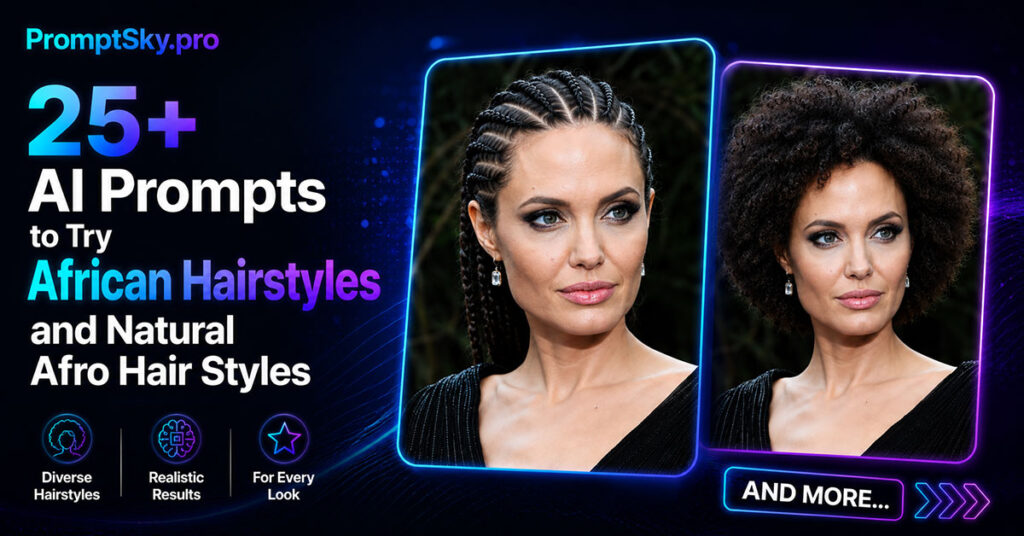
African and Afro hairstyle AI prompts make it easier to visualize natural Afros, braids, twists, locs, and other textured hairstyles on your own photo. This collection includes 30 detailed prompts covering styles such as Afro, Box Braids, Cornrows, Fulani Braids, Senegalese Twists, Bantu Knots, Locs, Faux Locs, and Two-Strand Twists.
How to Use These African Hairstyle AI Prompts
Upload a clear, high-resolution photo to an AI image editor and choose the hairstyle you want to try. Paste the corresponding prompt and let the AI transform the hair while keeping your facial identity, skin tone, expression, clothing, pose, background, lighting, and overall composition consistent with the original image. A front-facing or slightly angled portrait with clearly visible hair usually produces better results. You can also customize the length, braid size, twist thickness, volume, texture, or arrangement to match the exact look you have in mind.
For more hairstyle transformations, explore 25 Modern Women’s Hairstyle AI Prompts for Realistic Hair Transformations, featuring modern cuts such as Bobs, Pixie Cuts, Wolf Cuts, Butterfly Haircuts, and different types of bangs. You can also compare these textured and natural styles with 30 Classic Hairstyle AI Prompts for Realistic Haircut Edits.
Looking beyond hairstyle editing? Browse AI Prompts to find prompts for Photography, Career & Resume, Marketing, Product Promotion, Personal Growth, Social Media, and Writing & Creativity.
If there is an African hairstyle, braid pattern, twist style, or loc variation you want to see next, leave your request in the comments and tell us which prompt you need.
1. Afro
The Afro is a naturally voluminous hairstyle that celebrates the shape, texture, and density of tightly curled hair. This prompt is designed to create a full, rounded Afro while preserving the subject’s identity and the original characteristics of the reference photo.
Prompt:
A highly detailed photorealistic photo edit of the subject in the provided reference image, preserving the exact identity, facial structure, skin tone, facial expression, head shape, body proportions, and natural features of the original person. Transform only the hairstyle into a full, naturally rounded Afro with dense, tightly coiled hair extending evenly around the head. Create realistic coil patterns with varied strand directions, natural density, authentic volume, and subtle irregularities rather than an artificially perfect spherical shape. Maintain believable hairline details around the forehead, temples, and ears with individual strands and natural growth patterns. Add realistic texture, soft highlights, dimensional shadows, subtle flyaway hairs, and authentic separation between small sections of tightly coiled hair. Preserve the original clothing, pose, background, lighting, camera angle, framing, and composition exactly as shown. The final result should look like a professionally photographed person with a healthy, natural, voluminous Afro hairstyle.
2. Afro Puff
The Afro Puff gathers textured hair into a rounded puff, creating a simple but expressive hairstyle with visible natural volume. It works well for visualizing a clean updo while keeping the hair texture realistic.
Prompt:
A highly detailed realistic photo edit of the subject using the supplied reference image as the exact identity reference, preserving the person’s facial features, skin tone, expression, proportions, and natural appearance. Change only the hairstyle into a classic Afro Puff with the naturally textured hair gathered upward or toward the back into one prominent rounded puff. Keep the puff dense, voluminous, and visibly composed of tightly coiled natural hair with realistic variation in curl direction and strand density. Create a natural gathered section near the crown while preserving realistic edges and subtle baby hairs around the forehead, temples, and hairline. Add authentic coily texture, individual strands, soft shadows within the puff, natural highlights, and subtle flyaways. Avoid an unnaturally smooth or perfectly symmetrical shape, allowing realistic texture and volume variations. Preserve the original clothing, pose, background, lighting, camera perspective, framing, and composition exactly. The final image should look like a genuine high-resolution portrait of the same person wearing a naturally styled Afro Puff.
3. TWA (Teeny Weeny Afro)
A TWA is a very short natural hairstyle that keeps tightly coiled texture close to the scalp. This prompt focuses on realistic short coils, natural density, and a clean but authentic shape.
Prompt:
A highly detailed photorealistic hairstyle transformation of the subject in the provided reference image, preserving the exact identity, facial structure, skin tone, facial expression, head shape, and natural proportions. Transform only the hairstyle into a TWA, or Teeny Weeny Afro, with very short tightly coiled natural hair covering the scalp evenly and following the natural shape of the head. Create clearly visible micro-coil texture with realistic variation in curl direction, density, and length rather than making the hair appear like a flat textured surface. Maintain a natural hairline around the forehead, temples, ears, and nape with subtle baby hairs and realistic individual strands. Add detailed scalp-to-hair transitions, natural shadows, soft highlights, and authentic coily texture while keeping the overall hairstyle compact and low-profile. Preserve the original clothing, pose, background, lighting, camera angle, framing, and composition completely unchanged. The final result should look like a real professionally photographed TWA with highly realistic natural hair texture.
4. Afro Fade
The Afro Fade combines a textured Afro top with gradually shorter sides and back. It creates a strong contrast while maintaining natural volume and coily texture through the upper section.
Prompt:
A highly detailed professional photo edit of the subject in the supplied reference image, preserving the exact identity, facial structure, skin tone, expression, proportions, and natural characteristics. Change only the hairstyle into an Afro Fade with a full, naturally textured Afro section on top and progressively shorter sides and back. Create a smooth fade transition from the dense coily hair on the upper head toward very short hair around the temples, ears, and neckline. Maintain realistic tightly coiled texture across the top with varied curl density, individual strands, natural volume, and subtle irregularities. Carefully blend the fade into the natural hairline with realistic scalp visibility in the shortest areas and authentic barbering detail. Add soft shadows, natural highlights, subtle flyaway hairs, and believable hair growth patterns. Preserve the original clothing, pose, background, lighting, camera perspective, framing, and composition exactly. The finished hairstyle should look like a professionally executed Afro Fade captured in a realistic high-resolution photograph.
5. Flat Top
The Flat Top creates a structured, elevated shape with tightly textured hair and a noticeably level upper surface. It combines strong geometric definition with natural hair texture.
Prompt:
A highly detailed photorealistic photo edit of the subject in the provided reference image, preserving the exact facial identity, facial structure, skin tone, expression, head shape, and natural proportions. Transform only the hairstyle into a classic Flat Top with dense, tightly textured hair shaped upward into a structured silhouette and a noticeably level, horizontal top surface. Keep the sides shorter and neatly tapered while maintaining strong height and volume across the upper section. Create realistic coily hair texture throughout the top, with individual strands and subtle variations that prevent the flat surface from looking artificially smooth. Maintain clean but natural edges around the temples, forehead, ears, and neckline with realistic barbering detail. Add dimensional shadows, subtle highlights, authentic hair density, and believable scalp transitions in the shorter sections. Preserve the original clothing, pose, background, lighting, camera angle, framing, and composition exactly. The final result should resemble a professionally shaped Flat Top photographed with realistic high-resolution detail.
6. Box Braids
Box Braids divide the hair into individual square or rectangular sections and form long, uniform braids. This prompt emphasizes clean parting, realistic braid structure, and natural integration with the scalp.
Prompt:
A highly detailed realistic photo edit of the subject in the supplied reference image, preserving the exact identity, facial structure, skin tone, facial expression, proportions, and natural features. Transform only the hairstyle into long Box Braids created from clearly separated square or rectangular sections across the scalp. Form each braid with realistic three-dimensional strands and consistent but naturally varied thickness, extending from the roots toward the desired length. Create believable scalp parting with clean geometric sections while maintaining natural hair density and realistic tension at the roots. Add detailed braid patterns, individual interwoven strands, subtle texture, natural shadows between braids, and realistic highlights along the woven surfaces. Ensure the braids fall naturally around the head and shoulders with believable weight and movement. Preserve the original clothing, pose, background, lighting, camera perspective, framing, and composition completely unchanged. The final image should look like an authentic professionally photographed Box Braids hairstyle with highly detailed natural texture.
7. Knotless Braids
Knotless Braids use a smoother feed-in technique at the roots, creating a flatter and more natural transition from the scalp into each braid. The hairstyle should look neat without appearing excessively tight or artificial.
Prompt:
A highly detailed photorealistic hairstyle transformation of the subject in the provided reference image, preserving the exact facial identity, facial structure, skin tone, expression, proportions, and natural appearance. Change only the hairstyle into long Knotless Braids with clean, individually separated sections and a smooth feed-in appearance at the roots without visible bulky knots. Create realistic braids with consistent but slightly varied thickness, natural tension, and detailed interwoven strands extending from the scalp toward the desired length. Maintain believable parting patterns across the scalp with realistic spacing and natural hair density between sections. Add subtle shadows at the roots, individual braid strands, authentic texture, natural highlights, and realistic movement as the braids fall around the shoulders and back. Ensure the hairstyle follows the subject’s natural head shape and hairline without changing the face. Preserve the original clothing, pose, background, lighting, camera angle, framing, and composition exactly. The final result should look like professionally installed Knotless Braids photographed in high resolution.
8. Fulani Braids
Fulani Braids combine detailed cornrow patterns, individual braids, and decorative elements inspired by traditional Fulani hairstyling. The design should remain culturally recognizable while looking natural and professionally executed.
Prompt:
A highly detailed professional photo edit of the subject in the supplied reference image, preserving the exact identity, facial structure, skin tone, facial expression, proportions, and natural features. Transform only the hairstyle into an elegant Fulani Braids style featuring a combination of intricate cornrows, central braided sections, and longer individual braids flowing naturally around the head and shoulders. Create realistic scalp parting with carefully arranged geometric and curved braid patterns while maintaining natural hair density and believable root tension. Incorporate subtle traditional-inspired braid details and optional small decorative beads or braid accents in a restrained, authentic manner without overwhelming the hairstyle. Add realistic individual woven strands, natural shadows between braids, subtle highlights, fine baby hairs, and believable texture. Ensure every braid follows the natural contours of the scalp and falls with realistic weight and movement. Preserve the original clothing, pose, background, lighting, camera perspective, framing, and composition exactly. The final result should look like a professionally styled, highly detailed Fulani Braids hairstyle captured in a realistic portrait.
9. Ghana Braids
Ghana Braids are defined by structured, often thick cornrow patterns that can be arranged into elegant geometric designs. This prompt emphasizes clean scalp sections, dimensional braids, and realistic texture.
Prompt:
A highly detailed photorealistic photo edit of the subject using the provided reference image as the exact identity reference, preserving the person’s facial structure, skin tone, expression, proportions, and natural characteristics. Transform only the hairstyle into traditional Ghana Braids featuring thick, raised cornrows arranged in clean geometric or curved patterns across the scalp. Create realistic feed-in construction where each braid gradually develops thickness from the roots while maintaining smooth, believable transitions. Add carefully separated scalp sections, detailed woven texture, realistic braid volume, individual strands, subtle highlights, and dimensional shadows between the raised braids. Maintain natural hairline details and fine baby hairs around the forehead and temples for a realistic finish. Ensure the braid patterns follow the shape of the head and maintain believable tension without appearing digitally stamped onto the scalp. Preserve the original clothing, pose, background, lighting, camera angle, framing, and composition unchanged. The final result should resemble an authentic professionally installed Ghana Braids hairstyle photographed in high resolution.
10. Cornrows
Cornrows are tightly braided close to the scalp in structured rows or patterns. They can be arranged in straight, curved, geometric, or creative designs while maintaining clear scalp separation.
Prompt:
A highly detailed realistic hairstyle transformation of the subject in the supplied reference image, preserving the exact identity, facial features, skin tone, expression, head shape, and natural proportions. Change only the hairstyle into neatly executed Cornrows braided closely against the scalp in multiple clean, structured rows. Create realistic parting between each row with visible scalp separation and natural hair density around the braided sections. Use carefully controlled braid direction and slightly varied row thickness to create an authentic professionally installed appearance rather than perfectly identical patterns. Add detailed woven texture, individual strands, subtle shadows along the scalp, realistic highlights, and fine baby hairs around the hairline and temples. Ensure the cornrows follow the natural curvature of the head and maintain realistic tension and depth. Preserve the original clothing, pose, background, lighting, camera perspective, framing, and composition exactly. The final image should look like a genuine high-resolution photograph of the same person wearing professionally styled Cornrows.
11. Feed-In Braids
Feed-In Braids gradually incorporate additional hair into the braid, creating a smooth increase in thickness from the scalp. They offer a clean, controlled appearance with natural-looking roots.
Prompt:
A highly detailed photorealistic photo edit of the subject in the provided reference image, preserving the exact identity, facial structure, skin tone, expression, proportions, and natural features. Transform only the hairstyle into long Feed-In Braids with multiple neatly arranged braided rows that begin thin near the scalp and gradually increase in thickness as additional hair is incorporated. Create realistic scalp parting with clean sections and natural spacing between each braid. Maintain detailed woven texture, believable braid tension, individual interlaced strands, subtle variation in thickness, and realistic movement as the braids extend away from the head. Add fine baby hairs around the forehead and temples, natural scalp shadows, subtle highlights, and authentic hair texture. Ensure the braids follow the natural curvature of the head and do not appear pasted onto the scalp. Preserve the original clothing, pose, background, lighting, camera angle, framing, and composition completely unchanged. The final result should look like professionally installed Feed-In Braids captured in a realistic high-resolution portrait.
12. Lemonade Braids
Lemonade Braids are usually arranged in closely spaced, side-swept cornrow patterns that create a strong directional flow. The hairstyle should emphasize the curved rows and clean scalp sections.
Prompt:
A highly detailed professional photo edit of the subject in the supplied reference image, preserving the exact identity, facial structure, skin tone, facial expression, proportions, and natural appearance. Transform only the hairstyle into long Lemonade Braids featuring multiple cornrow-style braids arranged in a distinctive side-swept direction across the scalp. Create curved, parallel braid rows with realistic spacing, clean scalp sections, and natural variation in braid thickness. Allow the braids to flow toward one side of the head and continue naturally into longer braided lengths around the shoulder and back. Add detailed woven strands, realistic braid texture, subtle shadows between rows, natural highlights, fine baby hairs, and believable root tension. Ensure the side-swept pattern follows the subject’s head shape and remains professionally structured without looking mechanically perfect. Preserve the original clothing, pose, background, lighting, camera perspective, framing, and composition exactly. The final image should look like an authentic, professionally styled Lemonade Braids hairstyle photographed with high-resolution detail.
13. Tribal Braids
Tribal Braids feature creative combinations of cornrows, individual braids, geometric sections, and decorative details. The prompt should produce an intricate but cohesive hairstyle with realistic braid construction.
Prompt:
A highly detailed photorealistic hairstyle transformation of the subject in the provided reference image, preserving the exact identity, facial structure, skin tone, expression, proportions, and natural characteristics. Change only the hairstyle into an intricate Tribal Braids design combining multiple cornrow patterns, individual braids, curved sections, and carefully organized geometric parting. Create varied braid sizes and directions to produce a layered, artistic appearance while maintaining realistic scalp spacing and natural hair density. Add subtle decorative braid elements such as small beads or wrapped sections where appropriate, keeping the overall design balanced and authentic. Include detailed interwoven strands, realistic shadows between braids, natural highlights, fine baby hairs, believable root tension, and dimensional texture. Ensure the entire hairstyle follows the natural contours of the head and falls naturally around the shoulders. Preserve the original clothing, pose, background, lighting, camera angle, framing, and composition completely unchanged. The final result should look like a professionally crafted, highly detailed Tribal Braids hairstyle captured in a realistic editorial portrait.
14. Senegalese Twists
Senegalese Twists are smooth, rope-like two-strand twists with a polished appearance and consistent cylindrical texture. They can be worn long and flowing while retaining natural movement and realistic weight.
Prompt:
A highly detailed professional photo edit of the subject in the provided reference image, preserving the exact facial identity, facial structure, skin tone, expression, proportions, and natural features. Transform only the hairstyle into long Senegalese Twists with smooth, rope-like two-strand twists extending from cleanly separated sections at the scalp toward the shoulders and back. Create consistent cylindrical twists with realistic variation in thickness, natural tension, and believable individual strand integration. Maintain clear but natural scalp parting without making every section perfectly geometric, and allow the twists to overlap and move naturally according to gravity. Add subtle highlights along the twisted surfaces, dimensional shadows between twists, realistic root texture, fine baby hairs, and authentic hair density. Ensure the twists have believable weight and movement rather than appearing rigid or digitally generated. Preserve the original clothing, pose, background, lighting, camera perspective, framing, and composition exactly. The final result should look like professionally installed Senegalese Twists captured in a high-resolution realistic photograph.
15. Havana Twists
Havana Twists are thicker, fuller rope-like twists with a textured and slightly chunky appearance. They create substantial volume while maintaining the recognizable two-strand construction.
Prompt:
A highly detailed photorealistic photo edit of the subject in the supplied reference image, preserving the exact identity, facial structure, skin tone, expression, head shape, proportions, and natural characteristics. Change only the hairstyle into long, voluminous Havana Twists featuring thick, rope-like two-strand twists with a soft, textured surface. Create substantial but realistic volume around the head and shoulders while maintaining believable twist thickness and natural variation between individual sections. Keep the roots neatly separated with realistic scalp parting and natural tension, then allow the twists to become fuller through the lengths. Add detailed twisted strand patterns, subtle frizz, individual fibers, natural highlights, dimensional shadows, and authentic texture across each twist. Allow the twists to fall and overlap naturally according to gravity, preserving realistic weight and movement. Keep the original clothing, pose, background, lighting, camera angle, framing, and composition completely unchanged. The final result should resemble an authentic professionally styled Havana Twists hairstyle photographed with detailed natural texture.
16. Marley Twists
Marley Twists are rope-like twists with a naturally textured, slightly coarse appearance that closely resembles natural Afro-textured hair. The style creates substantial length and volume while retaining a soft, organic finish.
Prompt:
A highly detailed photorealistic photo edit of the subject in the provided reference image, preserving the exact identity, facial structure, skin tone, facial expression, head shape, body proportions, and natural features. Transform only the hairstyle into long Marley Twists with a naturally textured, slightly coarse rope-like appearance and clearly visible two-strand construction. Create medium-to-thick twists with realistic variation in thickness, length, and surface texture, avoiding an overly smooth or synthetic finish. Maintain clean but natural scalp sections at the roots, with believable tension and realistic transitions from the natural hair into each twist. Add fine fibers, subtle frizz, individual strands, natural highlights, dimensional shadows, and authentic Afro-textured detail throughout the hairstyle. Allow the twists to overlap and fall naturally around the shoulders and back according to gravity. Preserve the original clothing, pose, background, lighting, camera angle, framing, and composition exactly. The final image should look like a professionally styled Marley Twists hairstyle photographed in high-resolution natural light.
17. Passion Twists
Passion Twists have a soft, slightly undone rope-like appearance with visible texture and gentle irregularity. They create a relaxed hairstyle that looks intentionally natural rather than perfectly polished.
Prompt:
A highly detailed realistic hairstyle transformation of the subject in the supplied reference image, preserving the exact facial identity, facial structure, skin tone, expression, proportions, and natural appearance. Change only the hairstyle into long Passion Twists with a soft, textured, slightly bohemian appearance and clearly recognizable two-strand construction. Create medium-sized twists with gently irregular surfaces, subtle variation in thickness, and naturally loose sections that give the hairstyle an effortless appearance. Maintain realistic scalp parting with believable root tension while allowing individual twists to curve, overlap, and fall naturally around the shoulders and back. Add fine fibers, subtle frizz, individual strands, natural highlights, soft shadows, and authentic textured detail along each twist. Avoid excessive uniformity or artificial smoothness so the hairstyle feels genuinely hand-styled and natural. Preserve the original clothing, pose, background, lighting, camera perspective, framing, and composition completely unchanged. The final result should resemble a real professionally installed Passion Twists hairstyle captured in a high-resolution portrait.
18. Kinky Twists
Kinky Twists are compact twists with a distinctly textured, tightly coiled appearance. They combine defined rope-like sections with the natural texture associated with tightly curled hair.
Prompt:
A highly detailed photorealistic photo edit of the subject in the provided reference image, preserving the exact identity, facial structure, skin tone, facial expression, proportions, head shape, and natural characteristics. Transform only the hairstyle into medium-to-long Kinky Twists featuring tightly textured, compact two-strand twists with a visibly coily and slightly coarse surface. Create individual twists with realistic variation in length and thickness while maintaining a consistent overall hairstyle. Keep the roots naturally separated into clean sections with believable tension and realistic transitions from the scalp into the twisted lengths. Add fine fibers, subtle frizz, individual textured strands, natural highlights, dimensional shadows, and authentic Afro-textured detail throughout the hairstyle. Allow the twists to move naturally around the head, shoulders, and back rather than appearing rigid or perfectly parallel. Preserve the original clothing, pose, background, lighting, camera angle, framing, and composition exactly. The final result should look like an authentic professionally styled Kinky Twists hairstyle photographed with realistic high-resolution hair detail.
19. Spring Twists
Spring Twists are lightweight, tightly coiled twists with a bouncy, spring-like texture and visible curl definition. Their compact shape should create natural volume without looking stiff.
Prompt:
A highly detailed professional photo edit of the subject in the supplied reference image, preserving the exact identity, facial structure, skin tone, expression, proportions, and natural features. Change only the hairstyle into medium-length Spring Twists with tightly coiled, lightweight twists that naturally compress and expand like small springs. Create numerous individual twists with defined spiral texture, realistic variation in thickness, and subtle differences in length for an authentic appearance. Maintain natural scalp parting and believable root transitions while keeping the twists lightweight and slightly bouncy around the head and shoulders. Add detailed spiral fibers, fine flyaway hairs, natural highlights, soft shadows, subtle frizz, and realistic Afro-textured detail throughout. Allow individual twists to bend, curl, overlap, and separate naturally rather than forming rigid repetitive patterns. Preserve the original clothing, pose, background, lighting, camera perspective, framing, and composition completely unchanged. The final image should look like a professionally styled Spring Twists hairstyle captured in a realistic high-resolution photograph.
20. Bantu Knots
Bantu Knots are small sections of tightly coiled hair wrapped into compact rounded knots close to the scalp. The hairstyle creates a distinctive geometric pattern while celebrating natural hair texture.
Prompt:
A highly detailed photorealistic hairstyle transformation of the subject in the provided reference image, preserving the exact facial identity, facial structure, skin tone, expression, head shape, proportions, and natural features. Transform only the hairstyle into a series of neatly arranged Bantu Knots, with the hair divided into multiple individual sections and each section twisted and wrapped into a compact rounded knot close to the scalp. Create realistic geometric parting between the knots while allowing slight natural variation in size, shape, and placement. Maintain authentic Afro-textured hair at the roots with visible coily strands and believable tension around each wrapped section. Add subtle baby hairs around the hairline, fine individual strands, natural highlights, dimensional shadows, and realistic texture across every knot. Ensure the knots look securely wrapped but not unnaturally rigid or perfectly identical. Preserve the original clothing, pose, background, lighting, camera angle, framing, and composition exactly. The final image should look like a genuine professionally styled Bantu Knots hairstyle captured in high-resolution detail.
21. Bantu Knot-Out
A Bantu Knot-Out creates defined, voluminous curls after the knots are unraveled. The result should show soft, springy texture with natural separation and movement.
Prompt:
A highly detailed realistic photo edit of the subject in the supplied reference image, preserving the exact identity, facial structure, skin tone, facial expression, proportions, and natural characteristics. Change only the hairstyle into a natural Bantu Knot-Out with abundant defined curls created from previously twisted and unraveled sections. Create springy, tightly defined curls with varied curl sizes, natural volume, and visible separation between individual sections. Maintain realistic Afro-textured hair with subtle frizz, fine strands, soft irregularities, and believable curl direction rather than creating identical artificial ringlets. Add natural root volume and gentle movement around the face, crown, sides, and shoulders while preserving realistic hair density. Include soft highlights, dimensional shadows, individual flyaway hairs, and authentic texture throughout the curls. Ensure the curls frame the existing face naturally without changing any facial features or expression. Preserve the original clothing, pose, background, lighting, camera perspective, framing, and composition exactly. The final result should look like a freshly styled, naturally voluminous Bantu Knot-Out photographed professionally.
22. Locs
Locs are formed into long, structured sections of matted and twisted natural hair with a distinctive cylindrical or rope-like appearance. They can range from neat and uniform to organically varied while maintaining strong texture.
Prompt:
A highly detailed photorealistic photo edit of the subject in the provided reference image, preserving the exact identity, facial structure, skin tone, expression, head shape, proportions, and natural characteristics. Transform only the hairstyle into mature Locs consisting of numerous distinct, cylindrical sections of naturally locked hair extending from the scalp toward the shoulders or back. Create realistic locs with varied thickness, natural irregularities, visible texture, and believable separation between individual sections. Maintain authentic root growth and natural scalp parting without making the hairstyle appear mechanically uniform. Add fine loose fibers, subtle frizz, realistic surface texture, natural highlights, dimensional shadows, and small imperfections that make the locs look genuinely grown and maintained. Allow the locs to overlap and fall naturally according to their weight and length. Preserve the original clothing, pose, background, lighting, camera angle, framing, and composition completely unchanged. The final image should look like an authentic high-resolution portrait featuring naturally textured, professionally maintained Locs.
23. Freeform Locs
Freeform Locs develop with minimal manipulation, resulting in irregular shapes, varied thickness, and a more organic silhouette. The hairstyle should feel naturally grown rather than precisely sectioned.
Prompt:
A highly detailed professional photo edit of the subject in the supplied reference image, preserving the exact facial identity, facial structure, skin tone, expression, proportions, and natural features. Change only the hairstyle into authentic Freeform Locs with organically developed sections, irregular shapes, varied thickness, and natural separation throughout the hair. Avoid perfectly symmetrical parting or uniform cylindrical forms, allowing the locs to develop naturally with subtle variations in direction, density, and size. Create realistic textured surfaces with loose fibers, fine flyaway hairs, natural frizz, subtle imperfections, and believable growth at the roots. Allow individual locs to curve, merge visually, overlap, or extend in slightly different directions while maintaining a cohesive natural silhouette. Add dimensional shadows and restrained highlights that reveal the three-dimensional texture without making the hair overly glossy. Preserve the original clothing, pose, background, lighting, camera perspective, framing, and composition exactly. The final result should look like genuine Freeform Locs developed naturally over time and captured in a realistic portrait.
24. Sisterlocks
Sisterlocks are very small, carefully formed locs with a fine, uniform appearance and precise separation. The hairstyle should retain delicate texture and visible individual locking patterns.
Prompt:
A highly detailed photorealistic hairstyle transformation of the subject in the provided reference image, preserving the exact identity, facial structure, skin tone, expression, head shape, proportions, and natural appearance. Transform only the hairstyle into fine Sisterlocks consisting of numerous very small, neatly separated locs distributed evenly across the scalp. Create delicate cylindrical strands with realistic variation in length and subtle natural texture while maintaining an overall refined and organized appearance. Use detailed micro-sections at the roots with believable scalp visibility and precise but natural spacing between individual locs. Add tiny fibers, subtle frizz, realistic highlights, soft shadows, natural density, and authentic locked-hair texture without making the strands look like synthetic cords. Allow the small locs to fall naturally around the head and shoulders with realistic movement and weight. Preserve the original clothing, pose, background, lighting, camera angle, framing, and composition completely unchanged. The final image should resemble professionally maintained Sisterlocks photographed with high-resolution realistic hair detail.
25. Microlocs
Microlocs are extremely small individual locs that create a dense, flexible hairstyle with fine texture. Their size and separation should remain clearly visible while maintaining a natural overall appearance.
Prompt:
A highly detailed realistic photo edit of the subject in the provided reference image, preserving the exact facial identity, facial structure, skin tone, facial expression, proportions, and natural characteristics. Change only the hairstyle into dense Microlocs made up of numerous extremely small, individually defined locked sections throughout the scalp. Create fine, lightweight locs with realistic variation in length, slight irregularity, and authentic natural texture while maintaining consistent overall density. Show believable micro-parting between sections with subtle scalp visibility near the roots and natural transitions around the hairline. Add tiny individual fibers, soft frizz, realistic highlights, dimensional shadows, and delicate texture across the many small locs. Allow the locs to overlap and move naturally around the head and shoulders without appearing like a perfectly repeated digital pattern. Preserve the original clothing, pose, background, lighting, camera perspective, framing, and composition exactly. The final result should look like professionally maintained Microlocs captured in a realistic high-resolution portrait.
26. Faux Locs
Faux Locs recreate the appearance of traditional locs using extensions wrapped or integrated around the natural hair. They can provide substantial length and volume while maintaining a convincing locked texture.
Prompt:
A highly detailed professional photo edit of the subject in the supplied reference image, preserving the exact identity, facial structure, skin tone, expression, head shape, proportions, and natural features. Transform only the hairstyle into long Faux Locs with carefully constructed, rope-like locked sections that appear naturally integrated with the subject’s hair. Create realistic locs with varied thickness, subtle surface texture, believable wrapping patterns, and natural irregularities rather than perfectly identical cylindrical strands. Maintain clean but realistic root sections with natural scalp parting and convincing transitions where the faux locs connect to the hair. Add fine fibers, subtle frizz, individual surface strands, realistic highlights, dimensional shadows, and believable weight throughout the hairstyle. Allow the locs to fall naturally around the shoulders and back, overlapping according to gravity and movement. Preserve the original clothing, pose, background, lighting, camera angle, framing, and composition completely unchanged. The final image should look like a professionally installed Faux Locs hairstyle photographed in a realistic editorial setting.
27. Goddess Locs
Goddess Locs combine structured locs with softer, loose curls or wavy strands that create a more romantic and flowing appearance. The contrast between the locked sections and loose texture should remain visible.
Prompt:
A highly detailed photorealistic photo edit of the subject in the provided reference image, preserving the exact identity, facial structure, skin tone, expression, head shape, proportions, and natural characteristics. Transform only the hairstyle into long Goddess Locs featuring defined loc-like sections combined with soft, loose curls and wavy strands flowing naturally between and around the locs. Create medium-sized locs with realistic texture, varied thickness, subtle irregularities, and natural movement. Add delicate curly pieces around the face and throughout the lengths to create the characteristic soft, romantic Goddess Locs appearance. Maintain believable scalp parting, realistic root transitions, natural density, fine fibers, subtle frizz, highlights, and dimensional shadows. Ensure the loose curls appear organically integrated rather than artificially placed on top of the locs. Preserve the original clothing, pose, background, lighting, camera perspective, framing, and composition exactly. The final result should look like an authentic professionally styled Goddess Locs hairstyle with rich, realistic texture and natural movement.
28. Butterfly Locs
Butterfly Locs have a distressed, slightly undone texture with visible loops and irregular surface details. They create a soft, voluminous appearance that feels intentionally textured rather than perfectly smooth.
Prompt:
A highly detailed realistic hairstyle transformation of the subject in the supplied reference image, preserving the exact facial identity, facial structure, skin tone, expression, proportions, and natural appearance. Change only the hairstyle into long Butterfly Locs with a distressed, textured surface featuring subtle loops, folds, and irregular wrapped sections along each loc. Create medium-to-large locs with varied thickness and a soft, slightly messy appearance while maintaining an intentional and professionally styled overall shape. Add visible surface texture, small loops, loose fibers, subtle frizz, individual strands, natural highlights, and dimensional shadows that emphasize the distinctive distressed construction. Maintain realistic scalp sections and believable root transitions while allowing the locs to overlap and fall naturally around the shoulders and back. Avoid perfectly cylindrical or overly polished locs, keeping the hairstyle tactile and organic. Preserve the original clothing, pose, background, lighting, camera angle, framing, and composition exactly. The final image should look like a professionally installed Butterfly Locs hairstyle photographed with authentic high-resolution hair texture.
29. Flat Twists
Flat Twists are created by twisting sections of natural hair close against the scalp, producing raised, defined lines similar to cornrows but with a softer rope-like texture. They can follow straight or curved patterns.
Prompt:
A highly detailed photorealistic photo edit of the subject in the provided reference image, preserving the exact identity, facial structure, skin tone, expression, head shape, proportions, and natural features. Transform only the hairstyle into neatly executed Flat Twists with multiple sections of natural hair twisted closely against the scalp in defined raised lines. Create clean but organic parting patterns with realistic spacing and gently curved or directional sections that follow the contours of the head. Maintain visible two-strand twisting texture along each raised section, with subtle variations in thickness and natural tension. Add fine baby hairs around the hairline, individual fibers, realistic scalp shadows, soft highlights, natural density, and authentic Afro-textured detail. Allow the flat twists to transition naturally toward the ends without creating perfectly mechanical patterns. Preserve the original clothing, pose, background, lighting, camera perspective, framing, and composition completely unchanged. The final result should look like a professionally styled Flat Twists hairstyle captured in a high-resolution realistic portrait.
30. Two-Strand Twists
Two-Strand Twists divide natural hair into sections and twist each section around itself to create defined rope-like strands. The style can range from compact and short to long and flowing while preserving natural texture.
Prompt:
A highly detailed professional photo edit of the subject in the supplied reference image, preserving the exact facial identity, facial structure, skin tone, expression, head shape, proportions, and natural characteristics. Transform only the hairstyle into defined Two-Strand Twists created by dividing the natural hair into multiple sections and twisting each section around itself. Create medium-sized twists with realistic variation in thickness, length, curl pattern, and surface texture while maintaining a cohesive overall hairstyle. Keep the roots naturally separated with believable scalp sections and realistic transitions into each twist. Add authentic Afro-textured detail, fine individual fibers, subtle frizz, natural highlights, dimensional shadows, and small flyaway hairs throughout the hairstyle. Allow the twists to bend, overlap, and fall naturally according to their weight and the subject’s pose. Preserve the original clothing, pose, background, lighting, camera angle, framing, and composition exactly as shown. The final image should look like a professionally styled Two-Strand Twists hairstyle photographed naturally with highly realistic hair detail.