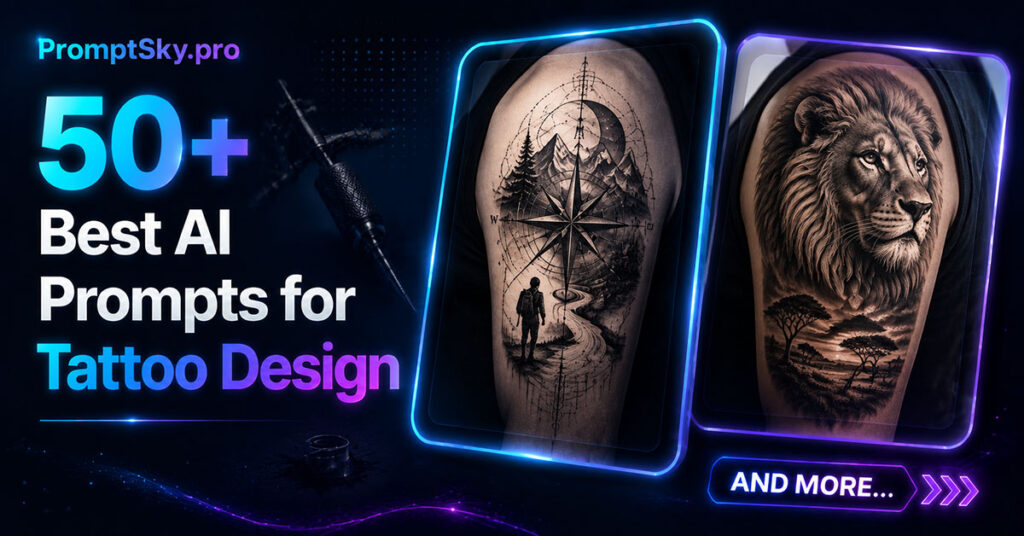
Prompt for tattoo design can help you turn a personal idea, symbol, memory, or visual style into a detailed tattoo concept. These 50 AI prompts cover everything from minimalist and fine-line tattoos to realistic, ornamental, sleeve, and cover-up designs.
To use them, choose a prompt that matches your idea, replace the bracketed details with your own information, and paste it into your preferred AI tool. You can also combine the generated concept with a reference image to refine the composition, style, placement, and visual details before discussing the final design with a professional tattoo artist.
Explore more ideas with our collection of AI prompts for creating realistic images and browse all AI prompt categories and collections for more creative use cases.
If you need a specific tattoo prompt that isn’t included here, leave a comment and tell us what kind of design you want—we may create a prompt for it.
1. Meaningful Personal Tattoo Design
A concept built around a personal experience, value, memory, or life milestone. The prompt asks the AI to turn an abstract story into a tattoo that feels personal rather than generic.
Prompt:
Design a highly meaningful tattoo concept based on this personal story: [DESCRIBE YOUR STORY, MEMORY, VALUE, OR LIFE EXPERIENCE]. Translate the emotional meaning into a strong visual concept rather than creating a literal illustration of the story. Develop the main symbolism, supporting elements, artistic style, composition, linework, shading, visual hierarchy, recommended placement, and approximate size. Make the design timeless, emotionally subtle, and visually readable as a tattoo, while avoiding generic clichés unless they genuinely fit the story. Provide a detailed description that a professional tattoo artist could use as a creative starting point.
2. Minimalist Tattoo Design
A clean tattoo concept for someone who prefers subtle artwork with limited visual elements. It focuses on simplicity without making the design feel empty or generic.
Prompt:
Create a refined minimalist tattoo design based on [IDEA, SYMBOL, OBJECT, MEMORY, OR CONCEPT]. Use clean lines, intentional negative space, simple geometry, restrained detail, and a balanced composition suitable for permanent body art. Avoid unnecessary decorative elements, excessive shading, complicated textures, and tiny details that may disappear over time. Recommend three suitable body placements and explain how the design should be scaled for each placement. Describe the exact visual structure, line weight, proportions, orientation, and overall aesthetic so the concept remains elegant and recognizable.
3. Realistic Tattoo Design
This prompt is designed for tattoos that require convincing proportions, depth, texture, and realistic visual detail.
Prompt:
Develop a highly detailed realistic tattoo concept featuring [SUBJECT, PERSON, ANIMAL, OBJECT, OR SCENE]. Describe the subject with realistic anatomy, natural proportions, believable textures, dimensional shading, highlights, depth, and carefully controlled contrast. Explain how the composition should translate from a realistic reference into tattoo artwork without becoming visually muddy when transferred to skin. Recommend an appropriate body placement, scale, orientation, black-and-gray or color treatment, and level of detail. Prioritize strong readability, natural aging, and a professional tattoo composition rather than simply copying a photograph.
4. Blackwork Tattoo Design
A bold tattoo concept built around strong black shapes, contrast, negative space, and graphic composition.
Prompt:
Design a bold blackwork tattoo based on [SUBJECT OR CONCEPT] using solid black shapes, controlled negative space, strong silhouettes, geometric structure, and high-contrast visual hierarchy. Create a composition that remains recognizable from a distance while still containing interesting details when viewed closely. Specify the main silhouette, secondary elements, black-to-negative-space balance, line thickness, shading approach, orientation, recommended placement, and ideal size. Avoid excessive micro-detail and unnecessary gradients so the tattoo remains visually powerful and readable as it naturally ages on the skin.
5. Fine-Line Tattoo Design
This prompt creates an elegant tattoo concept using delicate linework while keeping practical tattoo limitations in mind.
Prompt:
Create an elegant fine-line tattoo concept featuring [SUBJECT, SYMBOL, FLOWER, OBJECT, OR IDEA]. Use delicate but intentional linework, graceful contours, subtle details, balanced negative space, and a sophisticated composition that feels contemporary without being overly trendy. Describe the primary outlines, secondary details, proportions, placement, orientation, approximate size, and areas where detail should intentionally be simplified. Make sure the concept remains legible on skin and does not depend on extremely tiny details that could blur or fade over time.
6. Traditional American Tattoo Design
A classic tattoo concept inspired by bold outlines, limited colors, strong symbolism, and instantly recognizable forms.
Prompt:
Create a traditional American tattoo concept featuring [SUBJECT OR SYMBOL] using bold black outlines, simplified shapes, strong contrast, limited saturated colors, classic shading, and a visually confident composition. Incorporate traditional tattoo design principles such as clear silhouettes, intentional color separation, balanced proportions, and recognizable symbolism. Specify the central subject, secondary decorative elements, color palette, outline treatment, shading pattern, recommended placement, and orientation. Keep the design authentic to the visual language of traditional tattooing while giving it an original composition rather than copying an existing tattoo.
7. Japanese-Inspired Tattoo Design
A detailed concept using Japanese-inspired composition, symbolism, movement, and ornamental structure while avoiding inappropriate copying of sacred or culturally specific imagery.
Prompt:
Develop an original Japanese-inspired tattoo concept centered on [SUBJECT, ANIMAL, FLOWER, ELEMENT, OR STORY]. Use dynamic composition, flowing movement, controlled linework, layered background elements, appropriate visual rhythm, and a cohesive relationship between the main subject and surrounding motifs. Explain the symbolism of each major element and identify any cultural context that should be respected before using it as permanent body art. Recommend suitable placement, orientation, scale, color or black-and-gray treatment, and background structure while keeping the final concept original rather than imitating a specific existing tattoo artist’s work.
8. Geometric Tattoo Design
A structured tattoo concept based on symmetry, proportion, mathematical forms, and carefully controlled visual relationships.
Prompt:
Design a sophisticated geometric tattoo based on [CONCEPT, SYMBOL, ANIMAL, OBJECT, OR ABSTRACT IDEA]. Combine circles, triangles, polygons, symmetrical structures, repeating patterns, precise linework, and intentional negative space to create a visually balanced composition. Explain the geometric framework, central focal point, secondary shapes, symmetry or controlled asymmetry, line-weight hierarchy, recommended size, placement, and orientation. Make the design practical for tattooing by avoiding unnecessarily microscopic geometry and ensuring that the major shapes remain distinguishable as the tattoo ages.
9. Floral Tattoo Design
A customizable floral concept that connects the flower choice, composition, and symbolism to the person’s personality or story.
Prompt:
Create an elegant botanical tattoo design featuring [FLOWER OR PLANT] as the primary subject, combined with [SECONDARY ELEMENTS OR SYMBOLS]. Describe the flower’s natural structure, petal arrangement, leaves, stems, botanical details, composition, and visual flow across the body. Recommend a suitable tattoo style such as fine-line, blackwork, realism, illustrative, or traditional based on the desired appearance. Include placement, size, orientation, shading or color strategy, and symbolic meaning while avoiding overcrowded compositions and unnecessary decorative details that could reduce the botanical subject’s visual clarity.
10. Animal Tattoo Design
This prompt transforms an animal into a distinctive tattoo with emphasis on personality, symbolism, and strong visual composition.
Prompt:
Design a distinctive tattoo featuring a [ANIMAL] that represents [PERSONALITY TRAIT, VALUE, MEMORY, OR SYMBOLIC MEANING]. Capture the animal’s recognizable anatomy, characteristic posture, facial expression, movement, and natural features while adapting them for permanent body art. Recommend a suitable artistic style, composition, body placement, orientation, scale, linework, shading, and optional supporting elements such as plants, geometric forms, celestial details, or environmental textures. Make the animal the clear focal point and avoid generic stock-tattoo compositions or unnecessary visual clutter.
11. Memorial Tattoo Design
A subtle memorial tattoo concept for honoring someone important without relying entirely on a literal portrait.
Prompt:
Create a deeply personal memorial tattoo concept honoring [PERSON OR PET] using these meaningful details: [MEMORIES, PERSONALITY TRAITS, FAVORITE OBJECTS, PLACES, DATES, PHRASES, OR SHARED EXPERIENCES]. Develop several symbolic visual elements that represent the person’s identity without making the design overly literal or sentimental. Consider incorporating handwriting, meaningful objects, flowers, celestial elements, locations, initials, or subtle hidden details where appropriate. Recommend the most suitable style, composition, placement, scale, and visual hierarchy, and explain how each element connects to the memory while keeping the final tattoo elegant and emotionally meaningful.
12. Tattoo Design Based on a Quote
A text-focused tattoo concept that considers typography, placement, readability, and visual longevity.
Prompt:
Create a sophisticated tattoo design incorporating this exact quote: “[QUOTE]”. Preserve the wording exactly and explore several typography directions including elegant script, refined serif, minimalist lettering, handwritten style, or custom lettering depending on the emotional tone of the quote. Recommend suitable placement, orientation, approximate size, line spacing, capitalization, and supporting visual elements that enhance rather than overpower the words. Prioritize long-term readability and avoid excessively tiny lettering, overly complicated flourishes, or decorative elements that could interfere with the text as the tattoo ages.
13. Matching Tattoo Design for Couples
A concept where both tattoos feel connected while remaining attractive and meaningful when viewed separately.
Prompt:
Design a sophisticated matching tattoo concept for two people in a [RELATIONSHIP] based on [SHARED MEMORY, VALUE, PLACE, SYMBOL, OR STORY]. Create several concepts where each tattoo works independently but becomes more meaningful when viewed alongside the other person’s design. Explore complementary symbols, visual continuation, paired objects, shared themes, or different representations of the same idea instead of relying on cliché matching imagery. Include recommended style, size, placement, orientation, color treatment, and the specific relationship between both designs. Keep each tattoo visually complete on its own.
14. Sibling Matching Tattoo Design
A coordinated tattoo concept that represents a shared family connection without requiring identical artwork.
Prompt:
Create an original matching tattoo concept for [NUMBER OF SIBLINGS] siblings based on [SHARED MEMORY, CHILDHOOD EXPERIENCE, FAMILY SYMBOL, PLACE, OR PERSONAL STORY]. Develop designs that share a visual language while allowing each sibling to have a unique variation reflecting their individual personality. Explore complementary symbols, different parts of one larger concept, recurring motifs, or variations of the same central element. Specify the tattoo style, composition, size, placement, color palette, and how the designs relate to one another while ensuring every individual tattoo looks complete and intentional.
15. Travel Memory Tattoo Design
A tattoo concept that turns a meaningful journey or destination into something more personal than a basic location souvenir.
Prompt:
Turn this travel memory into an original tattoo concept: [DESTINATION, TRIP, MEMORY, OR EXPERIENCE]. Identify the strongest emotional or visual element from the journey and transform it into symbolic artwork rather than simply creating a generic landmark tattoo. Incorporate meaningful environmental details, local elements, coordinates, objects, architecture, landscapes, or subtle personal references where appropriate. Recommend the best tattoo style, composition, placement, orientation, size, linework, and optional color treatment while keeping the design elegant enough to remain meaningful even decades after the trip.
16. Nature-Inspired Tattoo Design
A natural composition built around landscapes, plants, animals, weather, or other environmental elements.
Prompt:
Design an original nature-inspired tattoo based on [NATURE ELEMENT, LANDSCAPE, ANIMAL, PLANT, MOUNTAIN, OCEAN, FOREST, OR WEATHER PHENOMENON]. Create a visually balanced composition that captures the atmosphere and emotional meaning of the subject rather than simply illustrating it literally. Describe the foreground, focal element, secondary details, depth, negative space, linework, shading, and visual flow. Recommend a suitable tattoo style, body placement, scale, orientation, and optional color palette, while keeping the composition clean enough to maintain strong readability and avoid excessive detail that may age poorly.
17. Mythology-Inspired Tattoo Design
A concept inspired by mythology while paying attention to symbolism and cultural context.
Prompt:
Create an original tattoo concept inspired by [MYTHOLOGICAL FIGURE, LEGEND, GOD, CREATURE, OR STORY]. First identify the historically or culturally relevant symbolism associated with the subject, then translate those ideas into an original visual composition. Describe the character or creature, pose, expression, surrounding elements, symbolic objects, artistic style, linework, shading, color strategy, placement, and scale. Clearly distinguish historically documented symbolism from modern interpretations and avoid copying recognizable artwork, existing tattoo designs, or another artist’s distinctive composition.
18. Gothic Tattoo Design
A darker tattoo concept using dramatic imagery, intricate forms, and atmospheric visual elements.
Prompt:
Design a sophisticated gothic tattoo based on [SUBJECT OR CONCEPT], combining dark romantic imagery, dramatic silhouettes, ornate details, controlled shadows, and atmospheric symbolism. Consider elements such as gothic architecture, roses, ravens, candles, moons, ornamental frames, antique objects, or other motifs only when they support the central concept. Describe the composition, focal point, linework, shading, negative space, visual density, placement, orientation, and recommended size. Keep the artwork dark and dramatic without allowing excessive black areas or tiny ornamental details to destroy the readability of the tattoo.
19. Cyberpunk Tattoo Design
A futuristic tattoo concept combining technology, circuitry, mechanical structures, and human or organic elements.
Prompt:
Create an original cyberpunk-inspired tattoo concept featuring [SUBJECT, SYMBOL, CHARACTER, OR OBJECT]. Combine futuristic mechanical details, circuitry patterns, digital motifs, angular geometry, technological textures, and organic elements in a coherent composition. Describe the primary focal point, secondary components, line-weight hierarchy, negative space, optional color accents, shading, and visual direction. Recommend a practical body placement and scale that allow the futuristic details to remain readable while avoiding excessive micro-detail. The design should feel technologically advanced and original rather than resembling a specific copyrighted character or existing tattoo.
20. Watercolor Tattoo Design
A colorful concept that recreates the impression of watercolor while maintaining enough structure for a tattoo.
Prompt:
Design an artistic watercolor-style tattoo based on [SUBJECT OR CONCEPT], combining recognizable tattoo linework with expressive color transitions and painterly visual movement. Use [COLOR PALETTE] with controlled washes, layered tones, subtle gradients, splatter-like accents, and intentional negative space without making the composition appear unfinished. Describe the main outlines, color placement, focal point, supporting elements, recommended size, placement, and orientation. Maintain enough structural definition for the tattoo to remain recognizable while acknowledging that tattoo pigments age differently from paint on paper.
21. Abstract Tattoo Design
A non-literal tattoo concept that communicates an emotion, idea, or personal experience through shapes and visual relationships.
Prompt:
Transform this abstract idea or emotional experience into an original tattoo concept: [IDEA, EMOTION, EXPERIENCE, OR PERSONAL MEANING]. Do not illustrate the concept literally; instead use abstract shapes, lines, textures, negative space, geometry, organic forms, or symbolic fragments to communicate the underlying meaning. Explain the visual metaphor, composition, movement, focal point, linework, shading, color strategy, placement, and scale. Create a design that remains visually compelling even when the viewer does not immediately understand its personal meaning, while avoiding random shapes that lack a clear artistic purpose.
22. Sleeve Tattoo Concept
A complete sleeve concept designed so individual elements connect naturally across the arm.
Prompt:
Design a complete tattoo sleeve concept for the [LEFT/RIGHT] [FULL/HALF] arm based on [THEME, STORY, SYMBOLS, OR VISUAL STYLE]. Create a clear focal element and build supporting motifs around it so the entire composition flows naturally from the shoulder toward the forearm or wrist. Describe how each major tattoo element connects through background textures, negative space, ornamental transitions, shading, or repeating visual motifs. Include recommended placement for every major element, scale, orientation, color treatment, and overall style while ensuring the sleeve remains cohesive instead of looking like unrelated individual tattoos placed next to one another.
23. Chest Tattoo Design
A composition specifically structured around the shape and symmetry of the chest.
Prompt:
Create a detailed chest tattoo concept based on [SUBJECT, SYMBOL, THEME, OR STORY], specifically designed to follow the natural anatomy and proportions of the chest. Consider the sternum, pectoral muscles, collarbone area, and natural body symmetry when planning the composition. Explain the central focal point, left-to-right balance, supporting elements, negative space, linework, shading, orientation, approximate dimensions, and visual flow. Recommend whether the design should be symmetrical, asymmetrical, centered, or slightly offset, and make sure the composition looks intentional both when the body is relaxed and when viewed from different angles.
24. Forearm Tattoo Design
A vertical composition optimized for visibility and the elongated shape of the forearm.
Prompt:
Design an original forearm tattoo featuring [SUBJECT, SYMBOL, QUOTE, OR CONCEPT], specifically optimized for the long vertical shape of the forearm. Create a strong visual flow from the wrist toward the elbow and determine the ideal orientation based on how the tattoo will be viewed by the wearer and by other people. Describe the focal point, secondary elements, proportions, linework, shading, negative space, recommended size, and placement boundaries. Ensure the composition remains readable from a normal viewing distance and avoid placing essential details in areas where natural arm movement could significantly disrupt the visual structure.
25. Custom Tattoo Design Based on a Reference Image
A flexible prompt for transforming an existing visual reference into an original tattoo concept without simply copying it.
Prompt:
Analyze the attached reference image and transform its key visual characteristics into an original tattoo design while avoiding a direct copy of the artwork. Identify the main subject, composition, silhouette, visual mood, proportions, important shapes, linework characteristics, and distinctive details that make the reference visually effective. Reinterpret those qualities into a tattoo-friendly composition with appropriate line weight, shading, negative space, size, placement, and optional color treatment. Simplify details that would not translate well to skin and create a fresh arrangement that preserves the general inspiration while remaining clearly distinct from the original artwork.
26. Fine-Line Floral Tattoo
A delicate floral concept designed around elegant linework and subtle botanical details. The composition should remain clean, readable, and suitable for long-term tattooing.
Prompt:
Create a highly detailed fine-line floral tattoo design featuring [FLOWER OR PLANT] with [OPTIONAL SECONDARY ELEMENTS]. Use elegant single-needle-inspired linework, graceful contours, natural botanical proportions, subtle internal details, and carefully controlled negative space. Arrange the flowers and leaves into a balanced composition with a clear visual flow that follows the natural shape of [BODY PART]. Specify the ideal tattoo size, orientation, line-weight hierarchy, shading approach, and areas where details should intentionally remain simplified. Make the design sophisticated and timeless while avoiding fragile micro-details that may become unclear as the tattoo naturally ages.
27. Lion Tattoo Design
A powerful lion tattoo concept emphasizing strength, confidence, leadership, and character.
Prompt:
Design a powerful and highly detailed lion tattoo representing [STRENGTH, COURAGE, LEADERSHIP, FAMILY, RESILIENCE, OR PERSONAL MEANING]. Create realistic but tattoo-friendly anatomy with expressive eyes, detailed mane texture, strong facial structure, dimensional shading, and a commanding posture. Choose a composition that works specifically for [BODY PLACEMENT] and specify the ideal size, viewing angle, orientation, linework, black-and-gray or color treatment, and supporting elements. Keep the lion as the unmistakable focal point and avoid excessive fur detail that could merge into dark areas over time.
28. Wolf Tattoo Design
A wolf tattoo concept combining realism, symbolism, and a strong visual silhouette.
Prompt:
Create an original wolf tattoo design based on the symbolism of [LOYALTY, FREEDOM, FAMILY, SURVIVAL, INSTINCT, OR PERSONAL STORY]. Show the wolf in a distinctive pose such as [HOWLING, WALKING, RUNNING, LOOKING FORWARD, OR RESTING], with believable anatomy, expressive eyes, layered fur, and carefully controlled contrast. Build the composition specifically for [BODY PLACEMENT], using the natural body contours to enhance the wolf’s silhouette. Include recommendations for size, orientation, black-and-gray or color treatment, background elements, negative space, and shading while maintaining strong readability from a distance.
29. Dragon Tattoo Design
A dramatic fantasy tattoo featuring a dragon with detailed anatomy and dynamic movement.
Prompt:
Design an original dragon tattoo with a powerful, dynamic composition based on [PERSONAL MEANING OR THEME]. Create detailed anatomical features including scales, horns, wings, claws, facial structure, tail movement, and muscular proportions while keeping every element practical for tattooing. Position the dragon in a flowing pose that naturally follows the contours of [BODY PLACEMENT], using the head as the primary focal point and the body or wings to create movement. Specify linework, shading, color palette if applicable, negative space, approximate size, orientation, and background elements, avoiding excessive microscopic scale details that could lose clarity over time.
30. Snake Tattoo Design
A flexible snake tattoo concept that can wrap naturally around different areas of the body.
Prompt:
Create a highly detailed snake tattoo design featuring [SNAKE SPECIES OR FANTASY SNAKE] wrapped naturally around [BODY PART]. Use realistic anatomy, accurate scale patterns, controlled curves, dimensional shading, and a strong silhouette that follows the body’s natural movement. Decide whether the snake should appear calm, defensive, striking, or gracefully coiled based on [DESIRED MOOD]. Specify the head position, body direction, scale detail, line weight, shading, size, orientation, and optional surrounding elements such as flowers, leaves, geometric shapes, or symbolic objects while keeping the composition visually balanced and tattoo-friendly.
31. Skull Tattoo Design
A bold skull tattoo concept that can range from realistic and dark to symbolic and artistic.
Prompt:
Design an original skull tattoo based on [THEME, PERSONAL MEANING, OR SYMBOLISM], using anatomically convincing skull proportions and a carefully structured composition. Choose a visual direction such as realistic black-and-gray, gothic, traditional, illustrative, ornamental, or surreal based on the desired aesthetic. Describe the skull’s angle, expression, surrounding elements, shading depth, highlights, linework, negative space, recommended size, and placement. Use supporting elements only when they strengthen the concept, and maintain enough separation between dark areas so the skull remains recognizable after the tattoo naturally ages.
32. Rose and Snake Tattoo
A dramatic combination of natural beauty and symbolic contrast.
Prompt:
Create an original tattoo combining a detailed [ROSE COLOR OR STYLE] with a gracefully positioned snake to represent [DUALITY, TRANSFORMATION, PROTECTION, BEAUTY, DANGER, OR PERSONAL MEANING]. Make the rose and snake visually interact instead of appearing as two unrelated objects. Describe the flower’s petals, leaves, stem, snake anatomy, scale pattern, overlapping areas, focal point, negative space, linework, shading, and optional color palette. Design the composition specifically for [BODY PLACEMENT] and specify the ideal orientation, scale, and visual flow while keeping the overlapping details clean enough for long-term tattoo readability.
33. Butterfly Tattoo Design
A refined butterfly tattoo that can symbolize transformation, freedom, growth, or personal change.
Prompt:
Design an elegant butterfly tattoo representing [TRANSFORMATION, FREEDOM, PERSONAL GROWTH, NEW BEGINNING, OR PERSONAL STORY]. Create anatomically balanced wings with carefully structured patterns while allowing artistic interpretation through [STYLE]. Choose a composition that complements [BODY PLACEMENT] and determine whether the butterfly should appear symmetrical, slightly angled, flying upward, resting, or integrated with other elements. Specify linework, wing details, shading, color palette, negative space, size, and orientation, keeping the smallest wing patterns simplified enough to remain visually distinct over time.
34. Clock and Compass Tattoo
A symbolic design combining time, direction, life choices, and personal journeys.
Prompt:
Create a sophisticated tattoo combining a detailed antique clock with a compass to symbolize [TIME, DIRECTION, LIFE JOURNEY, CHANGE, DESTINY, OR PERSONAL STORY]. Develop an original composition where both elements have a clear visual relationship rather than simply being placed side by side. Specify the clock face design, meaningful time if applicable, compass structure, surrounding elements, typography if needed, linework, shading, negative space, size, placement, and orientation. Avoid generic decorative clutter and ensure that every symbol has a clear purpose connected to the person’s story.
35. Sun and Moon Tattoo Design
A balanced celestial tattoo representing contrast, harmony, cycles, or two complementary forces.
Prompt:
Design an original sun and moon tattoo representing [DUALITY, BALANCE, RELATIONSHIP, PERSONAL GROWTH, CHANGE, OR SPIRITUAL MEANING]. Create a visually harmonious composition where the sun and moon have distinct identities while remaining connected through shape, positioning, shared linework, or surrounding celestial elements. Specify facial or non-facial treatment, rays, lunar texture, stars, ornamental details, line weight, shading, color strategy, size, placement, and orientation. Keep the composition sophisticated and avoid generic celestial imagery unless it has been customized to the user’s personal meaning.
36. Roman Numeral Tattoo Design
A clean tattoo concept built around meaningful dates while avoiding overly decorative typography.
Prompt:
Create a refined Roman numeral tattoo using the meaningful date [DATE] and incorporate it into an original visual composition connected to [PERSON, MEMORY, EVENT, OR MEANING]. First ensure the Roman numeral conversion is correct, then explore several typography treatments such as minimalist serif, engraved lettering, classical Roman-inspired forms, or subtle ornamental lettering. Recommend suitable placement, orientation, spacing, size, line weight, and optional supporting symbols. Keep the numbers highly readable and avoid unnecessary flourishes that could interfere with the permanent clarity of the date.
37. Initials Tattoo Design
A personalized lettering concept that turns initials into a subtle piece of body art.
Prompt:
Design an original tattoo incorporating the initials [INITIALS] in a sophisticated and visually meaningful way. Explore several approaches including minimalist lettering, custom monogram, intertwined initials, geometric construction, handwritten style, engraved typography, or integration with a meaningful symbol. Describe the exact letter structure, proportions, line weight, spacing, negative space, supporting elements, recommended size, placement, and orientation. Make the initials readable without making the design feel like ordinary text, and ensure the composition remains elegant if viewed without knowing the personal story behind it.
38. Quote and Symbol Tattoo
A combined lettering and imagery concept where the visual symbol strengthens the meaning of the words.
Prompt:
Create an original tattoo combining this exact phrase, “[QUOTE OR PHRASE],” with a symbolic visual element representing [MEANING OR PERSONAL STORY]. Design the typography and imagery as one cohesive composition rather than placing unrelated text beside an illustration. Explore appropriate lettering styles, word arrangement, symbol placement, linework, shading, negative space, and visual hierarchy. Recommend the ideal body placement, orientation, scale, and spacing while keeping the text legible and ensuring the symbolic element supports the message without overpowering the words.
39. Dark Realism Tattoo Design
A cinematic black-and-gray tattoo concept with strong depth, contrast, and dramatic atmosphere.
Prompt:
Create a dark realism tattoo concept featuring [SUBJECT] with an intense cinematic atmosphere and highly controlled black-and-gray shading. Build realistic depth through carefully layered shadows, highlights, textures, atmospheric contrast, and dimensional forms while preserving strong tattoo readability. Describe the focal point, secondary elements, lighting direction, darkest areas, highlight placement, linework, negative space, composition, recommended size, and placement. Avoid turning the entire design into an undifferentiated dark mass and maintain enough open skin and tonal separation for important features to remain visible as the tattoo ages.
40. Ornamental Tattoo Design
An elegant decorative tattoo using symmetry, intricate patterns, and carefully controlled visual detail.
Prompt:
Design an intricate ornamental tattoo inspired by [SYMBOL, FLOWER, JEWEL, MANDALA, ARCHITECTURAL FORM, OR PERSONAL CONCEPT]. Combine symmetrical patterns, fine linework, geometric details, decorative framing, subtle filigree, and intentional negative space into a cohesive composition. Establish a clear central focal point and build the surrounding ornamentation outward with consistent proportions and visual rhythm. Specify the line-weight hierarchy, symmetry, shading, recommended size, body placement, orientation, and areas where details should be simplified so the design remains crisp rather than becoming visually crowded.
41. Mandala Tattoo Design
A symmetrical design focused on radial geometry, balance, and detailed pattern work.
Prompt:
Create a highly detailed mandala tattoo based on [PERSONAL MEANING, SYMBOL, OR THEME], using precise radial symmetry, repeating geometric motifs, layered shapes, ornamental linework, and controlled negative space. Build the design from a strong central focal point outward, ensuring that each layer has a clear relationship with the previous one. Specify the number and structure of major layers, line-weight hierarchy, shading approach, recommended size, placement, orientation, and optional symbolic elements. Keep the smallest geometric details practical for tattooing and preserve sufficient spacing so the mandala remains visually crisp over time.
42. Celtic-Inspired Tattoo Design
A knotwork-based concept emphasizing interconnected lines and continuous visual movement.
Prompt:
Create an original Celtic-inspired tattoo design based on [SYMBOL, ANIMAL, FAMILY STORY, HERITAGE THEME, OR PERSONAL MEANING]. Incorporate carefully constructed knotwork, interwoven lines, circular or flowing structures, and appropriate symbolic elements while maintaining a clear and intentional composition. Explain the meaning of the selected motifs and distinguish historically documented symbolism from modern interpretations where relevant. Specify line thickness, knot structure, negative space, focal point, size, placement, orientation, and shading while ensuring that the interwoven patterns remain technically practical and readable when transferred to skin.
43. Tribal-Inspired Tattoo Design
A bold graphic concept using flowing black shapes and strong silhouettes while avoiding imitation of a specific cultural tattoo tradition.
Prompt:
Create an original bold tribal-inspired tattoo concept based on [SUBJECT, SYMBOL, PERSONAL STORY, OR ABSTRACT IDEA]. Use strong black shapes, flowing curves, pointed forms, controlled symmetry or asymmetry, negative space, and a powerful silhouette to create a visually dynamic composition. Do not imitate a specific Indigenous or cultural tattoo tradition; instead develop an original contemporary graphic design inspired by abstract ornamental principles. Specify the main structure, secondary shapes, line weight, black-to-negative-space ratio, body placement, orientation, and ideal size while keeping the artwork clean and readable.
44. Small Wrist Tattoo Design
A compact tattoo concept designed specifically for limited space and high everyday visibility.
Prompt:
Design a small but visually distinctive wrist tattoo based on [SYMBOL, WORD, OBJECT, OR PERSONAL MEANING]. Create a simplified composition that communicates the idea clearly without relying on excessive micro-detail. Specify the ideal dimensions, orientation relative to the wrist, line weight, negative space, shading or color treatment, and exact placement area. Consider how wrist movement, skin curvature, and frequent visibility affect the design and recommend a version that remains elegant when viewed from both the wearer’s perspective and from the outside. Avoid overcrowding the available space.
45. Behind-the-Ear Tattoo Design
A discreet tattoo concept that works within the small, curved area behind the ear.
Prompt:
Create a subtle behind-the-ear tattoo based on [SYMBOL, INITIAL, FLOWER, SMALL ANIMAL, OR PERSONAL CONCEPT]. Adapt the artwork specifically to the small curved anatomical area behind the ear, using a simplified composition, appropriate line weight, and enough negative space for long-term readability. Describe the exact shape, orientation, scale, visual density, shading or color approach, and how the design should follow the natural contour of the area. Keep the concept elegant and recognizable without relying on extremely tiny details that may blur or fade with time.
46. Neck Tattoo Design
A carefully composed neck tattoo that considers anatomy, visibility, and directional flow.
Prompt:
Design an original neck tattoo based on [SUBJECT, SYMBOL, THEME, OR PERSONAL MEANING], specifically adapted to the natural contours of the [FRONT/SIDE/BACK] of the neck. Create a composition with a clear focal point and visual direction that works with the neck’s vertical and curved anatomy. Specify placement boundaries, orientation, approximate size, linework, shading, negative space, color treatment if applicable, and supporting elements. Make the design visually strong without overcrowding the area, and consider how the tattoo will appear when the neck is relaxed, turned, or viewed from different angles.
47. Back Tattoo Design
A large-format tattoo concept that uses the broad surface of the back for a structured composition.
Prompt:
Create a large-scale back tattoo concept based on [THEME, SUBJECT, STORY, OR SYMBOLIC IDEA]. Use the broad surface of the back to establish a strong central focal point, balanced supporting elements, and a deliberate visual flow across the shoulder blades, spine, and lower back. Describe the complete composition, symmetry or asymmetry, major elements, background structure, negative space, linework, shading, color strategy, recommended dimensions, and orientation. Ensure the design feels cohesive as one artwork rather than a collection of separate tattoos, while preserving enough breathing room for the major elements to remain visually distinct.
48. Tattoo Cover-Up Design
A practical concept for transforming an existing tattoo into a new composition while working with the original ink underneath.
Prompt:
Analyze the existing tattoo shown in the attached image and develop an original cover-up tattoo concept that works realistically with its current shape, darkness, placement, and visible ink density. Identify which parts of the original tattoo will require darker coverage, stronger shapes, strategic texture, or compositional integration. Create a new design based on [NEW SUBJECT OR THEME] using appropriate blackwork, realism, ornamental, floral, animal, or illustrative techniques. Explain the proposed composition, darkest areas, focal point, supporting elements, size, orientation, and color limitations, and make clear that a professional tattoo artist should assess the actual skin and existing ink before finalizing the cover-up.
49. Tattoo Sleeve Based on a Personal Story
A narrative sleeve that turns several life experiences into one connected visual journey.
Prompt:
Transform this personal story into a cohesive tattoo sleeve: [DESCRIBE YOUR LIFE STORY, MAJOR EXPERIENCES, PEOPLE, VALUES, CHALLENGES, AND MILESTONES]. Identify the strongest themes and convert them into symbolic visual elements rather than literal illustrations. Organize the sleeve into a primary focal point, secondary scenes or symbols, transition elements, and background textures that connect the entire arm. Specify the placement of each element from shoulder to wrist, recommended scale, orientation, tattoo style, linework, shading, color strategy, and negative space. Make every element meaningful while ensuring the complete sleeve works as one visually unified composition.
50. Ultimate Personalized Tattoo Design
A comprehensive prompt that combines personal meaning, artistic style, body placement, and tattoo practicality into one final concept.
Prompt:
Act as an expert tattoo concept designer and transform the following information into an original tattoo concept: [PERSONAL STORY], [MEANING], [IMPORTANT SYMBOLS], [PREFERRED STYLE], [FAVORITE COLORS], [BODY PLACEMENT], [APPROXIMATE SIZE], [TATTOO EXPERIENCE], and [ELEMENTS TO AVOID]. Develop a complete visual concept including the central subject, symbolism, supporting elements, composition, proportions, linework, shading, color palette, negative space, orientation, and placement strategy. Explain how the design should be adapted specifically to the chosen body area and how it can remain readable as it ages. Avoid generic tattoo clichés, unnecessary visual clutter, direct copies of existing artwork, and extremely fragile details, and provide a polished concept that a professional tattoo artist can further refine into a final stencil.