
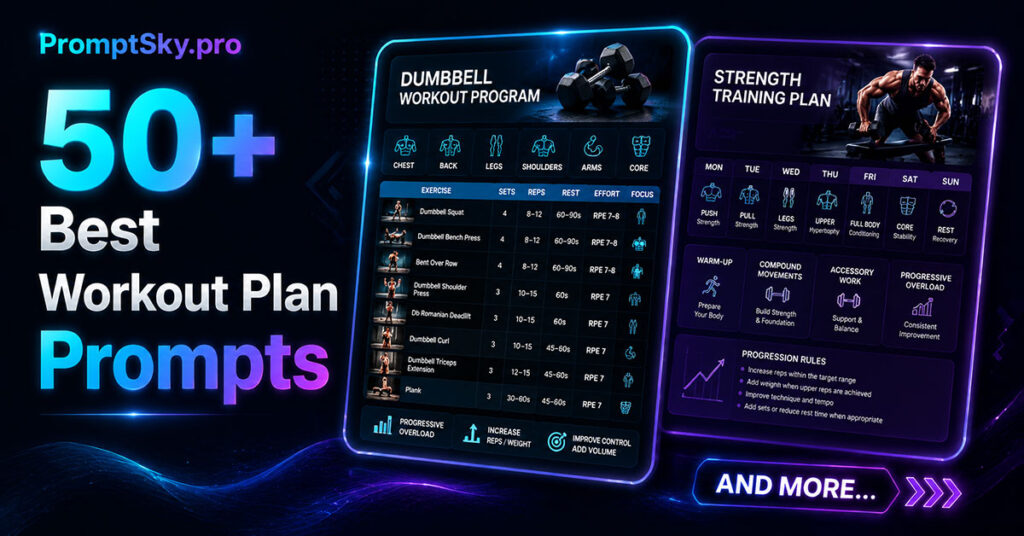
Workout plan prompts can help you create a structured fitness routine based on your goals, experience, schedule, equipment, and preferred training style. This collection includes 50 detailed prompts for everything from beginner workouts and muscle building to strength, endurance, HIIT, and home training.
To use them, copy a prompt into your preferred AI tool, replace the information inside [brackets] with your own details, and review the generated plan before starting. For health conditions, injuries, persistent pain, pregnancy-related considerations, or other medical concerns, consult an appropriate healthcare or fitness professional.
You can also explore more AI Prompts for Business, Marketing, Content, and Creative Projects if you use AI for goals beyond fitness. For marketing-focused workflows, check out 30 Best AI Marketing Prompts for Business Growth. If you have a specific workout or fitness prompt you want to see, request it in the comments and we may add it to the collection.
1. Beginner Full-Body Workout Plan
A structured prompt for creating a beginner-friendly training routine with manageable volume, clear progression, and recovery considerations.
Prompt:
Act as an experienced strength and fitness programming assistant. Create a detailed beginner full-body workout plan for a person with [AGE], [GENDER], [TRAINING EXPERIENCE], [GOAL], and [AVAILABLE EQUIPMENT]. Structure the program across [NUMBER OF DAYS] training days per week and include exercises, sets, repetitions, rest periods, exercise order, warm-up guidance, cooldown suggestions, and estimated session duration. Keep the progression gradual and explain how to increase difficulty without unnecessarily increasing training volume. Consider the user’s schedule, current fitness level, recovery capacity, and exercise preferences, and clearly identify any movements that may need professional supervision if the user has pain, injury, or medical limitations.
2. Muscle Building Workout Plan
This prompt creates a hypertrophy-focused routine with organized weekly volume and progression.
Prompt:
Design a detailed muscle-building workout program for an individual with [AGE], [TRAINING EXPERIENCE], [CURRENT FITNESS LEVEL], [GOAL], and access to [EQUIPMENT]. Build the routine around progressive resistance training and organize each workout by muscle group, exercise order, sets, repetitions, rest intervals, tempo guidance where useful, and approximate session length. Include weekly training frequency and explain how the user should progressively increase resistance, repetitions, or training difficulty over time. Balance training volume with recovery and avoid unnecessarily excessive exercise selection. Include practical substitutions for exercises that require equipment the user does not have.
3. Fat-Loss Workout Plan
This prompt focuses on building a training routine that supports an overall fat-loss goal while maintaining strength and muscle.
Prompt:
Create a detailed workout plan for a person whose primary goal is improving fitness while supporting a gradual fat-loss objective. Use the following information: [AGE], [FITNESS LEVEL], [TRAINING EXPERIENCE], [AVAILABLE EQUIPMENT], [DAYS PER WEEK], and [PREFERRED ACTIVITIES]. Combine resistance training with an appropriate amount of cardiovascular activity and recovery work. For every session, specify exercises, sets, repetitions, rest periods, intensity guidance, duration, and progression rules. Avoid promising a specific amount of weight loss and emphasize that nutrition, sleep, daily activity, and individual health factors also influence results.
4. Home Workout Plan Without Equipment
This prompt generates a practical bodyweight routine for people training at home without gym equipment.
Prompt:
Create a comprehensive home workout program requiring no specialized gym equipment for a person with [AGE], [FITNESS LEVEL], [GOAL], and [NUMBER OF DAYS AVAILABLE]. Use bodyweight movements that train major movement patterns and muscle groups, including lower body, pushing, pulling alternatives, core, balance, and conditioning. Provide a complete structure for each session with warm-up, exercise sequence, sets, repetitions or time intervals, rest periods, difficulty modifications, and cooldown guidance. Include beginner, standard, and harder variations where appropriate so the program can progress as the user’s fitness improves.
5. Dumbbell Workout Plan
This prompt creates a complete routine using dumbbells as the primary training tool.
Prompt:
Build a detailed dumbbell-based workout program for [AGE], [TRAINING LEVEL], [PRIMARY GOAL], and [NUMBER OF TRAINING DAYS] using [AVAILABLE DUMBBELL WEIGHTS]. Design sessions that efficiently train the major muscle groups and movement patterns while accounting for the equipment limitations. For every exercise, provide sets, repetitions, rest periods, technique priorities, recommended effort level, and progression instructions. Include alternatives for movements that are difficult with the available dumbbell range and explain how the user can progress through additional repetitions, heavier weights, improved control, or increased training volume without sacrificing technique.
6. Gym Workout Plan for Beginners
This prompt helps a new gym member understand what to do during each training session.
Prompt:
Create a detailed beginner gym workout program for someone who has little or no previous resistance-training experience. Use [AGE], [GOAL], [DAYS PER WEEK], [AVAILABLE EQUIPMENT], and [CURRENT FITNESS LEVEL] to customize the plan. Include a clear warm-up, machine and free-weight exercises where appropriate, sets, repetitions, rest periods, technique cues, exercise order, and estimated workout duration. Prioritize simple movements that are easy to learn and explain how the beginner should select an appropriate starting resistance. Include a progression system that increases training difficulty gradually while emphasizing safe technique and recovery.
7. Strength Training Workout Plan
This prompt focuses on developing general strength through progressive resistance training.
Prompt:
Design a structured strength-training program for an individual with [AGE], [TRAINING EXPERIENCE], [CURRENT STRENGTH LEVEL], [GOAL], and [AVAILABLE EQUIPMENT]. Organize the program across [DAYS PER WEEK] and prioritize appropriate compound and accessory movements for the user’s experience level. Provide exercises, sets, repetitions, rest periods, intensity or effort guidance, warm-up recommendations, and progression rules. Explain how to increase training load while maintaining good technique and how to adjust the program when performance decreases because of fatigue or insufficient recovery. Do not prescribe maximal-effort testing unless appropriate for the user’s experience and circumstances.
8. Three-Day Workout Plan
This prompt creates a balanced routine for people who can consistently train only three days each week.
Prompt:
Create a complete three-day-per-week workout program for a person with [AGE], [FITNESS LEVEL], [TRAINING EXPERIENCE], and the primary goal of [GOAL]. Make the three sessions efficient enough to fit within [TIME LIMIT] minutes while providing balanced training for the major muscle groups and movement patterns. For each day, list the warm-up, exercises, sets, repetitions, rest periods, intensity guidance, and cooldown. Explain how the user should progress from week to week and provide substitutions for exercises that cannot be performed because of equipment limitations or personal preferences.
9. Five-Day Workout Plan
This prompt is designed for users who have more training days available and want a structured weekly schedule.
Prompt:
Design a detailed five-day workout program for an individual with [AGE], [TRAINING LEVEL], [PRIMARY GOAL], and access to [EQUIPMENT]. Distribute training volume intelligently across the week so that major muscle groups receive appropriate stimulation without creating unnecessary overlap or excessive fatigue. Include exercises, sets, repetitions, rest periods, recommended effort, warm-up requirements, session duration, and weekly progression. Provide a logical schedule for training and rest, explain how to modify the plan during unusually stressful or low-recovery weeks, and include alternative exercises when equipment or movement preferences require substitutions.
10. Upper-Body Workout Plan
This prompt creates a focused upper-body routine covering the major pushing and pulling patterns.
Prompt:
Create a comprehensive upper-body workout plan for [AGE], [TRAINING EXPERIENCE], [FITNESS LEVEL], and [GOAL]. Include exercises targeting the chest, back, shoulders, arms, and relevant stabilizing muscles while maintaining a balanced ratio of pushing and pulling movements. For every exercise, provide sets, repetitions, rest intervals, technique priorities, effort guidance, and progression instructions. Organize the workout to place technically demanding movements earlier in the session and include substitutions for equipment limitations. Keep the overall workload appropriate for the user’s experience and recovery capacity.
11. Lower-Body Workout Plan
This prompt focuses on developing lower-body strength, muscle, stability, and conditioning.
Prompt:
Design a detailed lower-body workout routine for an individual with [AGE], [TRAINING EXPERIENCE], [CURRENT FITNESS LEVEL], and [PRIMARY GOAL]. Include appropriate exercises for the quadriceps, hamstrings, glutes, calves, and supporting musculature while incorporating multiple movement patterns such as squatting, hinging, lunging, and controlled single-leg work where suitable. Specify sets, repetitions, rest periods, technique cues, effort level, warm-up, and progression methods. Provide easier alternatives for demanding movements and explain how to adjust exercises if the user experiences discomfort rather than encouraging them to train through pain.
12. Push-Pull-Legs Workout Plan
This prompt creates a classic split while adapting the training volume to the user’s schedule and experience.
Prompt:
Build a detailed Push-Pull-Legs workout program customized for [AGE], [TRAINING EXPERIENCE], [PRIMARY GOAL], [DAYS PER WEEK], and [AVAILABLE EQUIPMENT]. On push sessions, prioritize chest, shoulders, and triceps; on pull sessions, emphasize the back, rear shoulders, and biceps; on leg sessions, train the major lower-body movement patterns and supporting muscles. Provide exercise order, sets, repetitions, rest periods, effort guidance, warm-up requirements, and progression rules. Adjust the frequency and volume intelligently if the user trains fewer or more than six days per week and include practical exercise substitutions.
13. Full-Body Home Workout Plan
This prompt combines efficient full-body training with the limitations of a home environment.
Prompt:
Create a detailed full-body home workout program for [AGE], [FITNESS LEVEL], [GOAL], and [AVAILABLE EQUIPMENT], assuming the user has only [NUMBER OF DAYS] days available each week. Each session should train the major movement patterns using practical exercises that can be performed safely in a home environment. Include warm-up, exercise order, sets, repetitions or timed intervals, rest periods, technique cues, progression options, and cooldown guidance. Provide lower-impact alternatives for jumping or high-impact movements and explain how to make exercises easier or harder without requiring additional equipment.
14. Core Workout Plan
This prompt creates a dedicated core routine that goes beyond repetitive crunches.
Prompt:
Design a comprehensive core-training program for [AGE], [FITNESS LEVEL], [TRAINING EXPERIENCE], and [PRIMARY GOAL]. Include exercises that develop different core functions such as anti-extension, anti-rotation, controlled flexion, lateral stability, and trunk coordination rather than relying exclusively on crunches. For every movement, provide sets, repetitions or time, rest periods, technique cues, progression methods, and appropriate regressions. Keep the total workload realistic and explain how the core sessions can be integrated with the user’s existing strength or conditioning routine without unnecessarily interfering with recovery.
15. Cardio and Strength Workout Plan
This prompt balances resistance training with cardiovascular conditioning for general fitness.
Prompt:
Create a balanced weekly workout program combining strength training and cardiovascular conditioning for a person with [AGE], [FITNESS LEVEL], [TRAINING EXPERIENCE], [GOAL], and [DAYS AVAILABLE]. Specify which days should focus on resistance training, steady-state cardio, intervals, active recovery, or rest. For every workout, provide exercise selection, sets, repetitions, duration, rest periods, intensity guidance, and progression rules. Organize the sessions to minimize unnecessary interference between demanding strength and cardio work and adapt the program to the user’s available equipment, schedule, recovery, and preferred forms of exercise.
16. Athletic Performance Workout Plan
This prompt is designed for athletes who want training organized around performance rather than appearance alone.
Prompt:
Create a structured athletic-performance workout program for an individual participating in [SPORT] at the [BEGINNER/INTERMEDIATE/ADVANCED] level. Use the athlete’s [AGE], [TRAINING HISTORY], [COMPETITION SCHEDULE], [AVAILABLE EQUIPMENT], and [PRIMARY PERFORMANCE GOALS] to organize strength, power, conditioning, mobility, and recovery work. Specify exercises, sets, repetitions, rest periods, intensity guidance, and weekly progression while accounting for sport practices and competition demands. Avoid unnecessary training volume and clearly separate general fitness recommendations from sport-specific programming that should be supervised by an appropriately qualified coach.
17. Mobility and Strength Workout Plan
This prompt combines resistance exercises with mobility-focused work for a balanced training session.
Prompt:
Design a detailed weekly workout plan combining strength training and mobility work for a person with [AGE], [FITNESS LEVEL], [TRAINING EXPERIENCE], [GOAL], and [AVAILABLE EQUIPMENT]. Include dynamic warm-ups, strength exercises, controlled mobility drills, recovery movements, sets, repetitions, durations, rest periods, and progression guidance. Select mobility work that complements the user’s training rather than simply adding large amounts of stretching. Provide modifications for limited mobility or exercise restrictions and clearly distinguish normal training discomfort from pain that should be evaluated by an appropriate healthcare professional.
18. Weight-Training Plan for Women
This prompt creates a resistance-training routine tailored to a woman’s stated goals without relying on unnecessary gender stereotypes.
Prompt:
Create a detailed resistance-training program for a woman with [AGE], [TRAINING EXPERIENCE], [FITNESS LEVEL], [PRIMARY GOAL], [DAYS PER WEEK], and [AVAILABLE EQUIPMENT]. Build the program around evidence-informed strength and muscle-development principles rather than gender stereotypes, and adjust exercise selection, volume, and recovery recommendations according to her actual experience and goals. Include warm-up, exercises, sets, repetitions, rest periods, effort guidance, progression, and substitutions. If the user provides pregnancy, postpartum, medical, pelvic-floor, or injury-related considerations, identify the need for appropriate professional guidance rather than making unsupported medical recommendations.
19. Weight-Training Plan for Men
This prompt provides a structured resistance routine based on the user’s goals, experience, and equipment rather than generic assumptions.
Prompt:
Design a detailed resistance-training program for a man with [AGE], [TRAINING EXPERIENCE], [FITNESS LEVEL], [PRIMARY GOAL], [DAYS AVAILABLE], and [EQUIPMENT]. Build the routine around the user’s actual objectives, whether strength, muscle development, general fitness, athletic performance, or body composition. Include exercise order, sets, repetitions, rest periods, effort guidance, warm-up, progression, and recovery recommendations. Avoid unnecessary volume and stereotypical assumptions, and provide exercise substitutions for equipment limitations or movements the user cannot perform comfortably.
20. Workout Plan for Busy Professionals
This prompt creates efficient training sessions for people with limited time during the week.
Prompt:
Create a time-efficient workout program for a busy professional with [AGE], [FITNESS LEVEL], [TRAINING EXPERIENCE], [PRIMARY GOAL], and only [MINUTES] minutes available per session. Build [NUMBER OF DAYS] weekly workouts using efficient exercise selection, sensible supersets where appropriate, short but adequate rest periods, and minimal unnecessary transitions between movements. Include warm-up, exercises, sets, repetitions, rest periods, progression, and a realistic session timeline. Make the program sustainable for a demanding schedule and provide a shorter backup version for days when the user has even less available time.
21. Workout Plan for Seniors
This prompt emphasizes adaptable exercise selection, gradual progression, balance, and practical safety considerations for older adults.
Prompt:
Create a gentle but progressive fitness program for an older adult with [AGE], [CURRENT FITNESS LEVEL], [TRAINING EXPERIENCE], [GOAL], [DAYS AVAILABLE], and [AVAILABLE EQUIPMENT]. Include appropriate strength, balance, mobility, cardiovascular activity, and recovery components based on the information provided. For each session, specify exercises, sets, repetitions or duration, rest periods, progression, and easier alternatives. Avoid assuming that age alone determines physical capability, but clearly flag medical conditions, dizziness, significant pain, previous falls, or other health concerns as reasons to seek appropriate professional clearance or supervision before beginning exercise.
22. Workout Plan for Beginners Over 40
This prompt creates a gradual training structure for adults returning to exercise or starting later in life.
Prompt:
Design a progressive beginner workout plan for an adult over 40 with [AGE], [CURRENT FITNESS LEVEL], [TRAINING HISTORY], [PRIMARY GOAL], [DAYS PER WEEK], and [AVAILABLE EQUIPMENT]. Focus on building consistency, movement quality, strength, cardiovascular fitness, mobility, and recovery without unnecessarily aggressive training. Provide a detailed warm-up, exercise sequence, sets, repetitions, rest periods, intensity guidance, progression rules, and cooldown. Include lower-impact alternatives and explain how to adjust the workload when recovery is slower than expected. Do not treat age as a diagnosis and flag health conditions or persistent pain for appropriate professional evaluation.
23. Bodyweight Strength Workout Plan
This prompt focuses on developing strength and control using bodyweight movements and progressive variations.
Prompt:
Create a detailed bodyweight strength-training program for [AGE], [FITNESS LEVEL], [TRAINING EXPERIENCE], and [PRIMARY GOAL]. Use progressive variations of movements such as squats, lunges, push-ups, pulling alternatives, hip-dominant exercises, carries where possible, and core stability work. For each session, provide exercise order, sets, repetitions or time, rest periods, technique cues, and progression criteria. Explain how the user can progress from easier to harder variations by improving range of motion, leverage, control, tempo, or repetitions while maintaining sound technique and appropriate recovery.
24. Workout Plan for Weight Loss Beginners
This prompt provides a beginner-friendly combination of resistance training and accessible conditioning.
Prompt:
Create a beginner-friendly weekly workout program for someone whose goal is to improve fitness while supporting gradual weight loss. Use [AGE], [CURRENT FITNESS LEVEL], [TRAINING EXPERIENCE], [BODYWEIGHT], [DAYS AVAILABLE], and [AVAILABLE EQUIPMENT] only as relevant inputs. Combine manageable resistance training with accessible cardiovascular activity and daily movement recommendations. Include warm-up, exercises, sets, repetitions, duration, rest periods, effort guidance, and progression. Avoid promising a specific rate of weight loss and explain that sustainable body-composition changes depend on nutrition, energy balance, sleep, recovery, and individual health factors.
25. Personalized Workout Plan Generator
This prompt creates a highly customized training plan by considering multiple personal variables before selecting exercises.
Prompt:
Act as an experienced fitness-programming assistant and build a personalized workout plan using the following information: [AGE], [FITNESS LEVEL], [TRAINING EXPERIENCE], [PRIMARY GOAL], [SECONDARY GOAL], [DAYS PER WEEK], [SESSION LENGTH], [AVAILABLE EQUIPMENT], [PREFERRED EXERCISES], [DISLIKED EXERCISES], [CURRENT ACTIVITY LEVEL], and [RECOVERY CONSIDERATIONS]. First summarize the training requirements, then create a complete weekly schedule with warm-ups, exercises, sets, repetitions, rest periods, intensity guidance, progression rules, recovery days, and exercise substitutions. Make the program practical and sustainable rather than unnecessarily complicated, clearly state assumptions, and flag any injury, medical, pain, or other health-related information that should be evaluated by an appropriately qualified professional before training.
26. Workout Plan for Muscle Gain at Home
A practical routine for building strength and muscle with limited home equipment. It adapts exercise selection and progression to the equipment available.
Prompt:
Create a detailed muscle-building workout plan for a person training primarily at home with [AVAILABLE EQUIPMENT], [AGE], [TRAINING EXPERIENCE], [CURRENT FITNESS LEVEL], [DAYS PER WEEK], and [SESSION LENGTH]. Prioritize progressive resistance training for all major muscle groups and use effective home-friendly exercises with realistic substitutions when equipment is limited. For every session, provide exercise order, sets, repetitions, rest periods, recommended effort, technique priorities, and progression rules. Explain how to make each movement harder through additional resistance, repetitions, range of motion, tempo, pauses, or more challenging variations while keeping weekly volume appropriate for recovery.
27. Beginner Workout Plan for Building Strength
This prompt focuses on teaching a beginner how to develop strength without unnecessarily complex programming.
Prompt:
Design a beginner strength-training program for [AGE], [FITNESS LEVEL], [TRAINING EXPERIENCE], [PRIMARY GOAL], [DAYS AVAILABLE], and [EQUIPMENT]. Use simple compound and accessory movements that allow the user to learn fundamental movement patterns while gradually increasing resistance. Include a complete warm-up, exercise sequence, sets, repetitions, rest periods, effort guidance, technique cues, and weekly progression system. Explain how to choose a starting weight, when to increase resistance, and when to reduce workload because of fatigue or poor technique. Keep the program practical, measurable, and sustainable for a beginner.
28. 30-Day Workout Plan
This prompt creates a structured month-long training schedule with gradual progression.
Prompt:
Create a complete 30-day workout program for a person with [AGE], [FITNESS LEVEL], [TRAINING EXPERIENCE], [PRIMARY GOAL], [AVAILABLE EQUIPMENT], and [DAYS PER WEEK]. Organize the month into logical training, recovery, and progression phases rather than repeating the same workout every day. For each training day, specify exercises, sets, repetitions or duration, rest periods, intensity guidance, warm-up, and cooldown. Include clear progression from the first week through the final week and provide modifications for days when the user has reduced energy, limited time, or cannot perform a particular exercise.
29. 8-Week Workout Program
This prompt builds a longer progression cycle with planned changes in training difficulty.
Prompt:
Design an eight-week progressive workout program for [AGE], [TRAINING LEVEL], [PRIMARY GOAL], [DAYS PER WEEK], [SESSION LENGTH], and [AVAILABLE EQUIPMENT]. Divide the program into logical phases and explain the purpose of each phase, including exercise selection, weekly volume, repetitions, intensity, rest periods, and progression. Provide a complete weekly schedule and explain when to increase resistance, repetitions, sets, or exercise difficulty. Include a sensible recovery or lower-volume strategy when appropriate and provide substitutions for unavailable equipment or movements that the user cannot perform comfortably.
30. Home Workout Plan With Resistance Bands
This prompt creates a complete resistance-band routine for people who want portable and versatile home training.
Prompt:
Create a detailed resistance-band workout program for [AGE], [FITNESS LEVEL], [TRAINING EXPERIENCE], [PRIMARY GOAL], [DAYS PER WEEK], and [AVAILABLE BAND TYPES]. Train the major muscle groups and movement patterns using exercises that can realistically be performed with resistance bands. For every exercise, provide sets, repetitions, rest periods, band-resistance guidance, technique cues, and progression methods. Include alternatives for exercises that require an anchor point and explain how to increase difficulty through stronger bands, greater range of motion, slower tempo, pauses, additional repetitions, or more challenging variations while maintaining controlled movement.
31. Kettlebell Workout Plan
This prompt provides a structured kettlebell program for strength, conditioning, and movement practice.
Prompt:
Design a progressive kettlebell workout program for [AGE], [FITNESS LEVEL], [TRAINING EXPERIENCE], [PRIMARY GOAL], [NUMBER OF KETTLEBELLS], and [DAYS PER WEEK]. Organize the program around appropriate kettlebell movements for the user’s experience, including strength, hinge, squat, carry, press, pull, and conditioning patterns where suitable. Specify exercises, sets, repetitions or intervals, rest periods, technique priorities, and progression rules. Avoid introducing technically demanding ballistic movements before establishing appropriate movement control and provide simpler alternatives for beginners.
32. Dumbbell Full-Body Workout
This prompt is useful for users who want a complete routine using only a pair of dumbbells.
Prompt:
Create a complete full-body workout program using only [DUMBBELL WEIGHT] dumbbells for a person with [AGE], [FITNESS LEVEL], [TRAINING EXPERIENCE], and [PRIMARY GOAL]. Cover the major movement patterns and muscle groups with an efficient combination of compound and isolation exercises. Provide exercise order, sets, repetitions, rest periods, tempo guidance where useful, effort recommendations, and progression methods. Explain how the user can continue progressing when the dumbbell weight cannot be increased by using repetitions, range of motion, pauses, tempo, unilateral variations, or additional sets without allowing training quality to decline.
33. Workout Plan for Busy Parents
This prompt creates flexible sessions for people whose schedules can change unexpectedly.
Prompt:
Build a flexible workout program for a busy parent with [AGE], [FITNESS LEVEL], [TRAINING EXPERIENCE], [PRIMARY GOAL], [AVAILABLE EQUIPMENT], and approximately [MINUTES] minutes per session. Create a primary weekly schedule and shorter backup versions of each workout for days when unexpected responsibilities reduce available time. Include warm-up, exercises, sets, repetitions, rest periods, progression, and recovery guidance while prioritizing consistency over perfection. Make the plan adaptable so missed sessions do not require excessive catch-up workouts, and explain how to rearrange training days without creating unnecessary fatigue.
34. Workout Plan for Office Workers
This prompt combines strength, mobility, and general activity for people who spend much of their day sitting.
Prompt:
Create a balanced weekly workout program for an office worker who spends approximately [HOURS] hours per day sitting and wants to improve [PRIMARY GOAL]. Use [AGE], [FITNESS LEVEL], [TRAINING EXPERIENCE], [DAYS AVAILABLE], [SESSION LENGTH], and [EQUIPMENT] to customize the plan. Combine resistance training, cardiovascular exercise, mobility, and practical movement breaks without assuming that sitting automatically causes a specific medical condition. Include detailed workouts with exercises, sets, repetitions, rest periods, duration, progression, and recovery guidance, plus simple strategies for increasing daily movement outside formal training sessions.
35. Functional Fitness Workout Plan
This prompt focuses on practical movement capacity rather than training only for appearance.
Prompt:
Design a functional fitness program for [AGE], [FITNESS LEVEL], [TRAINING EXPERIENCE], [PRIMARY GOAL], [DAYS PER WEEK], and [AVAILABLE EQUIPMENT]. Build the routine around practical movement patterns such as squatting, hinging, pushing, pulling, carrying, rotating or resisting rotation, stepping, balance, and controlled conditioning. Provide exercises, sets, repetitions, rest periods, technique cues, progression rules, and session duration. Explain how each training category contributes to practical physical capacity while avoiding unnecessary complexity, unstable exercises, or advanced movements that do not match the user’s current ability.
36. Workout Plan for Improving Endurance
This prompt creates a progressive training structure for improving cardiovascular and muscular endurance.
Prompt:
Create a progressive endurance-focused workout program for a person with [AGE], [CURRENT FITNESS LEVEL], [TRAINING EXPERIENCE], [PRIMARY GOAL], [PREFERRED CARDIO ACTIVITY], and [DAYS AVAILABLE]. Combine appropriate cardiovascular sessions with supporting strength and mobility work. Specify workout duration, intensity guidance, intervals where appropriate, recovery periods, strength exercises, and weekly progression. Gradually increase training demands rather than making every session difficult, and include easier recovery sessions. Adapt the plan to the user’s current conditioning level and clearly flag medical or health considerations that require professional assessment before beginning a demanding endurance program.
37. HIIT Workout Plan
This prompt creates interval-based conditioning while controlling intensity and recovery.
Prompt:
Design a structured high-intensity interval training program for [AGE], [FITNESS LEVEL], [TRAINING EXPERIENCE], [PRIMARY GOAL], [AVAILABLE EQUIPMENT], and [DAYS PER WEEK]. Select exercises appropriate for the user’s current ability and specify warm-up, work intervals, recovery intervals, number of rounds, total session duration, cooldown, and progression. Include lower-impact alternatives for jumping or high-impact movements and explain how to regulate intensity using perceived effort rather than requiring maximal effort in every interval. Avoid excessive HIIT frequency and include adequate recovery between demanding sessions.
38. Low-Impact Workout Plan
This prompt provides an accessible routine for users who prefer to minimize jumping and high-impact movements.
Prompt:
Create a detailed low-impact workout program for [AGE], [FITNESS LEVEL], [TRAINING EXPERIENCE], [PRIMARY GOAL], [DAYS AVAILABLE], and [EQUIPMENT]. Build each session around controlled resistance exercises, low-impact cardiovascular movements, mobility, and appropriate core training. Avoid unnecessary jumping, running, or repetitive high-impact movements and provide practical alternatives for exercises that typically create greater impact. Include sets, repetitions, duration, rest periods, intensity guidance, progression, warm-up, and cooldown. Do not assume that low-impact training is appropriate for a specific injury or medical condition without professional evaluation.
39. Morning Workout Plan
This prompt creates short, practical sessions that can be completed early in the day.
Prompt:
Create a practical morning workout program for [AGE], [FITNESS LEVEL], [TRAINING EXPERIENCE], [PRIMARY GOAL], and [AVAILABLE EQUIPMENT], with each session limited to approximately [MINUTES] minutes. Structure the workout so the user can gradually transition from a gentle warm-up into strength, conditioning, mobility, or mixed training without unnecessarily intense activity immediately after waking. Include exercise order, sets, repetitions or duration, rest periods, intensity guidance, and progression. Provide a shorter version for especially busy mornings and explain how the user can maintain consistency without treating missed morning sessions as a failure.
40. Evening Workout Plan
This prompt helps organize training for people who prefer exercising later in the day.
Prompt:
Design an evening workout program for [AGE], [FITNESS LEVEL], [TRAINING EXPERIENCE], [PRIMARY GOAL], [DAYS PER WEEK], and [AVAILABLE EQUIPMENT]. Create sessions that provide an effective training stimulus while considering the user’s preferred training time and recovery routine. Include warm-up, exercises, sets, repetitions, rest periods, intensity guidance, progression, and cooldown. Avoid unnecessarily stimulating or exhausting programming immediately before bedtime when the user reports sleep sensitivity, and provide lower-intensity alternatives for evenings when recovery or energy is limited.
41. Workout Plan for Beginners at the Gym
This prompt gives new gym users a clear weekly structure and teaches them how to use common equipment.
Prompt:
Create a detailed gym program for a complete beginner who wants to become comfortable with resistance machines, free weights, and basic cardiovascular equipment. Use [AGE], [PRIMARY GOAL], [FITNESS LEVEL], [DAYS PER WEEK], and [AVAILABLE GYM EQUIPMENT] to customize the routine. For each session, explain the exercise order, sets, repetitions, rest periods, starting-effort guidance, basic technique priorities, and approximate duration. Prefer movements that are straightforward to learn and provide alternatives if a machine or exercise is unavailable. Include a gradual progression system and emphasize learning technique before aggressively increasing resistance.
42. Workout Plan for Advanced Lifters
This prompt provides a more sophisticated framework for experienced trainees who already understand fundamental resistance training.
Prompt:
Design an advanced resistance-training program for an experienced lifter with [AGE], [YEARS OF TRAINING], [CURRENT TRAINING SPLIT], [PRIMARY GOAL], [DAYS PER WEEK], and [AVAILABLE EQUIPMENT]. Use appropriate exercise variation, training volume, intensity, effort management, rest periods, and progression strategies for an experienced trainee rather than simply increasing exercise quantity. Include a detailed weekly schedule, sets, repetitions, intensity targets or effort guidance, warm-up structure, progression criteria, fatigue-management strategy, and planned adjustments when performance stalls. Avoid recommending advanced techniques solely for complexity and prioritize measurable progress, recovery, and technically sound execution.
43. Workout Plan for Women Seeking Strength
This prompt focuses on strength development while customizing the routine around the individual’s actual goals and training background.
Prompt:
Create a progressive strength-training program for a woman with [AGE], [TRAINING EXPERIENCE], [CURRENT STRENGTH LEVEL], [PRIMARY GOAL], [DAYS PER WEEK], and [AVAILABLE EQUIPMENT]. Prioritize foundational strength movements and appropriate accessory exercises while considering the user’s actual training history rather than gender-based assumptions. Include warm-up, exercise order, sets, repetitions, rest periods, effort guidance, technique priorities, and progression rules. Provide alternative exercises when needed and explain how to increase training difficulty gradually. If pregnancy, postpartum status, injury, pelvic-floor concerns, or medical conditions are relevant, clearly recommend appropriate professional assessment instead of making unsupported modifications.
44. Glute-Focused Workout Plan
This prompt creates a lower-body routine that gives additional attention to the gluteal muscles while still maintaining balanced training.
Prompt:
Design a detailed lower-body workout program with additional emphasis on glute development for [AGE], [FITNESS LEVEL], [TRAINING EXPERIENCE], [PRIMARY GOAL], [DAYS PER WEEK], and [AVAILABLE EQUIPMENT]. Include appropriate hip-extension, squat, hinge, unilateral, and accessory movements while still training the hamstrings, quadriceps, calves, and supporting musculature. Specify exercises, sets, repetitions, rest periods, effort guidance, technique cues, and progression methods. Avoid excessive volume or claiming that a particular exercise can isolate one muscle completely, and provide substitutions for movements that cannot be performed comfortably or with the available equipment.
45. Upper-Body Muscle Building Plan
This prompt focuses on developing the upper body through structured hypertrophy training.
Prompt:
Create a detailed upper-body hypertrophy program for [AGE], [TRAINING EXPERIENCE], [CURRENT FITNESS LEVEL], [PRIMARY GOAL], [DAYS PER WEEK], and [AVAILABLE EQUIPMENT]. Train the chest, back, shoulders, biceps, triceps, and relevant supporting muscles using an appropriate combination of compound and isolation exercises. For every session, provide exercise order, sets, repetitions, rest periods, effort guidance, technique priorities, and progression rules. Balance pushing and pulling volume, avoid unnecessary redundancy, and provide substitutions when equipment or exercise preferences require changes. Explain how to increase training difficulty while maintaining consistent technique and recovery.
46. Workout Plan for Improving General Fitness
This prompt creates a balanced program for people who want to become fitter without specializing in one specific physical goal.
Prompt:
Build a comprehensive general-fitness workout program for a person with [AGE], [FITNESS LEVEL], [TRAINING EXPERIENCE], [PRIMARY GOAL], [DAYS AVAILABLE], and [EQUIPMENT]. Combine resistance training, cardiovascular conditioning, mobility, balance, and recovery in proportions appropriate for the user’s current ability. Provide a complete weekly schedule with warm-ups, exercises, sets, repetitions, cardio duration, rest periods, intensity guidance, and progression. Keep the program sustainable and explain how to adjust training volume when the user’s schedule, sleep, stress, or recovery changes.
47. Workout Plan With Progressive Overload
This prompt focuses specifically on creating a measurable progression system rather than simply repeating workouts.
Prompt:
Create a progressive workout program for [AGE], [TRAINING EXPERIENCE], [FITNESS LEVEL], [PRIMARY GOAL], [DAYS PER WEEK], and [AVAILABLE EQUIPMENT] with a clearly defined progressive-overload system. For each exercise, establish an appropriate starting range for sets and repetitions, rest periods, effort guidance, and criteria for increasing resistance or difficulty. Explain when to add repetitions, weight, sets, range of motion, tempo, or more challenging variations and when to maintain or reduce the workload. Include a weekly tracking method so the user can record performance and identify genuine progress without increasing training demands faster than recovery allows.
48. Workout Plan With Rest and Recovery
This prompt builds recovery directly into the training structure instead of treating rest as an afterthought.
Prompt:
Design a workout program for [AGE], [FITNESS LEVEL], [TRAINING EXPERIENCE], [PRIMARY GOAL], and [DAYS PER WEEK] that places equal importance on training stimulus and recovery. Create a weekly schedule showing training days, rest days, active recovery, and lower-demand sessions where appropriate. For every workout, provide exercises, sets, repetitions, rest periods, intensity guidance, and progression rules. Explain how to recognize common signs that training load may need adjustment, such as persistent performance decline, unusual fatigue, or inability to recover between sessions, while avoiding medical diagnosis. Make the plan adaptable to changes in sleep, stress, workload, and overall recovery.
49. Workout Plan for Maintaining Muscle
This prompt creates a lower-volume training approach for periods when maintaining existing strength and muscle is more important than maximizing growth.
Prompt:
Create a muscle-maintenance workout program for [AGE], [TRAINING EXPERIENCE], [CURRENT FITNESS LEVEL], [PRIMARY GOAL], [DAYS PER WEEK], and [AVAILABLE EQUIPMENT]. Design an efficient routine that maintains major movement patterns and existing strength while using a manageable amount of training volume. Specify exercises, sets, repetitions, rest periods, effort guidance, and progression or maintenance rules. Explain how the plan can be adjusted during travel, busy work periods, reduced gym access, or temporary schedule changes without unnecessary increases in training volume. Keep the program realistic and prioritize consistency, recovery, and sufficient training quality.
50. Complete Personalized Weekly Workout Plan
This prompt creates a complete weekly program by combining the user’s goals, schedule, equipment, preferences, and training experience into one structured plan.
Prompt:
Act as an experienced fitness-programming assistant and create a complete personalized weekly workout plan using [AGE], [FITNESS LEVEL], [TRAINING EXPERIENCE], [PRIMARY GOAL], [SECONDARY GOAL], [DAYS PER WEEK], [SESSION LENGTH], [AVAILABLE EQUIPMENT], [PREFERRED EXERCISES], [EXERCISES TO AVOID], [CURRENT ACTIVITY LEVEL], and [RECOVERY CONSIDERATIONS]. First identify the main programming priorities, then build the full weekly schedule with warm-ups, exercises, sets, repetitions, rest periods, effort guidance, cardio where appropriate, cooldowns, and recovery days. Add clear progression rules for the next 4–8 weeks, practical substitutions, and a simple tracking system for recording performance. Keep the program realistic rather than unnecessarily complicated and clearly flag any injury, persistent pain, medical condition, pregnancy-related consideration, or other health factor that should be reviewed by an appropriately qualified professional before exercise programming is followed.