
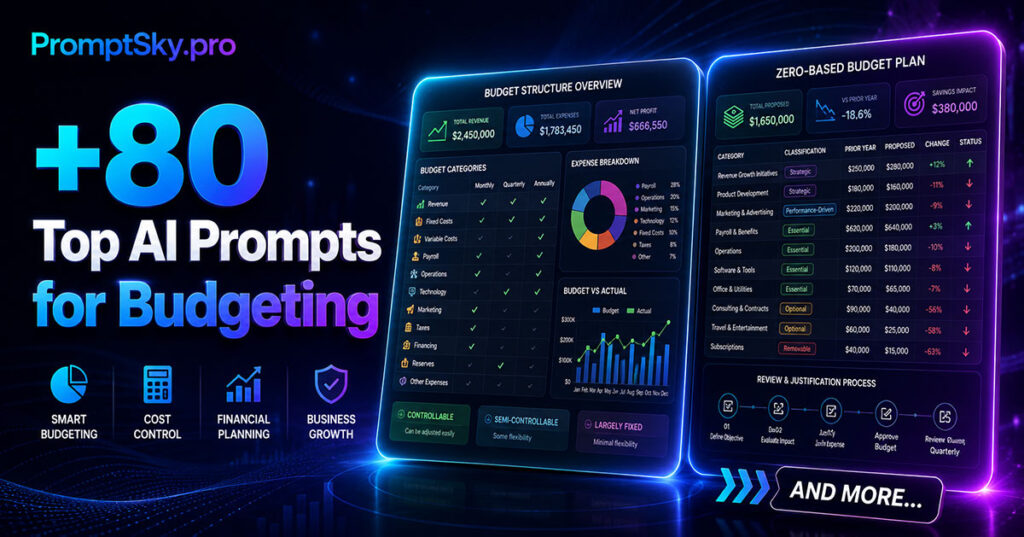
AI Prompts for Budgeting make it easier to organize business expenses, forecast revenue, control cash flow, and make better financial decisions. This collection gives entrepreneurs and business teams 80 practical prompts for building, reviewing, optimizing, and stress-testing a business budget.
To use these prompts, copy the prompt that matches your financial task and replace the information inside square brackets, such as [BUSINESS], [BUDGET DATA], [FINANCIAL DATA], or [TARGET PROFIT], with your own details. Add specific figures, time periods, expense categories, revenue assumptions, and business goals whenever possible. You can also adapt each prompt to your company size, industry, business model, and budgeting process. For financial, tax, legal, or regulatory decisions, use AI as a planning assistant and verify important conclusions with a qualified professional.
If you’re working on broader business planning, explore 30 Powerful AI Prompts for Business Planning and Growth for prompts focused on strategy, planning, and expansion. For customer acquisition and promotional activities, 30 Best AI Marketing Prompts for Business Growth provides additional marketing-focused ideas. You can also discover more collections through AI Prompts for Every Goal and Workflow.
Need a prompt for a specific budgeting problem, business model, or financial workflow? Leave your request in the comments and let us know what kind of prompt you need.
1. Business Budget Structure Builder
A well-structured budget gives a business a clear view of where money comes from and where it goes. This prompt helps create a practical budgeting framework without relying on overly complicated financial categories.
Prompt:
Act as a professional business budgeting strategist and design a complete budgeting structure for my business: [BUSINESS]. Organize the budget into logical categories for revenue, fixed costs, variable costs, payroll, operations, technology, marketing, taxes, financing, reserves, and other relevant expenses. Identify which categories should be tracked monthly, quarterly, and annually. Recommend appropriate subcategories without creating unnecessary complexity. Explain which expenses should be treated as controllable, semi-controllable, or largely fixed. Create a practical structure that can be used in a spreadsheet or accounting system and make it suitable for comparing planned spending against actual business performance throughout the year.
2. Monthly Business Budget Planner
Monthly budgeting becomes more useful when planned spending is connected to actual business priorities. This prompt creates a month-by-month financial plan that can be adjusted as circumstances change.
Prompt:
Act as an experienced business financial planning advisor and create a 12-month monthly budget for my business: [BUSINESS]. Use the following financial information, expected revenue, recurring expenses, variable expenses, payroll, planned investments, seasonal patterns, and financial goals: [FINANCIAL DETAILS]. Allocate expected income across appropriate expense categories and identify months where cash requirements may be unusually high. Separate essential spending from discretionary spending and strategic investments. Include monthly budget targets, expected cash requirements, variance thresholds, and review points. Make the plan flexible enough to accommodate changes in revenue while maintaining financial discipline and protecting the business from unnecessary spending.
3. Zero-Based Business Budget
Zero-based budgeting forces every significant expense to be justified instead of automatically carrying previous spending into a new period. This prompt helps rebuild a business budget around current priorities.
Prompt:
Act as a zero-based budgeting expert and rebuild the budget for my business from the ground up: [BUSINESS]. Use the following previous-year expenses and current business objectives: [EXPENSE DATA AND GOALS]. Do not assume that existing expenses should automatically continue. Evaluate every category based on its necessity, expected business value, strategic importance, measurable outcome, and cost. Classify expenses as essential, performance-driven, strategic, optional, or removable. Recommend a proposed budget amount for each category and explain the reasoning behind major changes. Identify expenses that should be reduced, redesigned, renegotiated, or eliminated and create a review process that requires meaningful justification for significant spending.
4. Annual Business Budget Plan
An annual budget should reflect the direction of the business rather than simply repeat last year’s numbers. This prompt connects financial planning with expected growth, strategic priorities, and operational requirements.
Prompt:
Act as a senior business financial planner and create a detailed annual budget for my business: [BUSINESS]. Analyze my previous financial performance, current revenue sources, expected growth, operating costs, staffing plans, strategic initiatives, capital requirements, seasonal fluctuations, and financial objectives: [FINANCIAL INFORMATION]. Build an annual budget covering revenue, operating expenses, payroll, marketing, technology, administration, taxes, investments, reserves, and other relevant categories. Define monthly or quarterly targets where appropriate. Include realistic assumptions, conservative scenarios, and potential financial pressure points. Explain which assumptions should be reviewed regularly and create a quarterly budget-review framework for adjusting the plan without losing control of overall spending.
5. Business Budget vs Actual Analysis
Comparing planned spending with actual results reveals where financial assumptions are accurate and where business operations are drifting from the original plan. This prompt helps turn budget variances into actionable insights.
Prompt:
Act as a business financial analyst and compare my planned budget with actual financial results: [BUDGET DATA] and [ACTUAL RESULTS]. Calculate or identify significant differences across revenue, payroll, operating costs, marketing, technology, administration, and other major categories. Classify each variance as favorable, unfavorable, timing-related, structural, temporary, or potentially recurring where the available information supports the conclusion. Investigate the likely causes of the largest differences and distinguish confirmed explanations from assumptions. Identify which variances require immediate action and which should simply be monitored. Recommend specific adjustments to the next budgeting period and create a variance-review process that management can repeat every month.
6. Business Expense Reduction Plan
Cutting costs without understanding their role can damage growth or customer experience. This prompt focuses on reducing unnecessary spending while protecting important business capabilities.
Prompt:
Act as a business cost-optimization consultant and analyze the following expense structure: [BUSINESS EXPENSES]. Identify opportunities to reduce spending without unnecessarily harming revenue generation, employee productivity, customer satisfaction, compliance, or long-term growth. Separate expenses that should be eliminated from those that should be renegotiated, consolidated, automated, replaced, or monitored more closely. Estimate the potential financial impact of each recommendation where sufficient information is available. Rank the opportunities according to savings potential, implementation difficulty, operational risk, and time required. Create a phased cost-reduction plan that protects essential business functions and includes safeguards against cutting expenses that generate measurable value.
7. Business Cost Allocation Framework
A business may have difficulty understanding how much money is actually being consumed by different departments, products, locations, or activities. This prompt creates a consistent cost-allocation approach.
Prompt:
Act as a business financial controller and design a cost allocation framework for my business: [BUSINESS]. Determine how shared expenses should be allocated across departments, products, services, projects, locations, customer segments, or business units. Review expenses such as rent, software, payroll, management time, utilities, administration, marketing, support, technology, and shared services. Recommend allocation methods that are logical, consistent, transparent, and useful for decision-making. Identify costs that should remain centralized rather than being artificially distributed. Create allocation rules, required data, review frequencies, and reporting structures that allow management to understand the true economic resources consumed by each part of the business.
8. Business Department Budget Allocation
Different departments often compete for limited financial resources. This prompt helps allocate the available budget according to strategic priorities and measurable business needs.
Prompt:
Act as a strategic business budgeting advisor and allocate a total available budget of [TOTAL BUDGET] across the following departments: [DEPARTMENTS]. Consider expected revenue contribution, operational necessity, customer impact, strategic priorities, staffing requirements, historical spending, measurable outcomes, risks, and growth opportunities. Do not simply distribute funds proportionally based on previous spending. Explain the reasoning behind each allocation and identify areas where additional funding could create disproportionate value. Create minimum, target, and stretch budget scenarios for each department. Also identify contingency funding requirements and define the conditions under which management should increase, maintain, reduce, or reallocate departmental budgets during the year.
9. Business Marketing Budget Allocation
Marketing budgets can easily become fragmented across channels without a clear connection to business outcomes. This prompt helps allocate marketing spending according to strategic objectives and expected performance.
Prompt:
Act as a business marketing finance strategist and develop a marketing budget allocation plan for my business: [BUSINESS]. Use the following available marketing budget, historical performance, target customers, acquisition channels, expected revenue, and growth objectives: [MARKETING INFORMATION]. Allocate resources across SEO, content, paid advertising, social media, email, partnerships, events, creative production, tools, and other relevant activities. Distinguish proven channels from experimental investments and brand-building activities from direct-response initiatives. Define performance expectations, testing budgets, spending limits, and review periods for each category. Create a flexible allocation model that allows funding to move toward strong-performing opportunities while protecting a reasonable budget for experimentation.
10. Business Payroll Budget Planner
Payroll is often one of the largest business expenses, so it should be planned alongside expected workload, growth, and operational capacity. This prompt helps create a sustainable payroll budget.
Prompt:
Act as a business workforce budgeting specialist and create a payroll budget for my business: [BUSINESS]. Analyze the current team, salaries, benefits, contractors, planned hires, expected departures, workload, revenue expectations, operational requirements, and growth plans: [WORKFORCE DETAILS]. Build a monthly or quarterly payroll projection that includes existing employees, planned positions, variable compensation, contractor costs, benefits, taxes, and other relevant employment expenses. Identify the financial conditions that should be met before each planned hire. Create conservative, expected, and growth scenarios and explain how payroll changes would affect the overall business budget. Recommend workforce-budget controls that prevent hiring commitments from exceeding sustainable financial capacity.
11. Business Hiring Budget
Hiring decisions can create long-term financial commitments that extend beyond the employee’s salary. This prompt helps evaluate the complete budgetary impact of adding new team members.
Prompt:
Act as a business workforce financial analyst and evaluate the budget impact of hiring the following positions: [POSITIONS]. For each role, estimate the full financial commitment including salary, benefits, recruitment costs, equipment, software, onboarding, training, management time, workspace, taxes, and other relevant expenses. Compare the expected cost with the business problem the role is intended to solve and the potential financial value it could create. Define the minimum business conditions required before hiring and identify lower-cost alternatives such as automation, outsourcing, process redesign, or temporary support. Create a hiring-budget priority ranking and explain which roles should be hired immediately, later, conditionally, or not at all.
12. Business Software Budget Optimization
Software subscriptions can quietly become a significant recurring expense as businesses accumulate tools. This prompt helps identify unnecessary overlap and improve technology spending.
Prompt:
Act as a business technology budgeting consultant and audit my company’s software expenses: [SOFTWARE LIST]. Analyze each subscription according to cost, users, utilization, business purpose, criticality, overlapping functionality, measurable value, contract terms, and alternatives. Identify tools that are underused, duplicated, unnecessarily expensive, or no longer aligned with business needs. Separate essential systems from optional productivity tools and experimental software. Recommend which subscriptions should be retained, downgraded, consolidated, renegotiated, replaced, or canceled. Create a software-budget management process with renewal reminders, ownership responsibilities, utilization reviews, and approval requirements for adding new recurring software expenses.
13. Business Subscription Expense Audit
Recurring subscriptions can continue unnoticed even when the original business need disappears. This prompt creates a broader recurring-expense audit beyond software alone.
Prompt:
Act as a business expense auditor and analyze all recurring expenses in my business: [RECURRING EXPENSE DATA]. Identify monthly, quarterly, annual, contractual, membership, service, maintenance, subscription, and recurring vendor charges. Categorize each expense according to business purpose, necessity, frequency, owner, utilization, contractual commitment, and measurable value. Identify charges that may be redundant, forgotten, underused, or no longer aligned with current priorities. Estimate annualized spending and potential savings from cancellations, renegotiations, consolidation, or plan changes. Create a recurring-expense review calendar that ensures important renewals are evaluated before automatic commitments occur.
14. Business Vendor Budget Review
Vendor costs can significantly affect operating margins, especially when businesses renew contracts without reassessing terms or usage. This prompt helps evaluate vendor spending strategically.
Prompt:
Act as a business procurement and budgeting specialist and review my current vendor expenses: [VENDOR DATA]. Analyze each vendor based on annual cost, services provided, usage, business importance, contract terms, pricing changes, service quality, switching difficulty, alternatives, and strategic dependency. Identify vendors where renegotiation, consolidation, competitive bidding, scope reduction, or replacement could improve the business budget. Separate critical suppliers from replaceable services and identify risks associated with changing each relationship. Create a vendor-review schedule and negotiation priorities. Recommend specific financial and operational information management should collect before renewing major vendor agreements.
15. Business Procurement Budget Strategy
Procurement decisions influence both immediate expenses and long-term operating efficiency. This prompt helps create purchasing rules that prevent uncontrolled spending.
Prompt:
Act as a business procurement strategist and design a purchasing and procurement budget framework for my company: [BUSINESS]. Analyze the types of goods and services the business regularly purchases, expected spending levels, departments involved, supplier relationships, purchasing frequency, approval processes, and available alternatives. Define spending thresholds that require employee approval, manager approval, financial review, or executive authorization. Recommend opportunities for bulk purchasing, vendor consolidation, contract negotiation, standardized purchasing, and planned procurement. Create a procurement calendar and budget-control process that balances financial discipline with operational flexibility. Include rules for urgent purchases and exceptions so the system does not prevent legitimate business needs from being addressed.
16. Business Capital Expenditure Budget
Capital expenditures can create significant long-term commitments, so they should be evaluated differently from ordinary operating expenses. This prompt helps prioritize major investments.
Prompt:
Act as a business capital expenditure planning specialist and create a capital expenditure budget for my business: [BUSINESS]. Evaluate the following planned investments: [CAPEX PROJECTS]. Consider equipment, technology infrastructure, vehicles, facilities, machinery, major software implementations, renovations, and other long-term assets. For each investment, analyze upfront cost, ongoing operating cost, expected useful life, financial benefit, strategic importance, implementation risk, maintenance requirements, and potential alternatives. Rank the projects according to business necessity, expected value, urgency, and financial capacity. Create a phased investment schedule and define approval criteria that management should use before committing significant capital.
17. Business Equipment Replacement Budget
Replacing equipment at the wrong time can either create unnecessary spending or expose the business to operational failures. This prompt helps determine when replacement is financially justified.
Prompt:
Act as a business asset and budgeting advisor and evaluate the replacement needs for my company’s equipment: [EQUIPMENT DATA]. Analyze purchase cost, age, maintenance history, repair frequency, downtime, productivity, energy consumption, reliability, remaining useful life, replacement cost, and operational importance. Identify equipment that should be maintained, repaired, replaced soon, replaced later, or monitored. Compare the financial impact of continuing to operate existing equipment with replacing it. Create a replacement-budget schedule that spreads major expenditures across appropriate periods while protecting critical operations. Include contingency recommendations for assets where unexpected failure could create substantial business disruption.
18. Business Technology Investment Budget
Technology investments can improve productivity and scalability but may also consume substantial resources without producing measurable benefits. This prompt helps prioritize technology spending.
Prompt:
Act as a business technology investment strategist and evaluate my planned technology investments: [TECHNOLOGY PROJECTS]. Analyze the expected business problem, implementation cost, ongoing expense, productivity impact, revenue potential, operational efficiency, scalability, security requirements, integration needs, employee adoption, and strategic importance of each investment. Compare projects using a structured financial and business-value scoring model. Identify investments that are essential, high-potential, experimental, premature, or low-value. Create a phased technology budget with milestones that must be achieved before additional funds are committed. Include post-implementation measurement criteria so the business can determine whether each technology investment delivered the expected value.
19. Business Cash Reserve Budget
A cash reserve can protect a business from unexpected expenses, revenue fluctuations, and temporary disruptions. This prompt helps determine an appropriate reserve strategy based on actual business conditions.
Prompt:
Act as a business financial risk advisor and design a cash reserve budgeting strategy for my business: [BUSINESS]. Analyze monthly operating expenses, revenue volatility, customer concentration, payment cycles, debt obligations, payroll requirements, seasonal fluctuations, supplier commitments, and major financial risks: [FINANCIAL DATA]. Estimate reasonable reserve targets under conservative, expected, and higher-risk scenarios. Separate emergency reserves from planned cash balances and explain when each should or should not be used. Create a process for building, maintaining, reviewing, and replenishing the reserve. Identify situations that should trigger a temporary increase in reserve targets and explain how reserve decisions should interact with business investment and growth plans.
20. Business Contingency Budget
Unexpected events can disrupt even carefully planned budgets. This prompt helps create financial contingencies for plausible business disruptions without simply adding arbitrary padding to every expense category.
Prompt:
Act as a business financial risk planner and create a contingency budget for my business: [BUSINESS]. Analyze the company’s most significant financial risks, including revenue declines, supplier problems, equipment failure, technology outages, unexpected repairs, staffing changes, customer concentration, regulatory costs, market disruptions, and other relevant scenarios: [RISK INFORMATION]. Estimate the potential financial impact and likelihood of each scenario using reasonable assumptions. Recommend which risks require dedicated reserves, flexible spending capacity, insurance consideration, alternative suppliers, or other mitigation measures. Create contingency spending rules that specify when funds can be accessed, who approves them, how usage is recorded, and how the reserve should be rebuilt afterward.
21. Business Seasonal Budget Planning
Many businesses experience predictable fluctuations throughout the year. This prompt helps align spending and financial preparation with seasonal demand.
Prompt:
Act as a business budgeting strategist specializing in seasonal planning and create a seasonal budget for my business: [BUSINESS]. Analyze historical revenue, customer demand, staffing requirements, inventory needs, marketing activity, supplier costs, operating expenses, and other seasonal patterns: [HISTORICAL DATA]. Identify periods of high revenue, low revenue, elevated spending, and potential cash pressure. Create monthly budget targets that reflect these patterns rather than assuming equal performance throughout the year. Recommend when the business should build reserves, increase inventory, increase marketing, control discretionary spending, or prepare additional staffing. Include a pre-season preparation checklist and a post-season review process for improving next year’s budget.
22. Business Revenue Budget Forecast
Revenue assumptions are the foundation of most budgets, but overly optimistic forecasts can lead to excessive spending. This prompt creates a more disciplined revenue-budgeting process.
Prompt:
Act as a business revenue planning analyst and create a realistic revenue budget for my business: [BUSINESS]. Use the following historical revenue, customer numbers, average transaction values, sales pipeline, recurring revenue, seasonality, pricing, conversion rates, retention, and market assumptions: [REVENUE DATA]. Build conservative, expected, and optimistic revenue scenarios and clearly identify the assumptions behind each. Separate predictable revenue from uncertain revenue and avoid treating unconfirmed pipeline as guaranteed income. Explain how revenue assumptions should influence expense limits and hiring decisions. Create monthly or quarterly revenue targets and define the indicators that should trigger a revision of the business budget.
23. Business Revenue Variance Investigation
Revenue can differ from budget for many reasons, and simply observing the variance does not explain what happened. This prompt helps identify the underlying drivers.
Prompt:
Act as a business financial performance analyst and investigate the difference between my budgeted and actual revenue: [BUDGETED REVENUE] versus [ACTUAL REVENUE]. Break the variance into meaningful drivers such as customer volume, pricing, product mix, sales conversion, retention, seasonality, timing, new business, lost business, cancellations, and unusual events where data is available. Identify the largest contributors to the variance and distinguish temporary effects from structural changes. Explain which assumptions in the original budget were inaccurate and how they should be revised. Create specific actions for improving future revenue forecasts and a recurring review framework that connects revenue changes with operational budgeting decisions.
24. Business Expense Forecasting Model
A budget becomes more useful when it can anticipate future spending instead of simply recording historical costs. This prompt helps create an expense forecasting framework.
Prompt:
Act as a business financial forecasting specialist and build an expense forecasting model for my business: [BUSINESS]. Analyze historical expenses, fixed commitments, variable costs, payroll, vendor contracts, seasonal patterns, planned projects, inflation or price changes, and known future events: [EXPENSE DATA]. Separate expenses that can be forecast reliably from those requiring scenario assumptions. Create monthly or quarterly projections for major expense categories and identify expected increases, decreases, and unusual spending periods. Develop conservative, expected, and higher-cost scenarios and explain which assumptions drive each scenario. Recommend a forecasting review process that updates future budgets using actual spending trends without allowing temporary anomalies to distort long-term expectations.
25. Business Budget Scenario Planning
Scenario planning allows a business to prepare for different financial outcomes instead of relying on one forecast. This prompt creates structured financial scenarios for decision-making.
Prompt:
Act as a strategic business financial planner and create three budget scenarios for my business: [BUSINESS]. Build conservative, expected, and growth scenarios using the following revenue assumptions, cost structure, staffing plans, investments, cash position, and market conditions: [FINANCIAL INFORMATION]. For each scenario, estimate revenue, major expenses, operating requirements, cash needs, discretionary spending capacity, and strategic investments. Identify the assumptions that change between scenarios and define trigger points that indicate when the business should move from one budget plan to another. Recommend specific management actions for each scenario, including spending controls, hiring decisions, investment timing, and reserve requirements. Keep the scenarios practical enough to guide real decisions during changing business conditions.
26. Business Budget Sensitivity Analysis
Some budget assumptions have a much larger financial impact than others. This prompt helps identify which variables management should monitor most closely.
Prompt:
Act as a business financial sensitivity analyst and examine the following budget model: [BUDGET MODEL]. Identify the assumptions that have the greatest potential effect on revenue, expenses, cash flow, and overall financial performance. Test how changes in variables such as sales volume, pricing, customer retention, payroll, supplier costs, advertising spend, conversion rates, and other relevant inputs could affect the budget. Rank the variables according to financial sensitivity and explain which assumptions require the closest monitoring. Create practical thresholds for management action when key variables move beyond expected ranges. Recommend which assumptions should be reviewed weekly, monthly, or quarterly based on their potential impact and volatility.
27. Business Break-Even Budget Planning
Break-even analysis becomes more useful when incorporated directly into budgeting decisions. This prompt helps determine the revenue and operating conditions required for the business to cover its costs.
Prompt:
Act as a business financial planning expert and develop a break-even budget analysis for my business: [BUSINESS]. Use the following pricing, revenue streams, fixed costs, variable costs, contribution margins, payroll, operating expenses, and other financial information: [FINANCIAL DATA]. Determine the approximate revenue, sales volume, customer count, or transaction level required to cover operating costs where the available data supports the calculation. Analyze how changes in pricing, costs, product mix, and sales volume affect the break-even point. Create multiple break-even scenarios and identify the budget assumptions that create the greatest financial risk. Translate the analysis into practical monthly and quarterly targets that management can use when planning spending and growth.
28. Business Profit Target Budget
A budget should not only prevent overspending; it should also help the business work toward a defined financial outcome. This prompt builds the expense plan around a desired profit objective.
Prompt:
Act as a business profitability planning strategist and create a budget designed to achieve a target profit of [TARGET PROFIT] for my business: [BUSINESS]. Analyze expected revenue, pricing, gross margin, fixed expenses, variable expenses, payroll, taxes, marketing, technology, financing costs, and other relevant categories: [FINANCIAL DATA]. Determine what level of revenue and spending discipline may be required to reach the target under conservative and expected assumptions. Identify expense categories with the greatest flexibility and explain where cost reductions could damage growth. Create monthly or quarterly financial targets and define corrective actions if the business falls behind. Clearly identify assumptions that require validation before the target is treated as realistic.
29. Business Budget Approval Framework
Without clear approval rules, employees and departments may make spending decisions inconsistently. This prompt creates a structured budget-approval system based on financial impact and business necessity.
Prompt:
Act as a business financial governance consultant and design a budget approval framework for my business: [BUSINESS]. Analyze the types of expenses the company makes and create approval levels based on spending amount, category, contractual commitment, strategic importance, recurring cost, operational urgency, and financial risk. Define which purchases employees can make independently and which require manager, finance, or executive approval. Create rules for planned spending, unplanned expenses, emergency purchases, recurring subscriptions, capital investments, vendor commitments, and budget overruns. Include documentation requirements and escalation procedures. Design the framework so approvals remain fast for routine purchases while providing stronger financial oversight for significant or risky commitments.
30. Business Budget Governance System
A budget is only useful when the business continuously monitors it, assigns ownership, and acts when results diverge from the plan. This prompt creates an ongoing governance system rather than a one-time budgeting exercise.
Prompt:
Act as a senior business financial governance advisor and design a complete budget-management system for my business: [BUSINESS]. Define how the budget should be created, approved, monitored, updated, and reviewed throughout the financial year. Establish responsibilities for business owners, department managers, finance staff, and other relevant stakeholders. Create monthly, quarterly, and annual review procedures covering revenue performance, expense variances, cash requirements, planned investments, budget changes, and emerging financial risks. Define variance thresholds that require investigation or management action and establish rules for reallocating unused or excess budget. Include reporting templates, review questions, escalation procedures, documentation standards, and decision checkpoints so budgeting becomes an ongoing business management process rather than a static financial document.
31. Business Personal vs Company Expense Separation
Mixing personal and business spending can make financial reporting unreliable and complicate budgeting decisions. This prompt helps create a clear framework for separating expenses and improving business financial visibility.
Prompt:
Act as a business financial organization specialist and help me separate personal expenses from legitimate business expenses using the following financial records: [EXPENSE DATA]. Review each transaction and classify it as business-related, personal, mixed-use, unclear, or requiring additional documentation. Explain the reasoning behind classifications without making unsupported legal or tax conclusions. Identify recurring transactions that may be creating confusion and recommend a cleaner expense-management structure. Create categories, documentation rules, account separation practices, and review procedures that make future business budgeting more accurate. Highlight transactions that should be reviewed by a qualified accountant or financial professional before being included in formal business records.
32. Business Discretionary Spending Budget
Discretionary expenses can provide value, but they should be controlled when financial resources are limited. This prompt helps establish clear limits without unnecessarily restricting useful business activities.
Prompt:
Act as a business budgeting consultant and analyze discretionary spending within my business: [BUSINESS]. Review the following expenses, activities, subscriptions, events, travel, entertainment, training, tools, services, and other optional costs: [EXPENSE DATA]. Classify each expense according to strategic value, employee benefit, customer impact, revenue potential, operational usefulness, and urgency. Identify which expenses should receive protected funding, flexible funding, temporary limits, or elimination. Create monthly and quarterly discretionary spending limits and define approval requirements for expenses outside those limits. Recommend a review process that allows worthwhile opportunities to receive funding while preventing low-value spending from becoming a permanent part of the business budget.
33. Business Travel Budget Planner
Travel costs can vary significantly depending on frequency, destination, purpose, and timing. This prompt helps create a travel budget connected to measurable business objectives.
Prompt:
Act as a business travel budgeting specialist and create a travel budget for my business: [BUSINESS]. Analyze planned business trips, destinations, employees, travel purposes, expected frequency, transportation, accommodation, meals, event costs, client meetings, and other related expenses: [TRAVEL DATA]. Categorize trips according to revenue potential, customer importance, strategic value, operational necessity, and optionality. Establish realistic spending limits and approval rules for different types of travel. Identify opportunities to reduce costs through advance planning, preferred suppliers, virtual alternatives, trip consolidation, or policy changes. Create monthly and annual travel budgets and define the information employees must provide when requesting travel approval.
34. Business Training and Development Budget
Employee development can support productivity and retention, but training spending should be aligned with actual business needs. This prompt creates a structured training budget.
Prompt:
Act as a business workforce development budgeting advisor and create a training and professional development budget for my business: [BUSINESS]. Analyze the current team, skill gaps, strategic priorities, required certifications, planned training programs, conferences, courses, coaching, workshops, and educational resources: [TEAM AND TRAINING DATA]. Prioritize investments based on business impact, employee role, urgency, expected capability improvement, and potential return. Separate mandatory training from optional development and define annual or quarterly spending limits. Recommend how the business should evaluate whether training delivered measurable value. Create a budget allocation framework that supports employee growth while ensuring development spending remains aligned with operational and strategic priorities.
35. Business Office Expense Budget
Office expenses can include many small recurring costs that become significant when combined. This prompt helps create a realistic office operations budget while identifying opportunities for efficiency.
Prompt:
Act as a business operations budgeting specialist and create an office expense budget for my business: [BUSINESS]. Analyze current and expected expenses including rent, utilities, supplies, furniture, maintenance, cleaning, communication services, equipment, security, refreshments, office software, and other workplace costs: [OFFICE EXPENSE DATA]. Separate fixed, variable, recurring, one-time, and discretionary expenses. Identify seasonal or usage-based fluctuations and potential cost-saving opportunities. Create monthly and annual budget targets and establish spending controls for common office purchases. Recommend which expenses should be centrally managed and which can be assigned to departments, while keeping the system simple enough for employees to follow consistently.
36. Business Remote Work Budget
Remote or hybrid work creates a different cost structure from traditional office operations. This prompt helps businesses understand and plan those expenses.
Prompt:
Act as a business operations and budgeting consultant and build a remote or hybrid work budget for my business: [BUSINESS]. Analyze the expected costs of remote employees, home-office support, collaboration software, communication tools, equipment, cybersecurity, coworking spaces, travel, training, IT support, and other relevant expenses: [REMOTE WORK DATA]. Compare these costs with current or previous office-related expenses where information is available. Identify which costs are essential, optional, employee-specific, or shared across the organization. Create monthly and annual budget scenarios for different workforce models and recommend policies that control spending without reducing employee productivity or operational reliability.
37. Business Customer Support Budget
Customer support spending should reflect customer volume, service expectations, staffing requirements, and strategic importance. This prompt helps build a support budget around actual business needs.
Prompt:
Act as a business customer support financial planner and create a support budget for my business: [BUSINESS]. Analyze customer volume, ticket volume, support channels, response-time expectations, staffing levels, contractors, support software, training, automation, escalation requirements, and expected growth: [SUPPORT DATA]. Estimate the resources required to maintain an appropriate level of service under current and future demand. Separate fixed support costs from volume-dependent costs and identify opportunities for automation or process improvement. Create conservative, expected, and high-demand budget scenarios. Define performance indicators that should be monitored alongside spending so the business can determine whether support costs are producing an appropriate level of customer service.
38. Business Customer Success Budget
Customer success investments can support retention, expansion, and long-term relationships. This prompt helps connect customer-success spending with measurable business outcomes.
Prompt:
Act as a business customer success budgeting strategist and create a customer success budget for my business: [BUSINESS]. Analyze customer segments, account volume, renewal patterns, onboarding requirements, success-management activities, account reviews, training, customer education, support needs, technology, and staffing: [CUSTOMER SUCCESS DATA]. Allocate resources according to customer value, complexity, growth potential, and retention requirements rather than treating every account identically. Identify activities that can be automated, standardized, or delivered through self-service resources. Create budget scenarios based on customer growth and define metrics for evaluating retention, expansion, engagement, and customer outcomes relative to customer-success spending.
39. Business Client Onboarding Budget
Onboarding costs can vary significantly between customer types and may influence profitability from the beginning of a relationship. This prompt helps businesses understand and control onboarding expenses.
Prompt:
Act as a business onboarding financial strategist and analyze the cost of onboarding customers for my business: [BUSINESS]. Review the following onboarding activities, employee time, implementation work, training, setup, software, documentation, support, communication, and customer-specific requirements: [ONBOARDING DATA]. Estimate the cost associated with different customer segments and identify activities that create excessive expense or unnecessary complexity. Recommend ways to standardize onboarding while preserving an appropriate customer experience. Create an onboarding budget framework with expected cost ranges, approval rules for unusual requirements, and indicators for identifying customers whose onboarding demands may exceed the economics assumed in the business model.
40. Business Event Budget Planner
Events can generate networking, sales, brand visibility, or customer engagement, but they should be planned against clear financial limits. This prompt helps create a complete event budget.
Prompt:
Act as a business event budgeting specialist and create a detailed budget for the following event: [EVENT]. Analyze expected expenses including venue, registration, travel, accommodation, equipment, production, catering, staffing, speakers, marketing, design, technology, insurance, contingency, and other relevant costs. Separate essential costs from optional upgrades and identify areas where supplier negotiation or alternative arrangements may reduce spending. Estimate expected business outcomes such as leads, customer engagement, partnerships, sales opportunities, or brand exposure where appropriate. Create a pre-event approval budget, a live spending-control process, and a post-event financial review that compares actual spending and outcomes against the original assumptions.
41. Business Inventory Budget
Inventory-heavy businesses need to balance product availability with the financial cost of holding stock. This prompt helps create an inventory budget based on demand and operational requirements.
Prompt:
Act as a business inventory budgeting specialist and develop an inventory budget for my business: [BUSINESS]. Analyze historical sales, product demand, seasonality, supplier lead times, minimum order quantities, purchase prices, storage costs, stock turnover, current inventory, expected growth, and cash constraints: [INVENTORY DATA]. Identify products that require higher or lower purchasing priority and estimate appropriate inventory spending by period. Highlight risks of overstocking, stockouts, obsolete inventory, and excessive cash tied up in products. Create purchasing thresholds and review points that connect inventory decisions with the overall business budget. Recommend adjustments based on actual sales performance and changing demand patterns.
42. Business Purchasing Forecast
Purchasing requirements often change with sales volume, seasonality, and supplier conditions. This prompt helps businesses forecast upcoming purchasing needs before committing funds.
Prompt:
Act as a business purchasing and budgeting analyst and forecast upcoming purchasing requirements using the following information: [PURCHASING DATA]. Analyze historical purchases, expected sales, inventory levels, supplier lead times, pricing changes, minimum order requirements, seasonal demand, current commitments, and planned promotions. Estimate purchasing needs by month or quarter and identify periods where cash requirements may become unusually high. Separate predictable purchases from uncertain requirements and create conservative and expected scenarios. Recommend when purchase orders should be placed, which purchases should be delayed or accelerated, and what information should be reviewed before committing significant funds. Ensure the purchasing forecast remains connected to the broader business budget.
43. Business Marketing Campaign Budget
Individual campaigns need their own financial boundaries so spending does not gradually exceed the original business plan. This prompt helps structure campaign-level budgeting.
Prompt:
Act as a business marketing budget strategist and create a detailed budget for the following campaign: [CAMPAIGN]. Analyze the campaign objective, target audience, expected duration, channels, creative requirements, media spending, software, freelancers, agencies, content production, testing, and measurement: [CAMPAIGN DATA]. Divide the budget into required costs, performance-based spending, testing funds, and contingency capacity. Establish spending limits for each stage and define conditions for increasing, maintaining, or reducing the budget based on performance. Create a reporting structure that compares planned and actual campaign spending with relevant business outcomes while avoiding decisions based solely on surface-level marketing metrics.
44. Business Advertising Budget Control
Advertising budgets can expand quickly when campaigns are automated or scaled. This prompt creates a control system for keeping advertising spending aligned with business objectives.
Prompt:
Act as a business advertising finance specialist and design a budget-control framework for my paid advertising activities: [ADVERTISING DATA]. Analyze campaign budgets, customer acquisition costs, conversion rates, revenue, margins, channels, target markets, campaign objectives, and historical performance. Establish daily, weekly, monthly, and campaign-level spending limits appropriate to the available business budget. Define financial thresholds that trigger investigation, optimization, scaling, or spending reduction. Separate testing budgets from established campaigns and create rules for reallocating funds between channels. Include safeguards against accidental overspending and explain how advertising budget decisions should account for profitability rather than focusing only on clicks, impressions, or lead volume.
45. Business Content Budget Planner
Content production can involve writers, designers, editors, video specialists, tools, agencies, and internal employee time. This prompt helps businesses build a content budget based on strategic priorities.
Prompt:
Act as a business content-budget strategist and create a content production budget for my business: [BUSINESS]. Analyze planned content types such as articles, videos, graphics, social media content, newsletters, guides, case studies, product content, and other formats: [CONTENT PLAN]. Estimate the resources required for internal production, freelancers, agencies, software, equipment, editing, design, research, and distribution. Prioritize content according to business goals, audience importance, expected value, and production complexity. Create monthly and quarterly budget allocations and identify content activities that should be standardized, repurposed, automated, or reduced. Include a measurement framework for evaluating whether content spending supports meaningful business outcomes.
46. Business Website Budget
A website can generate revenue, support operations, or serve primarily as a business presence, and its budget should reflect that role. This prompt helps plan both initial and ongoing website expenses.
Prompt:
Act as a business website budgeting consultant and create a complete website budget for my business: [BUSINESS]. Analyze expected costs for design, development, hosting, domains, maintenance, security, content, SEO, analytics, integrations, accessibility, performance optimization, updates, support, and future improvements: [WEBSITE REQUIREMENTS]. Separate initial project costs from recurring expenses and strategic investments. Identify which components are essential for launch and which can be implemented later. Create a phased budget with spending priorities, approval checkpoints, and contingency capacity. Recommend a process for evaluating future website expenses based on business goals, performance data, customer needs, and measurable operational or commercial value.
47. Business SEO Budget Allocation
SEO spending can involve content, technical work, tools, specialists, link acquisition, audits, and ongoing optimization. This prompt helps allocate resources according to business priorities.
Prompt:
Act as a business SEO budgeting strategist and create an SEO budget for my business: [BUSINESS]. Analyze the current website condition, organic traffic, target keywords, competition, content needs, technical SEO requirements, internal resources, external specialists, software, and business objectives: [SEO INFORMATION]. Allocate the available budget across technical optimization, content creation, keyword research, analytics, audits, digital PR or other appropriate activities. Separate foundational work from ongoing growth initiatives and experimental investments. Define realistic review periods and performance indicators. Create a flexible allocation system that allows the business to increase investment in strategies showing meaningful progress while avoiding spending based only on rankings or vanity metrics.
48. Business Customer Acquisition Budget
Customer acquisition spending should be connected to the economics of acquiring and serving customers. This prompt helps establish a disciplined acquisition budget across channels.
Prompt:
Act as a business customer acquisition financial strategist and create an acquisition budget for my business: [BUSINESS]. Analyze target customers, average transaction value, customer lifetime value where available, acquisition costs, conversion rates, sales cycles, marketing channels, sales resources, retention patterns, and available growth targets: [CUSTOMER ACQUISITION DATA]. Determine reasonable spending limits for acquisition activities and separate proven channels from experimental opportunities. Create monthly or quarterly acquisition budgets and define thresholds for scaling or reducing spend. Explain how acquisition spending should be evaluated against margins, retention, and customer quality rather than simply the number of leads generated. Include a process for reallocating budget toward stronger acquisition opportunities.
49. Business Sales Budget
Sales teams create expenses through salaries, commissions, tools, travel, training, events, prospecting, and other activities. This prompt helps create a sales budget connected to revenue objectives.
Prompt:
Act as a business sales-finance strategist and develop a sales budget for my business: [BUSINESS]. Analyze the sales team structure, compensation, commissions, sales tools, prospecting activities, travel, training, events, customer meetings, lead generation support, and expected revenue targets: [SALES DATA]. Estimate the cost required to achieve different revenue scenarios and identify the relationship between sales spending and expected business results. Separate fixed sales costs from variable costs and performance-dependent expenses. Create monthly and annual budget targets and define conditions for increasing sales investment. Highlight potential inefficiencies and recommend changes that improve sales productivity without assuming that additional spending automatically produces additional revenue.
50. Business Commission Budget
Commission structures can create unpredictable expenses when revenue changes, so businesses should model them before setting sales targets. This prompt helps forecast commission obligations.
Prompt:
Act as a business compensation and budgeting analyst and model the commission budget for my business: [BUSINESS]. Analyze the current commission structure, sales roles, rates, tiers, bonuses, revenue targets, payment timing, cancellations, refunds, and expected sales performance: [COMMISSION DATA]. Build conservative, expected, and high-performance commission scenarios and estimate the associated business expense under each. Identify situations where commission costs may materially affect margins and recommend appropriate monitoring metrics. Review whether the current structure aligns sales incentives with profitable business outcomes. Create a monthly forecasting process that updates expected commission expenses based on actual sales performance and clearly separates earned commissions from future estimates.
51. Business Financing Cost Budget
Financing can introduce interest, fees, repayment obligations, and other costs that need to be incorporated into the broader business budget. This prompt helps model those expenses.
Prompt:
Act as a business financial planning analyst and create a financing-cost budget for my business: [BUSINESS]. Analyze the following loans, credit facilities, financing arrangements, payment schedules, interest rates, fees, repayment obligations, and expected financing needs: [FINANCING DATA]. Estimate periodic financing expenses and cash requirements under current assumptions. Identify periods where repayment obligations may create pressure on the operating budget. Compare different financing scenarios when sufficient information is available and explain their potential effects on business cash availability. Create a monitoring framework for interest costs, repayment dates, fees, and financing capacity while avoiding unsupported recommendations about financial products or legal obligations.
52. Business Debt Repayment Budget
Debt repayment can compete with operating expenses and growth investments, making it important to plan repayments within realistic financial limits. This prompt creates a structured repayment budget.
Prompt:
Act as a business debt-planning analyst and build a repayment budget using the following business debt information: [DEBT DATA]. Analyze outstanding balances, interest rates, minimum payments, repayment schedules, fees, maturity dates, and available business cash: [FINANCIAL INFORMATION]. Create a repayment schedule that fits within expected operating cash requirements while identifying potential opportunities to accelerate repayment when financially appropriate. Compare conservative and stronger-cash-flow scenarios and show how different repayment speeds could affect available business resources. Identify financial pressure points and recommend monitoring metrics. Treat any legal, tax, or refinancing implications as matters requiring review by an appropriately qualified professional.
53. Business Tax Planning Budget Framework
Taxes should be anticipated as part of financial planning rather than treated as an unexpected expense. This prompt helps create a budgeting framework for expected tax-related cash requirements.
Prompt:
Act as a business financial planning assistant and create a tax-budgeting framework for my business: [BUSINESS]. Use the following financial information, revenue, expenses, payroll, prior tax payments, business structure, and expected changes: [FINANCIAL DATA]. Identify the types of tax-related cash requirements that may need to be considered and create a schedule for setting aside funds based on available information. Highlight assumptions that depend on jurisdiction, business structure, deductions, filing requirements, or professional tax advice. Do not invent tax rules or rates. Instead, create a practical budgeting structure that helps prevent tax obligations from disrupting operating cash and identifies the information a qualified tax professional should review.
54. Business Insurance Budget
Insurance costs can change with business size, operations, assets, employees, and risk exposure. This prompt helps organize insurance spending within the annual budget.
Prompt:
Act as a business risk-budgeting consultant and create an insurance expense framework for my business: [BUSINESS]. Analyze the current and expected insurance-related costs, coverage categories, renewal dates, deductibles, business assets, employees, locations, operations, contracts, and other relevant risk factors: [INSURANCE DATA]. Organize insurance costs into recurring premiums, one-time costs, deductibles, and potential risk reserves where appropriate. Identify renewal periods that may affect cash planning and recommend a review process for comparing coverage needs with business changes. Do not provide jurisdiction-specific insurance or legal advice; instead, identify questions and financial information that should be reviewed with a qualified insurance professional before major decisions are made.
55. Business Emergency Expense Budget
Unexpected expenses are easier to manage when the business has predefined categories and financial limits for emergencies. This prompt helps create a practical emergency-spending framework.
Prompt:
Act as a business financial risk-management specialist and design an emergency expense budget for my business: [BUSINESS]. Analyze potential urgent expenses related to equipment failure, technology problems, property damage, supplier disruption, staffing emergencies, critical repairs, customer-impacting incidents, and other plausible events: [RISK DATA]. Estimate reasonable financial exposure ranges where information is available and separate emergencies from ordinary unexpected expenses. Define which emergency costs can be covered from operating budgets and which require dedicated reserve funds. Create approval rules, documentation requirements, emergency spending limits, and replenishment procedures. Ensure the framework supports rapid operational response without allowing ordinary discretionary spending to be mislabeled as an emergency.
56. Business Cash Flow Budget
Cash flow budgeting focuses on when money actually enters and leaves the business rather than only on accounting profitability. This prompt helps create a forward-looking cash plan.
Prompt:
Act as a business cash flow planning specialist and create a detailed cash flow budget for my business: [BUSINESS]. Analyze expected customer payments, recurring revenue, accounts receivable timing, payroll, supplier payments, taxes, debt obligations, subscriptions, capital expenditures, seasonal expenses, and other known cash movements: [CASH FLOW DATA]. Build a monthly or weekly cash flow projection showing expected inflows, outflows, opening balance, closing balance, and potential periods of cash pressure. Separate confirmed amounts from estimates and identify assumptions that could materially change the forecast. Create conservative and expected scenarios and recommend cash-monitoring thresholds that should trigger management action before the business faces a serious liquidity problem.
57. Business Accounts Receivable Budget
Delayed customer payments can create cash pressure even when sales performance appears strong. This prompt helps incorporate receivables into business budgeting and cash planning.
Prompt:
Act as a business accounts-receivable planning specialist and analyze the following customer receivables data: [AR DATA]. Review outstanding invoices, payment terms, aging, customer concentration, historical payment behavior, overdue balances, expected collection dates, and disputed amounts. Estimate the timing of expected cash receipts and identify periods where delayed collections could affect the business budget. Segment receivables according to collection priority and risk without making unsupported assumptions about a customer’s ability to pay. Create a cash-collection forecast and recommend CRM, accounting, or operational processes for monitoring overdue balances. Define reporting thresholds for management attention and explain how receivable changes should influence short-term spending decisions.
58. Business Accounts Payable Budget
Accounts payable planning helps businesses manage supplier obligations without creating unnecessary cash pressure. This prompt creates a structured view of upcoming payments.
Prompt:
Act as a business accounts-payable budgeting analyst and organize the following outstanding and upcoming supplier obligations: [AP DATA]. Categorize payments by due date, vendor importance, amount, contractual requirements, recurring nature, and operational criticality. Build a forward-looking payment schedule and identify periods with unusually high cash requirements. Separate mandatory obligations from expenses where timing may be negotiable. Highlight opportunities to improve payment planning without violating agreements or damaging supplier relationships. Create a recurring accounts-payable review process that connects upcoming obligations with the business cash flow budget, reserve requirements, and planned discretionary spending.
59. Business Payment Timing Optimization
The timing of payments can influence short-term cash availability even when total expenses remain unchanged. This prompt helps businesses evaluate payment timing strategically and responsibly.
Prompt:
Act as a business cash-management analyst and review the timing of my company’s outgoing payments: [PAYMENT DATA]. Identify recurring obligations, supplier invoices, payroll, subscriptions, taxes, debt payments, and other cash outflows that create timing pressure. Determine which payment dates are fixed and which may have legitimate flexibility under existing agreements. Model how payment timing affects short-term cash availability without assuming that delaying obligations is always appropriate. Recommend a payment-calendar structure that improves visibility and reduces avoidable cash pressure. Create rules for coordinating payment timing with expected customer receipts, reserve levels, and major planned business expenses while maintaining reliable relationships with employees, suppliers, and other stakeholders.
60. Business Financial Dashboard Budget Monitoring
A budgeting system needs a concise way to monitor whether actual financial performance remains aligned with the plan. This prompt helps define a dashboard focused on actionable business decisions.
Prompt:
Act as a business financial dashboard strategist and design a budget-monitoring dashboard for my business: [BUSINESS]. Use the following financial goals, budget categories, actual results, cash information, revenue data, and operational metrics: [FINANCIAL DATA]. Identify the most useful indicators for monitoring budget performance, including revenue versus plan, expense variance, cash position, major spending categories, forecast changes, upcoming obligations, reserve levels, and other relevant measures. Separate leading indicators from historical results and define practical thresholds for management attention. Recommend daily, weekly, monthly, and quarterly views where appropriate. Keep the dashboard focused on decisions and financial control rather than unnecessary metrics, and explain what management should do when important indicators move outside expected ranges.
61. Business Budget Reallocation Strategy
A business budget should be flexible enough to respond to changing performance without becoming uncontrolled. This prompt helps determine when and how money should move between budget categories.
Prompt:
Act as a senior business budgeting strategist and create a budget reallocation framework for my business: [BUSINESS]. Analyze the current approved budget, actual spending, revenue performance, remaining funds, upcoming commitments, strategic priorities, and financial risks: [BUDGET DATA]. Identify categories with unused funds, overspending, declining importance, or increased strategic value. Recommend when budget should be transferred between departments, projects, marketing channels, operational activities, or investment categories. Establish clear rules for reallocating funds while protecting essential expenses and contractual obligations. Define approval thresholds, documentation requirements, decision criteria, and review intervals. Create practical scenarios showing how management should respond when revenue changes, costs increase, or a high-value business opportunity requires additional funding.
62. Business Budget Freeze Plan
A temporary spending freeze can protect cash during periods of uncertainty, but poorly designed restrictions can interfere with essential business operations. This prompt creates a targeted approach rather than an indiscriminate spending shutdown.
Prompt:
Act as a business financial crisis-planning specialist and design a temporary budget-freeze strategy for my business: [BUSINESS]. Analyze current cash availability, revenue trends, fixed obligations, payroll, supplier commitments, growth initiatives, discretionary spending, and financial risks: [FINANCIAL DATA]. Categorize expenses into protected, restricted, review-required, and temporarily frozen groups. Define which expenses must continue to protect operations, customers, employees, compliance, and revenue generation. Establish approval procedures for exceptions and create financial conditions for activating, reviewing, and ending the freeze. Include a communication framework for department managers and employees and create a monitoring process that prevents temporary spending restrictions from becoming unnecessary long-term limitations.
63. Business Budget Recovery Plan
When actual spending consistently exceeds the approved budget, the business needs more than simple cost-cutting. This prompt creates a structured recovery plan based on the causes of the financial deviation.
Prompt:
Act as a business financial recovery consultant and create a budget recovery plan for my business: [BUSINESS]. Analyze the following budget, actual spending, revenue performance, cash position, operational costs, staffing expenses, vendor commitments, and recent financial changes: [FINANCIAL DATA]. Identify the primary causes of the budget gap and distinguish temporary issues from structural problems. Calculate or estimate the scale of correction required where sufficient information exists. Create immediate, short-term, and medium-term actions covering expense controls, revenue improvements, budget revisions, vendor negotiations, project prioritization, and cash preservation. Establish weekly and monthly recovery targets, responsible owners, warning indicators, and decision points for escalating corrective action.
64. Business Budget Stress Test
A stress test can reveal whether a business budget remains viable when several negative conditions occur simultaneously. This prompt creates a structured test of financial resilience.
Prompt:
Act as a business financial risk analyst and stress-test my current budget using the following financial information: [BUDGET AND BUSINESS DATA]. Model several adverse scenarios such as a significant revenue decline, delayed customer payments, higher supplier costs, unexpected repairs, increased payroll expenses, loss of a major customer, reduced conversion rates, or other relevant business risks. Evaluate how each scenario affects operating expenses, cash availability, reserves, planned investments, and financial sustainability. Then model combinations of multiple negative events occurring together. Identify the points at which the business would need to reduce spending, delay investments, increase cash reserves, or activate contingency measures. Rank the most important vulnerabilities and recommend preventive actions.
65. Business Budget Resilience Assessment
Budget resilience measures whether a business can absorb financial shocks without immediately disrupting essential operations. This prompt evaluates that resilience across several dimensions.
Prompt:
Act as a business financial resilience advisor and evaluate the strength of my company’s current budget: [BUSINESS]. Review revenue concentration, expense flexibility, cash reserves, fixed obligations, debt payments, payroll commitments, supplier dependencies, customer payment behavior, planned investments, and other relevant financial factors: [FINANCIAL DATA]. Assess how quickly the business could respond to a financial shock and identify expenses that are difficult to reduce without operational damage. Create a resilience scorecard covering liquidity, cost flexibility, revenue stability, reserve capacity, operational dependency, and budget adaptability. Identify the weakest areas and develop a prioritized improvement plan that strengthens the budget without unnecessarily restricting healthy business growth.
66. Business Budget for New Product Launch
Launching a new product requires coordinated spending across development, production, marketing, sales, support, and operations. This prompt creates a launch budget based on stages and financial checkpoints.
Prompt:
Act as a business product-launch budgeting strategist and create a complete launch budget for [PRODUCT] within my business: [BUSINESS]. Analyze expected development, production, inventory, packaging, testing, branding, content, advertising, sales, distribution, customer support, technology, staffing, and other launch-related expenses: [LAUNCH DATA]. Divide spending into preparation, launch, early growth, and post-launch stages. Identify essential costs, optional investments, experimental spending, and contingency requirements. Establish financial checkpoints before moving from one stage to the next and define the performance conditions that justify additional spending. Include conservative and expected scenarios and explain how actual sales, customer demand, and operating costs should influence the remaining launch budget.
67. Business Budget for New Service Launch
Service businesses often face different launch costs because labor, systems, training, sales processes, and customer onboarding can be more important than inventory. This prompt creates a service-specific budget.
Prompt:
Act as a business service-launch financial planner and build a detailed launch budget for the following service: [SERVICE]. Analyze staffing, training, tools, technology, sales preparation, marketing, branding, customer onboarding, documentation, delivery infrastructure, quality control, support, and administrative requirements: [SERVICE DATA]. Separate one-time launch costs from recurring operating expenses and identify costs that increase with each additional customer. Create minimum viable, standard, and growth-oriented budget scenarios. Define financial checkpoints for validating demand before expanding spending. Identify which activities should be tested before committing significant funds and create a post-launch budget review process that compares actual service delivery costs with the assumptions used in the original business plan.
68. Business Budget for Market Expansion
Entering a new market can require significant investment before meaningful revenue appears. This prompt helps estimate the financial requirements and risks of expansion.
Prompt:
Act as a business expansion budgeting strategist and create a financial plan for entering [TARGET MARKET] with my business: [BUSINESS]. Analyze expected costs related to market research, localization, staffing, sales, marketing, partnerships, travel, technology, operations, compliance review, customer support, distribution, and other relevant requirements: [EXPANSION DATA]. Separate initial entry costs from recurring expenses and identify investments that can be delayed until demand is validated. Create conservative, expected, and growth scenarios with financial milestones for each stage. Define conditions for increasing, maintaining, pausing, or reducing expansion spending. Identify major uncertainties and create a budget-monitoring framework that allows management to evaluate whether the new market is progressing toward the original financial assumptions.
69. Business Budget for Business Relocation
Relocating an operation can involve overlapping costs, unexpected expenses, and temporary productivity disruptions. This prompt creates a comprehensive relocation budget.
Prompt:
Act as a business relocation budgeting specialist and create a detailed relocation budget for my business: [BUSINESS]. Analyze the current location, destination, lease commitments, moving services, deposits, renovations, equipment transportation, utilities, technology setup, signage, employee support, downtime, permits, professional services, insurance, and other relevant expenses: [RELOCATION DATA]. Separate unavoidable costs from optional improvements and identify expenses that could occur before, during, and after the move. Create a timeline-linked budget with contingency capacity for unexpected costs. Estimate the potential impact of operational downtime and identify measures for reducing disruption. Include approval checkpoints and a post-relocation financial review to compare actual spending with the original budget.
70. Business Budget for Scaling Operations
Scaling can increase revenue while simultaneously increasing payroll, infrastructure, inventory, support, marketing, and administrative costs. This prompt helps determine the budget required to grow without losing financial control.
Prompt:
Act as a business scaling and budgeting strategist and create a financial expansion model for my business: [BUSINESS]. Analyze the current operating model, revenue, gross margin, staffing, customer volume, infrastructure, technology, support capacity, marketing, suppliers, and planned growth rate: [BUSINESS DATA]. Identify which costs will remain fixed, which will increase gradually, and which will rise directly with business volume. Estimate the budget required for several growth levels and identify capacity constraints that may require investment before revenue increases. Create trigger-based spending rules tied to measurable growth indicators. Include cash requirements, hiring thresholds, infrastructure milestones, and contingency capacity so the business can scale deliberately rather than committing to costs before demand is sufficiently validated.
71. Business Budget for Automation Projects
Automation can reduce recurring workload but usually requires upfront investment. This prompt helps evaluate automation spending based on measurable business value.
Prompt:
Act as a business automation investment analyst and create a budget evaluation framework for the following automation projects: [AUTOMATION PROJECTS]. Analyze implementation costs, software, integrations, development, consulting, employee training, maintenance, monitoring, migration, and ongoing subscription expenses. Estimate the business resources currently consumed by the processes being automated, including employee time and operational delays. Compare the expected investment with potential savings, productivity improvements, capacity gains, error reduction, or revenue opportunities. Rank projects by financial impact, implementation complexity, risk, and time to value. Create phased budgets with validation checkpoints so the business can test high-potential automation initiatives before committing the full planned investment.
72. Business Budget for AI Implementation
AI initiatives can involve software, integration, training, data preparation, governance, and ongoing usage costs. This prompt helps create a realistic business budget for AI adoption.
Prompt:
Act as a business AI investment and budgeting strategist and create a detailed budget for implementing AI within my business: [BUSINESS]. Analyze the proposed AI use cases, software costs, API or usage expenses, implementation, integrations, employee training, data preparation, security, monitoring, maintenance, governance, and expected operational impact: [AI PROJECT DATA]. Separate experimentation from production deployment and distinguish one-time implementation costs from recurring expenses. Prioritize use cases according to expected business value, feasibility, risk, and time to measurable results. Create pilot, expansion, and full-deployment budget scenarios and define financial checkpoints that must be met before scaling AI investment across additional departments or workflows.
73. Business Budget for Process Improvement
Process improvement projects can create savings and productivity gains, but the improvement itself requires resources. This prompt helps determine whether proposed initiatives deserve funding.
Prompt:
Act as a business process-improvement budgeting consultant and evaluate the following improvement initiatives: [PROCESS PROJECTS]. Analyze current process costs, employee time, delays, errors, customer impact, operational bottlenecks, technology requirements, consulting costs, training, implementation effort, and expected improvements: [PROCESS DATA]. Estimate the financial resources required for each project and compare them with potential cost savings, productivity gains, capacity increases, or quality improvements. Rank initiatives based on expected business value, implementation difficulty, risk, and time to impact. Create phased budgets and define measurable success criteria that management can use to determine whether additional funding should be approved after the initial implementation stage.
74. Business Budget for Customer Retention
Retention activities can require investment in support, communication, loyalty programs, customer success, product improvements, and other initiatives. This prompt helps build a retention budget around customer economics.
Prompt:
Act as a business customer-retention budgeting strategist and create a retention budget for my business: [BUSINESS]. Analyze customer segments, churn patterns, customer lifetime value where available, renewal cycles, support costs, loyalty initiatives, customer success activities, communication programs, product improvements, and retention campaigns: [CUSTOMER DATA]. Identify which retention activities are essential, scalable, experimental, or low-priority. Allocate budget according to customer value and retention opportunity rather than distributing funds equally. Create conservative and growth scenarios and define metrics for evaluating retention spending. Explain how changes in retention performance should affect future budget allocation while avoiding assumptions that every customer-retention expense will automatically generate equivalent financial returns.
75. Business Budget for Customer Loyalty Programs
Loyalty programs can create recurring costs through discounts, rewards, technology, administration, and promotional activities. This prompt helps evaluate their budgetary impact before launch or expansion.
Prompt:
Act as a business loyalty-program financial strategist and create a budget model for the following customer loyalty initiative: [LOYALTY PROGRAM]. Analyze expected participation, reward costs, discounts, software, communication, administration, customer-service requirements, promotional spending, and other program expenses: [PROGRAM DATA]. Estimate the financial impact under different participation and redemption scenarios. Identify potential risks such as excessive discounting, low incremental revenue, or high administrative costs. Create spending limits and performance thresholds for continuing, modifying, expanding, or reducing the program. Compare the expected economics with alternative customer-retention approaches and provide a structured review framework that measures the program’s contribution to the broader business objectives.
76. Business Budget for Partnership Programs
Partnerships can require commissions, events, technology, marketing, management time, and other resources. This prompt helps determine the financial structure of partnership initiatives.
Prompt:
Act as a business partnership budgeting strategist and create a financial plan for my partnership program: [PARTNERSHIP PROGRAM]. Analyze partner acquisition costs, commissions, incentives, events, co-marketing, technology, account management, onboarding, training, legal or professional review costs, and ongoing support: [PARTNERSHIP DATA]. Separate fixed program expenses from performance-based costs and identify which expenses increase as the partner network grows. Create conservative, expected, and high-growth scenarios and define financial thresholds for recruiting additional partners. Establish a monitoring framework comparing partnership spending with qualified opportunities, revenue contribution, customer acquisition, and other meaningful business outcomes without assuming that every partnership will produce equal value.
77. Business Budget for Subscription Revenue Model
Subscription businesses need budgets that account for recurring revenue, churn, acquisition costs, service delivery, infrastructure, support, and growth investments. This prompt creates a subscription-specific budgeting framework.
Prompt:
Act as a business subscription-model financial strategist and create a detailed budget for my subscription business: [BUSINESS]. Analyze subscriber count, pricing tiers, recurring revenue, churn, upgrades, downgrades, acquisition costs, payment processing, infrastructure, support, content or service delivery, staffing, marketing, and technology expenses: [SUBSCRIPTION DATA]. Build monthly projections using conservative, expected, and growth assumptions. Identify which expenses scale with subscribers and which remain relatively fixed. Create budget thresholds based on subscriber growth and retention performance and define when additional spending should be approved. Include cash planning and explain how changes in churn, customer acquisition, and average revenue per customer should influence future business budget decisions.
78. Business Budget for E-commerce Operations
E-commerce businesses have complex cost structures spanning inventory, fulfillment, advertising, payment processing, returns, technology, customer support, and operations. This prompt creates a comprehensive e-commerce budget.
Prompt:
Act as an e-commerce business budgeting specialist and build a detailed operating budget for my online business: [BUSINESS]. Analyze product costs, inventory purchases, warehousing, fulfillment, shipping, returns, payment processing, marketplace fees, website costs, advertising, content, customer support, packaging, technology, staffing, and other relevant expenses: [E-COMMERCE DATA]. Separate fixed, variable, per-order, recurring, and seasonal expenses. Create monthly budget scenarios based on different order volumes and average order values. Identify cost categories that can damage margins when they scale unexpectedly. Establish spending limits and performance thresholds for advertising, inventory, fulfillment, and operations while keeping the budget connected to actual contribution margins and cash requirements.
79. Business Budget for Freelancers and Contractors
Businesses that rely on freelancers and contractors need to account for variable labor costs, project demand, and fluctuating workloads. This prompt helps establish a flexible contractor budget.
Prompt:
Act as a business contractor-budgeting specialist and create a contractor and freelance spending plan for my business: [BUSINESS]. Analyze current contractors, hourly or project rates, expected workload, project schedules, recurring assignments, specialized skills, internal capacity, and expected business demand: [CONTRACTOR DATA]. Separate essential contractor spending from flexible project-based costs. Estimate monthly and quarterly requirements under conservative, expected, and growth scenarios. Identify roles that could be standardized, automated, brought in-house, or outsourced depending on financial conditions. Create approval rules for new contractor commitments and define thresholds for evaluating whether contractor spending is producing sufficient operational, creative, or revenue-related value for the business.
80. Business Budget Optimization Master Plan
A complete budgeting system should connect revenue, expenses, cash, investments, risks, and strategic priorities instead of treating each category separately. This prompt brings the entire business budget into one decision-making framework.
Prompt:
Act as a senior business financial strategist and perform a comprehensive optimization review of my entire business budget: [BUSINESS]. Analyze revenue assumptions, fixed and variable expenses, payroll, marketing, sales, technology, operations, vendors, inventory, cash reserves, financing, investments, taxes, customer-related costs, and strategic initiatives using the following financial information: [COMPLETE FINANCIAL DATA]. Identify the strongest and weakest areas of the current budget and separate immediate opportunities from long-term improvements. Recommend where spending should be increased, reduced, delayed, reallocated, renegotiated, or protected. Build conservative, expected, and growth-oriented budget scenarios and define measurable financial triggers for switching between them. Create a practical monthly and quarterly governance system that connects actual business performance to budget decisions, protects cash resilience, supports profitable growth, and prevents unnecessary spending from becoming permanent.