
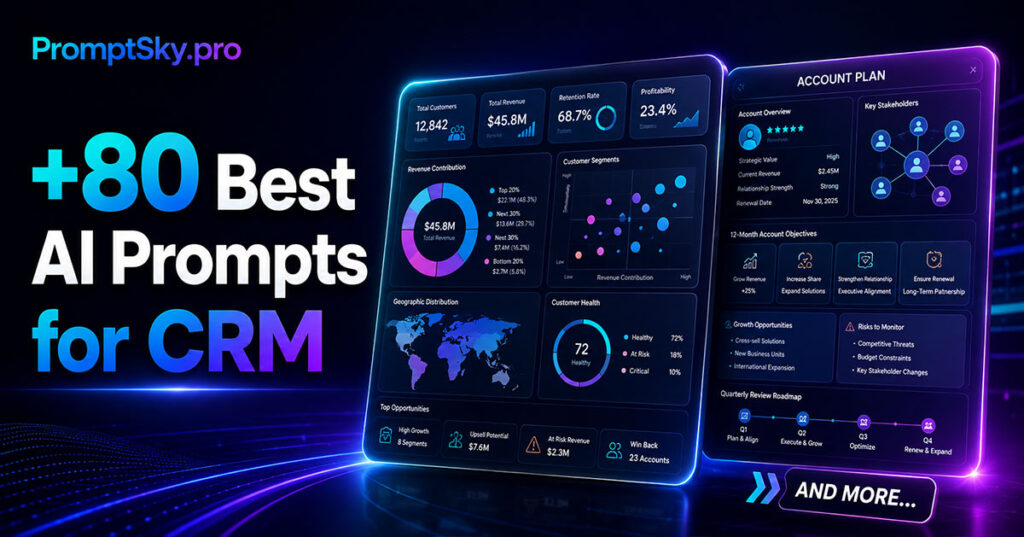
AI Prompts for CRM can help businesses turn customer data into clearer sales actions, better customer management, stronger retention, and smarter business decisions. This collection includes 80 detailed CRM prompts covering data quality, sales pipelines, customer intelligence, automation, account management, retention, reporting, and CRM strategy.
To use these prompts, copy the prompt that matches your goal and replace every placeholder inside square brackets, such as [BUSINESS], [CRM DATA], [ACCOUNT DATA], or [SYSTEMS], with your own information. Keep the rest of the prompt intact unless you need to adapt it to your CRM platform, industry, team structure, or workflow. The more accurate and specific your business and customer information is, the more useful the AI-generated analysis will be.
If you want to explore more specialized prompt collections, visit AI Prompts for Different Goals. For business strategy and planning, you can also read 30 Powerful AI Prompts for Business Planning and Growth, while 30 Best AI Marketing Prompts for Business Growth is useful for marketing, customer acquisition, and promotion tasks. If you need professional visual content for your business, explore 80 AI Prompts for Professional Profile Pictures.
Looking for a specific CRM prompt that is not included here? Leave your request in the comments, and we’ll create a prompt tailored to your CRM workflow, business, or customer-management goal.
1. CRM Data Cleanup Audit
A clean CRM is essential for reliable customer information and accurate business operations. This prompt helps identify incomplete, inconsistent, outdated, or poorly structured records before they create problems in sales and customer management.
Prompt:
Act as a senior CRM data quality specialist and audit the following CRM dataset or CRM structure: [CRM DATA OR DESCRIPTION]. Identify incomplete records, inconsistent naming conventions, invalid values, outdated information, missing fields, formatting problems, duplicate patterns, conflicting customer details, and other data-quality issues. Group the problems by severity and explain how each issue could affect sales, customer service, reporting, or business decisions. Create specific cleanup rules for each problem category and recommend a standardized format for important CRM fields. Prioritize corrections based on business impact and create a repeatable data-quality process that can be used by the team after the initial cleanup.
2. CRM Duplicate Record Detection
Duplicate contacts and companies can distort customer histories, create repeated outreach, and damage CRM reporting. This prompt creates a systematic framework for identifying records that may represent the same customer.
Prompt:
Act as a CRM database specialist and develop a duplicate-record detection framework for my business CRM. Analyze these available fields: [CRM FIELDS]. Define the strongest indicators that two contact, company, or account records may represent the same entity, including matching names, email addresses, phone numbers, domains, addresses, company identifiers, and similar information. Create a confidence scoring system that separates definite duplicates, probable duplicates, possible matches, and unrelated records. Recommend which records should be merged automatically and which require human review. Also define rules for preserving valuable historical activity, ownership information, notes, relationships, and transaction history during the merging process.
3. CRM Field Architecture
A poorly designed CRM structure can make customer information difficult to use and maintain. This prompt helps create a logical field architecture that supports a growing business without unnecessary complexity.
Prompt:
Act as a CRM architect and design an efficient field structure for my business CRM: [BUSINESS TYPE]. Identify the essential fields required for contacts, companies, deals, activities, products, customer relationships, communication preferences, and account status. Separate fields that are essential from those that are optional, redundant, or unlikely to provide meaningful business value. Define the purpose, data type, allowed values, ownership, and usage rules for each recommended field. Create naming conventions and standardization rules that keep the CRM consistent as more employees and records are added. Make the architecture flexible enough to support future growth while avoiding excessive custom fields that create administrative burden.
4. CRM Contact Segmentation
Effective CRM segmentation allows businesses to treat different customers according to their actual needs and characteristics. This prompt helps build useful segments that can support personalized communication and customer management.
Prompt:
Act as a CRM segmentation strategist and create a detailed contact segmentation framework for my business: [BUSINESS]. Analyze the customer information available in my CRM, including demographics, industry, location, purchase behavior, engagement, account value, relationship stage, communication preferences, and other relevant attributes. Create meaningful segments that can be used by sales, marketing, and customer service teams. Explain the purpose of each segment, the criteria required to enter or leave it, and the actions employees should take for each group. Avoid creating segments that are too broad or too small to be useful. Recommend a manageable segmentation structure that can evolve as the CRM database grows.
5. CRM Account Segmentation
This prompt focuses specifically on company-level segmentation, making it useful for B2B businesses managing multiple organizations and decision-makers inside each account.
Prompt:
Act as a B2B CRM strategist and create an account segmentation model for my business: [BUSINESS]. Segment the companies in my CRM according to factors such as industry, company size, geographic market, annual value, potential value, customer status, product usage, strategic importance, buying complexity, relationship strength, and expansion potential. Define clear criteria for every segment and explain how sales, account management, and customer success teams should interact differently with each group. Identify which segments deserve the highest level of attention and which can be managed through lower-touch processes. Create CRM field and tagging recommendations that make these segments easy to maintain.
6. CRM Lead Scoring Framework
This prompt helps businesses evaluate leads using multiple CRM signals instead of relying on subjective judgments from individual salespeople.
Prompt:
Act as a CRM lead-scoring specialist and build a detailed lead scoring framework for my business: [BUSINESS]. Define scoring criteria based on customer profile, company characteristics, engagement behavior, website activity, email interactions, content consumption, inquiries, product interest, buying signals, and other available CRM data. Assign logical score ranges and explain why each signal should increase, decrease, or leave the score unchanged. Separate demographic or firmographic fit from behavioral intent so the team can understand both dimensions. Define thresholds for low-priority, marketing-qualified, sales-qualified, and high-intent leads. Include rules for score decay when engagement becomes outdated and explain how the scoring model should be reviewed over time.
7. CRM Lead Qualification Rules
A consistent qualification system helps sales teams distinguish promising prospects from contacts that are unlikely to become customers. This prompt creates objective criteria that can be applied directly inside a CRM.
Prompt:
Act as a sales operations and CRM qualification expert and design a lead qualification framework for my business: [BUSINESS]. Define the characteristics that make a lead suitable, unsuitable, premature, or strategically valuable. Consider factors such as customer need, budget, authority, timeline, business fit, urgency, problem severity, purchasing process, existing solutions, and potential account value. Create qualification questions that sales representatives can use during calls, forms, emails, or CRM workflows. Define clear qualification outcomes and the CRM status that should be assigned to each outcome. Make the framework practical enough for different sales representatives to apply consistently without relying on personal interpretation.
8. CRM Lead Routing System
When leads are assigned to the wrong salesperson or remain unassigned, valuable opportunities can be lost. This prompt helps create rules for automatically distributing incoming leads according to business logic.
Prompt:
Act as a CRM sales operations architect and design a lead routing system for my business: [BUSINESS]. Determine how new leads should be assigned based on geography, industry, product interest, company size, account value, language, sales specialization, workload, customer ownership, or other relevant criteria. Define the routing hierarchy and explain what should happen when multiple criteria conflict. Include rules for unassigned leads, inactive representatives, duplicate contacts, existing customers, strategic accounts, and leads that require specialized expertise. Create an exception-handling process and recommended response-time rules so every qualified lead reaches the appropriate person without unnecessary delays.
9. CRM Lead Response-Time System
Response speed can directly affect the chance of successfully engaging a new prospect. This prompt helps businesses create CRM rules that make response expectations measurable and enforceable.
Prompt:
Act as a CRM operations specialist and create a lead response-time management system for my business: [BUSINESS]. Define appropriate response-time targets for different lead sources, customer segments, lead scores, inquiry types, and levels of buying intent. Create CRM statuses that clearly show whether a lead is awaiting contact, contacted, engaged, delayed, or overdue. Design escalation rules for leads that remain untouched beyond the defined threshold. Include notification logic, manager alerts, reassignment procedures, and reporting requirements. Make the system practical for both small and large sales teams and explain how response-time data should be analyzed to identify operational weaknesses.
10. CRM Activity Logging Standards
Incomplete activity histories make it difficult for teams to understand customer relationships and continue conversations effectively. This prompt establishes consistent rules for recording important interactions.
Prompt:
Act as a CRM process consultant and create standardized activity logging rules for my business: [BUSINESS]. Define what sales representatives, account managers, and customer service employees should record after calls, meetings, emails, demonstrations, proposals, support interactions, and other customer-facing activities. Specify which information is essential, including customer needs, objections, decisions, commitments, next actions, deadlines, stakeholders, and relevant context. Create examples of high-quality and low-quality CRM notes and explain why each differs. Establish naming conventions, required fields, follow-up rules, and documentation standards that preserve useful customer history without encouraging employees to write unnecessarily long notes.
11. CRM Note Quality Improvement
CRM notes often contain vague statements that provide little value to other team members. This prompt helps transform raw notes into structured customer intelligence.
Prompt:
Act as a CRM documentation specialist and improve the quality of customer notes in my CRM. Analyze the following example notes: [CRM NOTES]. Identify vague, incomplete, repetitive, subjective, or commercially irrelevant information. Rewrite the notes using a structured format that captures the customer’s situation, stated needs, important concerns, decisions, stakeholders involved, commitments made, next action, responsible person, and deadline. Preserve factual information and do not invent details. Create a reusable CRM note template that sales, account management, and customer support teams can follow after every meaningful customer interaction. The final structure should make it easy for another employee to understand the relationship without asking the original employee to explain the history.
12. CRM Customer Timeline Summarization
Long customer histories can make it difficult for employees to quickly understand an account. This prompt converts scattered CRM activity into a concise and useful relationship timeline.
Prompt:
Act as a CRM customer intelligence analyst and summarize the following customer history: [CRM RECORDS]. Organize the information into a chronological timeline covering important interactions, purchases, inquiries, problems, decisions, stakeholder changes, commitments, unresolved issues, and major relationship milestones. Distinguish between confirmed facts and uncertain information. Identify patterns in customer behavior and explain the current relationship status based only on the available CRM data. Highlight the most important information a salesperson, account manager, or support representative should know before contacting the customer. Finish with clearly identified open actions and unanswered questions that require attention.
13. CRM Account Brief Generator
This prompt helps salespeople prepare for customer conversations without manually searching through multiple CRM records, notes, activities, and transactions.
Prompt:
Act as an executive account intelligence assistant and create a concise but comprehensive account brief from the following CRM information: [ACCOUNT DATA]. Summarize the company profile, key contacts, relationship history, products or services used, recent interactions, important conversations, current opportunities, unresolved issues, stakeholder roles, customer preferences, previous objections, and upcoming commitments. Identify what appears most important to the account right now and explain why. Highlight information that may be outdated or contradictory and should be verified. Finish with five preparation points and five intelligent questions that the account manager should consider before the next customer meeting.
14. CRM Contact Relationship Map
In complex B2B sales, understanding who influences a purchasing decision can be as important as understanding the company itself. This prompt helps map relationships among contacts within an account.
Prompt:
Act as a B2B account intelligence specialist and create a relationship map from the following CRM information: [ACCOUNT CONTACT DATA]. Identify decision-makers, economic buyers, influencers, users, technical evaluators, blockers, champions, executive sponsors, and other relevant stakeholders. Explain the evidence supporting each role and distinguish confirmed roles from assumptions. Map relationships between the contacts and identify potential communication dependencies or conflicts. Highlight missing stakeholders that the sales team should consider identifying. Recommend a contact-engagement strategy for each important stakeholder and explain how the CRM should record these relationships so future employees can understand the account structure.
15. CRM Stakeholder Change Detection
Personnel changes inside customer organizations can create both risks and opportunities. This prompt helps teams detect when changes in contact information or roles may require account-management action.
Prompt:
Act as a CRM account intelligence analyst and analyze the following customer contact history: [CONTACT HISTORY]. Identify potential job changes, role changes, departures, promotions, new decision-makers, newly involved stakeholders, changes in influence, or other relationship changes visible in the available data. Separate confirmed information from signals that require verification. Explain how each change could affect the current business relationship, open opportunities, renewals, customer satisfaction, or account strategy. Recommend specific CRM updates and follow-up actions for each relevant change. Create a monitoring framework that helps account teams keep stakeholder information accurate without creating unnecessary administrative work.
16. CRM Communication Preference Management
Respecting communication preferences improves customer experience and reduces unnecessary or inappropriate outreach. This prompt helps establish consistent CRM rules for managing those preferences.
Prompt:
Act as a CRM customer experience specialist and design a communication preference management framework for my business: [BUSINESS]. Define the types of communication preferences that should be stored in the CRM, including preferred channels, communication frequency, language, business hours, contact restrictions, topic preferences, and other relevant customer choices. Create rules for recording explicit preferences, handling conflicting information, updating preferences after customer requests, and preventing inappropriate outreach. Define responsibilities for sales, marketing, customer support, and account management teams. Create a clear process for reviewing outdated preferences and ensuring customer communication remains relevant, respectful, and consistent across the business.
17. CRM Customer Consent Tracking
Customer consent information can become difficult to manage when multiple teams communicate through different channels. This prompt creates a structured CRM approach for recording and maintaining consent-related information.
Prompt:
Act as a CRM governance specialist and design a customer consent tracking framework for my business: [BUSINESS]. Identify the types of consent or communication permissions that should be recorded based on the channels and customer interactions used by the business. Define the CRM fields, statuses, timestamps, source information, update rules, and ownership requirements needed to maintain an accurate history. Create procedures for handling changes, withdrawals, conflicting records, imported contacts, manually added contacts, and requests from customers. Clearly distinguish operational communication from promotional communication where relevant. Design the framework so teams can easily determine whether a particular type of communication is appropriate before contacting a customer.
18. CRM Customer Profile Enrichment
This prompt helps businesses improve incomplete customer profiles by identifying which additional information would provide meaningful value for sales and account management.
Prompt:
Act as a CRM enrichment strategist and analyze the customer profile structure for my business: [BUSINESS]. Identify which missing contact, company, behavioral, commercial, and relationship attributes would meaningfully improve customer understanding and decision-making. Separate valuable enrichment fields from information that would add complexity without improving business outcomes. For each recommended field, explain its business purpose, ideal source, update frequency, reliability requirements, and which teams would use it. Create a prioritized enrichment framework for existing CRM records and define rules for handling uncertain or outdated information. Focus on actionable customer intelligence rather than collecting large amounts of information simply because it is available.
19. CRM Customer Health Score
A customer health score can help teams identify accounts that are stable, uncertain, or showing signs of relationship weakness. This prompt creates a structured model based on multiple customer signals.
Prompt:
Act as a CRM customer success strategist and create a customer health scoring model for my business: [BUSINESS]. Identify the CRM signals that can indicate strong, stable, uncertain, or deteriorating customer relationships. Consider usage or purchase activity, engagement, support history, unresolved issues, payment behavior, communication frequency, satisfaction feedback, stakeholder engagement, renewal proximity, and other relevant indicators. Assign logical weights to each factor and explain how the overall score should be interpreted. Define health categories and recommended actions for each category. Include rules for detecting sudden score changes and explain how customer teams should investigate the underlying cause instead of treating the score as a definitive diagnosis.
20. CRM At-Risk Customer Detection
This prompt helps customer-facing teams identify accounts that may require attention before relationship problems become severe. It emphasizes early signals rather than waiting for a cancellation or complaint.
Prompt:
Act as a customer retention and CRM intelligence specialist and identify early warning signals that could indicate an at-risk customer for my business: [BUSINESS]. Analyze possible signals such as declining purchases, reduced engagement, unresolved support issues, negative feedback, missed meetings, reduced stakeholder participation, payment problems, competitor mentions, changes in usage, or other relevant CRM patterns. Create a risk scoring framework that distinguishes weak signals from strong evidence. Define escalation levels and recommended actions for each level. Include investigation questions that account managers should ask before assuming a customer is at risk. Create CRM workflow recommendations that notify the appropriate team while avoiding excessive false alarms.
21. CRM Renewal Readiness Tracker
This prompt helps businesses organize renewal-related customer information and identify accounts that need attention before a renewal deadline approaches.
Prompt:
Act as a CRM customer lifecycle specialist and create a renewal readiness framework for my business: [BUSINESS]. Define the CRM information that should be tracked before each renewal, including contract details, customer objectives, product usage, unresolved issues, stakeholder engagement, satisfaction indicators, commercial history, previous commitments, and upcoming decision dates. Create renewal readiness stages that show whether an account is unprepared, under review, engaged, commercially ready, or finalized. Define actions and deadlines for each stage and identify warning signals that could threaten the renewal. Build a repeatable CRM process that starts well before the renewal date and gives account teams enough time to address problems or create additional value.
22. CRM Upsell Signal Detection
This prompt helps account teams identify genuine opportunities to expand an existing customer relationship using CRM evidence rather than pushing irrelevant offers.
Prompt:
Act as an account growth intelligence specialist and identify potential upsell signals in my CRM data: [CRM DATA]. Analyze customer purchases, product usage, account size, business changes, repeated requests, support conversations, feature interests, additional departments, stakeholder expansion, usage limitations, and other available signals. Separate strong commercial indicators from weak or speculative signals. For each potential opportunity, explain the evidence, the likely customer need, the appropriate offer category, the recommended timing, and the best person to contact. Create CRM rules for identifying and prioritizing expansion opportunities while ensuring that recommendations are based on customer value rather than aggressive selling.
23. CRM Cross-Sell Opportunity Mapping
This prompt helps businesses discover relevant complementary products or services that may solve additional customer problems.
Prompt:
Act as a CRM revenue intelligence strategist and build a cross-sell opportunity framework for my business: [BUSINESS]. Analyze the products or services customers currently purchase and identify logical complementary solutions based on customer type, industry, purchase history, usage patterns, business needs, and common customer challenges. Create opportunity rules that can be implemented in the CRM to identify suitable customers for each complementary offer. Define evidence thresholds, recommended timing, relevant customer segments, and messaging angles. Distinguish genuine customer needs from opportunities that would likely feel irrelevant. Create a prioritization model that helps account teams focus on cross-sell opportunities with the strongest combination of relevance, customer value, and commercial potential.
24. CRM Dormant Customer Reactivation
This prompt helps businesses identify previously active customers who have become inactive and develop a structured process for understanding and re-engaging them.
Prompt:
Act as a CRM lifecycle marketing strategist and design a dormant-customer reactivation system for my business: [BUSINESS]. Define what should qualify a customer as dormant based on purchase frequency, engagement, account type, contract status, or other relevant criteria. Segment dormant customers according to their previous value, relationship history, product usage, and likely reason for inactivity. Create different reactivation approaches for customers who may have forgotten, changed needs, experienced problems, moved to another solution, or simply stopped engaging. Define CRM workflow stages, outreach timing, message objectives, response tracking, and exit criteria. Include a process for recording the reason a customer returned or remained inactive so future strategies can improve.
25. CRM Customer Lifecycle Mapping
This prompt helps businesses structure the complete customer lifecycle inside their CRM so every stage has clear definitions, data, responsibilities, and actions.
Prompt:
Act as a CRM lifecycle architect and map the complete customer lifecycle for my business: [BUSINESS]. Define each stage from initial contact and qualification through active relationship, purchase, onboarding, adoption, support, expansion, renewal, inactivity, reactivation, and potential departure. For every stage, specify entry criteria, exit criteria, required CRM fields, responsible team, expected customer behavior, recommended actions, automated triggers, and key metrics. Identify stages that are commonly confused and create precise definitions to prevent inconsistent CRM usage. Design the lifecycle so customer records can move logically between stages while preserving historical information and giving every team a clear understanding of the customer’s current relationship status.
26. CRM Workflow Automation Design
This prompt helps businesses identify CRM workflows that can automate repetitive administrative processes while keeping important decisions under human control.
Prompt:
Act as a CRM automation architect and design a workflow automation system for my business: [BUSINESS]. Analyze recurring CRM processes involving lead intake, assignment, qualification, follow-up, customer onboarding, account updates, renewals, inactivity, support escalation, data maintenance, and internal notifications. For each process, identify the trigger, conditions, actions, responsible team, exception cases, and desired outcome. Separate workflows that can safely run automatically from those requiring human approval. Include safeguards against duplicate actions, conflicting workflows, outdated information, and accidental customer communication. Prioritize automations according to business impact, reliability, implementation complexity, and time saved, and create a phased rollout plan.
27. CRM Workflow Conflict Audit
As CRM systems grow, multiple automations can unintentionally interfere with one another. This prompt helps identify conflicts, loops, duplicate actions, and contradictory workflow logic.
Prompt:
Act as a CRM systems auditor and analyze the following CRM workflows: [WORKFLOW DEFINITIONS]. Identify overlapping triggers, contradictory conditions, duplicate actions, automation loops, conflicting field updates, premature status changes, repeated notifications, and workflows that could interfere with customer communication. Map the dependencies between workflows and explain which processes may be triggered simultaneously. Identify the highest-risk conflicts and recommend a revised workflow hierarchy. Create rules for naming, documenting, testing, monitoring, and retiring CRM automations so future workflows can be added safely. Finish with a testing checklist that should be completed before any new automation is activated in the production CRM.
28. CRM Task Prioritization System
This prompt helps sales and account teams decide which CRM tasks deserve immediate attention when employees face large numbers of follow-ups and customer activities.
Prompt:
Act as a CRM productivity and sales operations strategist and create a task prioritization framework for my business: [BUSINESS]. Analyze the types of tasks generated in the CRM, including lead follow-ups, customer requests, renewal actions, account reviews, proposals, overdue activities, support coordination, and expansion opportunities. Define a priority score using factors such as customer value, urgency, opportunity stage, potential revenue, deadline, relationship risk, customer impact, and strategic importance. Create priority categories with clear rules and recommended response times. Explain how the system should handle conflicting priorities and overdue tasks. Design CRM views and daily review principles that help employees focus on the most commercially and operationally important actions.
29. CRM SLA Monitoring
This prompt helps businesses monitor whether customer-facing teams are meeting defined service or response commitments recorded in the CRM.
Prompt:
Act as a CRM service operations analyst and design an SLA monitoring framework for my business: [BUSINESS]. Identify the customer-facing processes where response or completion commitments should be measured, such as new inquiries, support requests, sales follow-ups, account requests, escalations, and renewal actions. Define appropriate SLA metrics, start and stop conditions, business hours, priority levels, escalation thresholds, and responsible teams. Create CRM statuses that make SLA progress visible and identify conditions that should trigger alerts or reassignment. Recommend dashboards for monitoring compliance by employee, team, request type, customer segment, and time period. Also define a process for analyzing repeated SLA failures to identify operational root causes rather than simply reporting missed deadlines.
30. CRM Permission & Access Architecture
This prompt helps businesses control who can view, edit, export, or manage sensitive CRM information while keeping teams productive. It is designed for businesses where multiple roles interact with customer data.
Prompt:
Act as a CRM security and governance architect and design an access-control framework for my business CRM: [BUSINESS]. Analyze the different user roles, including administrators, sales representatives, managers, account managers, customer support, marketing users, contractors, and other relevant roles. Define what information each role should be able to view, create, edit, export, delete, or administer based on legitimate business responsibilities. Consider contact data, account records, sales information, customer communications, internal notes, financial information, reports, automation settings, and system configuration. Create principles for least-privilege access, role separation, sensitive-data protection, temporary access, employee departures, permission reviews, and audit trails. Finish with a practical quarterly CRM access-review process that helps prevent excessive permissions while maintaining operational efficiency.
31. CRM Sales Forecast Accuracy
Reliable forecasting helps a business understand which opportunities are genuinely likely to generate revenue. This prompt helps separate optimistic pipeline assumptions from evidence-based forecasts.
Prompt:
Act as a CRM sales forecasting analyst and evaluate the current sales pipeline for my business: [BUSINESS]. Analyze opportunity stage, deal age, expected close date, historical conversion rates, activity levels, stakeholder engagement, deal value, recent customer interactions, and other available CRM signals. Identify opportunities whose forecasted probability appears too high, too low, or unsupported by evidence. Create forecast categories such as committed, likely, possible, and high-risk, with clear criteria for each category. Explain which CRM fields should influence forecasting and which should not be trusted without validation. Create a recurring forecast-review process that improves accuracy over time and helps management understand the difference between pipeline volume and realistic expected revenue.
32. CRM Pipeline Aging Analysis
Old opportunities can consume sales attention while producing little commercial value. This prompt helps identify stalled deals and understand why they remain open.
Prompt:
Act as a CRM pipeline analyst and perform a detailed opportunity-aging analysis for my business: [BUSINESS]. Analyze the following CRM opportunity data: [OPPORTUNITY DATA]. Identify deals that have remained open longer than expected for their stage, product type, customer segment, or sales cycle. Group aging opportunities according to likely causes such as customer delay, internal delay, poor qualification, missing decision-makers, pricing concerns, inactive sales activity, or inaccurate CRM information. Define appropriate aging thresholds and explain when an opportunity should be advanced, requalified, paused, or closed. Create CRM reporting rules that prevent artificially inflated pipelines and help sales managers focus attention on opportunities with genuine commercial potential.
33. CRM Stalled Deal Diagnosis
This prompt helps sales teams understand why a specific opportunity has stopped progressing and what evidence-based action should happen next.
Prompt:
Act as a senior sales strategist and CRM opportunity investigator. Analyze the complete CRM history of this stalled opportunity: [OPPORTUNITY DATA]. Review previous activities, customer responses, meeting notes, stakeholder involvement, objections, proposals, timing changes, product interest, and internal actions. Identify the most likely reasons the opportunity stopped progressing and distinguish evidence from assumptions. Determine whether the deal should be reactivated, escalated, renegotiated, paused, or closed. Recommend the next action, the appropriate stakeholder to contact, the message objective, and the information that should be clarified before further outreach. Also identify CRM data that appears incomplete and could prevent accurate decision-making.
34. CRM Lost Deal Analysis
Lost opportunities contain valuable information about market demand, pricing, competition, product limitations, and sales execution. This prompt helps transform closed-lost records into actionable business intelligence.
Prompt:
Act as a CRM revenue intelligence analyst and conduct a structured analysis of closed-lost opportunities for my business: [BUSINESS]. Review the following lost-deal records: [CRM DATA]. Identify recurring loss reasons, competitor patterns, pricing objections, product gaps, timing issues, qualification problems, decision-making barriers, sales-process weaknesses, and customer characteristics associated with unsuccessful deals. Separate verified reasons from assumptions or incomplete CRM notes. Group losses into meaningful categories and determine which patterns are statistically or operationally important based on the available data. Recommend specific changes to qualification, sales messaging, pricing, product strategy, or CRM processes. Create a monthly lost-deal review framework that turns future losses into measurable learning.
35. CRM Win Pattern Analysis
Understanding why successful opportunities close can reveal repeatable behaviors that should be built into the sales process. This prompt identifies common characteristics among successful deals.
Prompt:
Act as a CRM sales intelligence specialist and analyze the following closed-won opportunities: [CRM DATA]. Identify recurring patterns related to customer profile, lead source, opportunity size, sales cycle, stakeholder involvement, activities completed, product interest, timing, objections, communication frequency, and sales behavior. Determine which patterns appear associated with successful outcomes and distinguish correlation from evidence that would require further validation. Identify actions that successful sales representatives consistently perform and opportunities that tend to close faster or generate higher value. Convert the findings into practical sales-process recommendations and CRM indicators that can help the team recognize and reproduce high-probability opportunity patterns.
36. CRM Sales Cycle Analysis
This prompt helps businesses understand how long different types of opportunities actually take to move through the sales process. It can reveal delays that are hidden by average sales-cycle numbers.
Prompt:
Act as a CRM sales operations analyst and analyze the sales cycle for my business: [BUSINESS]. Use the following opportunity history: [CRM DATA]. Calculate or structure the time spent between major sales stages and identify differences by customer segment, product, deal size, acquisition source, salesperson, geography, and other relevant dimensions. Identify stages where opportunities spend unusually long periods and investigate potential reasons for those delays. Distinguish normal variation from operational bottlenecks. Recommend specific CRM fields and timestamps that should be captured to improve future analysis. Create a sales-cycle optimization plan focused on reducing unnecessary delays without pressuring customers or shortening legitimate decision-making processes.
37. CRM Stage Conversion Analysis
This prompt helps businesses measure how effectively opportunities move from one CRM stage to another. It reveals where prospects are most frequently lost.
Prompt:
Act as a CRM funnel analytics specialist and analyze stage-to-stage conversion within my sales pipeline: [BUSINESS]. Review the available CRM opportunity history: [CRM DATA]. Calculate or estimate the conversion rate between each stage and identify where the largest losses occur. Segment the analysis by lead source, product, customer type, salesperson, deal size, geography, or other available variables. Investigate possible reasons for weak conversion, including qualification quality, messaging, timing, pricing, missing stakeholders, sales execution, or inaccurate stage definitions. Recommend specific actions for improving each weak transition and define the CRM data required to monitor whether those changes produce sustained improvement.
38. CRM Opportunity Qualification Audit
Poorly qualified opportunities can make a CRM pipeline appear healthier than it actually is. This prompt helps identify opportunities that should not currently be treated as active sales opportunities.
Prompt:
Act as a sales operations auditor and review the qualification quality of these CRM opportunities: [OPPORTUNITY DATA]. Evaluate whether each opportunity has a clearly defined customer problem, relevant solution, appropriate stakeholder, realistic timeline, commercial potential, demonstrated interest, next action, and credible path toward a decision. Identify missing qualification evidence and assign each opportunity a qualification confidence level. Recommend whether each should remain active, move backward for additional qualification, enter a nurture state, or be closed. Create mandatory qualification requirements for future opportunities and explain how CRM validation rules can prevent unqualified deals from entering advanced pipeline stages.
39. CRM Opportunity Next-Step Generator
This prompt helps sales representatives determine the most logical next action for an opportunity based on its actual CRM history rather than using generic follow-up routines.
Prompt:
Act as a senior sales strategist and analyze this CRM opportunity: [OPPORTUNITY DATA]. Determine the current situation, customer objective, known stakeholders, unresolved questions, previous commitments, objections, decision timeline, and last meaningful interaction. Based only on the available evidence, recommend the single most valuable next action. Explain why this action should happen before other possible actions and identify the person who should perform it. Draft a concise objective for the next interaction without creating unsupported claims or pressure. Also define what evidence should be captured in the CRM afterward to determine whether the opportunity is progressing and what the next decision point should be.
40. CRM Follow-Up Sequence Optimization
This prompt helps businesses improve follow-up logic based on customer behavior and opportunity context rather than sending the same sequence to everyone.
Prompt:
Act as a CRM sales automation strategist and optimize my follow-up process for [BUSINESS]. Analyze the available lead and opportunity stages, customer segments, previous engagement, sales cycle, product type, and buying behavior. Create differentiated follow-up sequences for highly engaged prospects, moderately engaged prospects, unresponsive prospects, proposal-stage opportunities, delayed decisions, and prospects who previously declined. Define the purpose of each message, recommended timing, channel, trigger, exit condition, and escalation rule. Ensure the sequences do not create excessive communication or continue after a customer has clearly indicated that outreach is inappropriate. Include CRM logic for stopping, changing, or restarting sequences based on customer behavior.
41. CRM Meeting Preparation Brief
This prompt helps customer-facing employees prepare for important meetings using CRM information in a structured way.
Prompt:
Act as an executive CRM meeting-preparation assistant and analyze the following customer record: [CRM DATA]. Create a meeting brief covering the customer’s company or profile, relationship history, previous conversations, current opportunities, products or services involved, known priorities, unresolved issues, stakeholders, previous commitments, recent activity, and relevant commercial context. Identify information that may have changed since the last interaction and should be verified before the meeting. Develop a short list of strategic questions designed to uncover current needs and decision factors. Recommend topics to avoid repeating and identify specific outcomes that the meeting should ideally produce. Keep the brief focused on actionable intelligence rather than unnecessary CRM history.
42. CRM Post-Meeting Intelligence Extraction
This prompt helps teams convert unstructured meeting transcripts or notes into useful CRM information without losing important details.
Prompt:
Act as a CRM intelligence extraction specialist and process the following customer meeting transcript or notes: [MEETING CONTENT]. Extract confirmed customer needs, objectives, concerns, objections, decisions, commitments, stakeholders, deadlines, commercial information, product requirements, competitive references, unresolved questions, and agreed next steps. Clearly distinguish statements made by the customer from internal interpretations or assumptions. Organize the information into CRM-ready fields and a concise activity summary. Identify which information should update the contact, account, opportunity, task, or customer-status records. Flag any contradictory or ambiguous information that requires clarification before being entered as a confirmed CRM fact.
43. CRM Email Intelligence Extraction
This prompt helps businesses convert important customer emails into structured CRM information while avoiding unnecessary copying of entire conversations.
Prompt:
Act as a CRM email intelligence analyst and process the following customer email or email thread: [EMAIL CONTENT]. Extract only the information that is commercially or operationally relevant to the CRM, including customer requests, decisions, concerns, commitments, deadlines, product interests, objections, stakeholders, account changes, and next actions. Distinguish confirmed facts from inferred meaning and do not invent missing information. Recommend which CRM records should be updated and what fields or activities should change. Create a concise CRM activity note that another employee can understand quickly. Also identify any unresolved question that requires a response and suggest the appropriate owner and deadline for that action.
44. CRM Conversation Sentiment Trend
This prompt helps businesses identify meaningful changes in customer tone across repeated interactions without treating sentiment analysis as a definitive measure of customer satisfaction.
Prompt:
Act as a customer relationship intelligence analyst and examine the following CRM conversation history: [CONVERSATION HISTORY]. Identify meaningful changes in customer tone, urgency, satisfaction signals, frustration, confidence, enthusiasm, uncertainty, or relationship strength across the timeline. Support every observation with evidence from the available communication and distinguish explicit statements from interpretation. Identify whether negative or positive signals appear isolated or recurring. Explain what operational or relationship issue may require investigation and recommend appropriate follow-up actions. Do not treat inferred sentiment as a fact or replace direct customer feedback with automated interpretation. Create a CRM-friendly trend summary that helps account teams decide where human attention is needed.
45. CRM Customer Complaint Pattern Analysis
Repeated complaints can reveal problems in products, service delivery, communication, or internal processes. This prompt helps businesses identify systemic issues rather than resolving complaints individually.
Prompt:
Act as a CRM customer experience analyst and analyze the following complaint and support records: [CRM DATA]. Categorize complaints by root issue, product or service, customer segment, frequency, severity, resolution time, responsible process, and business impact. Identify recurring patterns and determine whether multiple complaints may originate from the same underlying problem. Distinguish isolated incidents from systemic issues and highlight evidence that requires further investigation. Recommend corrective actions at the process, product, training, communication, or policy level. Create CRM categorization rules and reporting metrics that allow management to monitor whether complaint volume, severity, and recurrence are improving over time.
46. CRM Escalation Management
This prompt helps businesses create consistent rules for escalating customer issues to the right person without unnecessary delays or confusion.
Prompt:
Act as a CRM service escalation architect and design an escalation framework for my business: [BUSINESS]. Identify the types of customer situations that require escalation based on severity, financial impact, customer importance, contractual obligations, operational risk, reputation risk, technical complexity, or repeated failure. Define escalation levels, responsible roles, response expectations, required CRM fields, internal notifications, customer communication responsibilities, and resolution criteria. Create rules for preventing unnecessary escalation while ensuring serious issues receive immediate attention. Include procedures for documenting the root cause, actions taken, final resolution, and lessons learned so repeated escalations can be analyzed and reduced.
47. CRM Customer Issue Root Cause Analysis
This prompt helps businesses move beyond recording customer problems and determine why those problems happened in the first place.
Prompt:
Act as a CRM operations and root-cause analysis specialist. Analyze the following customer issue records: [CRM ISSUE DATA]. Identify recurring symptoms, possible underlying causes, process failures, communication gaps, product limitations, training problems, system errors, or external factors. Separate confirmed causes from hypotheses and specify what evidence would be needed to validate each hypothesis. Group related issues together to identify systemic patterns rather than treating every case independently. Recommend corrective and preventive actions and define which CRM fields should be updated to support future analysis. Create a repeatable root-cause review process that can be used during monthly customer-issue audits.
48. CRM Customer Request Classification
This prompt helps businesses classify incoming customer requests consistently so the right team can respond efficiently.
Prompt:
Act as a CRM service classification specialist and design a customer-request categorization framework for my business: [BUSINESS]. Analyze the types of requests customers commonly submit, including information requests, technical questions, account changes, billing matters, product requests, complaints, urgent issues, commercial opportunities, and other relevant categories. Create a hierarchy of categories and subcategories that is detailed enough for reporting but simple enough for employees to use consistently. Define classification rules, examples, priority levels, responsible teams, expected outcomes, and escalation conditions. Make the structure suitable for CRM reporting so management can identify trends in customer demand and operational workload.
49. CRM Case Prioritization
This prompt helps customer service teams determine which cases require immediate attention based on customer impact and business context.
Prompt:
Act as a CRM case-management strategist and create a customer case prioritization model for my business: [BUSINESS]. Define priority criteria based on issue severity, customer impact, urgency, account importance, contractual commitments, financial consequences, number of affected users, operational disruption, and other relevant factors. Create clear priority levels and explain the conditions required for each level. Define expected response and resolution targets, escalation rules, responsible teams, and CRM fields required to calculate priority consistently. Include examples of cases that may appear urgent but should not automatically receive the highest priority. Design the framework to balance customer needs, operational capacity, and business risk.
50. CRM Support Workload Analysis
This prompt helps managers understand how customer support workload is distributed and where capacity problems may exist.
Prompt:
Act as a CRM support operations analyst and analyze the following customer service data: [CRM CASE DATA]. Evaluate case volume, case categories, priority levels, response times, resolution times, reopen rates, customer segments, employee workload, recurring issues, and time-based patterns. Identify periods of excessive workload and determine whether the cause appears to be staffing, product problems, process inefficiency, seasonal demand, poor request classification, or another factor. Highlight employees or teams that may be overloaded without making performance judgments from incomplete data. Recommend staffing, automation, documentation, routing, training, or process changes and define KPIs that should be monitored regularly.
51. CRM Customer Support Knowledge Gaps
This prompt helps businesses identify where support teams lack sufficient information and where new documentation could reduce repetitive work.
Prompt:
Act as a CRM knowledge-management analyst and examine the following customer support records: [SUPPORT DATA]. Identify questions, issues, and procedures that repeatedly require employee research, escalation, or manual explanation. Group recurring knowledge gaps and determine which could be solved through internal documentation, customer-facing guides, training, automation, product improvements, or clearer processes. Rank the gaps according to frequency, customer impact, employee effort, and business value. Create a prioritized knowledge-base development plan and specify what information each new resource should contain. Also identify gaps caused by unclear ownership or outdated information rather than simply missing documentation.
52. CRM Customer Education Opportunity Mapping
This prompt helps businesses identify customers who may benefit from educational resources based on their CRM behavior, questions, purchases, or usage patterns.
Prompt:
Act as a customer education strategist and analyze my CRM data for opportunities to proactively educate customers: [CRM DATA]. Identify recurring misunderstandings, product questions, usage difficulties, common implementation mistakes, feature requests, and information gaps. Map these patterns to customer segments and lifecycle stages. Recommend educational content, onboarding materials, webinars, tutorials, documentation, workshops, or personalized guidance that could reduce support demand and improve customer outcomes. Define CRM triggers that could indicate when a particular educational resource is relevant. Prioritize education opportunities based on customer impact, support reduction, adoption potential, and business value.
53. CRM Customer Onboarding Tracking
This prompt helps businesses make customer onboarding measurable and visible inside the CRM instead of relying on scattered emails and individual employee memory.
Prompt:
Act as a CRM customer onboarding architect and design an onboarding tracking framework for my business: [BUSINESS]. Map the onboarding process from purchase or agreement through setup, training, implementation, first successful outcome, adoption, and transition into regular account management. Define milestones, required customer actions, internal responsibilities, deadlines, dependencies, blockers, and completion criteria for each stage. Create CRM statuses and task structures that make onboarding progress visible. Identify early warning signals such as inactivity, missing information, delayed implementation, unanswered requests, or unclear ownership. Design escalation rules and reporting dashboards that help managers detect onboarding problems before they negatively affect customer satisfaction or retention.
54. CRM Onboarding Delay Analysis
This prompt helps businesses identify why customers take too long to complete onboarding and which delays are within the company’s control.
Prompt:
Act as a customer onboarding operations analyst and analyze the following onboarding records: [CRM ONBOARDING DATA]. Identify where customers experience delays between onboarding milestones and determine the most likely causes. Analyze factors such as missing customer information, internal approvals, technical dependencies, unclear instructions, scheduling problems, employee capacity, product complexity, communication gaps, and customer-side delays. Separate controllable internal delays from legitimate customer dependencies. Identify patterns by customer segment, product, implementation type, employee, or onboarding pathway where data supports the comparison. Recommend process changes, automation, documentation, ownership rules, and escalation mechanisms that could reduce avoidable onboarding time.
55. CRM Customer Adoption Monitoring
This prompt helps businesses monitor whether customers are actually adopting a product or service after purchase rather than assuming that a completed sale means successful usage.
Prompt:
Act as a CRM customer adoption strategist and design an adoption-monitoring framework for my business: [BUSINESS]. Identify the behaviors, milestones, interactions, purchases, usage indicators, support requests, and customer outcomes that can demonstrate meaningful adoption. Create adoption stages and define the evidence required to move customers between them. Identify warning signals that indicate low adoption and recommend appropriate interventions for each situation. Design CRM fields, tasks, alerts, and reporting views that allow customer-facing teams to monitor adoption without manually reviewing every customer record. Explain how adoption information should influence onboarding, education, account management, renewal preparation, and expansion opportunities.
56. CRM Customer Milestone Tracking
This prompt helps businesses track important customer achievements and events that can strengthen relationships and create better opportunities for timely communication.
Prompt:
Act as a CRM lifecycle strategist and identify the most valuable customer milestones for my business: [BUSINESS]. Consider purchase anniversaries, implementation completion, first successful outcome, account growth, renewal periods, product milestones, business events, customer achievements, usage milestones, and other relevant moments. Define which milestones should be recorded in the CRM and which should trigger internal tasks or customer communication. Create milestone categories, timing rules, responsible teams, recommended actions, and personalization guidelines. Ensure the system adds genuine customer value rather than generating unnecessary automated messages. Build a framework that helps account teams recognize meaningful moments and use them to strengthen long-term customer relationships.
57. CRM Customer Success Plan
This prompt helps account teams create structured success plans for important customers with clear objectives, responsibilities, milestones, and evidence of progress.
Prompt:
Act as a strategic customer success consultant and create a CRM-based customer success plan for [CUSTOMER OR ACCOUNT]. Analyze the available information about the customer’s objectives, current situation, products or services, stakeholders, challenges, desired outcomes, previous commitments, and relationship history. Define measurable success outcomes and map the actions required from both the customer and the business. Create milestones, owners, deadlines, dependencies, risks, review points, and evidence that will demonstrate progress. Identify potential obstacles and escalation paths. Structure the plan so it can be maintained inside a CRM and reviewed regularly by account teams without becoming an administrative document that is disconnected from actual customer outcomes.
58. CRM Account Planning Framework
This prompt helps businesses develop deeper strategic plans for high-value accounts rather than treating every customer relationship in the same way.
Prompt:
Act as a strategic account management consultant and create an account plan for [ACCOUNT] using the following CRM information: [CRM DATA]. Analyze the account’s business context, current relationship, products or services, key stakeholders, strategic priorities, potential risks, competitive presence, current revenue, expansion opportunities, renewal considerations, and relationship strength. Identify the most important account objectives for the next 12 months and define specific actions for achieving them. Map stakeholder relationships and potential gaps, identify opportunities to increase customer value, and define risks that require monitoring. Create measurable account-plan KPIs and a quarterly review structure that keeps the strategy current as customer circumstances change.
59. CRM Strategic Account Prioritization
This prompt helps businesses determine which accounts deserve deeper strategic attention when account-management resources are limited.
Prompt:
Act as a strategic account prioritization analyst and rank the following customer accounts for my business: [ACCOUNT DATA]. Evaluate each account based on current revenue, future potential, profitability, relationship strength, strategic importance, retention risk, expansion opportunity, customer influence, market relevance, complexity, and required management effort. Create a weighted scoring model and explain the rationale behind each criterion. Separate high-value accounts from high-potential accounts and high-risk accounts because they may require different strategies. Recommend account-management tiers and define the level of attention, executive involvement, review frequency, and resources appropriate for each tier. Ensure the prioritization framework can be updated as CRM data changes.
60. CRM Customer Portfolio Analysis
This prompt helps business leaders understand the overall composition and quality of their customer base instead of evaluating accounts individually.
Prompt:
Act as a CRM portfolio strategy analyst and conduct a comprehensive analysis of my customer portfolio: [CRM CUSTOMER DATA]. Segment customers according to revenue contribution, profitability, retention, purchase frequency, growth potential, strategic importance, acquisition source, industry, geography, product mix, relationship strength, and risk where data is available. Identify concentration risks, overdependence on specific customer groups, underdeveloped segments, high-value clusters, declining segments, and unusual patterns. Explain how the portfolio composition affects business stability and growth. Recommend actions for protecting valuable accounts, developing promising segments, reducing concentration risk, and improving portfolio balance. Finish with a CRM dashboard structure that management can use for quarterly portfolio reviews.
61. CRM Customer Churn Analysis
Customer churn can reveal weaknesses in the customer experience, product value, pricing, or relationship management. This prompt helps identify patterns behind customer departures and turn them into actionable business insights.
Prompt:
Act as a CRM customer retention analyst and perform a detailed churn analysis for my business: [BUSINESS]. Analyze the following customer records, including active customers, inactive customers, canceled accounts, purchase history, support interactions, engagement patterns, contract information, customer feedback, and relationship history: [CRM DATA]. Identify recurring characteristics associated with churn and compare them with customers who remain active. Separate confirmed churn reasons from assumptions and incomplete information. Identify leading indicators that may appear before customers leave and determine which signals are most useful for early intervention. Create a churn-analysis framework with customer segments, risk factors, recommended actions, CRM fields, reporting metrics, and a recurring review process for reducing preventable customer loss.
62. CRM Churn Cohort Analysis
Cohort analysis can reveal whether customer retention is improving or deteriorating across different groups and time periods. This prompt helps businesses understand retention beyond a single overall churn percentage.
Prompt:
Act as a CRM retention and cohort-analysis specialist and analyze customer retention using the following CRM data: [CRM DATA]. Group customers into meaningful cohorts based on acquisition month, acquisition source, product purchased, customer segment, geography, business size, onboarding pathway, or other relevant dimensions. Compare retention, repeat purchases, engagement, revenue contribution, and churn across cohorts over time. Identify cohorts with unusually strong or weak outcomes and investigate possible explanations using the available CRM information. Highlight changes in customer behavior that may indicate improving or declining retention. Recommend specific business, onboarding, product, marketing, or account-management actions based on the strongest patterns and define the CRM reports needed to monitor future cohorts.
63. CRM Customer Win-Back Strategy
Former customers may still have value if the business understands why they left and whether their circumstances have changed. This prompt helps create targeted win-back strategies rather than generic reactivation campaigns.
Prompt:
Act as a CRM retention strategist and develop a customer win-back framework for my business: [BUSINESS]. Analyze the following former-customer records: [CRM DATA]. Segment former customers according to their previous value, reason for leaving, length of relationship, products used, satisfaction history, last interaction, and potential relevance today. Identify which customers are most appropriate for win-back efforts and which should not be prioritized. Create differentiated re-engagement strategies based on likely churn causes, including changed needs, pricing concerns, product limitations, service problems, inactivity, competitive replacement, or temporary circumstances. Define CRM triggers, outreach timing, messaging objectives, success criteria, and rules for permanently removing customers from win-back campaigns.
64. CRM Referral Opportunity Detection
Satisfied customers can become a valuable source of new business, but referral requests should be based on appropriate relationship signals rather than sent indiscriminately.
Prompt:
Act as a CRM referral-growth strategist and identify the strongest referral opportunities within my customer database: [CRM DATA]. Analyze indicators such as customer satisfaction, successful outcomes, long-term relationships, positive feedback, repeat purchases, account growth, engagement, advocacy behavior, and customer influence. Develop a scoring framework that identifies customers who may be appropriate referral candidates while avoiding customers experiencing unresolved problems or low satisfaction. Recommend the ideal timing, channel, context, and type of referral request for each customer segment. Create CRM triggers and follow-up processes for tracking referrals from initial introduction through qualification and outcome, while keeping the experience natural and customer-focused.
65. CRM Customer Advocacy Management
This prompt helps businesses systematically identify customers who are willing to support the brand through testimonials, case studies, references, events, or other forms of advocacy.
Prompt:
Act as a customer advocacy strategist and design an advocacy-management framework for my business: [BUSINESS]. Analyze available CRM information to identify customers who demonstrate strong satisfaction, successful outcomes, long-term engagement, product expertise, industry credibility, or willingness to provide feedback. Create advocacy categories such as testimonial candidates, case-study candidates, reference customers, event participants, community contributors, and strategic advocates. Define qualification criteria, appropriate timing, outreach approaches, consent considerations, CRM fields, ownership, and tracking stages. Ensure customers are not repeatedly approached or treated as marketing assets without regard for their relationship. Create a system that connects genuine customer success with appropriate advocacy opportunities.
66. CRM Testimonial Candidate Identification
This prompt helps businesses locate customers who may be strong candidates for testimonials based on actual evidence of success.
Prompt:
Act as a CRM customer marketing analyst and identify potential testimonial candidates from the following customer records: [CRM DATA]. Evaluate customer outcomes, satisfaction signals, positive feedback, measurable improvements, length of relationship, product usage, repeat purchases, and communication history. Rank candidates based on the strength and credibility of their customer experience rather than simply account value. For each candidate, identify the specific result or story that could make their testimonial meaningful. Recommend the ideal timing and approach for requesting a testimonial and define what information should be captured in the CRM after the request. Avoid suggesting customers whose unresolved problems or uncertain outcomes could make the request inappropriate.
67. CRM Case Study Candidate Selection
This prompt helps businesses find customers whose experiences could become detailed case studies that demonstrate measurable business value.
Prompt:
Act as a B2B case-study strategist and analyze my CRM customer database to identify the strongest case-study candidates: [CRM DATA]. Evaluate measurable customer outcomes, problem severity before adoption, transformation achieved, product usage, implementation complexity, customer credibility, industry relevance, relationship quality, and willingness to communicate. Rank potential candidates and explain the evidence behind each recommendation. For the strongest candidates, identify the story angle, original challenge, solution, implementation process, measurable outcome, and potential business lesson. Create a CRM workflow for approaching candidates, tracking approval, collecting evidence, coordinating interviews, and recording the final case-study status without disrupting the customer relationship.
68. CRM Customer Feedback Classification
Customer feedback often arrives in inconsistent formats and can be difficult to convert into useful business intelligence. This prompt creates a structured classification system for analyzing feedback at scale.
Prompt:
Act as a CRM customer insights analyst and classify the following customer feedback: [FEEDBACK DATA]. Organize each item according to sentiment, topic, product area, customer need, feature request, complaint, praise, usability issue, service issue, pricing concern, competitive reference, or other relevant category. Separate direct customer statements from internal interpretation and preserve the original meaning without exaggeration. Identify recurring themes and calculate or estimate their relative frequency when the dataset allows. Rank issues by customer impact, frequency, strategic importance, and potential business value. Recommend which feedback should influence product development, customer service, marketing, sales, documentation, or business strategy.
69. CRM Feature Request Prioritization
Not every customer-requested feature should be added to a product. This prompt helps businesses prioritize requests according to customer value, strategic relevance, feasibility, and commercial impact.
Prompt:
Act as a product strategy and CRM intelligence specialist and prioritize the following customer feature requests: [FEATURE REQUEST DATA]. Analyze each request based on frequency, customer importance, revenue impact, retention potential, strategic alignment, competitive relevance, implementation complexity, technical dependencies, and potential impact across customer segments. Identify requests that represent individual preferences versus broader market needs. Create a weighted prioritization model and rank the requests into categories such as immediate consideration, validation required, future opportunity, or low priority. Explain the reasoning behind each ranking and recommend which CRM fields should capture feature-request context so future decisions are based on evidence rather than isolated customer demands.
70. CRM Voice of Customer Dashboard
This prompt helps businesses create a centralized view of what customers are saying across sales, support, account management, feedback, and other CRM interactions.
Prompt:
Act as a voice-of-customer strategist and design a CRM-based customer insight dashboard for my business: [BUSINESS]. Identify the most valuable customer signals that should be aggregated across sales notes, support cases, feedback, surveys, product requests, account reviews, renewals, and other CRM records. Define categories for customer needs, satisfaction, complaints, feature requests, competitive mentions, purchasing concerns, retention risks, and positive outcomes. Recommend dashboard metrics that reveal recurring themes, changes over time, customer-segment differences, and emerging problems. Explain which metrics should be reviewed weekly, monthly, and quarterly. Design the dashboard so executives can connect customer feedback with revenue, retention, product decisions, and operational improvements.
71. CRM Competitive Mention Tracking
Customers frequently mention competitors during sales and account conversations. This prompt helps businesses capture and analyze those mentions systematically.
Prompt:
Act as a competitive intelligence analyst and analyze competitor references contained in my CRM records: [CRM DATA]. Identify competitor names, products, perceived strengths, weaknesses, pricing references, customer comparisons, switching reasons, objections, and competitive threats. Separate direct customer statements from assumptions made by employees. Group competitor mentions by sales stage, customer segment, product, win/loss outcome, and context where possible. Identify recurring competitive patterns and explain how they may affect positioning, sales messaging, product development, pricing, or retention. Create a CRM structure for recording competitive intelligence consistently and recommend reporting views that help management detect emerging competitive threats before they become widespread.
72. CRM Competitor Replacement Opportunities
This prompt helps businesses identify customers who may be using competing solutions and could potentially benefit from switching, while keeping outreach based on actual customer needs.
Prompt:
Act as a CRM competitive conversion strategist and analyze my customer and prospect data for potential competitor-replacement opportunities: [CRM DATA]. Identify accounts that appear to use competing products or services and evaluate available signals such as dissatisfaction, support problems, product limitations, contract timing, feature requirements, pricing concerns, organizational changes, or previous competitive discussions. Separate verified competitor usage from assumptions. Rank opportunities according to customer need, timing, relationship strength, fit, and likelihood of meaningful evaluation. Recommend an ethical engagement strategy focused on understanding customer requirements and demonstrating relevant value rather than making unsupported competitor claims. Define CRM fields and triggers for monitoring these opportunities over time.
73. CRM Partner Relationship Management
This prompt helps businesses organize partner relationships inside a CRM when partners influence referrals, distribution, implementation, integrations, or revenue generation.
Prompt:
Act as a CRM partner-management strategist and design a partner relationship framework for my business: [BUSINESS]. Define the information that should be tracked for partners, including partner type, capabilities, market coverage, relationship status, referred opportunities, shared customers, revenue contribution, performance, agreements, contacts, strategic importance, and current initiatives. Create partner lifecycle stages from identification and qualification through activation, collaboration, performance review, expansion, and inactive status. Define KPIs for evaluating partner value and recommend CRM workflows for onboarding, communication, opportunity attribution, performance monitoring, and relationship reviews. Make the system useful for both operational partner management and long-term business development.
74. CRM Partner Referral Tracking
This prompt helps businesses accurately track leads and revenue generated through partners while maintaining visibility into the entire relationship.
Prompt:
Act as a partner-sales operations specialist and create a CRM referral tracking framework for my business: [BUSINESS]. Design the process for recording partner referrals from initial submission through qualification, sales activity, conversion, revenue generation, customer onboarding, and final outcome. Define the fields required to identify the referring partner, referral date, customer, opportunity value, sales owner, status, attribution rules, commission or commercial terms where applicable, and outcome. Create rules for duplicate referrals, multiple partners, existing customers, disputed attribution, inactive partners, and referrals that do not qualify. Recommend dashboards that show referral volume, conversion, revenue contribution, partner performance, and pipeline value.
75. CRM Integration Requirements Planning
CRM integrations can create significant value, but poorly planned connections often duplicate data or create unreliable workflows. This prompt helps businesses define integration requirements before implementation.
Prompt:
Act as a CRM systems architect and analyze the integration requirements for my business: [BUSINESS]. Review the systems currently used for sales, marketing, customer support, billing, ecommerce, communication, analytics, project management, or other operations: [SYSTEMS]. Determine which systems should exchange information with the CRM and define the business purpose of each integration. Identify required data objects, synchronization direction, update frequency, ownership, field mapping, duplicate risks, error handling, security considerations, and dependencies. Separate essential integrations from optional enhancements. Create a phased integration roadmap and define validation tests that should confirm data accuracy and workflow reliability before each integration is released to the business team.
76. CRM Data Synchronization Audit
This prompt helps identify problems that occur when customer information is synchronized between the CRM and other business systems.
Prompt:
Act as a CRM data integration auditor and analyze the synchronization process between my CRM and connected systems: [SYSTEMS AND DATA]. Identify inconsistent field mappings, conflicting values, duplicate records, missing records, outdated information, synchronization delays, incorrect ownership, formatting differences, failed updates, and unclear source-of-truth rules. Determine which system should be authoritative for each important data field and explain why. Identify risks caused by two-way synchronization and recommend safeguards against overwriting accurate information. Create a data synchronization monitoring framework with error categories, alerts, reconciliation procedures, ownership responsibilities, and regular audit requirements.
77. CRM Migration Planning
Moving customer information from one CRM to another can create serious data-loss and operational risks. This prompt helps businesses plan migration before transferring production records.
Prompt:
Act as a senior CRM migration architect and create a migration plan for moving my business from [CURRENT CRM] to [NEW CRM]. Analyze the existing data structure, contacts, companies, opportunities, activities, notes, products, custom fields, pipelines, automations, permissions, reports, integrations, and historical information. Identify which data should be migrated, transformed, archived, consolidated, or removed. Create field-mapping rules and identify incompatible structures, duplicate risks, missing values, and historical-data limitations. Design a migration process involving backup, cleansing, test migration, validation, user acceptance testing, final migration, rollback preparation, and post-migration monitoring. Define measurable criteria that must be satisfied before the new CRM becomes the primary system.
78. CRM Adoption Improvement Plan
A powerful CRM provides little value when employees avoid using it or enter inconsistent information. This prompt helps identify adoption barriers and create a practical improvement plan.
Prompt:
Act as a CRM adoption and change-management consultant and diagnose why employees may not consistently use my business CRM: [BUSINESS]. Analyze current usage patterns, required fields, workflows, reporting needs, employee roles, training, management expectations, perceived administrative burden, duplicate processes, system usability, and incentives. Identify whether adoption problems are caused by lack of knowledge, poor CRM design, unnecessary data entry, unclear processes, weak management enforcement, missing integrations, or insufficient perceived value. Create a practical adoption-improvement plan with role-specific training, simplified workflows, documentation, management routines, usage metrics, feedback mechanisms, and accountability standards. Prioritize changes that make correct CRM usage easier rather than simply demanding more data entry.
79. CRM Executive Dashboard Design
Executives need a different view of CRM information than individual sales or support employees. This prompt helps design a dashboard focused on business performance and strategic decisions.
Prompt:
Act as a CRM analytics director and design an executive dashboard for my business: [BUSINESS]. Identify the most important metrics executives need to understand customer acquisition, pipeline quality, revenue opportunities, retention, customer health, account growth, sales efficiency, support performance, and relationship risk. Separate leading indicators from lagging indicators and explain why each metric matters. Define the required CRM data, calculation logic, reporting frequency, segmentation options, and alert thresholds. Avoid vanity metrics that look impressive but do not support decisions. Organize the dashboard into strategic sections and explain what management should investigate when each metric moves significantly above or below its expected range.
80. CRM Business Intelligence Strategy
This prompt helps entrepreneurs turn CRM data into a broader business intelligence system that supports strategic decisions across sales, marketing, customer experience, and growth.
Prompt:
Act as a senior CRM business intelligence strategist and design a complete customer-data intelligence framework for my business: [BUSINESS]. Analyze how CRM information can support decisions across sales, marketing, customer success, support, finance, product development, partnerships, and executive strategy. Define the most important business questions the CRM should help answer and map each question to the required data, metrics, segments, reports, and analysis methods. Identify data-quality gaps that could undermine decision-making and establish rules for reliable reporting. Create a hierarchy of operational dashboards, management reports, strategic analyses, and predictive indicators. Finish with a 12-month CRM intelligence roadmap showing which data capabilities should be developed first, what business decisions they will improve, and how success should be measured.