
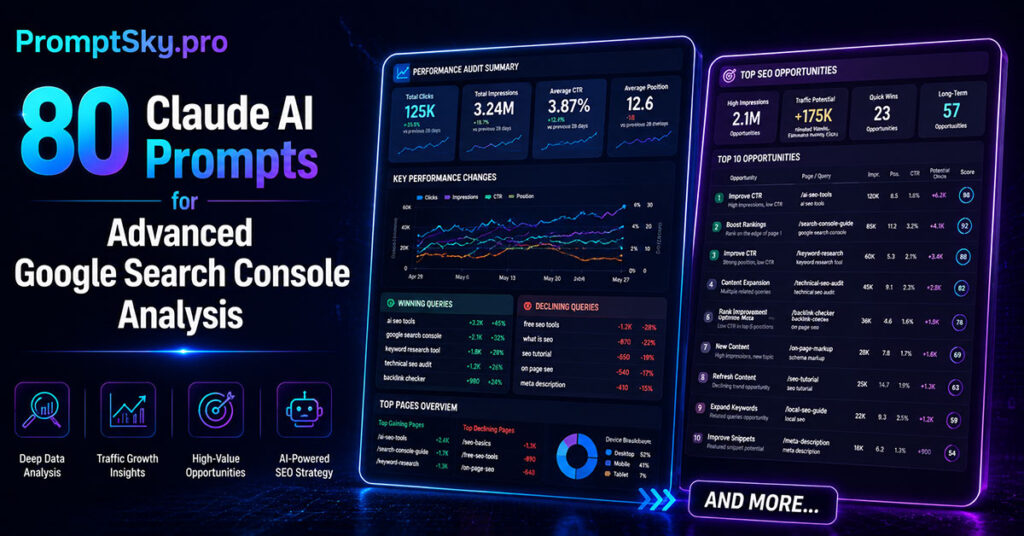
Google Search Console data analysis with Claude becomes much easier with the right prompts. These 80 AI prompts help you analyze clicks, impressions, CTR, rankings, queries, pages, and SEO trends across 7-day, 28-day, and 3-month periods.
To use them, export your relevant Google Search Console data, connect or upload or paste it into Claude, and choose the prompt that matches your goal. For more accurate results, provide separate datasets for the 7-day, 28-day, and 3-month periods so Claude can compare short-term changes with broader SEO trends.
You can also explore our 30 Powerful AI Prompts for Business Planning and Growth if you want to use AI for broader business strategy, planning, and growth. For more ideas, browse our complete collection of AI prompt templates.
Have a specific SEO analysis in mind? If you need another prompt, request it in the comments and we may add it to the collection.
1. Complete Google Search Console Performance Audit
Use this prompt to turn raw Google Search Console data into a structured SEO performance audit. It asks Claude to examine clicks, impressions, CTR, average position, queries, pages, countries, devices, and search appearance instead of focusing on a single metric.
Prompt:
Act as a senior SEO data analyst specializing in Google Search Console. Analyze the Google Search Console data I provide and create a comprehensive performance audit based strictly on the available data. Examine total clicks, impressions, average CTR, average position, top-performing queries, underperforming queries, landing pages, countries, devices, search appearance, and date ranges. Compare the most recent period with the previous equivalent period whenever comparison data is available, calculate meaningful percentage changes, identify significant gains and losses, and distinguish between statistically meaningful patterns and minor fluctuations. Do not invent missing information or assume causes that cannot be supported by the dataset. Organize the analysis into: executive summary, key performance changes, winning queries, declining queries, winning pages, declining pages, CTR opportunities, ranking opportunities, device insights, country insights, anomalies, likely explanations supported by evidence, and prioritized SEO actions. For every major finding, reference the relevant metric or data point that supports the conclusion. End with a prioritized action plan divided into immediate actions, medium-term improvements, and areas that should simply be monitored.
2. Find the Biggest SEO Opportunities
This prompt focuses on identifying opportunities hidden inside existing Search Console performance. It helps uncover pages and queries that already have visibility but could potentially generate significantly more organic traffic.
Prompt:
Analyze the Google Search Console dataset I provide as an SEO opportunity analyst and identify the highest-value opportunities for increasing organic search traffic. Look specifically for queries with high impressions but low CTR, queries ranking near the first page where small ranking improvements could create meaningful traffic gains, pages receiving impressions without proportional clicks, pages with strong average positions but weak CTR, and pages where multiple related queries indicate broader topical opportunities. Rank every opportunity using a practical opportunity score based on impressions, current position, CTR, clicks, and potential traffic impact when the available data supports such an estimate. Separate quick wins from long-term opportunities and avoid recommending changes where the data is too weak. For each opportunity, explain the evidence, the likely SEO lever involved, the page or query affected, and the specific action I should take. Finish with the top 10 opportunities ranked from highest to lowest priority.
3. Analyze CTR and Generate Optimization Opportunities
CTR often reveals pages that are visible in Google but fail to attract enough clicks. This prompt makes Claude investigate those cases and connect them to practical title and snippet optimization opportunities.
Prompt:
Perform a detailed Google Search Console CTR analysis using the dataset I provide. Identify queries and landing pages where impressions are high enough to matter but CTR is significantly below what would reasonably be expected based on their average position and search visibility. Compare CTR patterns across queries, pages, devices, countries, and search appearances whenever those dimensions are available. Identify pages that appear to have strong ranking potential but weak click attraction, and distinguish between CTR problems caused by poor positioning and CTR problems that may indicate weak search-result messaging. Do not claim that a title or meta description is the cause unless the data supports that interpretation. For each high-priority CTR opportunity, provide the query, page, impressions, clicks, CTR, average position, interpretation, and recommended optimization direction. Then create a prioritized list of title, meta-description, search-intent, and content-alignment improvements that could realistically improve click-through performance.
4. Identify Ranking Improvement Opportunities
This prompt is designed to find keywords that are close to valuable ranking thresholds. Claude analyzes positions and traffic potential to determine which terms deserve SEO attention first.
Prompt:
Analyze my Google Search Console keyword and page data to identify the strongest ranking improvement opportunities. Focus on queries currently ranking around positions 4–20, especially terms with substantial impressions, meaningful clicks, strong relevance to the associated page, and evidence of existing search visibility. Group opportunities into ranges such as positions 1–3, 4–5, 6–10, 11–20, and beyond 20, then explain the different strategic value of each group. Identify pages where several related queries are ranking close to the first page and determine whether improving one page could influence multiple keywords. For every recommended opportunity, provide the query, current position, impressions, clicks, CTR, associated URL, potential value, and recommended SEO action when the data supports it. Prioritize opportunities based on realistic traffic potential rather than simply choosing keywords with the highest search impressions. End with a concise ranking-improvement roadmap.
5. Find Pages Losing Organic Traffic
This prompt helps detect declining URLs and determine whether the decline is broad or isolated to specific queries, devices, countries, or search appearances.
Prompt:
Analyze the Google Search Console data I provide to identify pages experiencing meaningful organic search performance declines. Compare the current period with the previous equivalent period and examine changes in clicks, impressions, CTR, and average position at the page level. For every significantly declining URL, drill down into the queries responsible for the change and determine whether the decline appears to come from ranking losses, impression losses, CTR deterioration, reduced visibility for specific query groups, device-specific changes, country-specific changes, or another pattern visible in the data. Separate temporary fluctuations from sustained or strategically important declines when the available time series allows this distinction. Create a ranked list of declining pages and include the metrics behind each finding. For every page, provide evidence-based hypotheses for what may have happened, but clearly label hypotheses as hypotheses rather than facts. Finish with a recovery checklist for the highest-priority pages.
6. Find Winning Pages and Explain Why They Improved
Understanding successful pages can reveal repeatable SEO patterns. This prompt asks Claude to investigate growth rather than simply reporting which URLs gained traffic.
Prompt:
Analyze my Google Search Console data and identify the pages with the strongest organic growth during the selected comparison period. Examine changes in clicks, impressions, CTR, average position, query coverage, device performance, country performance, and search appearance where available. Do not stop at identifying the pages with the largest percentage increase; also consider absolute traffic growth so that small pages with unstable percentages do not automatically outrank strategically important pages. For each winning page, identify which queries contributed most to the growth and whether the improvement came primarily from better rankings, increased impressions, higher CTR, broader query coverage, or a combination of factors. Look for common characteristics among the winning pages and identify patterns that could potentially be replicated across other pages. End with practical recommendations for turning these successful patterns into a repeatable SEO strategy.
7. Analyze Query Cannibalization Signals
Search Console can reveal situations where multiple URLs receive impressions and clicks for similar queries. This prompt helps investigate potential cannibalization without automatically assuming that multiple ranking URLs are a problem.
Prompt:
Analyze the Google Search Console query and page data I provide for potential keyword cannibalization signals. Identify important search queries for which multiple URLs from the same website receive meaningful impressions or clicks, then determine whether the pattern represents a genuine SEO conflict, legitimate SERP diversity, branded variations, informational intent overlap, or insufficient evidence to make a conclusion. Examine average position, clicks, impressions, CTR, and query variations for each competing URL. Group semantically similar queries where the data supports grouping, but do not assume two URLs are competing simply because they share a few words. For every significant potential cannibalization case, explain which URLs are involved, which queries overlap, how their performance differs, and whether consolidation, internal linking, content differentiation, canonical review, intent clarification, or no action would be the most reasonable response. Clearly separate confirmed observations from hypotheses and prioritize cases by potential SEO impact.
8. Discover Low-Hanging Fruit Keywords
This prompt searches for keywords that already have measurable visibility and could deliver additional traffic with relatively focused optimization.
Prompt:
Use my Google Search Console data to identify low-hanging fruit SEO keywords that could potentially generate additional organic traffic with targeted optimization. Prioritize queries that already receive meaningful impressions or clicks and currently rank within a realistic improvement range, especially positions 5–20. Evaluate each keyword using impressions, clicks, CTR, average position, associated URL, query intent signals, and the presence of related queries on the same page. Identify clusters of related terms where improving one page could potentially improve multiple queries simultaneously. Do not recommend targeting a keyword simply because it has high impressions; consider whether the associated page and query relationship make the opportunity actionable. For every opportunity, provide the current metrics, why it qualifies as low-hanging fruit, what type of optimization is most appropriate, and the expected strategic value. Finish by ranking the opportunities into high, medium, and low priority.
9. Analyze Search Intent From GSC Queries
This prompt uses actual Search Console queries to classify the search intent behind traffic and identify whether the current landing pages appear aligned with those intents.
Prompt:
Analyze the Google Search Console queries I provide and classify their likely search intent using only evidence available from the query wording, associated landing pages, and performance patterns. Group queries into informational, commercial investigation, transactional, navigational, local, branded, or other relevant intent categories when appropriate. Then analyze whether the landing page receiving traffic appears logically aligned with the intent represented by each important query. Identify queries where the current page may be mismatched with user intent, especially when impressions are high but CTR or average position is weak. Group closely related queries into meaningful intent clusters and identify opportunities to improve page structure, content depth, internal linking, titles, headings, or dedicated landing pages. Do not invent user motivations that cannot reasonably be inferred from the query. Present the findings as an intent map followed by prioritized recommendations for improving search-intent alignment.
10. Analyze Branded vs Non-Branded Search Performance
This prompt separates brand-driven search visibility from non-branded SEO performance. It helps reveal whether organic growth is actually coming from broader search demand.
Prompt:
Analyze my Google Search Console query data by separating branded and non-branded search performance. First identify likely branded queries, including direct brand-name searches, brand variations, misspellings, product or service combinations containing the brand, and navigational variations. Keep ambiguous queries in a separate category instead of forcing them into branded or non-branded groups. Compare branded versus non-branded clicks, impressions, CTR, average position, growth rates, landing pages, devices, and countries whenever the data allows. Determine whether overall organic growth is primarily driven by existing brand demand or by broader non-branded search visibility. Identify pages that perform strongly for non-branded queries and pages that rely heavily on branded traffic. Highlight strategic risks, opportunities for expanding non-branded visibility, and areas where the dataset suggests stronger topical authority may be developing. Finish with a concise assessment of the website’s current organic search dependency on brand demand.
11. Find Content Gaps From Search Console Data
This prompt turns queries with impressions but weak page performance into potential content-gap signals. It can help reveal topics that deserve deeper coverage or dedicated pages.
Prompt:
Use the Google Search Console data I provide to identify potential content gaps and underserved search topics. Look for queries or closely related query groups that receive meaningful impressions but generate low clicks, weak rankings, or inconsistent landing-page performance. Determine whether these queries appear to represent subtopics that the current page does not adequately address, distinct search intents that may require separate pages, or simple ranking and CTR opportunities that do not justify new content. Group semantically related queries into topic clusters and identify recurring themes that appear across multiple URLs. For each potential content gap, provide the supporting queries, impressions, clicks, average position, current landing pages, inferred intent, and recommended content strategy. Distinguish between gaps that should be solved by improving existing content and gaps that may justify creating a new dedicated resource. Prioritize recommendations by potential organic impact and confidence in the evidence.
12. Analyze Device Performance
This prompt compares mobile, desktop, and other available device segments to uncover performance differences that may otherwise remain hidden in aggregate Search Console reports.
Prompt:
Perform a detailed device-level analysis of the Google Search Console data I provide. Compare clicks, impressions, CTR, average position, query performance, landing-page performance, and growth trends across mobile, desktop, tablet, and any other available device categories. Identify pages and queries where performance differs substantially between devices and determine whether the difference appears primarily related to rankings, impressions, CTR, or traffic distribution. Look for pages with strong desktop performance but unusually weak mobile performance and the reverse. Do not automatically attribute device differences to technical problems unless the dataset provides supporting evidence. Identify high-impact device-specific opportunities and explain which areas should be investigated further through technical SEO, UX, content presentation, SERP analysis, or other relevant checks. Finish with a prioritized list of device-related SEO actions and clearly distinguish Search Console evidence from recommendations that require additional validation.
13. Analyze Country-Level SEO Performance
Country-level data can reveal markets where a site already has organic visibility but is underperforming. This prompt helps identify those geographic opportunities.
Prompt:
Analyze my Google Search Console country-level performance and identify the strongest geographic SEO opportunities. Compare clicks, impressions, CTR, average position, growth, top queries, and top pages across all meaningful countries in the dataset. Identify countries where the website has substantial impressions but relatively low clicks, weak CTR, or rankings that suggest untapped potential. Also identify countries showing unusually strong growth and determine which pages and queries are contributing to that performance. Separate genuinely strategic markets from countries with small sample sizes where percentage changes may be misleading. Do not assume that a country should be targeted simply because it generates impressions; evaluate the actual evidence in the dataset. Provide a ranked list of geographic opportunities and explain whether each opportunity appears to require localization, content expansion, technical investigation, stronger rankings, improved CTR, or simply continued monitoring.
14. Analyze Search Appearance Performance
This prompt examines how different Google search appearances contribute to organic visibility when Search Console provides that data. It can reveal whether certain SERP features are associated with stronger or weaker performance.
Prompt:
Analyze the Google Search Console search appearance data I provide and determine how different search-result presentation types affect organic performance. Compare clicks, impressions, CTR, average position, and growth across every available search appearance category. Identify which search appearances contribute the most visibility, which generate the strongest click-through rates, and which produce large impression volumes without proportional traffic. Connect search appearance patterns to the pages and queries generating them whenever the dataset permits. Do not assume that a specific search feature caused performance changes unless the data supports a reasonable relationship. Highlight opportunities where improving structured content, page formatting, eligibility, relevance, or other SEO factors may potentially strengthen search visibility, while clearly labeling recommendations that require additional technical validation. End with a prioritized search-appearance strategy based on measurable performance rather than assumptions.
15. Detect Sudden Traffic Drops and Anomalies
This prompt is designed to detect unusual changes in Search Console performance and distinguish isolated anomalies from broader SEO problems.
Prompt:
Analyze the Google Search Console time-series data I provide and detect statistically or strategically significant anomalies in clicks, impressions, CTR, and average position. Identify sudden drops, sudden increases, unusual spikes, abrupt changes in query visibility, and pages that deviate substantially from their normal performance pattern. Compare the affected dates or periods with the preceding baseline and determine whether the change appears site-wide, page-specific, query-specific, country-specific, or device-specific. Quantify the magnitude and duration of each anomaly whenever the data allows. Do not automatically blame an algorithm update, technical issue, seasonality, or external event without evidence. For every major anomaly, provide the affected metric, date range, magnitude of change, affected pages or queries, likely evidence-based explanations, alternative explanations, and what additional data should be checked to validate the cause. End with an investigation priority score for each anomaly.
16. Analyze SEO Growth Trends Over Time
This prompt moves beyond month-to-month comparisons and asks Claude to identify broader patterns in organic search performance.
Prompt:
Analyze the historical Google Search Console data I provide to identify meaningful SEO growth trends over time. Examine clicks, impressions, CTR, average position, query diversity, landing-page performance, device distribution, country distribution, and other available dimensions across the full time range. Identify sustained growth, sustained decline, plateaus, acceleration periods, volatility, seasonal patterns, and major changes in search visibility. Compare short-term performance with longer-term trends so that temporary fluctuations are not mistaken for structural changes. Identify which pages and query groups appear to be driving long-term growth and which areas are losing momentum. Where possible, calculate growth rates and quantify changes rather than relying on vague descriptions. End with a strategic assessment of whether the website’s organic performance is accelerating, stable, declining, or highly volatile, followed by the most important actions for the next SEO cycle.
17. Find Underperforming High-Impression Pages
This prompt focuses specifically on URLs that receive substantial search exposure but fail to convert that visibility into clicks or strong rankings.
Prompt:
Analyze my Google Search Console page-level data and identify underperforming URLs with high search impressions but insufficient organic traffic. Consider clicks, impressions, CTR, average position, query distribution, and changes over time when available. Separate pages with poor CTR despite strong rankings from pages with low CTR because their rankings are too weak, since these require different optimization strategies. Identify pages where a relatively small improvement in ranking or CTR could potentially produce meaningful additional clicks. For each URL, show the supporting metrics, explain the primary performance limitation visible in the data, identify the queries contributing most to the problem, and recommend the most appropriate optimization direction. Consider title and snippet optimization, search-intent alignment, content improvements, internal linking, topical coverage, and ranking-focused improvements where relevant. Prioritize the pages according to realistic traffic opportunity rather than impressions alone.
18. Identify Pages With Expanding Keyword Visibility
This prompt identifies URLs that are appearing for an increasing number of search queries, which can be an early indicator of growing topical relevance.
Prompt:
Analyze the Google Search Console query and page data I provide to identify URLs whose organic keyword visibility is expanding. Determine which pages are appearing for an increasing range of queries and whether that expansion is accompanied by growth in impressions, clicks, CTR, or average position. Group related queries into topical clusters and identify pages that are beginning to rank across multiple variations of the same subject. Distinguish meaningful expansion from minor query-count fluctuations caused by low-volume terms. For each growing page, identify the query themes contributing to the expansion and explain what the pattern may indicate about the page’s topical reach based strictly on the available data. Recommend ways to strengthen these pages through internal linking, content depth, supporting sections, related content, and strategic optimization without unnecessarily changing pages that are already performing well. Finish with a list of pages that appear to have the strongest potential for further organic expansion.
19. Analyze Top Queries by Business Value
Search Console traffic alone does not reveal which queries matter most commercially. This prompt asks Claude to rank queries using available performance data and business relevance signals.
Prompt:
Analyze my Google Search Console query data and identify the search terms with the highest potential business value. Use clicks, impressions, CTR, average position, query wording, associated landing pages, search intent signals, and any business-context information I provide to classify queries according to likely commercial importance. Separate informational queries from commercial investigation, transactional, navigational, branded, and high-intent service or product queries when appropriate. Do not assume that a query with the most clicks has the highest business value. Identify queries that may have lower traffic volume but stronger conversion or revenue potential based on their intent. Create a prioritized table containing the query, performance metrics, intent category, associated URL, estimated strategic value, confidence level, and recommended SEO action. Clearly label any business-value assumptions that cannot be verified directly from Search Console and explain what conversion or revenue data would improve the analysis.
20. Create a 90-Day SEO Action Plan From GSC Data
This prompt turns Search Console findings into a practical SEO roadmap instead of leaving the analysis as a collection of charts and observations.
Prompt:
Act as a senior SEO strategist and use the Google Search Console data I provide to create a data-driven 90-day SEO action plan. First analyze the dataset thoroughly and identify the highest-impact opportunities and problems across queries, pages, clicks, impressions, CTR, rankings, devices, countries, search appearance, and historical trends. Then prioritize the findings according to potential organic impact, implementation difficulty, confidence in the evidence, and strategic importance. Divide the roadmap into three phases: days 1–30 for quick wins and urgent issues, days 31–60 for deeper content and on-page improvements, and days 61–90 for scalable growth initiatives and testing. For every recommended action, specify the target page or query group, the reason for prioritization, the relevant Search Console evidence, the expected outcome, the implementation task, and the metric that should be monitored afterward. Do not invent traffic forecasts or guaranteed ranking improvements. Finish with a concise KPI dashboard containing the Search Console metrics that should be reviewed weekly and monthly to determine whether the 90-day strategy is working.
Part 2 — Google Search Console Analysis Prompts
21. Analyze Page-Level SEO Performance
This prompt helps Claude evaluate every important URL instead of judging the website only by total clicks and impressions. It is useful for finding which pages deserve optimization, maintenance, or further investment.
Prompt:
Act as a senior technical SEO analyst and perform a detailed page-level analysis of the Google Search Console data I provide. Evaluate each URL using clicks, impressions, CTR, average position, query count, query diversity, and period-over-period changes whenever those metrics are available. Identify the strongest pages, weakest pages, fastest-growing pages, declining pages, high-impression pages with weak CTR, pages ranking near valuable positions, and pages receiving visibility without meaningful traffic. Group pages into practical categories such as high-performing assets, growth opportunities, declining assets, low-visibility pages, and pages requiring further investigation. For each important URL, identify the queries contributing most to its performance and determine whether its traffic is concentrated around a few terms or distributed across a broader topic. Do not make assumptions about content quality without evidence. Finish with a prioritized page optimization list explaining what should be improved, expanded, monitored, consolidated, or left unchanged.
22. Analyze Top Search Queries in Depth
This prompt goes beyond listing the top keywords and examines what those queries reveal about the website’s organic search visibility.
Prompt:
Perform an in-depth analysis of the top Google Search Console queries in the dataset I provide. Rank queries by clicks, impressions, CTR, average position, and growth, but do not rely on a single metric to determine importance. Identify queries generating substantial traffic, queries with strong visibility but weak CTR, queries close to page-one positions, rapidly growing queries, declining queries, branded queries, non-branded queries, and high-intent terms. For each major query, identify the associated landing page and determine whether the page appears to be the most appropriate destination based on the query and available performance data. Group semantically related queries into meaningful clusters and explain which clusters represent the strongest SEO opportunities. Highlight queries that deserve content optimization, internal-linking support, new content, CTR testing, or further research. End with a prioritized keyword strategy based entirely on the evidence available in Search Console.
23. Compare Two SEO Periods
This prompt is useful for monthly reports, quarterly reviews, or before-and-after analysis of SEO changes. Claude identifies exactly where performance moved between two periods.
Prompt:
Compare the two Google Search Console reporting periods I provide and produce a detailed SEO performance comparison. Calculate absolute and percentage changes in clicks, impressions, CTR, and average position, then identify which pages, queries, devices, countries, and search appearances contributed most to those changes. Do not focus only on percentage growth because small-volume data can create misleading percentages; consider both relative and absolute changes. Identify the largest winners and losers, newly visible queries, disappearing queries, pages gaining or losing visibility, and significant changes in CTR or rankings. Explain whether overall performance improved because of increased search demand, better rankings, broader keyword coverage, improved CTR, or another pattern supported by the data. Clearly distinguish correlation from causation and do not invent external explanations. Finish with a concise executive summary followed by the five most important actions suggested by the comparison.
24. Identify New Keywords the Website Is Starting to Rank For
This prompt detects emerging search terms that may indicate new topical opportunities or growing visibility.
Prompt:
Analyze the Google Search Console datasets from the two periods I provide and identify newly appearing search queries that were absent or insignificant in the previous period but gained measurable impressions or clicks in the newer period. Separate genuinely meaningful new query visibility from insignificant low-volume variations. Group new queries into semantic and topical clusters and identify the landing pages associated with each cluster. Determine whether the new visibility appears to represent expansion into a new topic, broader coverage of an existing topic, increased ranking strength, seasonal demand, or another pattern supported by the available data. For each important emerging query, provide its impressions, clicks, CTR, average position, associated URL, and growth where available. Highlight opportunities where emerging keywords could be strengthened through content expansion, internal linking, improved headings, supporting articles, or other evidence-based SEO actions.
25. Find Keywords That Lost Visibility
This prompt helps identify which queries disappeared or declined sharply and whether those losses are concentrated around particular pages or topics.
Prompt:
Use the Google Search Console data I provide to identify search queries that have lost meaningful organic visibility between the comparison periods. Look for queries with significant declines in impressions, clicks, average position, or CTR, as well as queries that were previously visible but are now receiving little or no measurable performance. Group lost queries by landing page, topic, search intent, and keyword type whenever possible. Determine whether the decline is isolated to individual queries or represents a broader loss affecting an entire topic or URL. Quantify the contribution of each query or query cluster to overall traffic loss. Do not automatically assume that disappearing queries indicate a penalty, algorithm update, or technical issue. Instead, provide evidence-based possibilities and clearly identify what additional data would be required to confirm the cause. End with a prioritized recovery list based on traffic impact and strategic importance.
26. Find Pages With Strong CTR but Weak Rankings
This prompt identifies URLs where search-result messaging appears effective but the pages need stronger ranking performance to unlock more traffic.
Prompt:
Analyze my Google Search Console page and query data to identify pages and queries with relatively strong CTR but weak or moderate average positions. Look for cases where users appear willing to click when the page is visible, suggesting that ranking improvement may offer a meaningful traffic opportunity. Compare impressions, clicks, CTR, average position, query intent, and performance across related keywords. Avoid using arbitrary CTR benchmarks without considering position, device, search intent, and query type. For every high-potential case, explain why the combination of CTR and ranking makes the URL interesting, identify the queries responsible for the opportunity, and recommend ranking-focused actions such as content improvements, topical expansion, internal linking, relevant backlinks, page structure improvements, or other appropriate strategies. Separate opportunities supported by strong data from cases with insufficient volume. Finish by ranking the best pages to prioritize for additional ranking gains.
27. Identify Queries With Weak CTR Despite Good Rankings
This prompt finds cases where a page already ranks reasonably well but does not attract enough clicks. These are often useful targets for title and snippet testing.
Prompt:
Analyze my Google Search Console data to identify queries and URLs that achieve relatively strong average rankings but receive weaker-than-expected click-through rates. Evaluate CTR in the context of average position, impressions, query intent, device, country, and search appearance whenever those dimensions are available. Avoid treating every low CTR as a title problem because SERP features, search intent, branded behavior, and query type can influence clicks. Identify the highest-value cases where improving search-result presentation could potentially increase traffic without requiring major ranking improvements. For each opportunity, provide the query, URL, impressions, clicks, CTR, average position, relevant context, likely interpretation, and recommended testing direction. Suggest multiple title or snippet angles only when they are appropriate, and explain the underlying intent each variation should address. Prioritize opportunities using both impression volume and realistic CTR improvement potential.
28. Analyze Long-Tail Keyword Performance
Long-tail queries can reveal highly specific search needs and valuable content opportunities that broad keyword reports often hide. This prompt analyzes them separately from generic head terms.
Prompt:
Perform a detailed long-tail keyword analysis using the Google Search Console query data I provide. Identify specific multi-word queries and highly descriptive search terms that generate impressions, clicks, or meaningful ranking signals. Group long-tail queries into semantic themes and identify recurring questions, modifiers, locations, product attributes, problems, use cases, or other patterns visible in the dataset. Determine which long-tail clusters are already performing well and which show high impressions but weak rankings or CTR. Identify pages that are attracting long-tail visibility without having been intentionally optimized for those terms, and explain how this may reveal broader topical opportunities. Do not recommend creating separate pages for every variation; determine when several queries should be addressed within one comprehensive page. Finish with prioritized recommendations for content expansion, FAQ sections, supporting articles, internal links, and other strategies supported by the data.
29. Analyze Question-Based Search Queries
This prompt focuses on queries that contain questions and helps uncover what users are trying to learn from the website.
Prompt:
Analyze the Google Search Console query dataset and identify question-based searches such as queries containing how, why, what, when, where, which, can, should, or other question structures relevant to the language of the dataset. Group these queries by topic and search intent, then evaluate impressions, clicks, CTR, and average position for each question or question cluster. Identify frequently appearing questions that the website already answers successfully and questions that receive significant impressions but have weak rankings or clicks. Determine whether each question should be addressed through existing content, expanded sections, FAQ content, a dedicated article, comparison content, or another format. Do not create artificial questions that are not present in the data. End with a prioritized question-content roadmap based on search visibility, user intent, and potential SEO value.
30. Find Seasonal SEO Patterns
This prompt helps identify recurring performance changes that may be related to seasonality rather than SEO problems.
Prompt:
Analyze the historical Google Search Console data I provide for recurring seasonal patterns in organic search performance. Examine clicks, impressions, CTR, average position, queries, pages, countries, and devices across comparable time periods whenever enough historical data exists. Identify recurring increases and decreases in search demand, pages that consistently perform better during specific periods, queries with seasonal behavior, and topics showing predictable cycles. Distinguish changes in search demand from changes in rankings by comparing impressions with average position and clicks. Do not label a pattern as seasonal unless the historical data provides reasonable evidence of repetition. Identify pages and query groups that should be prepared before their likely high-demand periods and explain what preparation could include. Finish with a practical seasonal SEO calendar based only on patterns visible in the supplied Search Console data.
31. Analyze Content Decay
This prompt is designed to discover previously successful pages whose organic performance has gradually weakened. It helps prioritize content refreshes.
Prompt:
Analyze the Google Search Console historical data I provide to identify signs of content decay. Look for URLs that previously generated strong clicks, impressions, rankings, or CTR but have experienced sustained deterioration over time. Compare current performance with historical peaks and identify the queries responsible for the decline. Determine whether the decay appears to affect one page, a group of related pages, or an entire topic. Distinguish gradual decline from short-term fluctuations and identify whether impressions, rankings, CTR, or query coverage deteriorated first. For every important decaying page, provide the historical evidence, affected queries, magnitude of decline, current performance, and potential SEO interpretation. Recommend whether the page should be refreshed, expanded, repositioned, consolidated, internally linked more strongly, or simply monitored. Prioritize content refresh opportunities according to lost traffic, strategic relevance, and confidence in the evidence.
32. Analyze SEO Performance by Query Intent
This prompt creates an intent-based performance report to show which types of searches are actually generating visibility and traffic.
Prompt:
Classify the Google Search Console queries I provide by search intent and analyze performance separately for each intent category. Use categories such as informational, commercial investigation, transactional, navigational, branded, local, comparison, problem-solving, or other categories that accurately fit the dataset. For each category, calculate or summarize clicks, impressions, CTR, average position, growth, top queries, and top landing pages when the data permits. Identify which intent categories are strongest, which have substantial visibility but weak traffic, and which appear to represent the largest strategic growth opportunities. Analyze whether the website’s current landing pages align with the intent behind the queries generating impressions. Do not force ambiguous queries into an inaccurate category; create an uncertain category where appropriate. Finish with recommendations for improving content and page strategy based on the strongest intent-level opportunities.
33. Identify Underperforming Topics
This prompt shifts the analysis from individual keywords to broader topic clusters, making it useful for topical SEO strategy.
Prompt:
Use the Google Search Console query and page data to identify underperforming topical clusters. Group semantically related queries into meaningful topics using the actual search terms and associated landing pages, then evaluate each topic using impressions, clicks, CTR, average position, number of ranking queries, and growth trends. Identify topics with substantial search visibility but weak organic traffic, topics experiencing ranking declines, topics with many queries but weak page performance, and topics where multiple pages appear to have fragmented visibility. Compare these underperforming topics with the website’s strongest topical clusters to identify meaningful differences. Do not create arbitrary topic groups simply to produce more categories. For each high-priority topic, identify the pages and queries involved, explain the performance limitation supported by the data, and recommend whether to improve existing content, create supporting content, strengthen internal links, consolidate pages, or conduct further research.
34. Find Pages That Could Become Organic Traffic Hubs
This prompt identifies pages that already rank for many related queries and could potentially become stronger central resources through strategic optimization.
Prompt:
Analyze my Google Search Console page and query data to identify URLs with strong potential to become organic traffic hubs. Look for pages already ranking for a broad range of related queries, receiving substantial impressions, attracting clicks from multiple keyword variations, or showing growth in topical visibility. Evaluate the breadth and quality of query coverage rather than simply counting keywords. Identify clusters of related queries that the page already captures and determine which closely related terms appear to be underperforming. For each potential content hub, provide its current clicks, impressions, CTR, average position, query count, major query clusters, and growth pattern when available. Recommend ways to strengthen the page’s topical coverage without unnecessary keyword stuffing, including useful content sections, supporting subtopics, internal links, related resources, and intent alignment. Prioritize pages where additional optimization could influence multiple related queries simultaneously.
35. Analyze Internal Linking Opportunities From GSC Data
This prompt uses Search Console performance to identify pages that may benefit from stronger internal-link support.
Prompt:
Use the Google Search Console data I provide to identify potential internal linking opportunities. Find pages that rank for valuable queries but remain in positions where additional authority or relevance could potentially help, as well as pages with strong organic performance that may serve as useful internal-link sources. Group related queries and pages into topical relationships and identify logical source-to-target connections based on topic relevance rather than metrics alone. For each recommended internal link, explain the source page, target page, relevant query or topic, reason the connection makes sense, and expected SEO purpose. Prioritize opportunities where the target page already has meaningful impressions or rankings and where the source page appears contextually relevant. Do not invent site structure that is not represented in the data. Clearly state that Search Console alone cannot prove internal-link causation and identify which recommendations should be validated by reviewing the actual page content.
36. Analyze Pages With Multiple Search Intent Signals
Some pages receive traffic from different types of queries, which can indicate strong versatility or potentially mixed intent. This prompt helps distinguish the two.
Prompt:
Analyze the Google Search Console queries associated with each important landing page and identify pages receiving traffic from multiple distinct search intents. Determine whether the different query groups are closely related and naturally served by one comprehensive page or whether they represent conflicting user needs that may indicate content-structure problems. Evaluate impressions, clicks, CTR, average position, and query distribution for each intent group. Identify pages where mixed intent appears to be a strength and pages where it may create unclear relevance or diluted optimization. For every significant case, describe the intent groups, associated queries, performance differences, and whether the page should remain unified, be expanded with clearly separated sections, or potentially be supported by additional dedicated content. Do not recommend splitting a page simply because it ranks for different keywords; consider whether those queries represent genuinely different search goals.
37. Find Pages With Strong Organic Potential but Low Traffic
This prompt looks beyond current clicks and identifies pages that show promising Search Console signals despite limited traffic.
Prompt:
Analyze the Google Search Console data to identify pages with strong organic potential despite currently generating relatively low traffic. Consider impressions, average position, CTR, number of ranking queries, query relevance, growth rate, and ranking distribution rather than clicks alone. Identify pages that already receive meaningful visibility, rank for multiple relevant terms, or are approaching valuable ranking thresholds but have not yet converted that visibility into substantial clicks. Separate pages with genuine growth potential from pages that have high impressions but weak relevance or consistently poor rankings. For each candidate page, explain the evidence supporting its potential and identify the most appropriate next action, such as CTR optimization, content expansion, ranking improvement, internal linking, or continued monitoring. Rank the opportunities according to expected strategic value and confidence rather than simply selecting the pages with the highest impressions.
38. Analyze SEO Performance by URL Type
This prompt compares different types of website pages to discover which content formats perform best in organic search.
Prompt:
Analyze my Google Search Console data by URL or page type. If the dataset includes URL structures or page labels, classify pages into meaningful groups such as blog articles, category pages, product pages, service pages, landing pages, guides, documentation, comparison pages, or other relevant types. Compare clicks, impressions, CTR, average position, query coverage, and growth across these groups. Identify which page types consistently generate strong organic performance and which types appear to struggle. Look for differences in ranking distribution and search intent between page types and identify whether certain formats appear particularly effective for specific query categories. Do not assume a URL type solely from a path if the classification is ambiguous; clearly mark uncertain classifications. Finish with recommendations for where the website should invest more content, optimization, testing, or technical attention based on the performance patterns observed.
39. Detect Query-Page Mismatches
This prompt identifies cases where Google is showing a URL for queries that may not closely match its intended topic or where another page may be a better candidate.
Prompt:
Analyze the relationship between Google Search Console queries and their associated landing pages to identify potential query-page mismatches. Look for important queries where the ranking URL appears weakly aligned with the query intent, pages receiving impressions for unexpected topics, queries where multiple URLs alternate in visibility, and cases where a different existing page may logically serve the search better. Evaluate query wording, intent, impressions, clicks, CTR, average position, and associated URLs before making any recommendation. Distinguish genuine relevance problems from useful long-tail visibility that should be preserved. For each significant mismatch, explain the query, current URL, likely intent, evidence of weak alignment, and recommended action, such as improving the current page, strengthening another existing page, creating new content, clarifying internal linking, or taking no action. Never recommend changing URLs solely because a query is unexpected without evaluating its performance and strategic relevance.
40. Build a Search Console SEO Executive Report
This prompt transforms raw Search Console exports into a concise report suitable for clients, managers, or internal stakeholders who need decisions rather than technical data dumps.
Prompt:
Turn the Google Search Console dataset I provide into a professional executive SEO report designed for a business owner, marketing manager, or senior stakeholder. Start with a concise overview of overall organic performance and clearly state the most important changes in clicks, impressions, CTR, and average position. Then summarize the strongest growth areas, biggest losses, highest-value queries, top pages, ranking opportunities, CTR opportunities, emerging topics, declining topics, and any significant anomalies. Use concrete numbers and percentage changes wherever available, but avoid overwhelming the reader with unnecessary metrics. Clearly distinguish facts directly supported by Search Console from interpretations or hypotheses. Translate technical SEO findings into business-friendly language and explain why each major issue or opportunity matters. End with a prioritized action plan containing no more than 10 recommendations, each with a priority level, target page or query group, evidence from the dataset, recommended action, and success metric. Do not invent conversions, revenue, causes, or forecasts that are not included in the data.
41. Analyze Google Search Console Data for SEO Quick Wins
This prompt helps Claude identify SEO improvements that can be implemented quickly without requiring a complete content strategy overhaul. It focuses on opportunities already visible in the Search Console data.
Prompt:
Act as an experienced SEO consultant and analyze the Google Search Console dataset I provide specifically for quick-win opportunities. Examine queries and pages with meaningful impressions, positions between approximately 4 and 20, strong or moderate CTR potential, declining but recoverable performance, and pages that are already receiving visibility for relevant search terms. Identify opportunities that could realistically be improved through title optimization, content refinement, search-intent alignment, internal linking, heading improvements, FAQ expansion, topical coverage, or other on-page actions. For every quick win, provide the affected URL, query or query cluster, clicks, impressions, CTR, average position, evidence supporting the opportunity, recommended action, expected SEO benefit, and implementation difficulty. Rank the opportunities by potential impact versus effort. Avoid recommending major technical projects when a simpler optimization is supported by the data, and do not guarantee ranking or traffic increases. End with a prioritized list of the 15 highest-value SEO quick wins.
42. Analyze Google Search Console Data for Content Refresh Opportunities
This prompt finds existing articles and pages that may benefit more from updating than creating entirely new content. It is especially useful for websites with a large content library.
Prompt:
Analyze the Google Search Console data I provide and identify existing pages that are strong candidates for a content refresh. Look for URLs with historical traffic that has declined, pages ranking for relevant queries but losing impressions or average position, pages receiving substantial impressions with weak CTR, and pages gaining visibility for related queries that are not adequately covered by their current content. Examine query patterns, ranking distribution, clicks, impressions, CTR, average position, and historical changes to determine why each page may deserve attention. For every recommended refresh, explain whether the priority is updating outdated information, expanding topical coverage, improving search-intent alignment, strengthening internal links, improving title and snippet appeal, restructuring the page, or addressing another issue supported by the dataset. Separate high-confidence refresh opportunities from pages where more investigation is needed. End with a content-refresh roadmap ranked by potential traffic recovery and growth opportunity.
43. Identify Pages That Should Be Consolidated
This prompt helps detect situations where several URLs may be competing for similar search visibility or covering closely related topics. Claude evaluates the evidence before suggesting consolidation.
Prompt:
Analyze my Google Search Console query and page data to identify potential content consolidation opportunities. Find groups of URLs that receive impressions or clicks for overlapping and closely related search queries, then compare their rankings, CTR, clicks, impressions, query coverage, and historical performance. Determine whether each group represents genuine keyword cannibalization, useful topical coverage across multiple pages, or simply normal SERP behavior. For potential consolidation cases, identify the strongest URL based on relevance, traffic, query coverage, ranking stability, and strategic value. Explain which pages appear redundant, which URL should potentially become the primary resource, and what evidence supports that recommendation. Do not recommend consolidation solely because two pages share keywords. Consider search intent, topic depth, traffic contribution, and the possibility that the pages serve different audiences. Finish with a prioritized consolidation list and clearly mark cases requiring manual content review before any URL changes are made.
44. Find Google Search Console Opportunities for New Content
This prompt uses existing search visibility to discover topics that could justify new articles, guides, landing pages, or supporting resources.
Prompt:
Use the Google Search Console query data I provide to discover opportunities for creating new SEO content. Look for recurring queries, related search themes, question patterns, high-impression topics with weak existing landing-page performance, and query clusters that appear to represent distinct search intents not adequately served by current pages. Group related queries into logical content opportunities instead of treating every keyword as a separate article. For each proposed content topic, list the supporting Search Console queries, impressions, clicks, average positions, current URLs, inferred intent, and reason the existing content appears insufficient or incomplete. Distinguish between topics that require a completely new page and topics that should instead be incorporated into an existing resource. Rank proposed content ideas by search visibility, strategic relevance, evidence strength, and potential to expand the website’s topical coverage. Do not invent search volume or keyword difficulty metrics that are not included in the dataset.
45. Analyze Google Search Console Data for Topic Clusters
This prompt turns individual queries into broader topic clusters so Claude can identify which subjects are strongest and where the site has room to grow.
Prompt:
Act as a topical SEO analyst and transform the Google Search Console query dataset I provide into a structured topic-cluster analysis. Group semantically related queries according to their underlying subject, user need, and search intent rather than simply matching individual words. For each cluster, analyze total impressions, clicks, CTR, average position, number of queries, number of ranking URLs, growth trends, and the pages responsible for visibility whenever the data allows. Identify dominant clusters, emerging clusters, declining clusters, fragmented clusters, and underserved clusters. Highlight topics where one page already captures many related queries and topics where visibility is spread across several pages. For every important cluster, explain the current SEO position and recommend whether to expand an existing page, create supporting content, improve internal linking, consolidate overlapping URLs, or pursue another strategy. Do not create artificial clusters when the query relationship is weak or ambiguous.
46. Analyze Google Search Console Data for Featured Snippet Opportunities
This prompt looks for queries where the website already has strong organic visibility and may have an opportunity to gain additional SERP visibility through better structured answers.
Prompt:
Analyze my Google Search Console queries and pages to identify potential featured snippet and answer-focused search opportunities. Look for informational and question-based queries where the website already ranks within a competitive range, receives meaningful impressions, or demonstrates strong relevance but does not appear to capture the maximum possible SERP visibility based on the available data. Identify queries that could potentially benefit from concise definitions, step-by-step answers, numbered lists, comparison tables, direct explanations, or clearly structured content. For every opportunity, provide the query, associated URL, impressions, clicks, CTR, average position, likely intent, and recommended content format. Do not claim that a page currently owns or lacks a featured snippet unless that information is explicitly present in the supplied data. Focus on identifying realistic optimization opportunities rather than guaranteeing SERP feature eligibility. End with the highest-priority answer-format opportunities.
47. Analyze Google Search Console Data for Local SEO Opportunities
This prompt is designed for websites targeting cities, regions, or local customers. It identifies geographic query patterns and local search opportunities visible in Search Console.
Prompt:
Analyze the Google Search Console data I provide to identify local SEO opportunities. Look for location-based queries, city names, regional modifiers, neighborhoods, service-area terms, near me variations, and combinations of locations with products or services. Group these queries by geographic area and analyze clicks, impressions, CTR, average position, growth, and associated landing pages. Identify locations with strong search visibility but weak traffic, locations showing rapid growth, and locations where the website appears to have demand but insufficient dedicated content or landing-page coverage. Distinguish branded location searches from non-branded local discovery queries whenever possible. For every important geographic opportunity, explain whether the best response is improving an existing location page, creating a dedicated service-area page, strengthening local relevance, improving internal linking, or conducting additional local SEO research. Do not create location recommendations unsupported by the Search Console dataset.
48. Compare Mobile and Desktop Search Performance
This prompt performs a deeper comparison between mobile and desktop rather than simply reporting device percentages.
Prompt:
Perform a detailed comparison of mobile and desktop Google Search Console performance using the dataset I provide. Compare clicks, impressions, CTR, average position, query visibility, landing pages, and growth trends across both device categories. Identify pages and queries where the performance gap is unusually large and determine whether the difference is primarily caused by rankings, impressions, CTR, or another measurable factor. Identify URLs that perform strongly on desktop but significantly weaker on mobile, as well as the reverse pattern. Examine whether certain query types, content categories, or landing pages consistently show device-specific differences. Do not automatically attribute these differences to responsive design, page speed, UX, or technical problems because Search Console data alone cannot prove those causes. Instead, identify which pages deserve additional technical and UX investigation and explain what should be checked. End with a prioritized mobile-versus-desktop optimization list based on traffic impact and confidence in the evidence.
49. Analyze Google Search Console Data for Query Growth Opportunities
This prompt identifies search terms that are gaining momentum and could become important traffic sources if optimized at the right time.
Prompt:
Analyze the historical Google Search Console query data I provide and identify search queries showing meaningful growth momentum. Compare impressions, clicks, CTR, and average position across available periods and distinguish sustained growth from short-term fluctuations. Identify queries with rapidly increasing impressions, queries moving toward page-one rankings, queries gaining clicks faster than impressions, and queries where ranking improvements are beginning to produce measurable traffic growth. Group related growing queries into topic clusters and identify the pages responsible for the growth. For every promising query or cluster, explain the evidence of momentum, current performance, associated URL, likely strategic importance, and recommended action to strengthen the trend. Avoid treating small-volume percentage changes as major opportunities. Rank the opportunities based on growth consistency, absolute visibility, current ranking position, and potential strategic value.
50. Create a Complete Google Search Console SEO Opportunity Matrix
This prompt combines multiple Search Console signals into one structured opportunity framework, making it useful when Claude needs to prioritize a large amount of SEO data.
Prompt:
Analyze the complete Google Search Console dataset I provide and build a comprehensive SEO opportunity matrix. Evaluate queries, pages, clicks, impressions, CTR, average position, historical changes, devices, countries, search appearance, and other available dimensions. Identify opportunities across ranking improvements, CTR optimization, content refreshes, new content, internal linking, query-page alignment, topic expansion, content consolidation, local SEO, mobile performance, and declining traffic recovery. For every opportunity, assign a priority score based on potential traffic impact, strategic importance, implementation effort, confidence in the available evidence, and urgency. Include the affected query or query cluster, URL, current metrics, change over time, opportunity type, recommended action, reason for prioritization, expected outcome, and validation metric. Separate high-confidence recommendations from hypotheses requiring additional investigation. Avoid invented metrics, unsupported causes, guaranteed traffic forecasts, or generic SEO advice. Finish by ranking the top 20 opportunities that should receive attention first and explain why each one deserves its position.
61. Compare 7-Day, 28-Day, and 3-Month SEO Performance
This prompt gives Claude a complete view of SEO performance across short-term, medium-term, and long-term periods, making it easier to distinguish real trends from temporary fluctuations.
Prompt:
Act as a senior SEO data analyst and analyze the Google Search Console data I provide across three specific reporting periods: the most recent 7 days, the most recent 28 days, and the most recent 3 months. Analyze each period separately and then compare all three periods to identify short-term, medium-term, and long-term SEO trends. Evaluate clicks, impressions, CTR, average position, top queries, top pages, ranking changes, device performance, country performance, and every other available dimension. For each major metric, clearly explain whether performance is improving, declining, stable, or volatile across the 7-day, 28-day, and 3-month windows. Pay special attention to situations where the 7-day trend contradicts the 28-day or 3-month trend, because this may indicate a recent change that has not yet become a long-term pattern. Do not treat a 7-day fluctuation as a confirmed trend without supporting evidence. Finish with a three-level SEO assessment covering the immediate 7-day trend, current 28-day direction, and overall 3-month direction, followed by the most important actions based on the combined evidence.
62. Find SEO Opportunities Across 7-Day, 28-Day, and 3-Month Data
This prompt identifies opportunities that remain consistent across multiple reporting periods while also detecting opportunities that have appeared only recently.
Prompt:
Analyze my Google Search Console data across three separate timeframes: the latest 7 days, latest 28 days, and latest 3 months. Identify SEO opportunities that appear consistently across multiple timeframes as well as opportunities that have emerged only recently. Compare clicks, impressions, CTR, average position, query visibility, and page performance between the three periods. Classify each opportunity as short-term, medium-term, long-term, or cross-period based on the evidence. Prioritize opportunities where the same page or query demonstrates positive potential in both the 28-day and 3-month periods, while separately highlighting new opportunities visible only in the latest 7 days. Do not give equal importance to every change; consider data volume, consistency, magnitude, and strategic value. For every opportunity, provide the affected query or URL, the relevant metrics for all three periods, the observed trend, recommended SEO action, confidence level, and priority. End with a ranked list of the highest-value opportunities that should be acted on now.
63. Detect Recent SEO Problems Using the 7-Day vs. 28-Day Comparison
This prompt is designed to detect fresh SEO declines by comparing the latest 7 days against the broader 28-day performance baseline.
Prompt:
Analyze the latest 7 days of Google Search Console data against the previous 28-day performance baseline to detect recent SEO problems. Compare clicks, impressions, CTR, average position, top queries, and top pages and identify sudden or meaningful deterioration in the latest 7-day period. Determine whether each decline affects the entire website, specific URLs, specific query groups, devices, countries, or search appearances. For every detected issue, compare the latest 7-day numbers with the 28-day baseline and, when available, use the 3-month data to determine whether the change is genuinely recent or part of a longer decline. Do not automatically classify normal weekly volatility as an SEO problem. Rank detected issues by severity, traffic impact, duration, and confidence. Clearly separate confirmed Search Console observations from possible explanations that require additional investigation. End with an urgent SEO investigation checklist for the highest-priority 7-day anomalies.
64. Identify Long-Term SEO Growth Using 3-Month Data
This prompt focuses primarily on the 3-month trend and then checks whether that growth is still continuing in the latest 28-day and 7-day periods.
Prompt:
Perform a long-term Google Search Console growth analysis using the latest 3-month dataset as the primary reporting period, while using the latest 28-day and 7-day periods to evaluate current momentum. Identify pages, queries, topics, devices, countries, and search appearances that contributed most to 3-month organic growth. Then determine whether those growth patterns are still active in the latest 28 days and latest 7 days. Separate sustained growth from growth that has recently slowed, stopped, or reversed. For every major growth area, provide the 3-month performance, 28-day performance, and 7-day performance and explain the direction of the trend. Identify pages and queries with the strongest long-term potential and recommend actions that could maintain or accelerate their growth. Do not mistake a temporary 7-day spike for sustainable growth. End with a prioritized list of long-term SEO growth opportunities supported by all three reporting periods.
65. Analyze 7-Day, 28-Day, and 3-Month Ranking Trends
This prompt focuses specifically on average position and ranking movement to determine whether ranking changes are recent, persistent, or part of a longer trend.
Prompt:
Analyze Google Search Console ranking performance across the latest 7 days, latest 28 days, and latest 3 months. Focus specifically on average position, query-level rankings, page-level rankings, ranking distribution, and changes across the three reporting periods. Identify queries and URLs that have improved consistently across all three periods, improved only recently, declined consistently, or experienced a recent reversal after a longer period of growth. Highlight keywords moving toward positions 1–3, 4–10, 11–20, and beyond page one, and explain the strategic importance of each ranking range. Compare ranking changes with impressions and clicks so that ranking movement is not evaluated in isolation. Distinguish meaningful ranking changes from low-volume fluctuations. For every major opportunity or problem, provide the 7-day, 28-day, and 3-month evidence and recommend the most appropriate SEO action.
66. Compare 7-Day, 28-Day, and 3-Month CTR Performance
This prompt isolates CTR changes to determine whether search-result visibility is becoming more or less effective over different timeframes.
Prompt:
Analyze Google Search Console CTR performance across the latest 7 days, latest 28 days, and latest 3 months. Identify pages and queries with significant CTR improvements, CTR declines, stable CTR, or unusual volatility across these periods. Always interpret CTR alongside impressions and average position because changes in ranking and query mix can naturally influence CTR. Find high-impression queries with declining CTR, pages with improving CTR despite stable rankings, pages with strong rankings but weak CTR, and recent 7-day CTR changes that differ substantially from the 28-day and 3-month patterns. For each important case, provide the CTR, impressions, clicks, and average position for all available periods and explain what the data suggests. Recommend appropriate actions such as title testing, search-intent alignment, content restructuring, or continued monitoring only when supported by the evidence.
67. Find Emerging Keywords in the Latest 7 Days
This prompt identifies newly visible or rapidly growing search queries in the most recent 7-day period while checking their historical context.
Prompt:
Analyze the latest 7 days of Google Search Console query data to identify emerging keywords and compare them against the latest 28-day and 3-month datasets. Find queries that are newly appearing, gaining impressions quickly, generating their first meaningful clicks, or moving into stronger ranking positions during the latest 7 days. Determine whether each query represents a genuinely new opportunity or a recurring query that has simply experienced a temporary increase. For each emerging query, provide its 7-day performance and compare it with its 28-day and 3-month visibility where available. Group related emerging queries into topic clusters and identify the pages responsible for their visibility. Prioritize keywords that show both recent momentum and meaningful strategic relevance. Do not overvalue extremely small data samples. Finish with a list of emerging keywords that deserve monitoring, content optimization, internal linking, or dedicated content development.
68. Identify Pages With Consistent 3-Month Growth
This prompt finds pages whose growth is supported by the longer-term data rather than a short-term spike.
Prompt:
Analyze the latest 3 months of Google Search Console page data and identify URLs demonstrating consistent organic growth. Use the latest 28-day and 7-day periods as additional signals to determine whether the long-term growth is still continuing. Evaluate clicks, impressions, CTR, average position, ranking query count, and query diversity across all three periods. Identify pages with sustained growth, pages that grew strongly over three months but recently slowed, pages showing recent acceleration, and pages experiencing a reversal. For every high-performing URL, explain which queries and topic clusters contributed most to its growth and whether the page appears to have additional optimization potential. Avoid calling a page a sustained growth winner based only on one unusually strong period. Rank the strongest pages according to consistency, absolute traffic contribution, visibility growth, ranking improvement, and strategic importance.
69. Detect SEO Declines That Started Within the Last 28 Days
This prompt focuses on identifying pages and queries whose decline is relatively recent rather than a long-standing problem.
Prompt:
Use the latest 28-day Google Search Console data to identify SEO declines that appear to have started or accelerated during the recent period. Compare the latest 28 days with the latest 3 months and use the latest 7 days to determine whether the decline is continuing, stabilizing, or recovering. Analyze clicks, impressions, CTR, average position, queries, landing pages, devices, and countries where available. Identify pages and queries that historically performed better but have recently lost visibility or traffic. Separate recent declines from pages that have been steadily declining for the entire three-month period. For every significant recent decline, provide the relevant metrics across the 7-day, 28-day, and 3-month periods, quantify the change where possible, and identify the most likely areas requiring investigation without presenting unsupported causes as facts. Finish with a prioritized recovery plan based on traffic impact, strategic value, and recency of the decline.
70. Build a 7-Day vs. 28-Day vs. 3-Month SEO Trend Dashboard
This prompt transforms raw Search Console exports into a structured trend dashboard that makes short-, medium-, and long-term performance easy to understand.
Prompt:
Transform my Google Search Console data into a structured SEO trend dashboard comparing the latest 7 days, latest 28 days, and latest 3 months. Create separate sections for overall performance, top pages, top queries, ranking trends, CTR trends, emerging opportunities, declining opportunities, device performance, country performance, and search appearance performance when those dimensions are available. For every major section, display the key metrics for all three periods and calculate meaningful changes between them. Clearly label each finding as short-term, medium-term, long-term, or consistent across periods. Highlight contradictions such as a 7-day decline inside a positive 3-month trend or a 7-day improvement occurring during a broader three-month decline. Identify which findings require immediate action, which should be monitored for 28 days, and which represent strategic three-month priorities. Keep the analysis evidence-based and do not invent causes, conversions, revenue, search volume, or ranking data that are not present in the supplied Search Console dataset.
71. Analyze 7-Day, 28-Day, and 3-Month Performance by URL
This prompt compares individual pages across all three periods to reveal exactly which URLs are gaining or losing momentum.
Prompt:
Perform a URL-level Google Search Console analysis using three reporting periods: the latest 7 days, latest 28 days, and latest 3 months. For each important URL, compare clicks, impressions, CTR, average position, ranking query count, and available growth metrics across all three periods. Identify URLs with sustained improvement, recent improvement, sustained decline, recent decline, recovery, stagnation, and high volatility. Determine which pages are responsible for the largest absolute gains and losses in organic traffic and visibility. Give additional attention to pages that show a strong three-month trend but a recent seven-day reversal, as well as pages that appear weak over three months but are beginning to recover during the latest seven days. Rank URLs by SEO opportunity and risk rather than simply by total traffic. Finish with a prioritized page-level action plan specifying what should be optimized immediately, monitored over the next 28 days, or evaluated as part of the longer three-month strategy.
72. Analyze 7-Day, 28-Day, and 3-Month Performance by Search Query
This prompt applies the same three-period analysis to keywords, making it useful for finding both rising and declining search terms.
Prompt:
Perform a detailed query-level Google Search Console analysis across the latest 7 days, latest 28 days, and latest 3 months. Compare clicks, impressions, CTR, average position, ranking changes, and associated landing pages for the most important search queries. Identify queries with sustained growth, recent growth, sustained decline, recent decline, recovery, ranking volatility, and emerging visibility. Separate queries that are strategically important because of their relevance and consistent performance from queries that show large percentage changes only because of very small data volumes. Identify query clusters where multiple related terms are moving in the same direction and determine which landing pages are responsible. For every major query opportunity or problem, provide the three-period metrics and explain whether the trend should be acted on immediately, monitored over the next 28 days, or considered as part of the broader three-month SEO strategy.
73. Find SEO Winners and Losers Across All Three Periods
This prompt creates a simple but data-rich winners-and-losers report using all three timeframes.
Prompt:
Analyze the Google Search Console data across the latest 7 days, latest 28 days, and latest 3 months and identify the biggest SEO winners and losers. Evaluate pages, queries, topics, devices, countries, and other available dimensions. For every winner, determine whether the improvement is recent, sustained, accelerating, or recovering from an earlier decline. For every loser, determine whether the decline is recent, sustained, accelerating, or showing signs of recovery. Compare clicks, impressions, CTR, average position, and relevant query or URL data across all three periods. Prioritize findings based on absolute traffic impact and strategic importance rather than percentage change alone. Clearly separate short-term anomalies from confirmed long-term trends. Finish with two ranked sections: the 15 most important SEO winners and the 15 most important SEO losers, followed by specific actions for each group.
74. Create a 7-Day Action Plan Based on 28-Day and 3-Month Evidence
This prompt uses long-term evidence to prevent short-term SEO decisions from being based on noise.
Prompt:
Create a practical 7-day SEO action plan using the latest 7-day Google Search Console performance while validating every major recommendation against the latest 28-day and 3-month data. Identify issues and opportunities that require immediate attention, but do not recommend action based solely on a short-term fluctuation unless the 28-day or 3-month data provides supporting evidence. Prioritize tasks involving pages with significant traffic loss, high-impression ranking opportunities, declining CTR, strong emerging queries, content decay, query-page mismatches, or other measurable Search Console opportunities. For each task, provide the target URL or query, evidence from the 7-day period, supporting evidence from the 28-day and 3-month periods, recommended action, expected SEO objective, implementation difficulty, and validation metric. Limit the final plan to the highest-impact tasks that can realistically be started or completed within seven days.
75. Build a 28-Day SEO Optimization Plan From 3-Month Trends
This prompt creates a medium-term optimization plan while using three-month data as the strategic foundation.
Prompt:
Build a 28-day Google Search Console optimization plan based on the latest 3-month SEO trends and validated against the latest 7-day and 28-day performance. Identify pages, queries, topics, and technical or content-related patterns that deserve attention during the next 28 days. Use the three-month data to identify persistent opportunities and problems, the 28-day data to determine their current direction, and the 7-day data to detect recent acceleration or deterioration. Prioritize content refreshes, ranking opportunities, CTR improvements, internal linking, query expansion, new content opportunities, consolidation candidates, and other actions supported by the data. For each recommendation, include the evidence from all three periods, the target URL or query group, priority, expected objective, implementation steps, and success metric. Avoid generic SEO recommendations that are not connected to the Search Console evidence. Finish with a week-by-week 28-day action schedule.
76. Build a 3-Month SEO Strategy From Search Console Data
This prompt turns the three-month Search Console analysis into a longer-term strategic roadmap rather than a list of isolated fixes.
Prompt:
Use the latest 3 months of Google Search Console data as the primary foundation for developing a three-month SEO strategy, while using the latest 28-day and 7-day periods to validate current momentum and identify recent changes. Analyze the strongest pages, weakest pages, fastest-growing queries, declining queries, emerging topics, content gaps, ranking opportunities, CTR opportunities, and areas of sustained visibility. Separate immediate problems from medium-term opportunities and long-term strategic priorities. Build a three-month roadmap divided into logical phases, such as recovery, optimization, expansion, and measurement, while adapting the phases to the actual evidence in the dataset. For every major strategic recommendation, identify the supporting Search Console data and explain why the opportunity matters. Define measurable KPIs based on available Search Console metrics and specify how performance should be reviewed after 7 days, 28 days, and 3 months. Do not promise specific ranking or traffic outcomes.
77. Detect Short-Term SEO Volatility vs. Real Trends
This prompt prevents Claude from incorrectly treating a temporary seven-day change as a genuine SEO trend.
Prompt:
Analyze the Google Search Console data across the latest 7 days, latest 28 days, and latest 3 months to distinguish short-term SEO volatility from genuine performance trends. Identify pages and queries with unusually large changes in clicks, impressions, CTR, or average position during the latest 7 days. Compare those changes with the 28-day and 3-month patterns to determine whether the movement is consistent, recurring, isolated, or potentially temporary. Classify each major finding as confirmed trend, emerging trend, temporary fluctuation, recovery signal, sustained decline, sustained growth, or insufficient evidence. Consider data volume and absolute changes before assigning significance. Do not interpret every percentage change as meaningful. For each classification, provide the supporting metrics from all three periods and explain what additional monitoring would confirm or reject the interpretation. End with a list of findings that should be acted on immediately and findings that should simply be monitored.
78. Analyze Seasonal and Recurring SEO Patterns Across 3 Months
This prompt uses the three-month period as the main historical window while checking recent 28-day and 7-day changes for recurring or seasonal signals.
Prompt:
Analyze the latest 3 months of Google Search Console data to identify potential seasonal, recurring, or cyclical SEO patterns, using the latest 28-day and 7-day periods to identify current changes within those patterns. Examine queries, pages, impressions, clicks, CTR, average position, devices, countries, and other available dimensions. Identify topics and URLs that repeatedly gain or lose visibility during particular portions of the three-month period and determine whether recent 7-day or 28-day performance appears consistent with the broader pattern. Clearly distinguish possible seasonality from ordinary ranking volatility or insufficient historical evidence. For each meaningful pattern, identify the affected queries and pages, supporting metrics, current stage of the pattern, and recommended preparation or optimization action. Do not claim that a pattern is seasonal without sufficient evidence. Finish with a practical list of pages and topics that should be monitored or prepared based on the observed three-month behavior.
79. Identify Priority SEO Tasks Using a 7-Day, 28-Day, and 3-Month Scoring Model
This prompt creates a structured scoring system so Claude can prioritize SEO tasks according to urgency, consistency, and potential impact.
Prompt:
Analyze the Google Search Console data across the latest 7 days, latest 28 days, and latest 3 months and create a prioritized SEO task scoring model. For every meaningful SEO opportunity or problem, evaluate traffic impact, impression volume, ranking position, CTR potential, trend consistency, recent urgency, strategic relevance, implementation effort, and confidence in the available evidence. Give additional weight to issues that appear across all three periods and to opportunities showing recent acceleration in the latest 7 days. Give lower confidence to findings based only on small-volume seven-day changes. Create a transparent scoring framework and use it to rank pages, queries, and topics that require action. For each task, show the relevant 7-day, 28-day, and 3-month metrics, opportunity type, priority score, reasoning, recommended action, expected objective, and validation metric. Finish with a Top 20 SEO Task list ordered from highest to lowest priority.
80. Generate a Complete 7-Day, 28-Day, and 3-Month Google Search Console Report
This prompt combines the entire framework into one comprehensive analysis that Claude can use to produce a complete Search Console report.
Prompt:
Act as a senior SEO strategist and create a comprehensive Google Search Console performance report using three clearly separated reporting periods: the latest 7 days, the latest 28 days, and the latest 3 months. Analyze each period independently and then compare them to identify short-term, medium-term, and long-term trends. Cover total clicks, impressions, CTR, average position, top pages, top queries, ranking changes, emerging queries, declining queries, content opportunities, content decay, query-page relationships, topic clusters, device performance, country performance, search appearance, and every other available dimension. For every major finding, provide the relevant 7-day, 28-day, and 3-month evidence and clearly classify the finding as short-term, medium-term, long-term, consistent, emerging, declining, recovering, or inconclusive. Identify contradictions between timeframes, such as recent declines inside long-term growth or recent growth inside a broader decline. Separate facts directly supported by Search Console from hypotheses requiring additional investigation. Do not invent search volume, conversions, revenue, algorithm updates, causes, or ranking data that is not included in the dataset. Finish with an executive summary, the 10 biggest SEO opportunities, the 10 biggest SEO risks, a prioritized 7-day action plan, a 28-day optimization plan, and a 3-month strategic roadmap.