
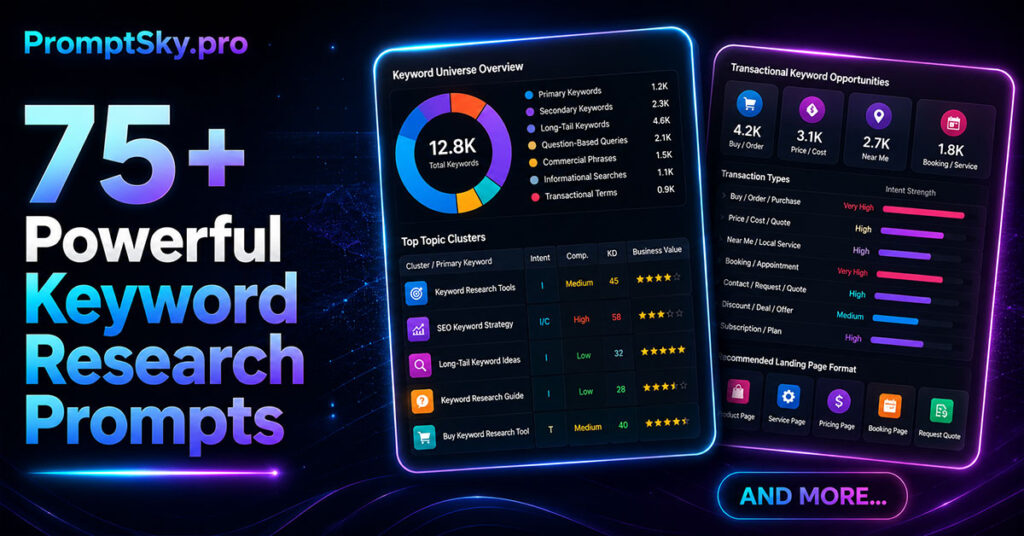
Keyword research prompts can help you discover valuable search terms, understand search intent, analyze competitors, find content gaps, and build a more focused SEO strategy. Instead of starting every research task from scratch, you can give these prompts to an AI model and turn raw keyword data into actionable insights.
How to Use These Prompts
Choose a prompt based on your SEO goal, replace the placeholders with your website, niche, keyword list, or competitor data, and run it in your preferred AI tool. For deeper analysis, provide real data from Google Search Console or your SEO platform so the AI can identify patterns, opportunities, and priorities based on actual search behavior.
From competitive keyword analysis and search intent mapping to content clusters, keyword cannibalization, SERP opportunities, and conversion-focused research, these prompts cover different stages of a modern SEO workflow.
If you need a specific keyword research prompt for a particular niche, SEO task, or business goal, leave a comment and request it.
1. Complete SEO Keyword Research
A comprehensive starting point for discovering valuable keywords for a website, content strategy, or SEO campaign. It helps organize keywords by search intent, relevance, competition, and potential business value.
Prompt:
Act as a senior SEO strategist and keyword research specialist. Perform a comprehensive keyword research analysis for [WEBSITE/BRAND] in the [INDUSTRY/NICHE] targeting [COUNTRY/REGION] and [LANGUAGE]. Generate a large keyword universe around [PRIMARY TOPIC], including primary keywords, secondary keywords, long-tail variations, question-based queries, semantic keywords, commercial phrases, informational searches, and transactional terms. For every important keyword, analyze search intent, estimated competition level, business relevance, ranking difficulty, content type required, and potential conversion value. Group closely related keywords into logical topic clusters and identify the strongest primary keyword for each cluster. Prioritize keywords that balance realistic ranking potential with meaningful organic traffic and business value. Do not simply list obvious variations; uncover specific search opportunities that competitors may be overlooking.
2. Long-Tail Keyword Research
Long-tail keywords can reveal highly specific searches with clearer intent and stronger conversion potential. This prompt focuses on finding detailed queries instead of relying only on broad, highly competitive terms.
Prompt:
Act as an advanced SEO keyword researcher specializing in long-tail search opportunities. Analyze [TOPIC/NICHE] and generate a comprehensive list of highly specific long-tail keywords that real users may search for on Google. Include question-based queries, problem-solving searches, comparison queries, location-based phrases, feature-specific searches, beginner queries, advanced queries, and purchase-focused long-tail terms. Categorize every keyword according to informational, commercial investigation, transactional, or navigational intent. Identify which keywords are likely to be easier to rank for and explain the reasoning based on specificity, topical relevance, and likely competition. Group similar phrases together to prevent keyword cannibalization and recommend which long-tail keywords should become standalone articles, supporting sections, FAQs, landing pages, or product pages.
3. Search Intent Keyword Research
Understanding why users search for a phrase is essential for choosing the correct content format. This prompt maps keywords to the intent behind the search rather than treating every query equally.
Prompt:
Act as an SEO strategist and search intent analyst. Build a detailed keyword research dataset for [TOPIC/WEBSITE] and classify each keyword according to the user’s underlying search intent. Separate keywords into informational, commercial investigation, transactional, navigational, local, comparison, and problem-solving categories where appropriate. For each keyword, explain what the searcher most likely wants to accomplish, what type of page should satisfy the query, and what content format would best match the intent. Identify keywords where the wording suggests multiple possible intents and explain which interpretation should be prioritized. Organize the results into clusters and rank the opportunities based on relevance, business value, ranking potential, and intent clarity.
4. Keyword Research for Blog Content
A useful approach for building an SEO-focused editorial calendar from keyword opportunities. It helps transform keyword data into practical article ideas.
Prompt:
Act as an expert SEO content strategist and editorial keyword researcher. Analyze [NICHE/TOPIC] and create a keyword research plan specifically for a blog content strategy. Discover primary keywords, supporting keywords, long-tail searches, questions, related entities, comparison terms, problem-based searches, and emerging content opportunities. Group the keywords into topic clusters and assign each cluster a recommended article topic, primary keyword, secondary keywords, search intent, suggested content format, and recommended funnel stage. Identify which topics should be cornerstone articles and which should function as supporting content. Prioritize opportunities based on realistic ranking potential, topical authority, user usefulness, and business relevance rather than search volume alone.
5. Commercial Keyword Research
Commercial keywords often indicate that users are comparing solutions or preparing to make a purchase. This prompt focuses on discovering those valuable searches.
Prompt:
Act as a commercial SEO keyword research specialist. Analyze [PRODUCT/SERVICE/NICHE] and identify keywords used by people who are actively evaluating products, services, providers, brands, or solutions before making a decision. Include comparison searches, best-of queries, alternatives, reviews, pricing searches, cost-related terms, feature comparisons, provider searches, and solution-specific phrases. Categorize every keyword by commercial intent strength and explain what stage of the buying journey it represents. Identify keywords suitable for service pages, product pages, comparison articles, review content, landing pages, and buyer guides. Prioritize terms with strong business relevance and realistic ranking opportunities, while avoiding irrelevant high-volume keywords that are unlikely to generate qualified visitors.
6. Transactional Keyword Research
This prompt identifies searches that indicate users are close to taking an action such as purchasing, booking, ordering, subscribing, or requesting a service.
Prompt:
Act as a senior SEO specialist focused on transactional search behavior. Perform detailed keyword research for [PRODUCT/SERVICE] and identify search queries that indicate strong intent to purchase, book, order, subscribe, contact, request a quote, or take another commercial action. Include variations containing words such as buy, order, price, cost, quote, discount, near me, service, provider, package, deal, booking, and other relevant transactional modifiers. Group keywords by transaction type and intent strength. Recommend the ideal landing-page format for each keyword cluster and identify which terms deserve dedicated commercial pages versus supporting content. Exclude keywords that generate traffic but have weak commercial relevance unless they support a clear conversion path.
7. Competitor Keyword Gap Research
Keyword gaps can reveal topics competitors rank for while your website has little or no visibility. This prompt turns competitor analysis into a structured opportunity list.
Prompt:
Act as an advanced competitive SEO analyst. Compare the keyword landscape of [YOUR WEBSITE] against [COMPETITOR 1], [COMPETITOR 2], [COMPETITOR 3], and other relevant competitors in the [NICHE]. Identify important topics and keyword groups where competitors appear to have stronger visibility or broader topical coverage. Separate the opportunities into missing keywords, weakly covered keywords, keywords with outdated content opportunities, and keywords where your site could realistically outperform competitors. Analyze search intent, relevance, content type, estimated difficulty, commercial value, and topical relationship for each opportunity. Build a prioritized keyword gap list and recommend which pages should be created, expanded, consolidated, or improved to close the most valuable gaps.
8. Keyword Clustering Prompt
Keyword clustering prevents dozens of similar search terms from turning into unnecessary or competing pages. This prompt organizes related queries around common search intent and topics.
Prompt:
Act as an SEO information architect and semantic keyword clustering specialist. Take the following keyword list and organize it into meaningful SEO topic clusters: [KEYWORD LIST]. Group keywords based on semantic relationship, search intent, topical relevance, and the likelihood that one comprehensive page could satisfy the searches. For every cluster, identify one primary keyword, supporting keywords, closely related entities, search intent, recommended page type, and a suggested SEO-friendly page title. Flag keywords that should remain separate because their intent differs significantly. Identify potential keyword cannibalization risks and explain when multiple keywords should be targeted on one page instead of creating separate URLs.
9. Local Keyword Research
Local businesses need location-specific searches that connect users with nearby services and providers. This prompt focuses on building a strong local keyword universe.
Prompt:
Act as a local SEO keyword research expert. Perform comprehensive keyword research for [BUSINESS TYPE] in [CITY/REGION/COUNTRY]. Discover location-based keywords, service-plus-location combinations, neighborhood searches, near-me queries, local commercial terms, local comparison searches, emergency searches, appointment-related searches, and questions users may ask about the service in this area. Organize keywords by service, location, intent, and customer journey stage. Identify which keywords are best suited for the homepage, service pages, location pages, Google Business Profile content, local landing pages, FAQs, and supporting blog articles. Avoid creating unnatural keyword combinations and prioritize phrases that sound like genuine local searches.
10. Question Keyword Research
Question-based searches are useful for informational content, FAQs, featured snippets, and conversational search visibility. This prompt discovers questions around a specific subject.
Prompt:
Act as an SEO researcher specializing in question-based search behavior. Research [TOPIC] and generate a comprehensive collection of questions users may ask before, during, and after researching this subject. Include who, what, why, when, where, which, how, can, should, does, is, and comparison-style questions where relevant. Categorize each question by search intent, user knowledge level, funnel stage, and recommended content format. Identify questions suitable for standalone articles, FAQ sections, comparison pages, tutorials, product pages, and short direct-answer content. Prioritize questions that demonstrate genuine information needs and have strong topical relevance instead of generating repetitive variations simply to increase the keyword count.
11. E-Commerce Keyword Research
E-commerce websites need keywords covering discovery, product research, comparisons, features, categories, and purchasing. This prompt creates a keyword framework for online stores.
Prompt:
Act as an e-commerce SEO keyword strategist. Perform detailed keyword research for an online store selling [PRODUCT CATEGORY] to customers in [MARKET]. Identify category keywords, product keywords, brand-related terms, feature-based searches, size and specification queries, material searches, use-case keywords, comparison terms, best-product searches, price-related queries, discount searches, and transactional phrases. Group the keywords according to product categories, customer intent, and buying stage. Recommend which keywords should target category pages, product pages, collection pages, buying guides, comparison articles, and blog content. Prioritize commercially valuable keywords while avoiding duplicate variations that could create thin pages or keyword cannibalization.
12. Keyword Research for New Websites
New websites usually need a different keyword strategy from established domains. This prompt emphasizes achievable opportunities rather than only high-volume competitive terms.
Prompt:
Act as an SEO strategist specializing in new websites with limited domain authority. Build a realistic keyword research strategy for [NEW WEBSITE] in the [NICHE]. Identify low-competition and moderate-competition keywords that remain highly relevant to the target audience and business model. Include long-tail queries, question keywords, specific problem searches, niche subtopics, commercial opportunities, and underserved search terms. Classify every opportunity by search intent, topical importance, estimated difficulty, potential traffic value, and business value. Create a priority system that separates quick-win keywords, medium-term targets, and long-term authority keywords. Recommend an initial content sequence that allows the website to build topical authority before attempting highly competitive head terms.
13. Keyword Research for Established Websites
Established websites can target broader topics while also expanding into deeper semantic coverage. This prompt identifies opportunities for growth without abandoning existing authority.
Prompt:
Act as a senior SEO growth strategist for an established website. Analyze [WEBSITE/NICHE] and develop an advanced keyword research strategy focused on expanding organic visibility. Identify high-value head terms, supporting keywords, semantic variations, long-tail opportunities, emerging topics, commercial searches, comparison queries, and underserved subtopics. Separate keywords that strengthen existing topical clusters from completely new topic opportunities. Identify opportunities to improve existing pages instead of automatically creating new URLs. Evaluate potential cannibalization, content overlap, search intent changes, and internal linking relationships. Prioritize keywords based on business value, existing topical authority, ranking potential, content quality requirements, and the ability to create a stronger overall topic ecosystem.
14. Semantic Keyword Research
Semantic research helps content cover a topic comprehensively without awkwardly repeating the same keyword. This prompt identifies concepts, entities, attributes, and related terminology.
Prompt:
Act as a semantic SEO and entity research specialist. Analyze [PRIMARY TOPIC] and build a comprehensive semantic keyword map around it. Identify closely related terms, entities, subtopics, attributes, concepts, synonyms, industry terminology, user vocabulary, related questions, processes, tools, problems, solutions, and contextual phrases that search engines may associate with the topic. Separate genuinely useful semantic concepts from weak or irrelevant keyword variations. Organize the findings into primary topic, subtopics, supporting concepts, entities, questions, and related terminology. Explain which concepts should appear naturally in headings, body content, FAQs, comparison tables, examples, or supporting articles to create comprehensive topical coverage.
15. Keyword Research for Content Gaps
Content gaps are not limited to missing keywords; they can represent missing search intents, formats, audiences, or depth. This prompt investigates those opportunities.
Prompt:
Act as a content-gap and SEO opportunity analyst. Analyze [WEBSITE] and its current content around [TOPIC/NICHE] to identify important search opportunities that are missing, underdeveloped, outdated, or poorly aligned with user intent. Research potential keywords across informational, commercial, transactional, comparison, local, and problem-solving intent. For each gap, explain what users are likely looking for, why the current content does not fully satisfy the need, what keyword cluster is involved, and what type of page should address it. Prioritize gaps according to business value, search relevance, ranking potential, topical importance, and content effort. Recommend whether each opportunity requires a new page, content expansion, page consolidation, or a complete rewrite.
16. Keyword Research for Affiliate Websites
Affiliate websites need keywords that attract users who are researching products and moving toward purchase decisions. This prompt focuses on high-value commercial opportunities.
Prompt:
Act as an affiliate SEO strategist and commercial keyword researcher. Build a keyword research strategy for an affiliate website focused on [NICHE/PRODUCT CATEGORY]. Discover keywords related to best products, product comparisons, alternatives, reviews, specific features, use cases, pricing, discounts, buyer concerns, and product selection. Categorize each keyword by commercial intent and buying-stage position. Identify which keywords should target comparison articles, individual reviews, best-of lists, buying guides, alternatives pages, or informational content. Prioritize keywords where the search intent naturally supports affiliate monetization while maintaining genuine usefulness for readers. Avoid low-value queries that generate traffic but have little relationship to product evaluation or purchase decisions.
17. B2B Keyword Research
B2B searches often involve specialized terminology, complex buying journeys, and multiple decision-makers. This prompt builds a keyword strategy around those characteristics.
Prompt:
Act as a B2B SEO strategist and enterprise keyword research specialist. Perform comprehensive keyword research for [B2B COMPANY/SERVICE] targeting [INDUSTRY/AUDIENCE]. Identify keywords used by business owners, executives, procurement teams, managers, technical professionals, and other relevant decision-makers. Include solution searches, problem-based queries, software or service comparisons, implementation questions, pricing searches, industry terminology, use cases, integrations, compliance topics, and vendor evaluation searches. Categorize keywords by search intent, buyer role, funnel stage, business value, and recommended page type. Prioritize keywords that can attract qualified business leads rather than maximizing traffic volume alone.
18. SaaS Keyword Research
SaaS companies need keyword strategies that connect product discovery with educational and problem-solving searches. This prompt covers the full SaaS customer journey.
Prompt:
Act as a SaaS SEO strategist and keyword research expert. Analyze [SAAS PRODUCT] and identify keyword opportunities across the entire customer journey, from problem discovery to product evaluation and purchase. Include problem-aware searches, solution-based queries, software category keywords, feature searches, use cases, integrations, alternatives, competitors, comparisons, pricing, implementation questions, templates, and educational topics. Group keywords by user intent, funnel stage, customer persona, and product relevance. Recommend whether each keyword should target a landing page, feature page, comparison page, integration page, blog article, template, glossary entry, or other content format. Prioritize opportunities that can generate qualified product interest and support long-term topical authority.
19. Keyword Research by Customer Persona
Different audiences can search for the same product or topic using completely different language. This prompt creates keyword groups based on specific customer types.
Prompt:
Act as an SEO strategist and customer research specialist. Build a persona-based keyword research map for [PRODUCT/SERVICE/NICHE]. Target these customer personas: [PERSONA 1], [PERSONA 2], [PERSONA 3], and [PERSONA 4]. Identify the phrases, questions, problems, goals, objections, comparisons, and solution-oriented searches each persona is likely to use. Separate generic keywords from persona-specific opportunities and categorize each term by search intent and buying stage. Explain differences in vocabulary, priorities, and search behavior between personas. Recommend which keyword clusters should be addressed through shared pages and which deserve dedicated landing pages or content because the underlying intent is substantially different.
20. Keyword Research for Product Launches
A new product requires keyword discovery before and after launch to understand demand, positioning, and content opportunities.
Prompt:
Act as a product-launch SEO strategist and keyword research specialist. Build a comprehensive keyword research plan for the upcoming launch of [PRODUCT] in the [MARKET]. Identify existing category keywords, problem-based searches, solution keywords, feature searches, use cases, competitor alternatives, comparison terms, pricing queries, emerging terminology, and potential searches around the product’s unique value proposition. Separate keywords that can be targeted before launch from those that become more valuable after launch. Identify opportunities for landing pages, educational content, comparison articles, product documentation, FAQs, and supporting resources. Prioritize keywords according to relevance, commercial intent, audience demand, competitive landscape, and alignment with the product’s positioning.
21. Seasonal Keyword Research
Seasonal search behavior can create temporary but valuable traffic opportunities. This prompt identifies recurring and event-driven keyword patterns.
Prompt:
Act as a seasonal SEO keyword research specialist. Analyze [NICHE/PRODUCT/SERVICE] and identify keywords whose demand may change throughout the year because of seasons, holidays, events, weather, shopping periods, industry cycles, or recurring consumer behavior. Separate evergreen keywords from seasonal keywords and organize seasonal opportunities by month, quarter, or relevant event. Identify early-research queries, peak-demand searches, last-minute searches, and post-event queries where applicable. Recommend the ideal publishing and optimization timeline for each keyword group so content can gain visibility before demand reaches its peak. Prioritize keywords according to relevance, business value, seasonality, search intent, and potential long-term reuse.
22. Keyword Research for Voice and Conversational Search
Conversational queries are often longer and more natural than traditional keyword phrases. This prompt discovers how people may verbally search for a topic.
Prompt:
Act as a conversational SEO and voice-search keyword specialist. Research [TOPIC/NICHE] and identify natural-language queries that users may speak into smartphones, smart assistants, or conversational search systems. Include complete questions, long-tail phrases, location-based questions, comparison questions, problem-solving requests, recommendation searches, and follow-up questions. Organize the queries by user intent and identify which questions deserve direct concise answers versus detailed explanatory content. Look for natural variations in wording rather than forcing traditional keyword patterns into conversational phrases. Recommend content structures that make these answers easy to understand, extract, and navigate while maintaining strong topical relevance.
23. Keyword Research for Featured Snippets
Featured-snippet opportunities often come from questions, definitions, lists, comparisons, and concise informational queries. This prompt identifies terms where structured answers may perform well.
Prompt:
Act as an SEO strategist specializing in featured snippet opportunities. Research [TOPIC] and identify keywords where users are likely seeking a concise, structured answer that could potentially qualify for a featured search result. Focus on definition queries, how-to searches, comparison questions, lists, numerical answers, process queries, and direct informational questions. For every opportunity, identify the likely search intent, expected answer format, recommended content structure, primary keyword, supporting keywords, and ideal answer length. Distinguish between opportunities that require a paragraph, list, table, steps, or concise definition. Prioritize keywords where the query has clear informational intent and where a well-structured answer could provide a stronger result than existing content.
24. Keyword Research for Topical Authority
Topical authority requires more than ranking for a handful of keywords. This prompt creates a comprehensive topic map that connects primary subjects with supporting subtopics.
Prompt:
Act as an advanced topical SEO strategist. Build a complete keyword and topic map for [MAIN TOPIC/NICHE] designed to establish strong topical authority. Start with the primary topic and expand into major subtopics, supporting concepts, entities, questions, problems, solutions, comparisons, use cases, tools, definitions, and advanced subjects. Identify primary keywords and supporting keyword clusters for every major topic. Organize the results into a logical hierarchy showing pillar pages, cluster pages, supporting articles, and internal linking relationships. Prioritize missing or underserved subtopics and identify areas where comprehensive content could establish stronger topical coverage. Avoid creating separate pages for keywords that share the same search intent and can be naturally satisfied by one authoritative resource.
25. Keyword Prioritization and SEO Opportunity Scoring
A large keyword list is only useful when you know which terms deserve attention first. This prompt turns research into a prioritized action plan.
Prompt:
Act as a senior SEO strategist and keyword prioritization analyst. Analyze the following keyword dataset for [WEBSITE/NICHE]: [KEYWORD DATA]. Evaluate each keyword using relevance, search intent, business value, ranking difficulty, estimated traffic potential, conversion potential, topical importance, existing website authority, and content effort. Create a practical opportunity score for every keyword and explain the scoring logic clearly. Divide the keywords into immediate opportunities, medium-term targets, long-term authority keywords, and low-priority terms. Identify keywords that should be grouped into the same page and flag potential cannibalization risks. Finally, create a prioritized SEO roadmap showing which keyword clusters should be targeted first and what type of content or landing page should be created for each opportunity.
26. Keyword Research for Search Console Data
This prompt turns Google Search Console performance data into actionable keyword opportunities. It focuses on queries already generating impressions and clicks, making the analysis more practical for an existing website.
Prompt:
Act as a senior SEO analyst specializing in Google Search Console keyword data. Analyze the provided Search Console query dataset for [WEBSITE] and identify the strongest organic search opportunities. Evaluate clicks, impressions, average position, CTR, and query relevance to identify keywords with high impressions but weak CTR, keywords ranking just outside the top positions, keywords already generating qualified traffic, and unexpected queries that reveal new content opportunities. Separate branded and non-branded searches, group semantically related queries, identify potential keyword cannibalization, and recommend specific optimization actions for each opportunity. Prioritize recommendations based on realistic ranking potential, traffic impact, search intent, and business value rather than impressions alone.
27. Low-Competition Keyword Discovery
Low-competition keywords can help websites gain visibility without immediately competing for extremely difficult head terms. This prompt focuses on realistic opportunities with strong topical relevance.
Prompt:
Act as an advanced SEO keyword researcher focused on discovering realistic low-competition opportunities for [WEBSITE/NICHE]. Research [MAIN TOPIC] and identify specific keywords that have relatively low competition while maintaining meaningful search intent and business relevance. Look for long-tail queries, underserved questions, niche terminology, specific use cases, comparison searches, location modifiers, and problem-focused phrases. Evaluate each opportunity according to search intent, topical relevance, estimated ranking difficulty, potential traffic value, conversion potential, and content depth required. Avoid recommending keywords simply because they appear easy; every keyword must have a clear connection to the target audience and overall SEO strategy.
28. High-Volume Keyword Analysis
High-volume keywords can attract substantial traffic but often come with intense competition and broad intent. This prompt helps determine which high-volume opportunities are actually worth pursuing.
Prompt:
Act as a senior SEO strategist analyzing high-volume keyword opportunities for [WEBSITE/NICHE]. Research [TOPIC] and identify the most valuable broad and high-volume search terms related to the subject. For each keyword, analyze search intent, competition, ranking difficulty, business relevance, traffic potential, SERP characteristics, and the level of topical authority likely required to compete. Separate high-volume keywords with strong commercial value from those that are primarily informational or too broad to convert effectively. Recommend which keywords should be targeted immediately, which should become long-term goals, and which should be approached through narrower supporting keyword clusters first.
29. Keyword Research for Competitor Pages
Competitor pages can reveal the exact topic areas and search terms driving their organic visibility. This prompt analyzes those pages without blindly copying their strategy.
Prompt:
Act as a competitive SEO researcher. Analyze the following competitor pages and their visible content structure: [COMPETITOR URLS OR PAGE DATA]. Identify the major keyword themes, primary topics, supporting queries, search intents, entities, subtopics, and content formats they appear to target. Separate obvious keyword targeting from semantic coverage and identify important topics that may not be explicitly repeated as keywords. Compare those findings with [YOUR WEBSITE] and highlight opportunities where your content could provide greater depth, clearer answers, better organization, stronger examples, or more useful information. Do not copy competitor wording or structure; extract strategic keyword opportunities and build an original content plan around them.
30. Keyword Research for FAQ Content
FAQ keywords can uncover specific problems and questions that users need answered before choosing a product, service, or solution. This prompt builds a useful FAQ keyword database.
Prompt:
Act as an SEO content strategist specializing in FAQ and question-based keyword research. Analyze [PRODUCT/SERVICE/TOPIC] and generate a comprehensive list of realistic questions users may search before, during, and after learning about the subject. Include beginner questions, advanced questions, pricing concerns, setup questions, compatibility questions, troubleshooting queries, comparison questions, safety considerations, limitations, benefits, alternatives, and common misconceptions where relevant. Group questions by topic and search intent, remove repetitive variations, and identify which questions deserve dedicated articles versus short FAQ answers. Prioritize questions based on relevance, usefulness, potential organic visibility, and their ability to address genuine user concerns.
31. Keyword Research for How-To Content
How-to searches often represent clear informational intent and can support tutorials, guides, and educational content. This prompt discovers actionable instructional queries.
Prompt:
Act as an SEO strategist specializing in instructional and how-to search behavior. Research [TOPIC/PRODUCT/SERVICE] and identify practical searches where users are trying to learn how to complete a task, solve a problem, configure something, improve a result, or achieve a specific outcome. Include beginner and advanced queries, step-by-step searches, troubleshooting variations, tool-specific questions, process-related keywords, and outcome-focused searches. Group the keywords by task and intent, then recommend the ideal tutorial format for each cluster. Identify which topics should become comprehensive guides, short tutorials, troubleshooting pages, checklists, or supporting FAQ sections, and prioritize opportunities according to relevance, ranking potential, and user value.
32. Keyword Research for Comparison Content
Comparison searches are valuable because users are often evaluating alternatives before making a decision. This prompt identifies comparison opportunities across products, services, tools, and methods.
Prompt:
Act as a commercial SEO strategist specializing in comparison search intent. Research [PRODUCT/SERVICE/CATEGORY] and identify valuable comparison keywords users may search when evaluating different solutions. Include “[A] vs [B]” queries, best-for-use-case searches, alternatives, competitors, feature comparisons, pricing comparisons, performance comparisons, pros-and-cons searches, and “which is better” questions. Group the keywords according to comparison type and buyer intent. Recommend which comparisons deserve dedicated pages and which can be addressed within broader buying guides. For each cluster, identify the decision factors users are likely to care about and the type of evidence or information a high-quality comparison page should provide.
33. Keyword Research for Alternative Keywords
Users frequently search for alternatives when they are unhappy with a product, looking for a cheaper option, or evaluating competing solutions. This prompt uncovers those high-intent searches.
Prompt:
Act as a competitive SEO and product-alternative keyword researcher. Analyze [PRODUCT/SERVICE/BRAND] and discover searches users may perform when looking for alternatives. Include direct alternative queries, competitor searches, cheaper alternatives, free alternatives, better alternatives, open-source alternatives, feature-specific alternatives, industry alternatives, and use-case-specific alternatives where relevant. Classify each keyword according to the reason behind the alternative search and the buyer stage. Identify which alternatives have meaningful search intent and commercial value, and recommend dedicated comparison or alternative pages where appropriate. Keep the research objective and do not assume one alternative is superior without evidence.
34. Keyword Research for Pricing and Cost Searches
Pricing-related searches often indicate strong commercial intent. This prompt identifies the different ways users investigate costs before contacting or purchasing from a business.
Prompt:
Act as a commercial SEO keyword research specialist focused on pricing intent. Analyze [PRODUCT/SERVICE] and identify the full range of searches users may perform to understand its cost. Include price, pricing, cost, rates, fees, packages, plans, monthly pricing, annual pricing, quotes, estimates, discounts, affordable options, premium options, hidden costs, setup fees, maintenance costs, and comparison-based pricing searches. Group keywords according to intent and customer stage, then identify which terms should target pricing pages, service pages, calculators, comparison articles, FAQs, or buying guides. Prioritize keywords that indicate genuine purchasing consideration and provide recommendations for addressing pricing questions transparently.
35. Keyword Research for Problem-Aware Users
Some users search for a problem without knowing which product or service can solve it. These searches can be powerful sources of early-stage traffic.
Prompt:
Act as an SEO strategist specializing in problem-aware search behavior. Research [NICHE/INDUSTRY] and identify the problems, frustrations, symptoms, obstacles, risks, inefficiencies, and challenges that potential customers may search for before they know the appropriate solution. Convert these problems into realistic search queries and organize them by severity, audience, intent, and customer journey stage. Identify which problems naturally connect to [PRODUCT/SERVICE] without forcing commercial language into informational searches. Recommend educational articles, guides, checklists, calculators, troubleshooting resources, and solution pages that could satisfy these searches while creating a logical path toward relevant products or services.
36. Keyword Research for Solution-Aware Users
Solution-aware users already understand the type of solution they need and are comparing ways to achieve their desired outcome. This prompt targets that middle stage of the search journey.
Prompt:
Act as an SEO strategist analyzing solution-aware search intent for [PRODUCT/SERVICE/NICHE]. Identify keywords used by people who understand their problem and are actively researching possible solutions but have not necessarily chosen a specific provider or product. Include solution-category searches, method comparisons, tool searches, service searches, feature requirements, implementation queries, and “best way to” searches. Categorize each keyword by intent, customer stage, business value, and recommended content type. Identify which searches can lead naturally to commercial pages and which require educational content first. Prioritize opportunities where the website can demonstrate expertise while helping users move from solution research toward informed decision-making.
37. Keyword Research for Buyer-Intent Modifiers
Modifier-based keyword research can uncover highly specific searches that broad keyword research often misses. This prompt systematically expands a core keyword using meaningful intent modifiers.
Prompt:
Act as an advanced keyword expansion specialist. Take the core keyword [PRIMARY KEYWORD] and systematically generate relevant search variations using meaningful modifiers related to price, quality, location, audience, use case, size, feature, experience level, urgency, comparison, benefit, problem, solution, brand, platform, format, and purchase intent. Do not generate meaningless keyword permutations. For every keyword variation, determine the likely search intent, commercial value, relevance, and recommended page type. Group similar queries into clusters and highlight the strongest opportunities that offer a meaningful difference in search behavior rather than simply changing one word.
38. Keyword Research for Beginners
Beginner searches can attract new audiences and build topical authority. This prompt focuses on queries from users who are unfamiliar with a subject.
Prompt:
Act as an SEO strategist researching beginner-level search behavior for [TOPIC]. Identify the questions and keywords used by people who are discovering this subject for the first time. Include definitions, basic concepts, terminology, beginner mistakes, setup questions, first-step searches, simple comparisons, essential tools, common concerns, and introductory how-to queries. Avoid assuming prior knowledge and distinguish beginner keywords from advanced searches. Organize the results into logical learning stages and recommend content formats such as beginner guides, glossaries, tutorials, checklists, FAQs, and introductory articles. Prioritize keywords that can attract relevant new users while establishing a strong foundation for deeper topical content.
39. Advanced Keyword Research
Advanced users search with more technical language and specific requirements. This prompt helps uncover deeper keywords that can strengthen expert-level content.
Prompt:
Act as an advanced SEO researcher specializing in expert-level search behavior. Analyze [TOPIC/INDUSTRY] and identify sophisticated keywords used by experienced professionals, advanced users, specialists, and decision-makers. Include technical terminology, advanced processes, edge cases, implementation details, optimization queries, performance questions, integrations, limitations, frameworks, methodologies, and specialized use cases. Separate genuinely advanced searches from unnecessarily complicated keyword variations. Categorize each opportunity by expertise level, search intent, topical relationship, and recommended content format. Identify areas where highly detailed expert content could create topical authority and attract a qualified professional audience.
40. Keyword Research for Mobile Search
Mobile searches often use shorter, faster, and more location-sensitive queries, while user behavior can differ depending on the context. This prompt explores mobile-focused keyword opportunities.
Prompt:
Act as an SEO strategist specializing in mobile search behavior. Research [TOPIC/BUSINESS] and identify keywords and query patterns that are particularly relevant to users searching from smartphones. Include concise searches, location-based queries, near-me variations, urgent searches, service availability queries, appointment searches, directions-related intent, quick-answer questions, and mobile-friendly informational searches. Analyze the likely context behind each query and identify whether the user is researching, comparing, visiting, contacting, or purchasing. Recommend which keywords should be prioritized for local landing pages, service pages, FAQs, mobile-first content, and conversion-focused pages.
41. Keyword Research for International SEO
International websites must account for regional terminology, language differences, and local search behavior. This prompt creates keyword strategies for multiple markets.
Prompt:
Act as an international SEO keyword research specialist. Build a localized keyword strategy for [WEBSITE] targeting [COUNTRIES/REGIONS] in [LANGUAGES]. Research how users in each market may describe [PRODUCT/SERVICE/TOPIC], accounting for regional terminology, spelling differences, local expressions, cultural search behavior, currency-related searches, and market-specific intent. Do not simply translate keywords word for word. Identify keywords that are genuinely used or likely to be used by local audiences and separate global concepts from market-specific opportunities. Organize the results by country, language, search intent, keyword cluster, and recommended page or localization strategy.
42. Keyword Research for Multilingual Websites
Multilingual SEO requires understanding how the same topic is searched differently across languages. This prompt helps avoid poor literal translations and builds native keyword sets.
Prompt:
Act as a multilingual SEO strategist and native-language keyword researcher. Develop keyword research for [TOPIC/PRODUCT/SERVICE] across [LANGUAGES/COUNTRIES]. For each language, identify natural search phrases, long-tail queries, local terminology, commercial modifiers, question patterns, product terms, and culturally specific expressions. Do not translate the original keyword list literally; instead, reconstruct the search landscape based on how native users would naturally search. Group keywords by intent and topic, identify equivalent concepts across languages, and highlight terms that cannot be translated directly without losing search meaning. Recommend the appropriate localized content structure and flag keywords that require separate market-specific pages.
43. Keyword Research for YouTube SEO
YouTube search behavior differs from traditional web search and often includes tutorial, review, demonstration, and entertainment intent. This prompt discovers video-focused keyword opportunities.
Prompt:
Act as a YouTube SEO strategist and video keyword research specialist. Analyze [NICHE/TOPIC] and identify search queries users are likely to enter on YouTube when looking for tutorials, reviews, demonstrations, comparisons, explanations, walkthroughs, opinions, or entertainment. Include long-tail video queries, question-based searches, “how to” phrases, review terms, comparison searches, beginner queries, and problem-solving searches. Classify each keyword by viewer intent, content format, funnel stage, and potential video angle. Identify which keywords could support standalone videos, series, Shorts, tutorials, comparison videos, or educational content. Prioritize topics based on relevance, audience value, search intent, and potential to generate engaged viewers.
44. Keyword Research for Social Media Content
Social platforms generate different discovery behaviors than traditional search engines. This prompt identifies searchable topics and phrases that can inform social content.
Prompt:
Act as a social SEO strategist and content keyword researcher. Analyze [NICHE/AUDIENCE] and identify topics, phrases, questions, trends, problems, and searchable concepts that users may explore through social platforms. Focus on keywords that can inspire educational posts, short-form videos, carousels, tutorials, comparisons, reviews, and discussion-driven content. Group opportunities according to audience intent, content format, awareness level, and platform suitability. Identify recurring questions and language patterns that could become content series. Avoid relying solely on traditional Google keyword logic; prioritize phrases and topics that are naturally useful for social discovery, engagement, and audience growth.
45. Keyword Research for Content Refreshes
Existing pages often contain valuable keyword opportunities that can be unlocked through strategic updates. This prompt identifies terms that an old page could target without creating unnecessary new content.
Prompt:
Act as an SEO content-refresh specialist. Analyze the existing page content and keyword data for [URL/PAGE/TOPIC]. Identify relevant keywords the page already ranks for, keywords where rankings have weakened, related queries the page could reasonably target, missing subtopics, outdated terminology, and search-intent changes. Separate opportunities that require simple on-page improvements from those that require substantial content expansion. Identify potential keyword cannibalization and determine whether the page should be updated, expanded, consolidated, redirected, or replaced. Create a prioritized optimization plan covering title, headings, content sections, semantic terms, FAQs, internal links, and other relevant improvements while preserving the page’s original search value.
46. Keyword Cannibalization Analysis
Multiple pages targeting similar queries can compete with one another and weaken overall organic performance. This prompt detects overlapping keyword intent and recommends a solution.
Prompt:
Act as a technical SEO specialist focused on keyword cannibalization. Analyze the following pages, target keywords, ranking queries, and Search Console data: [PAGE DATA]. Identify pages that appear to target the same or highly overlapping search intent and determine whether the overlap is intentional or problematic. Compare keyword relevance, search intent, page purpose, rankings, impressions, clicks, and content similarity. For every potential cannibalization case, recommend whether the pages should be differentiated, consolidated, redirected, re-optimized, internally linked more strategically, or assigned clearly separate keyword clusters. Provide a specific primary keyword and supporting keyword strategy for each surviving page.
47. Keyword Research for Internal Linking
Keyword research can also reveal how pages should connect to one another. This prompt maps keyword relationships into an internal linking strategy.
Prompt:
Act as an SEO information architect and internal linking strategist. Analyze the following keyword clusters and existing pages for [WEBSITE]: [DATA]. Identify semantic relationships between pages and determine which pages should link to each other based on topic relevance and user journey. Recommend appropriate internal-link anchor text that sounds natural and accurately describes the destination page without repetitive exact-match manipulation. Identify pillar pages, supporting pages, parent-child relationships, and contextual linking opportunities. Highlight orphan-page risks and pages that need stronger internal authority. Build a practical internal linking map that supports both user navigation and broader topical relevance.
48. Keyword Research for Google Discover and Trending Topics
Trending topics can create sudden visibility opportunities when they match audience interests and website expertise. This prompt identifies timely topics without abandoning long-term SEO value.
Prompt:
Act as an SEO content strategist specializing in emerging search trends and timely topics. Analyze [NICHE/INDUSTRY] and identify emerging subjects, new terminology, developing questions, recent product developments, seasonal interests, and trend-driven keyword opportunities that could attract search and discovery traffic. Separate short-lived trends from topics with potential long-term search value. For each opportunity, identify the likely audience, search intent, content angle, primary keyword, supporting terms, freshness requirements, and recommended publishing urgency. Avoid chasing irrelevant trends simply because they are popular; prioritize developments that align with the website’s expertise, audience, and business objectives.
49. Keyword Research for SEO Content Briefs
A keyword list becomes much more useful when converted into a structured content brief. This prompt transforms research into a writing blueprint.
Prompt:
Act as a senior SEO content strategist. Using the keyword research for [TOPIC], create a detailed SEO content brief for a new page targeting [PRIMARY KEYWORD]. Identify the primary keyword, secondary keywords, semantic concepts, related entities, supporting questions, search intent, target audience, user journey stage, recommended content format, and major subtopics that should be covered. Organize the keyword clusters into a logical heading structure without forcing keywords unnaturally. Identify important questions competitors may be missing and suggest original examples, data points, comparisons, or practical insights that could improve the page. The final brief should guide a writer toward comprehensive search-intent satisfaction rather than keyword stuffing.
50. Complete Keyword Research Strategy and Action Plan
This final prompt combines discovery, analysis, clustering, prioritization, and content planning into one comprehensive SEO workflow.
Prompt:
Act as a senior SEO strategist responsible for building a complete keyword research and content strategy for [WEBSITE/BRAND] in the [NICHE]. Research and organize primary keywords, secondary keywords, long-tail queries, questions, semantic entities, commercial terms, transactional searches, comparison keywords, local opportunities, competitor gaps, and emerging topics. Classify every opportunity by search intent, funnel stage, relevance, business value, competition, ranking potential, and recommended content type. Cluster keywords according to shared intent and identify the strongest primary keyword for each cluster while preventing cannibalization. Then create a prioritized roadmap covering quick wins, medium-term opportunities, long-term authority targets, content refreshes, new pages, internal linking opportunities, and commercial landing pages. Explain the reasoning behind the priorities and focus on building sustainable organic visibility rather than pursuing search volume alone.
51. Search Intent Gap Analysis
This prompt goes beyond basic intent classification and identifies mismatches between what users want and what existing pages provide. It is useful for finding keywords where better intent alignment can create ranking opportunities.
Prompt:
Act as an advanced SEO search-intent analyst. Analyze [WEBSITE], [TARGET TOPIC], and the available keyword and ranking data to identify gaps between user intent and existing search results. For every important keyword cluster, determine whether users expect an educational explanation, step-by-step guide, comparison, product evaluation, service page, local result, calculator, template, review, or another format. Compare the expected intent with the current page targeting the keyword and identify mismatches, incomplete answers, outdated formats, or content that satisfies only part of the query. Prioritize intent gaps where a better-aligned page could realistically improve rankings, CTR, engagement, and conversions. Recommend the exact content format and information architecture required to satisfy the searcher more completely.
52. Keyword Difficulty Reality Check
Keyword difficulty scores from SEO tools can be useful, but they do not always reflect the real difficulty of ranking. This prompt evaluates the competitive landscape more deeply.
Prompt:
Act as a senior SEO analyst performing a real-world keyword difficulty assessment for [WEBSITE]. Analyze these target keywords: [KEYWORD LIST]. Do not rely on a third-party difficulty score alone. Evaluate the current SERP competition, domain strength of ranking pages, topical authority, content depth, search intent alignment, backlink requirements, brand dominance, SERP features, freshness expectations, and the quality of competing pages. Estimate how difficult each keyword would realistically be for this website based on its current authority and content profile. Divide the keywords into realistic quick wins, achievable medium-term targets, difficult strategic targets, and keywords that should currently be avoided. Explain the specific competitive factor driving each classification.
53. SERP Feature Keyword Research
SERP features can dramatically change the type of content needed to compete for a query. This prompt identifies keywords where features such as snippets, videos, local packs, images, or shopping results influence the opportunity.
Prompt:
Act as an advanced SERP analyst and keyword researcher. Analyze [KEYWORD LIST/TOPIC] and identify the search engine result page features associated with each keyword, including featured snippets, AI-generated answers, People Also Ask, image results, video results, local packs, shopping results, knowledge panels, related searches, and other relevant SERP elements. Determine how each feature affects organic click potential and content strategy. Identify which keywords still offer strong opportunities for traditional organic rankings and which require specialized formats such as video, structured answers, visual content, local optimization, product content, or comprehensive guides. Recommend a SERP-specific optimization strategy for each major keyword cluster.
54. Zero-Click Keyword Analysis
Some keywords generate substantial impressions but limited clicks because search engines answer the query directly. This prompt helps distinguish traffic opportunities from visibility-only opportunities.
Prompt:
Act as an SEO strategist specializing in zero-click search behavior. Analyze [KEYWORD DATA] and identify queries where users may receive enough information directly within the search results to reduce organic clicks. Examine impressions, clicks, CTR, ranking position, SERP features, query type, and search intent to identify likely zero-click patterns. Separate keywords that are primarily useful for brand visibility and authority from those where additional optimization could increase clicks. Recommend whether each keyword should be pursued for traffic, visibility, brand exposure, conversions, or supporting topical authority. Identify opportunities to provide a stronger reason to click through by offering unique data, tools, detailed explanations, original examples, or information unavailable directly in the SERP.
55. CTR Opportunity Keyword Research
Low CTR does not always mean poor rankings. Sometimes the keyword has strong impressions and positions but an unappealing search result. This prompt identifies those opportunities.
Prompt:
Act as an SEO CTR optimization specialist. Analyze the following Search Console keyword and page data: [DATA]. Identify queries with unusually low click-through rates compared with their ranking position, impressions, search intent, or expected SERP behavior. Determine whether the problem is likely related to title wording, meta description, search intent mismatch, SERP competition, rich-result appearance, brand recognition, or another factor. Prioritize the keywords where improving the search snippet could generate meaningful additional clicks without requiring a major ranking increase. For each opportunity, propose several SEO-friendly title concepts and meta-description angles that communicate a clear benefit without using misleading clickbait.
56. Position 4–10 Keyword Opportunities
Keywords ranking on the first page but below the top results can provide highly valuable optimization opportunities. This prompt identifies pages closest to significant traffic gains.
Prompt:
Act as an SEO growth specialist focused on page-one keyword opportunities. Analyze [SEARCH CONSOLE DATA] and identify keywords currently ranking between positions 4 and 10 that have meaningful impressions and strong relevance to the website. Evaluate the associated pages, search intent, content depth, topical coverage, internal links, title optimization, semantic relevance, and competitive SERP landscape. Rank these opportunities according to the likelihood of moving into positions 1–3 and the potential traffic or business impact of doing so. For every selected keyword, provide a precise optimization strategy and explain whether the page needs better content, stronger internal linking, improved intent alignment, refreshed information, better SERP presentation, or another targeted improvement.
57. Position 11–20 Keyword Opportunities
Keywords near the first page can often be improved through focused content and authority work. This prompt finds terms with realistic potential to cross into page one.
Prompt:
Act as an advanced SEO optimization strategist. Analyze keywords currently ranking between positions 11 and 20 for [WEBSITE] using the provided Search Console and page data. Identify which keywords have the strongest potential to move onto the first page based on impressions, relevance, existing content quality, search intent, topical authority, competition, and page performance. Separate realistic opportunities from terms that require substantially more authority or a completely different page. For each priority keyword, determine whether to improve the existing page, create supporting content, strengthen internal links, consolidate overlapping pages, acquire relevant authority, or change the target keyword. Build a prioritized action plan based on expected impact rather than ranking position alone.
58. Keyword Cannibalization by Search Intent
Two pages can target different keywords while still competing for the same underlying intent. This prompt analyzes cannibalization at a deeper semantic level.
Prompt:
Act as a technical SEO strategist specializing in semantic keyword cannibalization. Analyze [PAGE URLs], their target keywords, Search Console queries, rankings, titles, headings, and content topics. Determine whether multiple URLs are competing for the same underlying search intent even when their exact keywords differ. Identify which page has the strongest relevance and authority for each intent cluster and recommend a clear primary URL. For every overlap, decide whether to merge pages, differentiate search intent, reposition a page, redirect an outdated URL, or create stronger internal distinctions. Provide a revised keyword ownership map showing one primary intent and keyword cluster for each important URL to prevent future competition.
59. Keyword Decay Analysis
Keyword performance can gradually decline because of outdated content, competitors, changing intent, algorithm changes, or market shifts. This prompt investigates the cause rather than simply identifying traffic loss.
Prompt:
Act as an SEO performance analyst investigating organic keyword decay. Compare [WEBSITE] keyword and Search Console performance across [DATE RANGE 1] and [DATE RANGE 2], using periods such as 7 days, 28 days, 3 months, 6 months, and 12 months where data is available. Identify keywords with significant declines in clicks, impressions, CTR, or average position. Separate temporary fluctuations from sustained deterioration and group declining keywords by likely cause, including outdated content, stronger competitors, changed search intent, SERP changes, keyword cannibalization, technical problems, declining demand, or insufficient topical coverage. Prioritize recovery opportunities and recommend a specific action for each important declining keyword cluster.
60. Keyword Growth Analysis
Growth analysis reveals which keywords are gaining visibility before they become major traffic drivers. This prompt turns positive movement into an expansion strategy.
Prompt:
Act as an SEO growth analyst. Compare keyword performance for [WEBSITE] across [TIME PERIODS], including 7-day, 28-day, 3-month, and longer-term periods when available. Identify keywords and topic clusters showing meaningful growth in impressions, clicks, CTR, or average position. Separate temporary spikes from sustained upward trends and identify related keywords that are also beginning to gain visibility. Determine which growing topics deserve content expansion, supporting articles, internal links, dedicated landing pages, or additional optimization. Build a growth opportunity map showing how the website can turn emerging keyword momentum into broader topical authority and sustained organic traffic.
61. Keyword Research Using Search Console Query Expansion
Search Console often reveals valuable queries that were never part of the original keyword strategy. This prompt expands those real-world terms into new SEO opportunities.
Prompt:
Act as an advanced SEO researcher using Google Search Console as a source of real user search behavior. Analyze the query data for [WEBSITE] and identify unexpected, emerging, and underused keyword opportunities. Find queries that generate impressions or clicks but are not currently represented by the page’s primary keyword strategy. Expand these queries into related long-tail phrases, questions, semantic variations, commercial modifiers, comparison searches, and supporting subtopics. Group them according to search intent and determine whether each opportunity belongs on an existing page or deserves a new URL. Prioritize opportunities based on actual Search Console evidence, relevance, ranking potential, and business value.
62. Keyword Research from Customer Questions
Customer questions can reveal language that conventional keyword tools miss. This prompt converts real customer concerns into an SEO opportunity map.
Prompt:
Act as an SEO strategist and customer research analyst. Analyze the following real customer questions, support conversations, sales questions, reviews, comments, and feedback: [CUSTOMER DATA]. Extract recurring problems, terminology, questions, objections, comparisons, desired outcomes, and decision factors that could become valuable search queries. Convert these insights into realistic keyword phrases without inventing unnatural wording. Group the keywords by search intent and customer journey stage, then identify which should become articles, FAQs, landing pages, comparison guides, product content, or supporting resources. Highlight customer language that differs from industry terminology because those differences may reveal overlooked search opportunities.
63. Keyword Research from Reddit and Community Discussions
Community discussions can expose real problems and natural language that traditional keyword databases may not capture. This prompt turns those discussions into structured SEO research.
Prompt:
Act as an SEO researcher specializing in audience language and community-driven keyword discovery. Analyze the following Reddit threads, forums, community discussions, comments, and user conversations related to [TOPIC]: [DATA/LINKS/TEXT]. Identify recurring questions, frustrations, terminology, comparisons, misconceptions, recommendations, objections, and unresolved problems. Convert meaningful patterns into realistic search queries while preserving the natural language users actually use. Group opportunities by intent, audience need, topic, and funnel stage. Distinguish genuine recurring demand from isolated comments and recommend which insights should become SEO articles, FAQs, comparison pages, tutorials, tools, or commercial content.
64. Keyword Research from Competitor Content Silos
Competitors often organize their content around topic structures that reveal their SEO strategy. This prompt reverse-engineers those structures without copying them.
Prompt:
Act as an enterprise SEO strategist analyzing competitor content architecture. Review the content categories, URLs, titles, headings, navigation structures, and visible topic coverage of [COMPETITOR WEBSITES]. Extract their major content silos and map the keywords and search intents likely associated with each silo. Identify pillar topics, supporting subtopics, commercial landing pages, educational resources, comparison content, and potential internal linking relationships. Compare the competitor topic architecture with [YOUR WEBSITE] and identify missing or weak clusters. Build an original content architecture for the website that covers valuable search demand more comprehensively while avoiding duplicate or thin pages.
65. Keyword Research for Product Features
Feature-specific searches can attract users with precise requirements and strong product intent. This prompt maps features to search behavior and content opportunities.
Prompt:
Act as a product SEO strategist and feature-based keyword researcher. Analyze [PRODUCT/SERVICE] and identify search queries related to its features, capabilities, specifications, integrations, functions, limitations, compatibility, performance, and use cases. For each major feature, generate natural informational, commercial, comparison, and transactional keyword variations. Determine which features are searched independently and which should remain supporting concepts on broader product pages. Identify feature combinations that represent strong buyer intent and recommend dedicated feature pages where justified. Prioritize terms according to actual customer importance, search intent, competitive opportunity, and their ability to attract qualified users rather than simply listing every possible feature variation.
66. Keyword Research for Pain Points and Objections
Search behavior often reflects concerns rather than direct product searches. This prompt finds keywords connected to hesitation, risk, cost, difficulty, and uncertainty.
Prompt:
Act as a customer-intent SEO researcher. Analyze [PRODUCT/SERVICE/NICHE] and identify the doubts, fears, objections, risks, frustrations, costs, limitations, implementation concerns, and common barriers that users may search about before taking action. Convert these concerns into realistic keyword queries and classify them by informational, commercial, transactional, comparison, or problem-solving intent. Identify which concerns can be addressed through FAQs, educational articles, case studies, comparison pages, product documentation, pricing content, or dedicated landing pages. Prioritize keywords that indicate meaningful consideration and explain how addressing each concern could support both organic visibility and conversion confidence.
67. Keyword Research for Content Consolidation
More content is not always better. Sometimes several weak pages should become one stronger resource. This prompt identifies consolidation opportunities using keyword and intent overlap.
Prompt:
Act as an SEO content consolidation specialist. Analyze the following pages, keywords, rankings, impressions, clicks, and search intents: [DATA]. Identify groups of pages that cover substantially overlapping topics or satisfy the same user intent. Determine whether consolidation into a stronger authoritative page would improve topical clarity and reduce keyword cannibalization. For each group, identify the strongest URL, the most valuable keyword cluster, important content elements to preserve, sections that should be rewritten, and pages that should be redirected or retired. Do not recommend consolidation solely because keywords are similar; confirm that the underlying search intent and user need are sufficiently aligned before combining pages.
68. Keyword Research for Pillar Pages
Pillar pages need broad but focused keyword coverage that connects naturally to supporting content. This prompt identifies the ideal scope for a central authoritative resource.
Prompt:
Act as a topical authority strategist designing a pillar page for [MAIN TOPIC]. Build a comprehensive keyword framework that defines the central topic, major subtopics, supporting questions, entities, concepts, comparisons, use cases, problems, solutions, and advanced areas that should be covered. Identify one primary keyword and a carefully selected group of secondary keyword clusters without creating unnatural repetition. Determine which subtopics belong directly on the pillar page and which should become separate supporting articles connected through internal links. Define the ideal topical boundaries so the pillar page is comprehensive without becoming unfocused, and create a logical hierarchy that supports both users and search engines.
69. Keyword Research for Supporting Cluster Content
Supporting articles should strengthen a central topic instead of competing with it. This prompt finds the right subtopics to build a connected content cluster.
Prompt:
Act as an SEO topic-cluster strategist. Given the pillar topic [PILLAR TOPIC] and existing primary page [URL], identify the most valuable supporting keyword clusters that should be developed around it. Find questions, subtopics, use cases, problems, comparisons, definitions, tutorials, advanced concepts, and related searches that deserve dedicated pages because they represent distinct search intent. For each proposed supporting article, provide the primary keyword, secondary keywords, search intent, target audience, recommended content angle, relationship to the pillar page, and suggested internal-link direction. Exclude topics that would unnecessarily duplicate the pillar page or another supporting article.
70. Keyword Research for Search Journey Mapping
A keyword strategy becomes more powerful when it reflects the complete journey from problem discovery to conversion. This prompt maps keywords across that journey.
Prompt:
Act as an SEO strategist and customer journey researcher. Build a complete keyword journey map for [PRODUCT/SERVICE/NICHE], covering users from initial problem awareness through research, solution discovery, comparison, evaluation, purchase, implementation, and post-purchase support. Identify the keyword types users are likely to search at each stage and classify them by intent, awareness level, business value, and recommended content format. Connect informational keywords to commercial opportunities without forcing sales messaging into early-stage content. Identify missing stages in the current website’s keyword coverage and recommend a content sequence that guides users naturally from their first search through the final conversion decision.
71. Keyword Research for Conversion-Focused SEO
Traffic alone is not enough when the goal is qualified leads or sales. This prompt prioritizes keywords based on their ability to contribute to business outcomes.
Prompt:
Act as an SEO strategist focused on revenue and conversion potential. Analyze [WEBSITE/PRODUCT/SERVICE] and identify keywords most likely to attract users who can become customers, leads, subscribers, or qualified inquiries. Evaluate each keyword according to search intent, commercial proximity, problem severity, product relevance, buyer stage, expected traffic quality, and conversion potential. Separate high-traffic informational keywords from high-value commercial opportunities and identify the role each should play in the conversion funnel. Recommend content formats and conversion paths for each major keyword cluster, ensuring informational content can naturally support relevant commercial pages without compromising search intent.
72. Keyword Research for Lead Generation
Lead-generation websites need searches that indicate a need for professional assistance, consultation, or service. This prompt focuses on qualified inquiry opportunities.
Prompt:
Act as a lead-generation SEO specialist. Perform detailed keyword research for [SERVICE/BUSINESS] targeting [CUSTOMER TYPE] in [LOCATION/MARKET]. Identify keywords indicating that users need professional help, consultation, quotes, appointments, service providers, agencies, experts, or solutions. Include problem-based, service-based, location-based, comparison, pricing, urgent, and provider-selection searches. Classify each keyword by lead intent and funnel stage and recommend whether it should target a service page, location page, landing page, comparison article, FAQ, or educational resource. Prioritize keywords that can generate qualified inquiries rather than maximizing raw organic traffic.
73. Keyword Research for Informational-to-Commercial Funnels
Informational content can generate large audiences, but the strongest strategy connects useful education with relevant commercial intent. This prompt builds that bridge.
Prompt:
Act as an SEO funnel strategist. Analyze [NICHE/PRODUCT/SERVICE] and identify informational keywords that can naturally introduce users to commercial topics without manipulating their search intent. Map each informational keyword to related solution, comparison, and transactional keyword clusters that represent later stages of the same customer journey. Identify appropriate internal-link opportunities and recommend the type of educational content that should introduce each commercial concept. Build a complete keyword funnel showing awareness, education, solution discovery, evaluation, and conversion stages. Prioritize topic relationships where the transition from informational search to commercial consideration is genuinely useful to the user.
74. Keyword Research for AI Search and Conversational Results
Search is increasingly becoming conversational, with users asking longer questions and expecting synthesized answers. This prompt identifies keyword opportunities suitable for modern AI-driven search experiences.
Prompt:
Act as an advanced SEO strategist specializing in AI-assisted and conversational search behavior. Analyze [TOPIC/NICHE] and identify detailed natural-language questions, multi-part queries, comparisons, follow-up questions, entity relationships, and problem-solving searches that users may ask conversational search systems. Identify the underlying concepts and entities required to answer each query accurately. Group related questions into topic clusters and determine which pages should provide direct answers, comprehensive explanations, comparisons, original data, examples, or expert analysis. Focus on building genuinely useful, well-structured content that demonstrates topical depth and clear relationships between concepts rather than simply repeating exact-match keywords.
75. Keyword Research for Entity-Based SEO
Modern search systems understand topics through entities and relationships, not only exact keyword matches. This prompt builds an entity-centered keyword map.
Prompt:
Act as an entity SEO and semantic search specialist. Analyze [PRIMARY TOPIC] and identify the major entities, attributes, organizations, products, people, locations, concepts, technologies, processes, and relationships associated with the subject. Map the keywords and search queries connected to each entity and identify how users search for relationships between them. Separate primary entities from supporting entities and determine which should be covered on the main page versus dedicated supporting content. Identify important entity relationships that competitors may overlook and recommend ways to explain them naturally through definitions, comparisons, examples, structured sections, and contextual internal links.
Related SEO & AI Prompt Resources
For analyzing your actual organic search performance, check out 80 Powerful Claude Prompts for Google Search Console Data Analysis.
If you’re working on professional branding and career-related search visibility, 30 AI Prompts to Improve Your LinkedIn Profile and Attract Better Opportunities can also be useful.