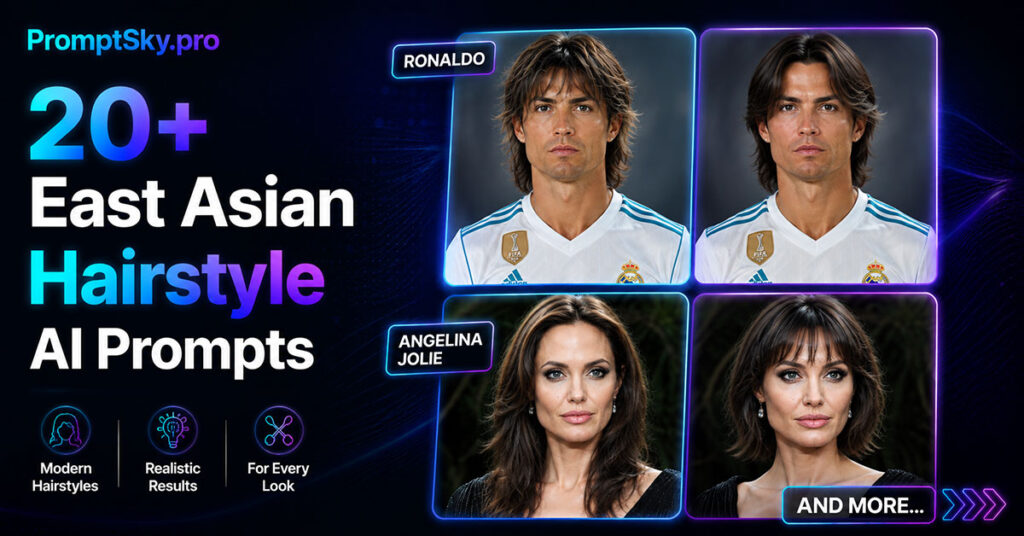
East Asian hairstyle AI prompts let you realistically preview popular Japanese, Korean, and Chinese hairstyles on your own photo. This collection includes 20 detailed prompts for styles such as Hime Cut, Japanese Wolf Cut, Korean Two-Block, Comma Hair, C-Curl, Jelly Perm, and Chinese Layered Cut.
How to Use These East Asian Hairstyle AI Prompts
Upload a clear, high-resolution photo to your preferred AI image editor, then choose the hairstyle you want to test and paste its prompt. The prompts are designed to change the hairstyle while keeping your facial identity, skin tone, expression, clothing, pose, background, lighting, and composition consistent with the original image. For the most convincing result, use a well-lit portrait where the face, head shape, and existing hair are clearly visible. You can also adjust details such as hair length, volume, curl intensity, fringe position, or layer definition to match your preferred look.
If you want to explore more hairstyle transformations, check out 25 Modern Women’s Hairstyle AI Prompts for Realistic Hair Transformations for modern Bobs, Pixie Cuts, Wolf Cuts, Butterfly Haircuts, and trendy bangs. You can also explore 30 AI Prompts for African Hairstyles and Natural Afro Hair Styles for Afros, Braids, Twists, Locs, and other textured hairstyles.
For more traditional and widely recognized haircut styles, see 30 Classic Hairstyle AI Prompts for Realistic Haircut Edits. You can also browse AI Prompts for additional collections covering Photography, Career & Resume, Marketing, Product Promotion, Personal Growth, Social Media, and Writing & Creativity.
If there is a Japanese, Korean, Chinese, or other East Asian hairstyle you want to see added, leave your request in the comments and tell us which prompt you need.
1. Hime Cut
The Hime Cut is a distinctive Japanese hairstyle featuring straight, blunt side sections around the cheeks and longer hair at the back. Its strong geometric structure makes it especially useful for testing a dramatic yet elegant hairstyle transformation.
Prompt:
A highly detailed photorealistic photo edit of the subject in the provided reference image, preserving the exact facial identity, facial structure, skin tone, facial expression, head shape, and natural proportions. Transform only the hairstyle into a traditional Japanese Hime Cut with long, straight hair and clearly defined blunt side sections ending around the cheeks or jawline. Create a precise horizontal fringe across the forehead while keeping the side locks visibly shorter than the long hair behind them. Maintain sleek, naturally dense hair with realistic individual strands, subtle variations in texture, believable weight, and smooth movement through the longer sections. Add natural highlights, soft shadows, fine flyaway hairs, and realistic hairline details around the temples, forehead, and ears. Ensure the geometric haircut remains sharp and recognizable without appearing digitally generated or excessively perfect. Preserve the original clothing, pose, background, lighting, camera angle, framing, and composition exactly. The final image should look like a professionally photographed subject wearing an authentic, elegant Hime Cut.
2. Japanese Shag
The Japanese Shag combines soft layers, airy texture, and natural movement for a relaxed but carefully styled appearance. It works well for creating a lightweight haircut with visible dimension around the face and shoulders.
Prompt:
A highly detailed realistic hairstyle transformation of the subject in the supplied reference image, preserving the exact identity, facial structure, skin tone, expression, head shape, and natural characteristics. Change only the hairstyle into a modern Japanese Shag featuring multiple soft layers, lightweight ends, subtle crown volume, and natural movement around the face and shoulders. Create gently feathered and slightly uneven layers that give the haircut an effortless appearance without becoming excessively messy or choppy. Keep the hair naturally textured with believable density, individual strands, fine flyaways, subtle frizz, soft highlights, and dimensional shadows between the layers. Add delicate face-framing pieces that blend naturally into the longer sections while keeping the subject’s facial features completely unchanged. Ensure the hairstyle follows the natural shape of the head and falls realistically according to gravity. Preserve the original clothing, pose, background, lighting, camera perspective, framing, and composition exactly. The final result should resemble a professionally styled Japanese Shag captured in a high-resolution fashion portrait.
3. Japanese Wolf Cut
The Japanese Wolf Cut combines shaggy layers with a softer, more controlled silhouette than an extremely dramatic wolf cut. It creates volume around the crown and textured movement toward the ends.
Prompt:
A highly detailed photorealistic photo edit of the subject in the provided reference image, preserving the exact facial identity, facial structure, skin tone, expression, proportions, and natural features. Transform only the hairstyle into a modern Japanese Wolf Cut with layered crown volume, soft face-framing pieces, textured mid-lengths, and longer tapered sections toward the back. Create visible but carefully blended layers that provide airy movement without making the hairstyle excessively chaotic. Maintain natural volume around the crown and temples while allowing the ends to separate into lightweight, slightly feathered sections. Add realistic individual strands, subtle flyaway hairs, natural density, soft highlights, dimensional shadows, and authentic hair texture. Ensure the haircut follows the subject’s head shape and naturally frames the face without changing facial characteristics. Preserve the original clothing, pose, background, lighting, camera angle, framing, and composition exactly. The final image should look like a professionally styled Japanese Wolf Cut photographed with realistic high-resolution hair detail.
4. Japanese Bob
The Japanese Bob is a clean, refined haircut with a compact silhouette and smooth, precise shape. It can range from chin-length to slightly longer while maintaining an understated, polished appearance.
Prompt:
A highly detailed professional photo edit of the subject in the supplied reference image, preserving the exact identity, facial structure, skin tone, facial expression, head shape, and natural proportions. Change only the hairstyle into a sleek Japanese Bob with a clean, compact shape ending around the chin or slightly below the jawline. Keep the perimeter precise and softly rounded while maintaining naturally full ends and subtle movement around the face. Create smooth, healthy-looking hair with realistic individual strands, believable density, subtle texture, and natural weight rather than an artificial glossy finish. Add delicate flyaway hairs, soft highlights, realistic shadows, and natural transitions around the ears, temples, and neckline. Ensure the bob complements the subject’s existing face without altering facial proportions, eyes, nose, lips, or expression. Preserve the original clothing, pose, background, lighting, camera perspective, framing, and composition completely unchanged. The final result should resemble a refined Japanese Bob captured in a professional high-resolution portrait.
5. Japanese Perm
Japanese Perm styling often creates soft, controlled waves or curls with a polished and airy appearance. This prompt focuses on realistic movement and texture rather than exaggerated curls.
Prompt:
A highly detailed photorealistic hairstyle transformation of the subject in the provided reference image, preserving the exact facial identity, facial structure, skin tone, expression, proportions, and natural appearance. Transform only the hairstyle into a soft Japanese Perm with controlled waves and gentle curls distributed naturally throughout the hair. Create airy, lightweight movement with subtle variation in curl size and direction so the texture appears professionally styled rather than mechanically repetitive. Maintain realistic volume around the roots and mid-lengths while keeping the overall silhouette elegant and balanced. Add individual strands, natural curl separation, fine flyaway hairs, subtle frizz, soft highlights, and dimensional shadows to create authentic photographic texture. Ensure the curls follow realistic hair behavior and naturally frame the subject’s face without changing any facial characteristics. Preserve the original clothing, pose, background, lighting, camera angle, framing, and composition exactly. The final image should look like a professionally styled Japanese Perm photographed naturally in high resolution.
6. Kawaii Layered Cut
The Kawaii Layered Cut emphasizes soft layers, gentle volume, and youthful face-framing pieces. The style should look playful and polished while retaining realistic hair texture.
Prompt:
A highly detailed realistic photo edit of the subject in the supplied reference image, preserving the exact facial identity, facial structure, skin tone, expression, head shape, proportions, and natural characteristics. Change only the hairstyle into a Kawaii-inspired Layered Cut with soft graduated layers, gentle volume, and delicate face-framing sections around the cheeks and jawline. Create a light, youthful silhouette with naturally curved ends and subtle movement throughout the hair. Maintain realistic hair density and smooth texture while allowing individual strands, fine flyaways, subtle imperfections, and natural variations in layer length. Add soft highlights and dimensional shadows that enhance the layered structure without producing an artificial salon-gloss effect. Ensure the hairstyle frames the existing face naturally and does not modify the subject’s facial features or expression. Preserve the original clothing, pose, background, lighting, camera perspective, framing, and composition exactly. The final result should look like a polished but natural Kawaii-inspired layered hairstyle in a professional portrait.
7. Korean Two-Block
The Korean Two-Block creates a strong contrast between shorter sides and back and a longer, textured top. It is especially recognizable for its clean structure and flexible styling on top.
Prompt:
A highly detailed photorealistic photo edit of the subject in the provided reference image, preserving the exact facial identity, facial structure, skin tone, facial expression, head shape, and natural proportions. Transform only the hairstyle into a modern Korean Two-Block haircut with noticeably shorter and neatly tapered sides and back combined with a longer, fuller top section. Keep the upper hair textured and naturally layered, allowing it to fall softly toward the forehead and sides while maintaining controlled volume. Create a smooth transition around the ears and neckline while keeping the two-block structure clearly recognizable. Add realistic individual strands, natural density, subtle flyaways, soft highlights, and dimensional shadows throughout the hairstyle. Ensure the top hair has believable weight and movement rather than looking stiff or heavily styled with artificial product. Preserve the original clothing, pose, background, lighting, camera angle, framing, and composition exactly. The final image should look like a professionally styled Korean Two-Block haircut captured in a realistic high-resolution portrait.
8. Korean Comma Hair
Korean Comma Hair is characterized by a curved front section that bends inward or outward to create a distinctive comma-like shape. It gives the hairstyle a polished, controlled appearance while retaining softness.
Prompt:
A highly detailed professional hairstyle transformation of the subject in the supplied reference image, preserving the exact identity, facial structure, skin tone, expression, proportions, and natural features. Change only the hairstyle into a polished Korean Comma Hair style with a distinctive curved front section forming a soft comma-like shape across the forehead. Create natural volume at the roots and direct one prominent front section into a smooth inward or outward curve that gently frames the forehead and eyebrow area. Keep the remaining hair naturally layered and controlled, with subtle texture and movement around the sides and back. Add realistic individual strands, natural density, fine flyaway hairs, soft highlights, and dimensional shadows to prevent the hairstyle from appearing digitally sculpted. Ensure the curved fringe looks naturally styled and physically believable while leaving the subject’s face completely unchanged. Preserve the original clothing, pose, background, lighting, camera perspective, framing, and composition exactly. The final result should resemble a professionally styled Korean Comma Hair look photographed in high resolution.
9. Korean Curtain Hair
Korean Curtain Hair features a center or slightly off-center part with longer front sections that naturally divide and frame the face. The style combines volume, softness, and controlled movement.
Prompt:
A highly detailed photorealistic photo edit of the subject in the provided reference image, preserving the exact facial identity, facial structure, skin tone, expression, head shape, proportions, and natural appearance. Transform only the hairstyle into a modern Korean Curtain Hair style with a natural center or slightly off-center part and longer front sections sweeping away from the forehead. Create soft curtain-like pieces that frame both sides of the face while blending smoothly into the longer hair around the temples and sides. Add subtle root volume and gentle movement without making the hairstyle overly large or stiff. Maintain realistic hair density, individual strands, fine flyaways, natural highlights, soft shadows, and authentic texture throughout the hairstyle. Ensure the front sections fall naturally according to gravity and frame the existing facial structure without altering it. Preserve the original clothing, pose, background, lighting, camera angle, framing, and composition completely unchanged. The final image should look like a polished Korean-inspired hairstyle captured in a realistic professional portrait.
10. Korean Perm
The Korean Perm is known for soft, flowing waves or curls that create volume without looking overly formal. It provides a polished appearance with relaxed movement and natural texture.
Prompt:
A highly detailed realistic photo edit of the subject in the supplied reference image, preserving the exact identity, facial structure, skin tone, facial expression, proportions, and natural characteristics. Change only the hairstyle into a modern Korean Perm featuring soft, flowing waves with gentle curl definition and natural volume throughout the hair. Create larger, relaxed waves rather than tight ringlets, with subtle variation in curl direction and size for realistic movement. Maintain soft root volume and flowing texture through the mid-lengths and ends while keeping the overall silhouette controlled and elegant. Add realistic individual strands, subtle flyaways, fine texture, natural highlights, and dimensional shadows between the waves. Ensure the curls and waves behave naturally around the face, shoulders, and back according to gravity. Preserve the original clothing, pose, background, lighting, camera perspective, framing, and composition exactly. The final result should look like a professionally styled Korean Perm photographed with authentic high-resolution hair texture.
11. Korean C-Curl
Korean C-Curl styling creates smooth, rounded curls at the ends of the hair, producing a soft and polished silhouette. The curved ends should remain subtle and naturally integrated into the rest of the hairstyle.
Prompt:
A highly detailed photorealistic hairstyle transformation of the subject in the provided reference image, preserving the exact facial identity, facial structure, skin tone, expression, head shape, and natural proportions. Transform only the hairstyle into a Korean C-Curl style with smooth, rounded bends at the ends that curve gently inward or outward to create a soft C-shaped finish. Keep the upper and middle sections relatively smooth and natural while concentrating the curl definition toward the lower lengths and ends. Create subtle volume around the roots and realistic movement through the hairstyle without making the curls overly dramatic. Add fine individual strands, believable hair density, soft highlights, dimensional shadows, and delicate flyaway hairs for authentic texture. Ensure the curved ends frame the face and shoulders naturally while leaving all facial features unchanged. Preserve the original clothing, pose, background, lighting, camera angle, framing, and composition completely unchanged. The final result should resemble a polished Korean C-Curl hairstyle photographed in a high-resolution professional portrait.
12. Korean S-Curl
Korean S-Curl styling uses flowing S-shaped waves that create movement and dimension from the roots through the lengths. The waves should be soft, controlled, and naturally blended.
Prompt:
A highly detailed professional photo edit of the subject in the provided reference image, preserving the exact identity, facial structure, skin tone, facial expression, proportions, and natural characteristics. Change only the hairstyle into a Korean S-Curl style featuring soft, flowing S-shaped waves that create continuous movement throughout the hair. Form elegant wave patterns with natural changes in direction rather than tight curls, maintaining a smooth transition from the roots through the mid-lengths and ends. Add moderate volume around the crown and sides while keeping the overall hairstyle lightweight and controlled. Maintain realistic individual strands, natural density, subtle frizz, fine flyaway hairs, soft highlights, and dimensional shadows between the waves. Ensure the S-shaped texture follows realistic hair behavior and falls naturally around the face and shoulders. Preserve the original clothing, pose, background, lighting, camera perspective, framing, and composition exactly. The finished image should look like an authentic Korean S-Curl hairstyle captured in a polished, high-resolution portrait.
13. Korean See-Through Bangs
See-Through Bangs are lightweight, sparse bangs that partially reveal the forehead and eyebrows. They create a delicate frame around the eyes while maintaining a soft, airy appearance.
Prompt:
A highly detailed photorealistic photo edit of the subject in the supplied reference image, preserving the exact facial identity, facial structure, skin tone, expression, proportions, and natural features. Transform only the hairstyle by adding delicate Korean See-Through Bangs across the forehead, using lightweight strands with visible spaces that allow portions of the forehead and eyebrows to remain naturally visible. Keep the center fringe slightly fuller while gradually thinning toward the sides and blending into the surrounding hairstyle. Create soft, fine strands with slightly varied lengths rather than a rigid or perfectly horizontal edge. Add realistic individual hairs, subtle flyaways, natural density, soft highlights, and delicate shadows around the forehead and temples. Keep the eyes, eyebrows, facial structure, expression, and skin completely unchanged. Preserve the original clothing, pose, background, lighting, camera angle, framing, and composition exactly. The final result should look like naturally styled Korean See-Through Bangs photographed in a realistic professional portrait.
14. Korean Air Bangs
Korean Air Bangs are extremely light, wispy fringe pieces that gently sweep across or around the forehead. Their defining feature is their airy movement and minimal visual weight.
Prompt:
A highly detailed realistic hairstyle transformation of the subject in the provided reference image, preserving the exact identity, facial structure, skin tone, facial expression, head shape, proportions, and natural characteristics. Change only the hairstyle by adding soft Korean Air Bangs consisting of extremely lightweight, wispy strands that gently sweep across the forehead. Keep the fringe sparse and delicate, allowing significant portions of the forehead to remain visible while a few fine strands naturally frame the eyebrows and upper face. Blend the outer sections seamlessly into the surrounding hair near the temples. Add realistic individual strands, subtle flyaways, fine texture, natural density, soft highlights, and gentle shadows without creating heavy or opaque bangs. Ensure the fringe moves naturally and does not obscure or modify the subject’s eyes, eyebrows, expression, or facial structure. Preserve the original clothing, pose, background, lighting, camera perspective, framing, and composition exactly. The final image should resemble a soft, airy Korean Air Bangs hairstyle captured in a high-resolution beauty portrait.
15. Korean Jelly Perm
The Korean Jelly Perm features soft, bouncy curls with a rounded, playful texture and noticeable volume. It creates a polished yet youthful hairstyle with smooth curl definition.
Prompt:
A highly detailed photorealistic photo edit of the subject in the provided reference image, preserving the exact facial identity, facial structure, skin tone, expression, head shape, proportions, and natural appearance. Transform only the hairstyle into a Korean Jelly Perm with soft, bouncy curls that create rounded volume and a playful but polished silhouette. Develop loose-to-medium curls with smooth definition and natural variation in size, direction, and spacing rather than identical repetitive ringlets. Maintain gentle root volume and fuller texture through the mid-lengths while allowing the ends to curl naturally around the shoulders and face. Add realistic individual strands, subtle frizz, fine flyaway hairs, natural highlights, dimensional shadows, and believable curl separation. Ensure the curls remain soft and flexible rather than stiff, glossy, or artificially inflated. Preserve the original clothing, pose, background, lighting, camera angle, framing, and composition completely unchanged. The final image should look like a professionally styled Korean Jelly Perm photographed with authentic high-resolution hair texture.
16. Korean Shadow Perm
The Korean Shadow Perm creates soft, layered waves with controlled volume and a slightly tousled finish. Its subtle texture adds depth and movement while keeping the overall hairstyle refined and wearable.
Prompt:
A highly detailed photorealistic photo edit of the subject in the provided reference image, preserving the exact facial identity, facial structure, skin tone, facial expression, head shape, body proportions, and natural characteristics of the original person. Transform only the hairstyle into a modern Korean Shadow Perm with soft, layered waves, subtle root volume, and a naturally tousled silhouette. Create gentle S-shaped and loose C-shaped movements throughout the hair, with slightly stronger texture around the mid-lengths and ends while keeping the roots controlled and believable. Maintain realistic hair density, individual strands, subtle frizz, fine flyaway hairs, natural highlights, and dimensional shadows between the layered waves. The texture should appear soft and touchable rather than overly glossy, stiff, or artificially curled. Allow the waves to frame the face naturally and fall realistically around the shoulders according to gravity and hair weight. Preserve the original clothing, pose, background, lighting, camera angle, framing, and composition exactly as shown. The final result should look like a professionally styled Korean Shadow Perm captured in a high-resolution beauty photograph.
17. Korean Wolf Cut
The Korean Wolf Cut combines layered volume, airy texture, face-framing pieces, and a softer overall silhouette. It creates noticeable movement without making the hairstyle excessively dramatic.
Prompt:
A highly detailed realistic hairstyle transformation of the subject in the supplied reference image, preserving the exact identity, facial structure, skin tone, expression, head shape, and natural proportions. Change only the hairstyle into a modern Korean Wolf Cut featuring layered crown volume, soft face-framing sections, feathered mid-lengths, and longer textured ends. Create a balanced combination of volume and movement, with shorter layers around the crown gradually blending into longer sections toward the back and shoulders. Keep the layers visibly separated but naturally blended, avoiding overly sharp or chaotic transitions. Add realistic individual strands, subtle flyaways, fine texture, natural density, soft highlights, and dimensional shadows that reveal the layered structure. Allow selected pieces to curve naturally around the cheeks and jawline while keeping the subject’s facial features completely unchanged. Preserve the original clothing, pose, background, lighting, camera perspective, framing, and composition exactly. The final image should resemble a professionally styled Korean Wolf Cut photographed with realistic high-resolution hair detail.
18. Chinese Wolf Cut
The Chinese Wolf Cut blends shaggy layers, controlled volume, and face-framing texture into a modern hairstyle with strong movement. It should feel fashionable while retaining a realistic, wearable shape.
Prompt:
A highly detailed photorealistic photo edit of the subject in the provided reference image, preserving the exact facial identity, facial structure, skin tone, facial expression, head shape, and natural features. Transform only the hairstyle into a modern Chinese Wolf Cut with layered volume around the crown, soft feathered sections near the face, and longer textured layers flowing toward the shoulders. Create a distinctive layered silhouette with visible separation between sections while maintaining smooth transitions throughout the haircut. Add airy volume at the top and natural movement through the mid-lengths and ends, with slightly tapered and textured tips. Maintain realistic individual strands, fine flyaway hairs, subtle frizz, believable density, soft highlights, and dimensional shadows between the layers. Ensure the face-framing pieces naturally follow the contours of the existing face without changing facial structure or expression. Preserve the original clothing, pose, background, lighting, camera angle, framing, and composition completely unchanged. The final result should look like a professionally styled Chinese Wolf Cut captured in a realistic editorial portrait.
19. Chinese Layered Cut
The Chinese Layered Cut features carefully arranged layers that add movement, volume, and softness without creating an overly shaggy appearance. It is ideal for a polished, dimensional hairstyle transformation.
Prompt:
A highly detailed professional photo edit of the subject in the supplied reference image, preserving the exact identity, facial structure, skin tone, expression, proportions, head shape, and natural characteristics. Change only the hairstyle into a sophisticated Chinese Layered Cut with multiple smooth layers that create controlled volume and natural movement throughout the hair. Build shorter face-framing sections around the cheeks and jawline that gradually transition into longer layers toward the shoulders and back. Keep the layers soft and blended rather than sharply disconnected, creating a refined salon-finished silhouette. Add realistic hair density, individual strands, fine flyaways, subtle texture, natural highlights, and dimensional shadows between the layers. Ensure the haircut follows the natural shape of the head and frames the existing facial features without altering them. Preserve the original clothing, pose, background, lighting, camera perspective, framing, and composition exactly. The final result should resemble a professionally cut Chinese Layered hairstyle photographed in high resolution.
20. Chinese Curtain Bangs
Chinese Curtain Bangs create soft, parted fringe sections that open around the forehead and blend into longer face-framing layers. The style provides a refined frame for the face while maintaining natural movement.
Prompt:
A highly detailed photorealistic hairstyle transformation of the subject in the provided reference image, preserving the exact facial identity, facial structure, skin tone, facial expression, head shape, proportions, and natural appearance. Transform only the hairstyle by adding elegant Chinese Curtain Bangs with a natural center or slightly off-center part and soft fringe sections that sweep outward from the forehead. Create longer inner bang pieces that gently frame the eyebrows, temples, cheekbones, and upper sides of the face while gradually blending into the surrounding hairstyle. Keep the fringe lightweight and naturally layered, with subtle variations in strand length and direction rather than a perfectly symmetrical artificial shape. Add realistic individual hairs, fine flyaways, soft highlights, natural density, subtle texture, and dimensional shadows around the fringe and temples. Ensure the curtain bangs move naturally and remain physically believable without covering or changing the subject’s facial features. Preserve the original clothing, pose, background, lighting, camera angle, framing, and composition exactly. The final image should look like a professionally styled Chinese Curtain Bangs hairstyle captured in a high-resolution beauty portrait.